I love this clip (description below) because it reminded me that often spikes like this are installed to prevent humans from lingering or resting in public places, and are generally directed at people who are or appear to be homeless. We should all be more ungovernable and more gracious.
[For Ken Shiotani, so some of the photos will be illustrative of text and some will be random trains. Ken generously helped with the alt text for many of the train photos.]
During the summer of 1985, my mother, Ruth Blau, and I took the Trans-Siberian Railway from Beijing to Moscow. Here we are getting ready to board in Beijing. (I’m adding alt text to the photos. So I don’t have to repeat: Mom and I are both white women with short brown hair. In July, 1985, Mom is 48 and I’m 24.)
I had just spent two years (and three out of the last four) in Taipei, Taiwan, first as a gap year (which we called “taking a year off” or “not being ready to face your senior year”) in 1981-82, during which I took odd jobs teaching English, getting my head around the idea of my future, and eating extraordinary things from food carts, night markets, and the occasional restaurant. I came back to Taiwan after graduating in 1983, first on a one-year fellowship to study legal history at National Taiwan University, and then stayed on for another year of teaching, translating, saving for law school, and eating. In 1985, I was heading back to start law school at Yale, but took the long way from Taipei to New Haven through Hong Kong, Nanjing, Beijing, Ulan Batur, Irkutsk, Moscow (for about 2 hours, but that’s another story), Kyiv (which we called Kiev), St. Petersburg (which we called Leningrad), Helsinki, London, Edinburgh (for a friend’s wedding), and Arlington.
I met my mother in Hong Kong, traveled to Nanjing, somewhere along the way climbed Tai Shan at four in the morning (yet another story), and ended up in Beijing where we boarded the Trans-Siberian Railway for the trip to Moscow. I was at that point fluent in conversational Mandarin, and my mother had brushed up on her master’s-degree-level Russian from 1960.
These are mostly my mother’s photos, as I was still in the phase of my photography habit known as “I don’t have the money to develop a ton of 36-frame rolls” so I took photos pretty sparingly. Luckily my mother had a bit more money to devote to the photo counter at Drug Fair (the CVS of early 1980s suburban DC). In addition, both my mother’s and my photos sat in boxes in our respective attics/basements for the past 35 years, so the organization is not great. That is, I may call something “heading out of the station in Beijing” that is really “pulling through some other random station.” But you’ll get the gist.
Couple of photos in the station in Beijing and heading out.
The dining car. We were, if I recall correctly, told that we were lucky to be riding from Beijing to Moscow rather than the reverse direction, as we had Chinese chefs most of the way and therefore far better fare than was offered by the Soviet chefs. After spending a week in the USSR – where the five year plan appeared to have focused on cucumbers – I’m guessing that was accurate.
Also note that while my hair is grayer, my fashion choices and coffee addiction have not changed in almost 40 years.
Although both of us are introverts, my mother and I somehow managed to occupy this space together for five days.
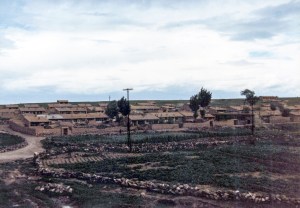
Not far outside Beijing we crossed a portion of the Great Wall — not the well maintained, touristy part, but a part that gives a sense of what the builders were trying to do (and how silly, for example, a modern-day wall might be).
Also during the first day out of Beijing.
Somewhere between Beijing and Mongolia.
Mongolia:
Yurts! For real!
Though both Mongolia and the USSR were still communist in 1985, small-scale, babushka-based capitalism thrived along the railway.
We would be allowed off the train very briefly at stops, though the stations were tightly patrolled. Although this was taken in the Beijing station, it is relevant to the end of our journey.As we got closer to Moscow, we were told to close the window in our compartment as the train had switched to a diesel engine. I managed to convince my mother that this was no big deal and that we should keep the windows open — it was, after all, July. The result – of which I don’t appear to have a photo – was that we arrived in Moscow covered in diesel soot.
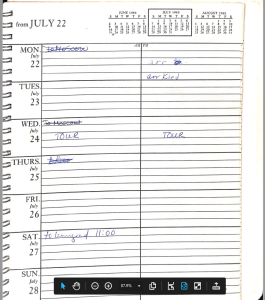
Our arrival in Moscow marked the end of the Trans-Siberian part of the trip, but not the adventure. We were met by our Intourist guide who told us that “Moscow is closed,” and that she’d be transporting us to the airport for an immediate flight to Kyiv, the next stop on the trip, but one that was supposed to come after a couple of days touring Moscow. Turned out there was some sort of Communist youth festival in Moscow — the 12th World Festival of Youth and Students to be precise — and Intourist did not want rando Americans wandering around interacting with Youth and Students. So after all that, the entirety of my experience of Moscow is a cab ride from the train station to the airport. We continued our trip with an extended stay in Kyiv — which was cool, as my grandmother was born there — and then Leningrad. We took another train from Leningrad to Helsinki, but sadly I don’t seem to have photos. My memory is that that train ride was VERY tightly controlled, so it’s possible photography was not permitted?
It was truly the trip of a lifetime, and I’ll be forever grateful to my mom for making it happen and putting up with me in a small compartment for five days!
Extra bonus train photos for Ken – from the Beijing to Nanjing trip:
Update: In the process of scanning & tossing old documents, I came across my calendar for 1985, Here is the page for the week of July 22-28, 1985, reflecting the quick change in our itinerary.
Fox & Robertson along with a dream team of drafting partners filed an amicus brief today in the case of Acheson Hotels v. Laufer, currently pending in the Supreme Court. The case addresses the issue of “tester standing,” that is, whether people protected by civil rights laws have standing to sue when they intentionally investigate compliance and encounter discrimination.
Because tester litigation has been responsible for calling out and challenging widespread disability discrimination, businesses hate it. The amicus briefs they filed were full of hair-on-fire numbers — of pending ADA lawsuits — that they characterize as a “staggering,” “unrelenting tide” that is “clog[ging] federal court dockets.” Chamber of Commerce Br. 7, 11; Retail Litig. Ctr. Br. 4, 11, 20, 22. One business brief asserted that tester standing “threat[ened] . . . the cohesiveness of our union.” Ctr. for Constitutional Responsibility Br. 1. Drama much?
Of course numbers are catnip to the data nerds here at Fox & Robertson World Headquarters, so we decided to take a look at the actual numbers of ADA cases filed in federal court — based on data gathered by the United States Courts on its uscourts.gov website — and see how they looked in context. Here’s a chart comparing the “ADA-Other” category — roughly speaking, non-employment ADA cases, including the Title III cases that cause flaming hair on the business side — with six other common types of cases. Note the bright red ADA-Other line at the bottom.
See? Not so bad after all! If business put half the effort into compliance that they put into whining, the world would be pretty damn accessible by now.
Should we against whom revenge is fully justified, from whose depredations others need rest, find joy? Live well? Rest?
Do the small things I do, the cases I bring, the occasions I speak up (so few opportunities, I tell myself, because I’m an introvert) suffice? Do they make up for the cases not brought, the protests not attended, the reparations not made? The land I have not returned?
Not looking for yes. Looking for the wisdom and space to figure this out.
Scene: Tim and Amy, having had a rough day for unrelated reasons, have decided to go to a bar, hoping for a quiet relaxing drink and some appetizers. It’s a reasonably fancy place – we really wanted calm and relaxing – with dark wood fixtures and an expensive menu. A random white woman approaches Amy.
RWW: Hi. How are you?
Amy: [Desperately trying to recall what lawyer event I met her at.] Fine.
RWW: What’s your name?
Amy: Amy.
RWW: How funny, my name is Anna.
Amy: [puzzled look] Nice to meet you.
RWW: My father is a doctor who practices at [I’ve now forgotten wtf she said about her father].
Amy: That’s nice.
RWW: I’m approaching you because I wanted to say to him [indicates Tim] …
Amy & Tim more or less in unison: You can just talk to me/him.
RWW: But I approached you because you’re the caregiver.
Amy: [stunned look] I’m his wife.
RWW: Oh you’re his wife.
Amy: Get lost. Just go away. [If I recall anything verbatim about this interaction it’s those two phrases.]
RWW: I’m sorry, am I stressing you out?
Amy: [turns away]
Tim and Amy: wtaf?
And . . . scene.
We were going to order food, but decided to gtfo of there. Staff were very embarrassed, comped our drinks, apologized profusely and then – after we went down the block, had some amazing Mexican apps and drinks, and were heading back – came out of the restaurant to follow us down the block and apologize all over again.
So many emotions. For now I’ll just say that, while I didn’t need them, I’m glad that I know a number of excellent criminal defense attorneys.
Legal conservatives are always whining about “originalism,” by which they mean “the law back when the Constitution was drafted,” but which really means “the description of law ca. 1787 that we pulled straight out of our tucheses and that coincidentally happens to support whatever rich and/or white people want the result to be in 2023.” For as-yet undisclosed but intensely law-nerdy reasons, I’m poking around in cases from that era and stumbled across evidence that those white guys in the constitution-drafting era really were much more sophisticated about the law:
The new trial had been pressed on five grounds:
1st. That the verdict was against the weight of evidence.
2d. That Herman Skiles, one of the jurors, some weeks before the trial, had betted a pint of wine with colonel James Mercer, that a verdict would go for the plaintiff, and thereby shewed his partiality.
3d. That five of the jurors eat or drank during the trial, at the expence of one of the lessors of the plaintiff.
4th. That two of the jurors declared their opinion in favour of the plaintiff before they heard the testimony.
5th. That Herman Skiles aforesaid, and two others of the jurors, threatened to throw three others of the jury, who dissented from them in opinion, out of the window of the second story of the Court House, where they were deliberating on their verdict, unless they would agree to find a verdict for the plaintiff.
Goodright v. McCausland, 1794 WL 615, at *1 (Pa. 1794). So, yeah, let’s take all our legal cues from that august system as it existed in the late 18th century.
I won’t say this to you directly, because you don’t want to hear from me. This makes me sad, but I don’t want to add to your stress with an unwelcome text or email. But I miss you and I wonder sometimes, no matter how angry you are, whether you miss me. Or whether you miss at least our shared past.
Bruce’s 3d birthday in 1965. Seven small white kids at a picnic table; Bruce is at the far end of the table; I’m to my Dad’s left in a blue dress and red shoes. Dad stands at the head of the table in his Summer Nerd outfit: blue button down, sleeves rolled above his elbows; shorts in a different shade of blue; black socks and black business shoes.
One of the coolest things about having a sibling is making fun of your nuclear and extended family; the next coolest thing is the shared memory of stupid shit you did as kids. Remember Dad’s attempts at casual dress? He was incapable of anything between a three-piece suit and ancient repurposed suit pants, often rolled up to his knees for a stroll on the beach, often (see left) paired with black socks and shoes. Remember making fun of Mom’s boyfriend’s name? (Sorry, Mom – I know you hated it, but we laughed our inconsiderate asses off.) Remember the way Aunt Martha would introduce you to anyone who had anything to do with something vaguely sciencey and assume you’d have a lot to talk about? Or Dad opening your Chemical Engineering PhD thesis to a random page and claiming to have found a typo – man he was proud of someone in our family doing sciencey things!
Neither of us knew what “calvados” was when offered it at my graduation dinner, and spent the next few hours saying the word and laughing ourselves silly. (It was my law school graduation, for the record.) Remember when Dad tried to throw an ice cream cone at you, but hit the inside of the car’s back door. We’re still considering a plaque for that specific Dairy Queen in Brunswick, Maine. Remember the trip to France in 1986 – three generations of stubborn, crabby Robertsons in a small car without much of a plan, where the conversations ranged from Granddaddy’s adventures in WWII to Granddaddy’s contemporary struggles with constipation.
We laughed at it all – even the stuff we probably should not have laughed at (I think Granddaddy was actually pretty uncomfortable, though the TMI factor was pretty high). We laughed at some of the painful shit around the divorce, and laughed and cried around the really painful shit when Dad died. (They buried him in the wrong grave? One belonging to the cousin who hated him? We tried to cry, but it was also fucking hilarious.)
Well, Happy Birthday and thank you – it’s been cathartic to write just this sampling of hilarity and stupid shit. But it was also a good reminder that I do, indeed, love you and miss you.
I’ve been trying to process how I feel about the circus that is most of the confirmation hearings for Judge Ketanji Brown Jackson. No, that’s unfair to clowns. The middle school recess that the GOP bullies have turned these hearings into.
Before turning to the school bullies, I want to thank Sen. Cory Booker, whose words moved me to tears. This clip is about 20 minutes long and all very worth it, but if you don’t have the time, start around the 14-minute mark. I am deeply grateful for Sen. Booker’s speech – it was an act of healing to watch it and, I hope, to speak it.
[Image description: split screen showing Sen. Cory Booker (Black man in dark suit with red tie) on the left and Judge Jackson (Black woman in royal blue suit and black shell; she has shoulder-length braids and glasses) on the right. The video is captioned.]
But what to say of the white boys hurling ignorant insults at this brilliant, brave woman? I want to find a way to apologize to her, as if some ignorant, racist, drunken relative of mine had crashed a civilized gathering at which I had the privilege of listening to and learning from her. I’m grateful that she has a wonderful family and a supportive network of friends with whom she can process this bullshit. And I want to send her comfort food, maybe a big bowl of pasta and a chocolate chip cookie. Or whatever is her favorite when she can get home, kick off the heels, and feel safe amongst people who love her. You don’t deserve any of this, Judge. But you do deserve to be on the Supreme Court.
Introductory note: I am a privileged, white, cis/het, abled woman, and this post is intended to address other privileged non-marginalized people. I don’t know and would not dare to guess or pontificate on the self-care or life-balance situation of people outside that category. YMMV.
***
I started my legal career in a large commercial law firm where we regularly worked 12-hour days and pulled occasional all-nighters. It wasn’t healthy. After Tim and I started our own firm, we pledged to have more control over our time. And we did. We’d close the office for a “weather emergency” when it hit 70 degrees in March and everyone had spring fever. We’d take off to a baseball game (remember those?) on a whim. But we had started a law firm dedicated to something we cared deeply about: disability rights. So there were also long days, weekend hours, and a general blurring of work/life boundaries.
Now, 26 years after we started that little firm, that imbalance still exists. We set our own hours — a huge privilege — but we also work plenty of weekends and spend plenty of our off-time thinking and talking about our work.
And that’s OK.
Younger lawyers now demand work-life balance. They need time for self-care. And that’s OK, too.
But I’m concerned that that demand has become the same sort of brass ring/competition that long hours were to us in the 80s and 90s. Then it was cool to brag that you’d been at the office all weekend, or billed 250 or 300 hours that month,* sweeping into the competition folks who might have needed more time for themselves or their families.
Now if feels — at least from the perspective of this late-Boomer/Gen-X-cusper — that self-care has become as competitive as billable hours once were. And that the quest for work-life balance can sometimes lose sight of clients with even more radically imbalanced lives.
I’m not suggesting we go back to defining our self-worth in billable hours. Just that long hours on behalf of a cause you believe in may be the source not only of eye bags, caffeine jitters, and piles of unwashed laundry, but also great satisfaction and even joy.
Work life balance/imbalance balance.
***
* I was actually present for a conversation among male attorneys comparing competitively who returned to work fastest after their wives gave birth. Even for the early 90s, that was gross.























 Thought Snax