Category Archives: Civil Rights

It shouldn’t be about choice; it should be about respect.

Cynthia Nixon has spurred an interesting dialog by embracing the concept that being gay or lesbian can be a choice.  In the civil rights world,the it’s-not-a-choice-it’s-an-inborn-trait position is an attempt to connect being gay with other protected classes defined by immutable characteristics, such as race, gender, and disability.   It’s also embraced as a counter to the common homophobic position* that if you can choose to love people of your own gender, you can equally easily — like choosing a different flavor of ice cream — choose to love people of the other gender.   Or perhaps choose to live a celibate life.

But Nixon makes I think the precise right point:

I say it doesn’t matter if we flew here or we swam here, it matters that we are here and we are one group and let us stop trying to make a litmus test for who is considered gay and who is not. . . .  It seems we’re just ceding this point to bigots who are demanding it, and I don’t think that they should define the terms of the debate.

It has always seemed bizarre to me that religious folks stress that this protected class — gays and lesbians — is based on choice, when the most mutable, chosen-not-born protected class is religion.  You don’t choose your race, disability, or national origin, and most people don’t choose their gender.  But if you can choose to be Christian, you can just as easily choose to be Jewish or Muslim, right?  Why on earth should we protect Christians against all that discrimination** they face when they could simply elect to be Jewish or Muslim and get away scot-free?***

Seriously, we shouldn’t be discussing choice vs. innate; we should be discussing respect.   And in the discrimination context, relevance.  What on earth relevance does it have to someone’s ability to do their job who they sleep with?  What faith they practice?  Their gender?  Their race?

***********

* Did you know there is something called Conservapedia?  Me neither.  It’s precisely as informative as the name suggests.  For example, this is the only substantive information it provides on the ADA:

The Americans with Disabilities Act (ADA) is a broad federal law that requires places of public accommodation to comply with numerous regulations relating to access by persons having disabilities. The Act encourages lawsuits against restaurants, schools, retail stores, hospitals and other small businesses by providing for the recovery of attorneys fees by successful plaintiffs.

Go forth and be informed, young conservatives with homework projects!

** Clearly Conservapedia is going to be my go-to source for links to straw-man conservative arguments.  They make it so easy!

*** Can I say that?  Does that discriminate against Scottish people?  Or is it OK because I’m a Jewish-Scottish-American?

File under “o” for occasionally we make some progress

One of the (many many) things I love about legal research is that you can get swept up in the interesting stories that cases tell, many of them totally irrelevant to the point you’re researching.   This is also a happy by-product of ADD.   I think of it as the legal research scenic route, and have no fear, I don’t bill for it.

Today’s scenic route was not so scenic, but was instead a startling history lesson.  I’ll let it speak for itself:

The Court notes that until 1950, the National Association of Real Estate Boards (NAREB) counseled its members to maintain segregated neighborhoods in the interest of maintaining property values. The Code of Ethics of the NAREB provided until then that:  ‘A REALTOR SHOULD NEVER BE INSTRUMENTAL IN INTRODUCING INTO A NEIGHBORHOOD A CHARACTER OF PROPERTY OR OCCUPANCY, MEMBERS OF ANY RACE OR NATIONALITY, OR ANY INDIVIDUALS WHOSE PRESENCE WILL CLEARLY BE DETRIMENTAL TO PROPERTY VALUES IN THAT NEIGHBORHOOD.’

Zuch v. Hussey, 394 F. Supp. 1028, 1054 n.12 (E.D. Mich. 1975).

So, yeah, we’ve made some progress.

Gratuitous political comment:  and this is what Ron Paul would take us back to.

Have I mentioned recently how much I love Michael Bérubé?

A new Bérubé post!  Just in time for Christmas!  Let there be joy throughout the land!  (As we’ve previously established, I’m a HUGE FAN.)  And he’s writing on one of my favorite topics:  universal design.  Let’s face it, the world is full of accommodations . . . for people with physically and psychologically typical bodies.   But they’re only really called “accommodations” when someone with a disability requests them.  Though try attending a meeting where you’re the only hearing person or the only person who doesn’t ride in her own chair, and it will be brought home to you that the typical are accommodated all the damn time.

Future post:  why our lack of wings requires the accommodation of stairs, elevators, escalators, and other ways of accessing upper stories without having to fly.

Anyway, Bérubé’s insight into how this worked in academic accommodations was wonderful:

So in response to my student with CP, I decided to distribute a take-home exam on the final day of class, and then give students 72 or 96 hours to write two essays.  That way, the exam itself would be turned in (and graded) during finals week, and students could devote as much (or as little) time to the exam as they desired.  I’ve done this ever since. . . .

Lastly, for even more extra extra upside, the students who need accommodations  . . . get to work at their own pace, like everybody else.  It’s like universal design … for final exams.

More on the “r-word”

Sam Bagenstos has written a thoughtful post on the use of the word “retard” in movies and our response as a community.  He was responding to this post, which was reacting, in turn, to the use of the word “retard” in the Alexander Payne/George Clooney movie, The Descendents.  I tend to agree — on general free expression and artistic license grounds — that we should not be in the business of telling writers what to write.  But I’m hoping for the day when the casual use of the word “retard” carries the weight that the casual use “nigger” or “cunt” would.  (For example, I’m predicting it was pretty jarring to read those words in my blog.  Was it equally jarring to read the word “retard”?)

Given the intersection of language nerdery and disability rights, this is a subject that interests me and that I’ve written about a couple of times.  Sam’s blog post makes excellent points, including that

People use the r-word in real life, just like they use slurs against other groups (and just like they do other harmful and wrongful things), and it would be wrong to say that movies and literature can’t depict that.  (And I think it’s a cheat to say that the use of the word can be depicted but only if the character who uses it “learns the lesson” that it’s wrong or is otherwise shown to be a bad and unsympathetic character.  That’s not any different than requiring purely idealized depictions of people.)

Very true.  In fact, if the word were restricted to movies, books, or tv shows in which lessons were learned, we’d only hear it in after-school specials, where the bully turns out to have problems of his own, reforms, and everyone has a group hug in the end.  No, rather than requiring lessons be learned or the word avoided, I’m hoping the movie-going public evolves to the point where the writer knows that putting that word in a character’s mouth will communicate something deeply negative about that character.  Right now, the choice to have a white character use the word “nigger,” without the quotes, directed to or about an African-American, communicates something very specific and negative:  the speaker is a racist asshole.  Same with “cunt”:  sexist bastard, or denizen of frontier Deadwood, South Dakota.

The truth is, I find it incredibly jarring and disappointing when a character in a movie with whom I sympathize (or perceive that I’m supposed to sympathize) uses the word “retard” as a casual epithet.  It’s similar to the phenomenon that Ta-Nehisi Coates has called “the John Mayer Rule,” and which I called “drinking with white people”:   that moment when someone you thought was cool says something bigoted  . . . and the concomitant urge to avoid situations (in my case, drinking with acquaintances who don’t get disability rights) where this might happen.  There are good reasons why George Clooney would not say a long list of offensive epithets in a movie of the type I understand The Descendants to be.  I’m hoping for the day when writers and actors will think that way about the word “retard” and use it accordingly.

One final thought:  a laser-focus on one word misses is the many ways movies and TV can be demeaning to people with disabilities while remaining pristine in language use.  One of my favorite examples is Law & Order, which has presented a long string of pathetic and/or criminal people with disabilities, without once (that I can recall) showing, say, an attorney, detective, forensic professional, or random witness in a wheelchair.  Two episodes stick in my mind.  In one, a mother is accused of killing her son, a quadriplegic.  The son is presented as unable to get out of bed and as a result we are asked to sympathize with the homicidal mother.  Scenery-chewing DA Jack McCoy tells the jury — as a fact, I promise, not as a negative comment on the mother’s narrow world view — “she knew he’d never grow up to be a doctor or lawyer.”  Seriously – how hard would it have been for the writers to figure out that there are all sorts of quad doctors and lawyers and other professionals?  The other episode I recall was where the hunt for the killer led toward the brother who was paralyzed and as a result bitter and murderous.  While I can’t recall others off the top of my head, I don’t recall any portrayals of people who use wheelchairs straying beyond vegetative and/or embittered.  I’d take 100 George Clooney “retard” utterances over this.  Although we keep watching the damn show,* we know to turn it off the instant there is mention of a character with a disability.  We know, to a 100% certainty, that L&O will screw it up.

********************
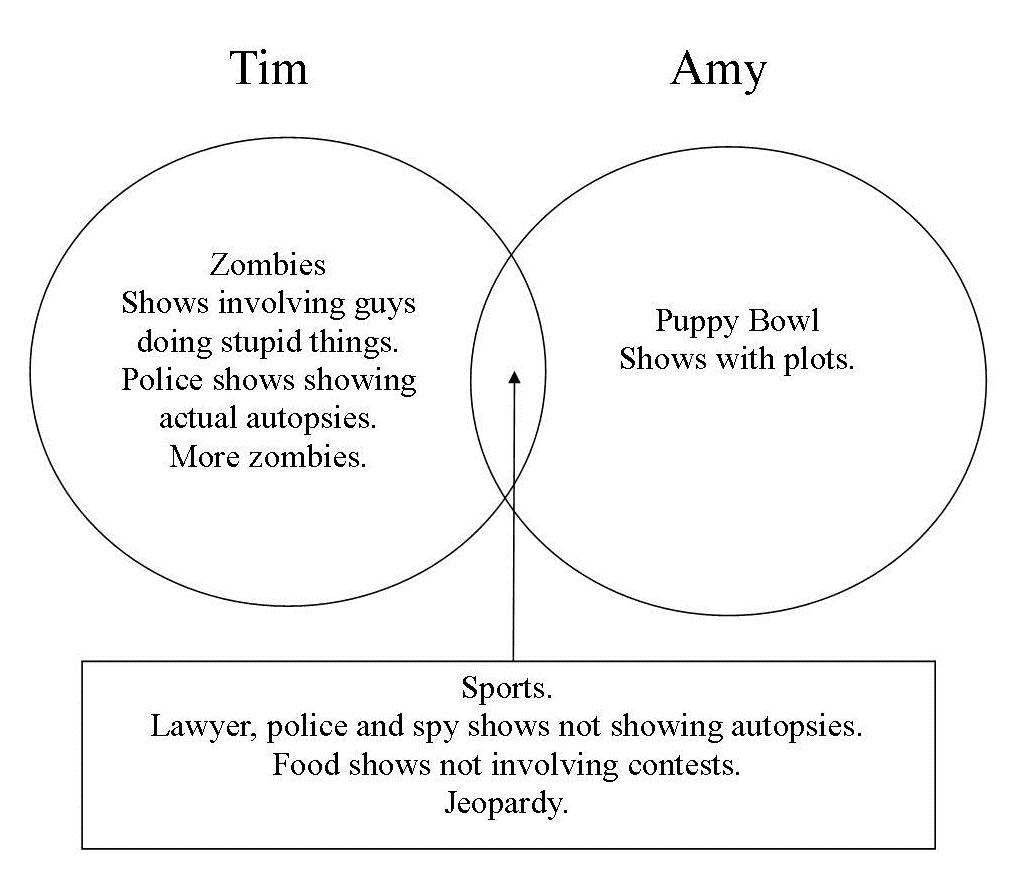
* L&O occupies the very small overlapping area of Tim and my taste in television:

Defame This!

Remember just the other day I was ridiculing some over-caffeinated opposing counsel for accusing CCDC of defamation for posting, on its website, pleadings in case alleging that his client violated the ADA.  Highlight:


My position is that you and your clients have been defaming my clients by raising false allegations of discrimination . . .


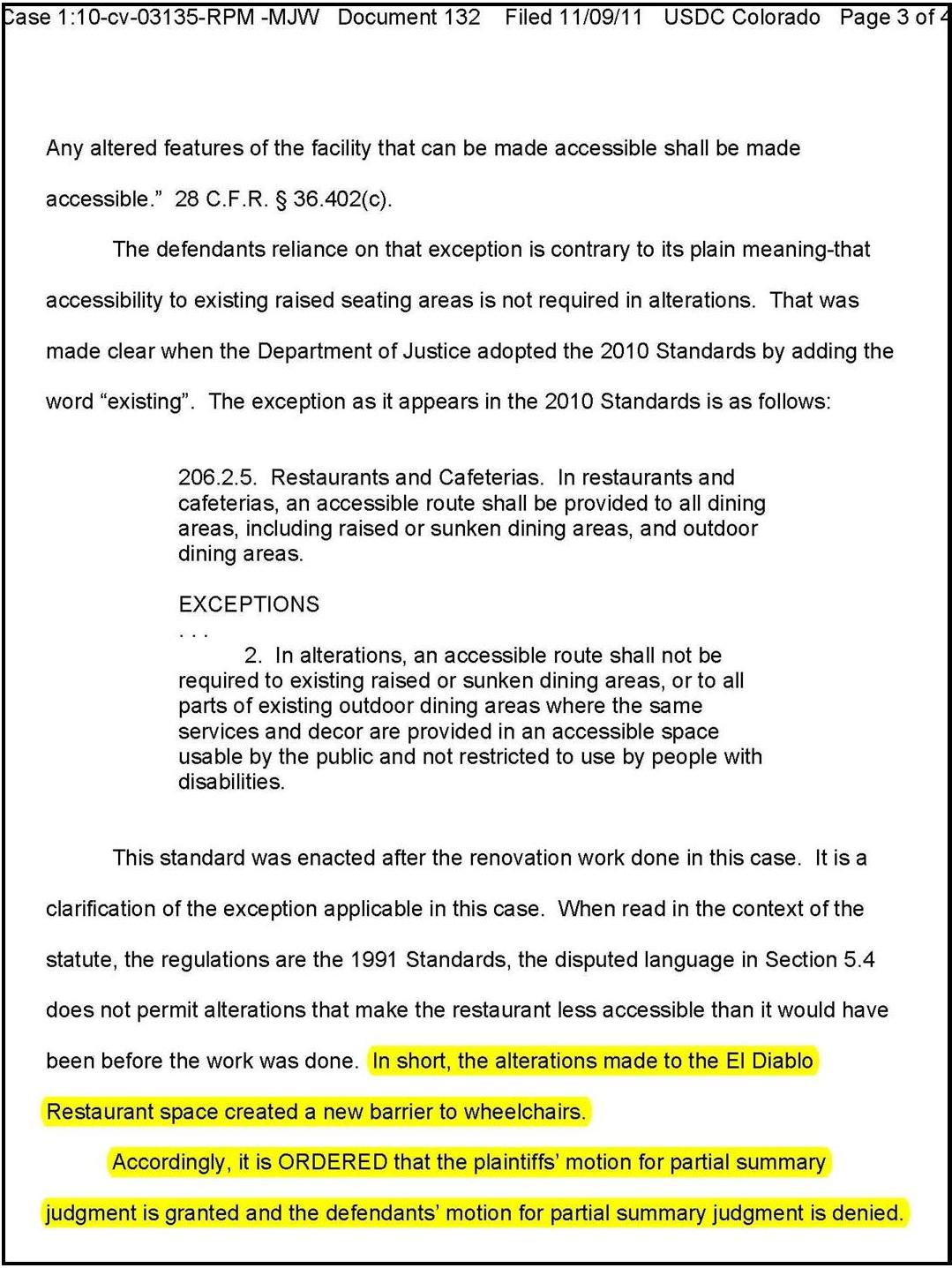
On Wednesday, we got the judge’s decision on our motion for summary judgment.  Here’s page 3 — the key portion: 


That’s right, Ladies and Gentlemen, summary judgment granted to plaintiffs!  Big thanks for the excellent legal work of Team CCDC:  Kevin Williams, Andrew Montoya, and Briana McCarten.


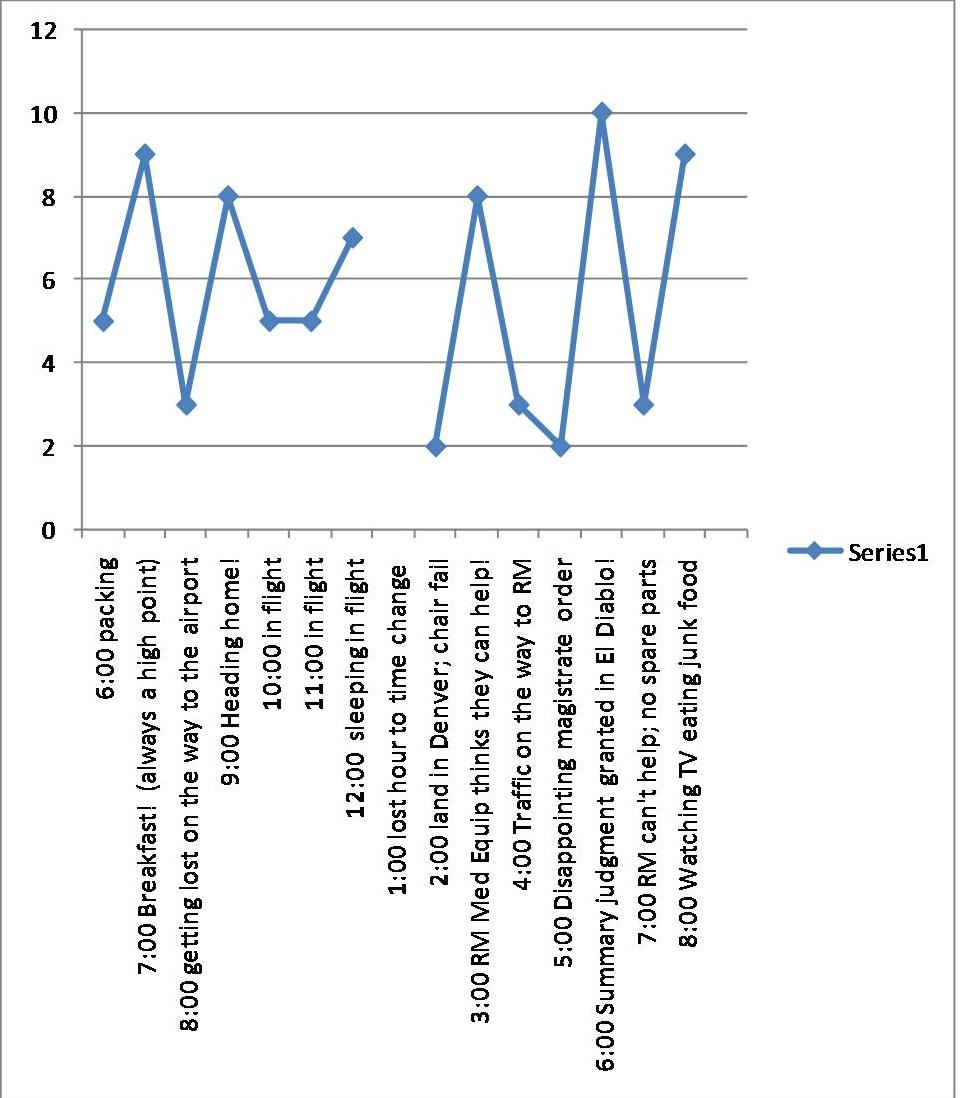
My Day: A Chart

Flew home from Portland, wheelchair fail, and two very different court decisions in a short period of time:


This Week In Random Media Hypocrisy

Breaking News!  Did you know that the mayor of a  major American city said that treating African-Americans equally was an “inconvenience” that was “unfair to average people” because it made them “uncomfortable”?  You didn’t!?  What a scandal – how did the media miss this?

Oh, right, sorry — it was just the civil rights of people with disabilities.  Silly media consumers — you know that’s not the same thing.  So no reason to expect 24/7 handwringing, apologies, and navel-gazing talk shows about the state of civil rights in response to the MAYOR OF OUR LARGEST CITY SAYING THAT RESPECTING THE RIGHTS OF HIS MINORITY-GROUP CONSTITUENTS IS INCONVENIENT AND UNFAIR TO “AVERAGE” PEOPLE.

In fact, I have to cut the intrepid reporters on the civil rights beat some slack on this because they were busy pursuing a much more important story.

Yes, leading liberal website ThinkProgress was far too busy tracking the astonishing news that  beauty queen got drunk and used a bad word.  In fact, the website was so on top of this story that they got an …

That’s right, an EXCLUSIVE.  You won’t read this important story ANYWHERE ELSE!   And in fact, ThinkProgress has the crucial details, too.  Miss Virginia’s roommate told the reporter that she was “extremely intoxicated” that night and seemed upset that she did not have the full house to herself, so she  “downgraded people based on their physical appearance and economic status.”  Now this is indeed breaking civil rights news:  college girl gets drunk, says something stupid and hurtful.

How on earth did ThinkProgress beat out The Onion to this important scoop?

Stupid Lawyer Tricks: alleging defamation as defense to inaccessibility

It should be obvious that whatever the ADA does or does not permit, it would not permit a business owner to DECREASE accessibility.

ADA 101:  You’re supposed to build new facilities to be accessible and make old ones accessible when it’s “readily achievable” — that is, when the cost and your resources make it reasonable.*  When you’re making alterations, you’re supposed to make them accessible “to the maximum extent feasible.”  But fer Pete’s sake — a phrase that really should appear verbatim in the regs — don’t take something that’s accessible and make it inaccessible.

This is what the regs actually say about it:  “No alteration shall be undertaken which decreases or has the effect of decreasing accessibility or usability of a building or facility below the requirements for new construction at the time of alteration.”  ADAAG § 4.1.6(1)(a).

When we moved into our office space in February, 2008, the space across the street was empty and essentially gutted.  Among other things:  flat.  The floor of the space was had no changes in level.  Did I mention it was flat?

Hoping for another good restaurant in our neighborhood, we were psyched to learn that someone was opening a mid-scale Mexican restaurant & bar across the street.  We looked forward to good food and after-work gatherings, especially with our friends & co-counsel at the Colorado Cross Disability Coalition, which is right up the street.

This is what the space looked like before:

Here’s what it looks like now:

We don’t have a panoramic shot of the restaurant, but this is the newly constructed raised area on the north side — the mirror image of the newly constructed raised area on the south side.  No ramps.  Over half of the total floor area is now inaccessible, and most of the rest is occupied by a bar, leaving a couple of tables — often inaccessible high tables — on the ground level.

To summarize:  The owners constructed two inaccessible raised areas in a previously flat, fully-accessible space.  They took a space that could have been completely integrated and created — at best — a wheelchair ghetto.

In brief:

Before: flat.
After:  inaccessible.

We tried hard to talk to them about this, with no success.  So we got together with the Colorado Cross-Disability Coalition and filed suit.

Pause for a brief introduction to CCDC, as if all five of my readers aren’t already intimately familiar with them.  On a shoestring budget, CCDC works with the legislature, conducts training, engages in outreach and advocacy and — when called for — files suit to ensure equality of opportunity for people with disabilities.  During the legislative session, their volunteers are at the capitol every day.  When people are having difficulty securing needed services or benefits, their volunteers are on the phone.  And their advocacy and litigation have increased Denver’s physical accessibility from the Pepsi Center to Red Rocks, and … done a lot of other amazing stuff.  I was going to give some more examples, but just click here and scan the list!

In response to the lawsuit, the restaurant retained Littler Mendelson, a nationwide employment discrimination defense firm.  And by “nationwide” I mean, of course, “expensive.”**  Instead of working with us to make the place more accessible — and saving everyone’s attorneys’ fees — it’s been scorched earth litigation.  But I think what has been most entertaining for us is the Littler lawyer’s decision to accuse CCDC of defamation.  Yup:  the fact that CCDC posts, on its website, the pleadings — public documents — containing the undisputed facts above — took a flat space; made most of it inaccessible — constitutes defamation.  Here is the Littler Mendelson attorney, verbatim, in a deposition of CCDC’s executive director:

5     ……My position is that
6   you and your clients have been defaming my clients by
7   raising false allegations of discrimination, repeatedly
8   accusing my client, both in this case, in judicial
9   filings, but also in Internet filings, which simply
10   reiterate the false allegations put into the court
11   record that my client discriminates against individuals
12   with disabilities.
13                You are trying to present a picture of my
14   client to the Court which is not true, and I’m entitled
15   to present a picture of your client which I believe
16   demonstrates its motives in pursuing this case.  You’re
17   trying to present a picture of your client to the Court
18   of a noble organization just trying to obtain
19   additional access for people with disabilities.
20                I’m allowed to present to the Court a
21   picture of your organization as one which shakes down
22   and scourges local businesses and forces them to incur
23   tens to hundreds of thousands dollars in attorney’s
24   fees and costs in order to promote the organization’s
25   revenue and business, and I think I’m allowed to make
1   the same types of — I’m allowed to rebut the glowing
2   picture of your organization that you’re trying to
3   present to the Court . . .

That’s right:  calling attention to the fact that the defendant took an accessible space and made it inaccessible is defamation.  I suppose we should be glad that being accused of inaccessibility is at least regarded as a bad thing!

Just after we started our firm in 1996, I was talking to my Dad about some of the baloney we were already starting to get from defense counsel.  He told this story. When he was the Executive Director of the Missouri Commission on Human Rights in the early 1960s, he decided to drive around rural Missouri testing the newly-enacted Civil Rights Act which prohibited discrimination on the basis of race in places of public accommodation, for example, restaurants.  On at least one occasion, the restaurant he had just tested called ahead to the next one down the road, and the folks at the second place were waiting at the door with shotguns when he arrived.

I suppose it represents a sort of progress that enforcing the civil rights laws in 2011 requires only a thick skin and a high tolerance for bullshit rather than a up-armored ’64 Dodge Falcon and firearms.

************
* OK, the definition is slightly more complex than that, but I sense your eyes glazing over already.

**  We haven’t seen their legal bills, but I’m fairly certain Littler Mendelson is not working for free.  Our assumptions did lead to this dryly hilarious exchange in the deposition of CCDC’s executive director:

18 Q. All right. Then in the
19 next line, the next paragraph, second sentence, says,
20 “[The restaurant’s] owner is spending money, lots of money, on
21 a 17th Street law firm to fight providing access.” Do
22 you see that?
23 A. Yes.
24 Q. What is the basis of your knowledge
25 concerning the amount of money, if any, that
1 [the restaurant’s] owner is spending on legal fees?
2 A. I — I guess I don’t know exactly. It’s
3 an assumption. Maybe I shouldn’t have made that
4 assumption. Maybe you’re working pro bono and I don’t
5 know that.

If you are not rolling around on the floor laughing so hard you can’t breathe, you probably aren’t a plaintiffs’ lawyer.

Stopping to appreciate

I was just about to post a cranky post about opposing counsel in a case we’re involved in* and my last two Facebook posts have been

This is where we are on our Big Case: witness has to go back to doctor for urgent tests and possible exploratory surgery for cancer; Defendant refuses to withdraw the subpoena for her deposition at the same time as the medical appointment.

Mamas don’t let your babies grow up to be lawyers.

and

File under “K” for karma’s a bitch. Opposing counsel who refused to reschedule a deposition for the witness’s medical procedure now needs us to reschedule for *his* medical procedure. Must.Control.Sarcastic.Response.

so it hasn’t been a good week for Rule 1.5.  But before I launch into my latest diatribe, I wanted to link to this, a wonderful meditation** by my friend and co-counsel Kevin Williams on how lucky we are to practice in the field we do.

As many of you know, CCDC’s offices are like many non-profit’s, but from my office, I can see the Colorado Rockies South and West.  From Pike’s Peak…almost…(if you stretch)… to Long’s.  This evening, as I wrap up today’s work (responding to letters from some lawyer telling me why he thinks I’m an a**hole), I was lucky enough to remember to turn around from my desk and look out my window.  I just watched the magnificence of another spectacular Colorado sunset.

The sunsets keep coming.  Fifteen years of being a disability rights lawyer has taught me one undeniable principle: When you represent people who have a righteous cause, you are doing the right thing.  Although we have had a few let-downs over the years, and many, many contentious battles, the victories keep coming. I look forward to tomorrow’s sunset.

We are lucky.  I’ll be ranting again soon — tomorrow, even — about the antics of our opposing counsel, but for tonight I’m thankful to practice in the field that I do, with a partner like Tim, co-counsel like Kevin and the rest of our incredible and various teams, and righteous clients, cases, and issues.  And much as I love our coastal colleagues, with the amazing view of the sun setting over the Rockies.

**********

*Coming soon.

**I think Kevin will hate this word.  I think he’d prefer something more like gin-fueled philosophizing.

I realize I have no standing to discuss Black hair

I get that. In Emily Hauser’s words, “This is not my business. Not.My.Business. I know that, and if any African-American readers want to tell me as much, I won’t be able to argue.”

I also get that there are things that African-American women do to their hair that is arduous, painful, and time-consuming. I can’t even be motivated to dry my hair unless I have to appear in court before 10:00 a.m., so I am in awe of the effort. But I also realize that what many African-American women do to their hair is motivated by generations of internal and external prejudices about what constitutes good hair, meaning, most of the time, hair like white people have.

With all those caveats here is my small contribution to the conversation: our family’s micro-level Kenneth Clark experiment.

I have a November birthday. When I was ready for kindergarten in 1965, the Jefferson City, MO, public schools were not ready for me, so my folks sent me to the kindergarten affiliated with Lincoln University, an historically black university.* As a result, my kindergarten class was almost entirely African-American, but for me and one other white kid. Our teachers were all African-American, many of them being student teachers from Lincoln U. I still remember Miss Flowers — pictured below — who I totally idolized. My fifth birthday — Mom brought cupcakes:


Anyway, what the hell does this have to do with hair? I’ll tell you. Apparently one day during my year at Lincoln U’s kindergarten, my folks discovered me in our bathroom applying Vaseline to my hair, in an effort to make my hair look like my classmates’ hair. I don’t actually remember doing this, though I do remember thinking that being able to braid your hair effortlessly into multiple braids was way cooler than anything my hair could do. OK, the photo shows that really almost anything would have been cooler than my hair,** but the cute ‘dos of my two female classmates were out of reach even if I (or, let’s be candid, my mother) had had any hairstyling sense at all.***

So I think about this every time I read about what African-American women go through with their hair, or even what teenage girls of all races do to conform to the (skinny, racy) images that confront them constantly.  I wonder if you sent a skinny girl to a school full of fat girls — and deprived her of access to fashion magazines — whether she’d come away with an earlier recognition of this life truth:  fat people are generally cooler than skinny people.

*********
* While getting the link for their website, I learned that Lincoln U’s mascot is a blue tiger.  I wish I had known that all these years.  That is seriously awesome!  I’m thinking of acquiring a blue tiger sweatshirt — my earliest alma mater!

** Memo to my brother:  comment on this at your own risk. I have photos of your haircuts from the late 60s and early 70s. You know what I’m talking about.

*** I can’t tell from the length whether this was before or after the “one more word out of you and I’m cutting it all off” incident, but let’s just say that I did not spend much of my childhood with long hair.