Category Archives: Disability Rights

“The Case Against Gay Marriage: Top Law Firms Won’t Touch It”

The Case Against Gay Marriage: Top Law Firms Won’t Touch It – NYTimes.com.

Here is what I wrote to the author:

I find it funny that the unwillingness of big law firms to handle cases that might affect their bottom line is getting a lot of attention around the marriage equality issue. We run a small civil rights non-profit that files lawsuits to enforce the Americans with Disabilities Act, and honestly, big firms that will represent tobacco companies and death row inmates won’t touch our cases. Why? Because we are asking their [potential] clients to be accessible to people who use wheelchairs, to deaf and hard of hearing people, to others with other disabilities. It’s not front page news; it’s business as usual for us.

Here is what I wrote on Facebook:

Oh cry me a fucking river. Your position is unpopular. Deal with it. Grow some balls and speak up for what you believe in. It’s not “crushing dissent” when you self-censor for economic gain.

Dignify THIS!

I’m done. I’m done being polite.* I’m done shutting up about good liberals who seem to get every sort of civil rights and civil liberties except the equality of rights, respect, and dignity of our brothers and sisters with disabilities. I’m done with disability rights as a “when we get around to it” right. I’m done with people who are willing to use respectful terminology except — *big sigh* — avoiding using the word “retard” is just one step too far toward thought control.  And I’m done with “civil rights” law firms in inaccessible offices and “civil rights” lawyers who don’t hire interpreters. I’m done.

What pushed me over the edge was this voicemail, from a fellow attorney who would, I believe, describe himself as favoring civil rights. I suppose it’s my one last shred of not-yet-quite-doneness that leads me to keep him anonymous.

But who he thinks he is and who his words and actions show him to be should not be anonymous. It needs to be out there for good liberals — chock full of self-righteousness and non-disabled privilege — to observe and perhaps see themselves.  And become real civil rights lawyers by according people with disabilities the same rights and respect you accord other groups you work so hard for.

First let’s play the “protected class switcheroo” game. Imagine I got this voicemail:

Hey Amy, [Name Redacted] here. Trying to get in touch with you and/or Tim. I’m working with a group that is sponsoring legislation to increase penalties for disrespecting police officers. They got bogged down because of some African-American, ah, community concerns – said it would be used as a sword instead of a shield. Um, I think it’s miscommunication. I think the African-American community should be absolutely in favor of it and I wanted to hook up with folks, the right folks, in the African-American community and I thought you would know the behind the scenes politics of who best to contact. . . . .

Pretty gross, eh? No good liberal would talk that way, at least not in public in 2015. This is, in fact, the voicemail I received. Verbatim.

Hey Amy, [Name Redacted] here. Trying to get in touch with you and/or Tim. Um, I’ve done work in the past through when I was at the ACLU with the Hemlock Society; they’re now the Compassion and Choices organization and they sponsored some legislation about right to choose or to refuse treatment. They got bogged down because of some disability, ah, community concerns – said it would be used as a sword instead of a shield. Um, I think it’s miscommunication. I think the disability community should be absolutely in favor of it and I wanted to hook up the Compassionate Choices people with folks, the right folks, in the disability community and I thought you would know the behind the scenes politics of who best to contact. . . . .

And here is my response:

[Name Redacted] –

Thanks for your voicemail.  I think I can say with a fair degree of confidence that there was no miscommunication on the disability rights side.  The position of CCDC, Not Dead Yet Colorado, and a long list of prominent disability rights groups opposing physician assisted suicide is well thought out and thoroughly researched.  I can’t possibly improve on the information on NDYCO’s website, so I’ll provide a link:  http://www.notdeadyetcolorado.org/.

To be clear, Colorado’s bill was not about refusing treatment:  anyone can do that at any time without the proposed legislation.  It is also not about choices:  we can all choose to buy a gun and shoot ourselves; to drive in front of a train; to stop eating and drinking; etc.  Instead, the discussion revolves around getting a doctor to assist you in killing yourself to avoid — tracking the title of the bill — an undignified death.  What is characterized as “lack of dignity,” however, are conditions that many people with disabilities live and thrive with every day:  the need for a vent; a feeding tube; colostomy; urostomy; assistance with activities of daily living.  Statistics from Oregon, for example, a state that has legalized assisted suicide, demonstrate that people do not chose assisted suicide to relieve intractable pain — the purpose for which it has been sold to the public — but rather to address perceived loss of autonomy, inability to engage in activities of daily living, and loss of dignity.

These perceptions and the urge to kill oneself over them result directly from a society that does not value people with disabilities — and such perceptions are (circularly) reinforced by bills like these and the rhetoric that surround them.  Assisted suicide is urged in an environment in which people with disabilities do not have universal access to attendant care in their homes and communities, to assistive technology and mobility devices, to accessible vehicles or modifications, or to home modifications — hell, to accessible homes to start with.  These are all things that people need to continue to live — with dignity — in the community.  In the absence of this sort of support, many disabilities fit the bill’s definition of “terminal,” making it the worst sort of health care rationing:  cheaper dead than disabled.

A bill proposing that it was “undignified” to live as an African-American, an LGBT* person, or — to take an historical example — as a Jew, thereby justifying easy access to death would be rejected with horror.  Yet good liberals appear completely at home with providing a cheap and easy path to death for people with disabilities.

Furthermore, the concerns of people with disabilities reflect a great deal of thought and considered analysis; it is patronizing to suggest that they result from miscommunications.  I can’t imagine any other group active in the civil rights dialog that would be the subject of a voicemail like this.  When LGBT* groups oppose civil rights rollbacks, are they perhaps just victims of a miscommunication, which can be corrected by identifying the “right” groups?  How about African-Americans calling for law enforcement reform?  Shall we identify the “right” groups to support our men and women in blue?

The debate over physician assisted suicide has been plagued by this sort of condescension, as liberal and radical disability rights groups are accused of being pawns of religious conservatives, as if incapable of independent thought.  This infantilizing of our movement underscores our fears that disability is so stigmatized that ostensible civil rights champions would rather be dead than disabled.

Ultimately, if the ACLU is devoted to nondiscriminatory civil liberties, it should support a universal right to assisted suicide.  Anyone, anytime, can request a lethal dose, not just those in circumstances defined in terms of a protected classification.  This I would support, though I believe other members of the disability rights community are more compassionate than I am.

I would be happy to put you in touch with any of the groups on this list to help with any miscommunications:

  • Access & Ability Colorado
  • ADAPT
  • ADAPT Colorado
  • Assn of Programs for Rural Independent Living
  • Autistic Self Advocacy Network
  • The Center for Rights of Parents with Disabilities
  • Colorado Cross-Disability Coalition
  • Disability Rights Center
  • Disability Rights Education and Defense Fund
  • Justice For All
  • National Council on Disability
  • National Council on Independent Living
  • National Spinal Cord Injury Association
  • Not Dead Yet USA
  • Not Dead Yet Colorado
  • Patients’ Rights Action Fund
  • TASH
  • The World Association of Persons with Disabilities
  • The World Institute on Disability

Sincerely,

Amy

********

* Yes, I know, there is clear and convincing evidence that I was done with politeness, as a general matter, a long time ago.

“Assisted” Suicide, Prologue

Compassion and Choices and Flowers and Rainbows,* aka Big Suicide,** is pushing bills  to permit people to kill themselves legally.  Not all people, just certain disabled people in danger of dying — and thus living? — in an undignified way.  They’re pushing this in Colorado and it will not surprise you to learn that I’ll have more to say about this when I’m not barreling into a day full of actual work-related tasks.

As a prologue, I leave you with this juxtaposition, which greeted me in my Facebook feed this morning.

Image:  Facebook feed with links by Stephen Drake and Dian Coleman to an article entitled "Opposing An Assisted Dying Law," and immediately below, a link by Prison Legal News to an article entitled, "CIA killed prisoners, made it look like suicide."

More to come.  Meanwhile, the source for calling bullshit on Big Suicide is the excellently Monty-Python-named Not Dead Yet.****

Update:  Not Dead Yet Colorado now has its own website.*****

******

* OK, it’s Compassion and Choices, but they used to be the Hemlock Society, which was at least honest about the fact that they are a bunch of privileged intellectuals who want to be able to off themselves in a philosophically elegant fashion.  Then they focused-grouped the name, I guess, and are now Compassion and Choices, two random nouns meant to make you feel good about them while not really knowing exactly what they do.

** If we can have Big Pharma, Big Agriculture, and Big Sugar,*** why not Big Suicide?

*** Actually, this turns out to be a Canadian blues band, and not a bad one, actually.   The unexpected benefits of blogging.

****  Best. Logo. Ever.

Image:  Logo:  Not Dead Yet -- the Resistance.

***** And badass logo:

Image:  Not Dead Yet logo superimposed on the Colorado state flag.

Image Description and Identity

Sometimes I try to take on big questions; today we’re going to keep it light and only tackle the nature of identity and the relationship between author and reader in interpreting an image.

It all started with a question about image descriptions. Image descriptions are a way of making the images in webpages more accessible, primarily for readers with print disabilities. Screen readers will read accessible text, but when they encounter a photo, say (to take an image at random)

Image: Photo of golden retriever.

the screen reader can’t read it or render any useful information from it unless you add an image description. To make sure that print-disabled readers aren’t left out, I would add the description “Image: Photo of golden retriever.” I can put that either in the body of the blog, or in the “alt-text” field of the photo when I upload it. Here, I did both.

When adding image descriptions, I’m always challenged by how much detail to include. The photo above is easy: there’s one major feature and it’s quick and easy to describe. When I describe people, I’ve tended to describe them using a couple of basic characteristics: gender; age(ish); race; and perhaps an additional detail or two (color of clothing; glasses; sitting/standing). When someone is in a wheelchair, I say that; when they’re not, I don’t say anything.

For example, I described this photo

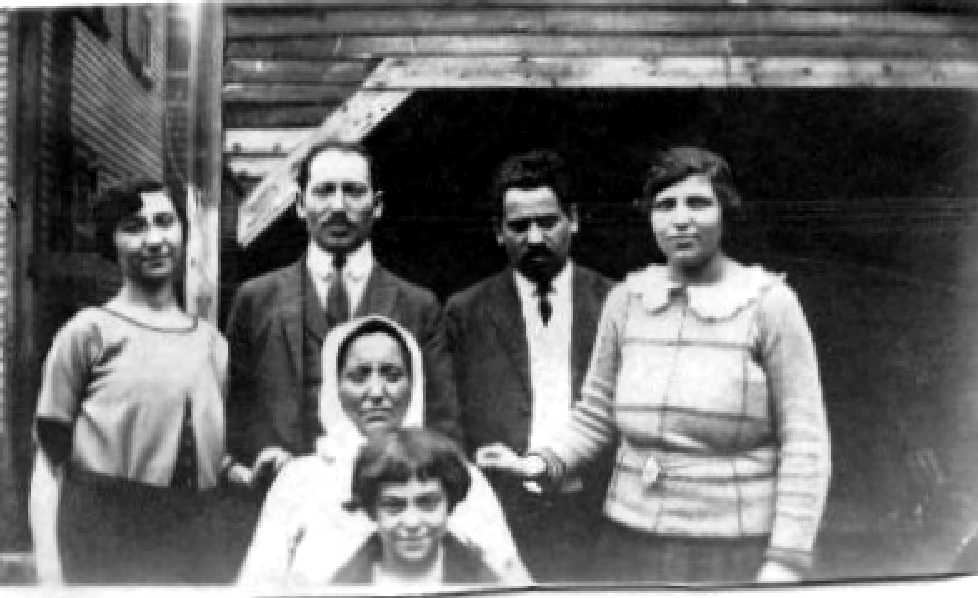
Image: slighly blurry black & white photo of a group of 6 people. In back, a young woman, two middle aged men and a middle aged woman; in front of them, an older woman, and in front of her, a child of about 10.

as

slightly blurry black & white photo of a group of 6 people. In back, a young woman, two middle aged men and a middle aged woman; in front of them, an older woman, and in front of her, a child of about 10.

When I started adding image descriptions to the large number of people photos in the presentation we put together to introduce CREEC, I started tripping over the question of how — if at all — to describe race and ethnicity.  Many of the photos depicted people whose races were (1) obvious; and (2) known to me.  For example, this awesomely cliched photo that Tim and I had taken around 2002 as an Official Fox &  Robertson Photo:

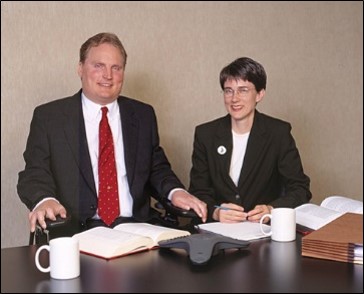
Tim and Amy at a conference table ca. 2002.  (Tim is a white man with short blond hair who uses a wheelchair.  He is dressed in a suit.  Amy is a white woman with short brown hair and glasses.  She is sitting in a chair, also wearing a suit.  In the foreground, a table posed with law books, a speaker phone, files and mugs.

I described it:

Tim and Amy at a conference table ca. 2002.  Tim is a white man with short blond hair who uses a wheelchair.  He is dressed in a suit.  Amy is a white woman with short brown hair and glasses.  She is sitting in a chair, also wearing a suit.  In the foreground, a table posed with law books, a speaker phone, files and mugs.

That was easy:  I’m white; Tim’s white; I know our races.  Tim’s disability is visible.  All the props on the table probably aren’t that relevant, but my view is that the description helps convey the posed-ness of the photo.

But what about photos depicting people whose race or ethnicity was either unknown to me or not easily described?  This, in turn, raised the obvious question whether it is relevant at all. I felt torn between trying to achieve accuracy for print-disabled readers and adding unnecessary focus on race and ethnicity. I posed this question on Facebook, and deeply enjoyed the ensuing discussion.

When adding image descriptions to photos, what do you do about perceived vs. known vs. visible ethnicities? For example, if I’m in a photo with an African-American woman, I would say something like, “White woman in white shirt and jeans; African-American woman in dark shirt and skirt.”  Easy.  But what about describing someone whose ethnicity is likely neither white nor African-American but is not known to me? Or someone who “looks” “white,” but I know would be annoyed by being described as “white.” Describing degrees of skin tone seems weird.

A surprising number of people responded with something like, “I don’t describe race.”   From Andrew Montoya:

Generally I do not comment on race/skin tone in alt text unless it’s germane to the picture.

From Carrie Lucas:

I don’t describe skin color.  If race is important to the picture, or skin, hair, etc, then describe it.  Otherwise just say “person” or “people of multiple races.”

My response (edited for coherence):

But that would mean that (respectfully) I’m making the decision for the reader when race/color/ethnicity are relevant. I try to be complete and objective in descriptions, though completeness is never possible and there is always editorial discretion.

If you don’t mention race, do you say “woman in a wheelchair” “older woman” “young girl” or just “person”?   What matters?  Gender? Race? Age? Disability? Hair color? Skin color?  At what point are we short-changing a blind reader who just wants to know what the photo looks like.

Carrie:

  I wouldn’t say race; I would say “dark colored skin, light colored skin, olive colored skin.”

Me:

But if I say that [Chinese-American colleague] has “olive skin” don’t I leave out something important, that is, that he’s Asian?  Or do I have to anatomically describe his eyelids?

Andrew:

But then where do you draw the line? How much detail do you use to describe the individual’s clothes, type of glasses, how the hair swoops over an eye, where the person’s shadow falls against the all white background even? It seems a line must be drawn somewhere lest you lose the content to the details of the description. So unless race is part of the relevance of the picture, I prefer to let people be people.

I will state that a person is in a wheelchair or using other equipment if it’s relevant. I rarely mention age, unless it’s relevant to the description (i.e., saying “cranky man” doesn’t convey the image as well as saying “cranky old man” for the stock picture of the muppet in the theater box guy). I do often state gender, as it seems a natural descriptor, but generally only for pictures where there’s only one gender present. However, stating a race or skin color where it’s not relevant to the picture seems odd and forced to me. As for determining relevance, I think that I’m already editorializing by having used the picture. I intend it to convey a particular thing by using it, so that’s where I focus my alt text description.

Corbett:

Some descriptions I have seen include information that is visible such as describing the skin tone but not assigning racial identity. So the description might say: “a light skinned female appearing person sits in a wheelchair. A dark skinned male appearing person stands nearby wearing a dark suit with a light shirt and plaid tie.”

Good point:  you can’t assume gender either.

Carrie:

It depends on why you are including the picture; whether race is important to the purpose of the picture.

Me:

But I think that’s circular, in the sense that “importance” is created by the interaction of creator and reader.  Should my purpose be the be-all-and-end-all of the decision?  I totally agree you have to make choices or you’d spend 3 paragraphs describing the building in the background of the photo, etc. But the question of when race is relevant seems to me to be one that the reader should make.

Carrie:

Yes, you are the author.

Me:

Don’t you often see things in photos that the photographer or user didn’t see or intend? I think we’re heading into lit crit territory!!!

That is, it was starting to sound very vaguely like the discussions of author, reader, and text that my much smarter classmates were having in 1981.  Which, to me, meant that I was way in over my head, and thus could start making shit up with impunity!

Then my law school roommate, Kristin Robinson, chimed in.  She was a grad student in American Studies (IIRC) when the two of us and a med student shared a house in 1985, and we’ve only recently reconnected on Facebook.

Long descriptions include information that is relevant to understanding the reason (instructional goal) the image has been included. It highlights salient information. So, if race or other aspects of people’s appearance is salient, you would include it. If it isn’t, you wouldn’t.

So perhaps in a strictly educational context, the teacher’s purpose is more important than total transparency.  Kristin also provided a helpful link to guidelines for describing science and technology images in the educational context.  The very first guideline is

Brevity. The most frequent recommendation from respondents was for more brevity in description. Simply put, it takes people with visual impairments more time to read books and articles than people without visual impairments and the process should not be further slowed down by unnecessarily long image descriptions.

For all my pontificating about the need for enough detail to let print-disabled readers interpret the image, I may also be annoying the crap out of them with verbose image descriptions.

Here’s where I end up.  Once you start describing people — that is, going beyond something like “three people in the background” — you owe it to your readers to give a description sufficient to let them decide what features are relevant.  To my mind, that includes at least (perceived) gender, age, race/ethnicity/skin tone, and [visible] disability/lack.

There will always be filtering and interpretation in the descriptions and I realize that my perceptions (and thus descriptions) will not always be accurate.  That I may describe someone in a way that suggests the wrong identity, or that suggests an ethnic, gender or disability identity where the subject would prefer to be just “a person.”  So I’m making a decision that affects not only the reader but the subject.

Ultimately — perhaps by dint of what I do for a living — I don’t think I should be deciding for the reader that race and other identities don’t matter.  I may use a photo for one purpose, while my reader perceives other meanings.  When I see a photo, my eyes and brain (with its inevitable set of life experiences and preconceptions) conspire to give it meaning.  Sometimes that meaning may be different from what the photographer and/or author intended.  My goal in creating an image description should be to try — with acknowledged and inevitable limitations — to provide the opportunity for a print-disabled reader to have that same conspiracy of brain and ear to give their meaning to the image.

Suing to protest your child’s existence should be prima facie evidence of child abuse

Perhaps you’ve seen the articles about a white lesbian couple who are suing because the sperm bank they used to conceive their child gave them the sperm of Donor #330 instead of Donor #380.  Likely would not have been a problem, but Donor #330 turned out to be African-American, and the women are freaking out because they have to raise a mixed-race child.

This reminded me instantly of parents who bring “wrongful life” or “wrongful birth” lawsuits, [.pptx]* alleging that doctors failed to warn them of potential risks of disability that would have caused them to abort their unborn child.  The mixed-race case and the undetected-disability case share this in common:  they require parents to say they would not have had a child who is now born, is now here, is now A PERSON.

It always makes me think:  Don’t these parents realize their unwanted infants will grow up to be teenagers who can use Google?  Don’t they realize that even the youngest of children will understand an environment of unwantedness?

The request for damages is usually for the extreme distress of raising a disabled child (wrongful birth) or BEING a disabled person (wrongful life).  What it should be for is PREPAYMENT OF THE SHRINKS’ BILLS THE KID WILL INCUR BECAUSE HER PARENTS DECIDED TO TELL THE WORLD THEY DIDN’T WANT HER.

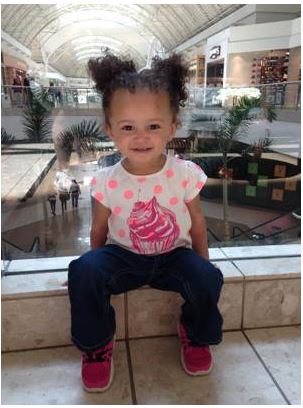
Image:  mixed race toddler girl in pick polka-dot t-shirt and jeans sitting in what appears to be a shopping mall.

Original caption:  “This undated family photo provided by Jennifer Cramblett shows her daughter, Payton.”   So not only is she telling the world that her daughter is a mistake, she’s publishing her name and photograph.  Do they think that their child alone in the world will never Google her own name?  W.T.F.?

This situation is so fucked up that my conservative brother and I — who agree about almost nothing except that his kids are awesome and the rest of our family is a clown car — are in complete agreement.  Take it away, Bruce!

Two white people decide to have a baby and, surprise, it comes out black (or half black). They’re lesbians so you’d think maybe they’d have some sensitivity to being a minority (and pay some lip service to that), but fundamentally they’re pissed that they bargained for a white baby and got a half-black one.

But, don’t people get surprises not of their choosing with babies all the time. I think this has been your mantra for a long time – that all life is equally valuable, etc. Interesting that therapists actually recommended they move out of a white neighborhood into a more “diverse” neighborhood.

Not sure, but this story seems to have about a million things wrong with it, none of which have to do with the mistake made by the sperm bank.

Sadly I learned early in my career in civil rights law that being in one minority does not guarantee you give a rat’s ass about any other minority or civil rights in general.  In an investigation not long after we started Fox & Robertson, we were interviewing people with disabilities whose personal care assistants were managed by a company who we thought might be committing Medicaid fraud.  The primary complaint of one of the first people I spoke with was that, despite her request, the agency would not stop sending Black people to her house.   Sigh.  This recent post by our friend Corbett describes a similarly depressing lack of rat’s-ass-giving by a group of non-disabled feminists.

Working hypothesis:  Humans are selfish, insular, and thoughtless, except the ones who are generous, compassionate, and funny.  It’s hard to say.

But back to parents who sue because their child exists.  As Bruce says:  having a kid is always full of surprises.  My parents — dyed-in-the-wool liberals — could not possibly have predicted they’d have a gen-u-ine Republican son.  But then, my dyed-in-the-wool Republican/WASP grandparents could not possibly have predicted they’d have a Democratic son who married a Jewish liberal, either.  Generations of parents — to the beginning of time — cope with children who aren’t what they expect them to be, yet the law does not recognize a right to compensation for parental disappointment unless the child is disabled or — I guess we’ll soon learn — of a different race.

Meanwhile, I’d like to set up shop as the lawyer representing the grown kids of these hateful lawsuits, bringing suit against their parents for the child abuse of publicly rejecting their very existence.

**********

* Link is to an excellent PowerPoint presentation on the subject by Samantha Crane, Public Policy Director at the Autistic Self Advocacy Network.

Municipal Planning Morass = Disability Discrimination Travesty

A weird, complicated, simple, dramatic, Aspen-based soap opera of a legal case started trial yesterday.  The City of Aspen is suing two wealthy condo-owners and the developer/landlord of the rest of the building for privatizing the only accessible entrance.  It’s a smaller but more disturbing version of the “poor door” controversies in New York and other cities, where affordable housing tenants are forced to use a side entrance to mixed use buildings.

Image:  the front of a brick building with a restaurant patio and covered entryway.

Photo from aspenpublicradio.org. Original caption: The building at the center of the dispute, at 308 East Hopkins in downtown Aspen. The entrance in question is on the right side of the building. Credit Loopnet.com

Elise Thatcher of Aspen Public Radio interviewed me about it on Monday and posted the Court’s decision granting in part and denying in part the City’s motion for summary judgment.

In short, JW Ventures, a developer in Aspen, Colorado, constructed a building in downtown Aspen to include two “market value” apartments, three “affordable housing units,” and two restaurants.  It also had, as required, an accessible entrance from the sidewalk with an elevator serving all apartments and the two restaurants, as well as an alley entrance and service elevator.   Fast forward to today:  the owners of the two market value units — a couple who combined them into a single apartment (the “Fancy Apartment”) — have asserted that the street-side accessible entrance and elevator are theirs alone, and that tenants of the affordable units and patrons of the restaurants must use the alley entrance and service elevator.  The legal case, brought by the City of Aspen to enforce its own ordinance, centers around the city’s conflicting actions with respect to building and condo plans.  I’ll get to the untested ADA and Fair Housing angles in a second.

I want to start in the middle and slightly to the side of the poor-door, privatized-accessibility story, with an email reporting an appalling quote by one Charles Cunniffe, an architect and principal with JW Ventures.  At the point when the status of the accessible entrance was being debated, the Fancy Apartment owners’ broker called Cunniffe and reported this conversation in an email back to the owners:

So, I called Cunniffe who said, Denis Murray of the bldg. dept has a personal agenda with handicap usage because its his personal MO (he’s handicapped).

Let’s put this quote in the More Traditional Minority Insult Conversion Machine:

We may not be able to exclude Jews from our apartment building.  That code inspector has a personal agenda with anti-Semitism because it’s his personal MO (he’s Jewish).

See how that works? Not OK, right?  In fact, prima facie evidence of discriminatory animus IMHO. In case Cunniffe’s appalling disability discrimination weren’t enough, he goes on, per the email, to recommend illegal retaliation.

If [affordable housing] tenants don’t like that and want to make an issue, the building owners have the right to terminate their lease based on being noisey, pet issues, smoking, etc.

In other words, if they stick up for their rights under the Fair Housing Act, just find a pretext to kick them out. ZZzzzzzt! You lose! That violates 42 U.S.C. § 3617, which prohibits retaliation for asserting rights under the FHA.

Stepping even farther aside, this is an object lesson in privilege. The wheelchair-using code inspector is likely a well-educated, competent guy. Maybe he has a degree in architecture or engineering. Maybe a professional license or two. But when he takes the radical position that JW Ventures should comply with federal law and municipal ordinance, he is reduced to his wheelchair and his views dismissed because of it.  If the email is accurate, this guy Cunniffe was determined to discriminate and retaliate, so even if Murray were not disabled, Cunliffe might have disparaged him as a bureaucrat or a jerk, but his views would not have been brushed off as a mere product of his minority status.

Back to the legal case. Turns out the city required, in the ordinance permitting the redevelopment, that the building be accessible and approved plans showing access from the street to all units and both restaurants.  The city later signed off on a condo map showing the street-side entrance and elevator as within the exclusive control of the Fancy Apartment. It is the conflict created by these apparently contradictory actions that is being tried — under the City ordinance — in court this week.

Because this case was brought by the city to enforce its ordinance it does not address the ADA or FHA, but I will.

JW Ventures designed and constructed the building in around 2010.  The apartments are thus covered multifamily housing under the FHA and the restaurants are places of public accommodation under Title III of the ADA.  All were required to be accessible when built — and apparently were.*   Having done this, JW Ventures, as the landlord, has to maintain the features that were originally required to be accessible.  This would require it to keep the elevator in good repair; naturally, taking affirmative steps to prevent use of the elevator would be covered by this provision as well.  Both the FHA and ADA also require reasonable accommodations/modifications in policies and procedures, so the landlord would also have to modify a policy that barred people from the accessible entrance.  Bottom line:  should a resident or guest of one of the affordable units or a patron of one of the restaurants require wheelchair access, that person would have the right to use the entrance and elevator currently privatized based on the landlord’s policies.

This may be a one-off situation, based on the complex set of conflicting communications during the building and condominiumization** process.  But if more and more mixed-use buildings are going to have “poor doors,” they may find themselves in violation of the ADA and the accessibility provisions of the FHA, in addition possibly to FHA disparate impact provisions, and of course common decency.

************

* Lawyerly disclaimer:  I have not seen the place, so I can’t vouch for its accessibility.  Everyone seems to agree that the street-side entrance and elevator would provide compliant access if not restricted.

**  Yes, this is a word.

[Cross-posted at CREECblog.]

The introvert vs. the anti-vaxxer: I wimped out

I was recently at an event — the type where you’re supposed to mingle holding a drink and make small but significant conversation with total strangers.  In other words, hell.  I ended up caught in a conversation with a woman whose adult son is Autistic, and who wanted to lecture me on how it was caused by vaccines, mercury in fillings, and fluoridation in the water.  (The conversation happened last week, not in 1965.)  She “warned” that soon 1 in 2 boys would have autism.  She said her son was “her part-time job.”  I asked (assumed, actually; that’s how far inside my own head I generally dwell) about involvement in groups of parents of adults with disabilities; her husband chimed in that these groups were “just” interested in “access” — the latter term enunciated as if “interest in access” was as absurd as “interest in pro wrestling” or “interest in wearing white after Labor Day.”

As an introvert and a klutz, I could not figure out the cocktail-party-level response to this.  So I put down my beer (half-finished!  desperate times!) and left. I have this question for you extroverts and people with social skills but also a righteous civil rights message:  what do you do in shallow social situations when someone says something deeply misguided or offensive?  I’ve blogged about avoiding entirely situations in which people — especially people you don’t know well but thought you respected — might say something buttheaded about disability or civil rights.  But what do you do when you’re stuck?  You’ve taken the highly questionable step of actually putting yourself in the position of making small talk with strangers, and the conversation takes a distinctly buttheaded turn.

Saw this on Facebook today; wish I could have responded as cleverly.

anti vax refutation

Image: the graphic consists of five text boxes, arranged with one at the top, and then two rows of two below. The top text box contains the meme being ridiculed. It shows a syringe and states “If you mixed Mercury, Aluminum phosphate, Ammonium sulfate, and Formaldehyde with VIRUSES, then got a syringe and INJECTED it into your child . . . you would be ARRESTED and sent to JAIL for child endangerment and abuse. Then WHY is it legal for a doctor to do it? and WHY would you let them? Educate yourself. Re-Think Vaccines.”  The box in the second row on the left has an icon of two cars colliding head on, and reads “If you welded some scrap Aluminum and Steel together, added some Tires, Cylinders, Spark plugs and GASOLINE, then took it out and DROVE it on a public road, you would be ARRESTED and sent to JAIL for public endangerment and unsafe vehicle. Then WHY is it legal for Ford & Chevy to do it? and WHY would you let them? Educate yourself. Re-Think Vehicles.”The next box has a wall socket and reads “If you look Copper wiring, connected It to the city power grid, then ran it through the walls of your house and into the bedroom of your child, you would be arrested for child endangerment and fire code violations. Then WHY is it legal for electrician to do it? and WHY would you let them? Educate yourself. Re-Think Electricity.” The box on the bottom left has a fireman’s ax and reads, “If you burst Into the bedroom of a child you didn’t know wielding and Axe and then forcibly took the child out of bed and carried them outside the house, you would be arrested and sent to jail for the assault and kidnapping of a child. Then WHY is it legal for firefighter to do it? and WHY would you let them? Educate yourself. Re-Think Firefighters.” The final box on the lower right has an airplane seating chart and reads, “if you took over a hundred people, packed Them into a pressurized metal tube, then used refined KEROSENE to LAUNCH Them to over 35,000 feet at speeds of over 450 knotsyou would be ARRESTED and sent to JAIL for . . . . I’m not sure, probably a lot of things. Then WHY is it legal for pilots to do it? and WHY would you let them? Educate yourself. Re-Think Aviation.”

“Valid point, but different conversation, folks.”

There is a lot of overlap between the way cops treat African-Americans and the way they treat people with disabilities.  And in Denver, that conversation blurs into  one about the Denver Sheriff Department’s violence and incompetence.  There are times that call for conversations about overlap and blurring and intersectionality, and there are times we need to FOCUS.  Right now, we need a bit of focus on a specific problem:  the mortal danger of being an African-American — specifically, a young, male African-American — in any action with the cops.

Often discussions of derailing can sound like shutting down.  That’s why I like the way Anita puts it:

Valid point, but different conversation, folks.

Stop Derailing This Conversation! – Musings Of An Angry Black Womyn.

Peter Singer and the TERFs: We Know You Better Than You Know Yourself

And we want to make pejorative, exclusionary and — in Singer’s case — homicidal* decisions based on our superior knowledge of your inner state.

I had just written my random thoughts on the importance of trans* [**], Autistic and other former others rejecting the default setting, and my view that this made it easier for all of us “to be who we are and find or create our own cubbyhole, or none, or multiple,” when the New Yorker published “What is a Woman?” by Michelle Goldberg, an article describing the anti-trans* faction of “radical feminism” called, variously, Radfems or — more pejoratively but accurately — “trans-exclusionary radical feminists” (“TERFs”).

But what truly reminded me of Peter Singer was the TERFs’ certainty that they know the inner life of trans women and trans men. One Sheila Jeffreys has written a book, “Gender Hurts: A Feminist Analysis of the Politics of Transgenderism,” in which she proclaims her knowledge of and judgment on the inner life of trans men and trans women by seeing them entirely through the political prism of male-dominated society. A man, per Jeffreys, can never appropriate the experience of being a woman. Accordingly, Jeffreys “insists on using male pronouns to refer to trans women and female ones to refer to trans men.” To her, trans men are simply trying to “raise their status in a sexist system” while trans women, well, “when trans women ask to be accepted as women they’re seeking to have an erotic fixation indulged,” or — according to the psychology professor on whose work she relies — trans women have “‘autogynephilia,’ meaning sexual arousal at the thought of oneself as female.”

So Jeffreys and other TERFs — cis women all — have decided that they know the inner life of trans people better than trans people themselves do, and not only pontificate about this in writing, but ultimately reject trans women as women, refuse to use their preferred pronouns, and in some cases exclude them from women-only spaces.

This is rank Singerism. Peter Singer is a Princeton professor who believes that, well, I’ll let Harriet McBryde Johnson describe it:

Applying the basic assumptions of preference utilitarianism, he spins out his bone-chilling argument for letting parents kill disabled babies and replace them with nondisabled babies who have a greater chance at happiness. It is all about allowing as many individuals as possible to fulfill as many of their preferences as possible.

In other words, privileged white male Princeton professor asserts that he knows with such certainty the inner life of people with disabilities that he advocates killing them as infants. To me, Singerism means making policy — usually negative — based on the facially impossible premise that you can know and pass judgment on someone else’s inner life. Singer can never know how happy any particular person is or will be, much less disabled infants he’s never met. Jeffreys and the TERFs have no idea how trans women experience their lives and their identities.

Where the fuck do they get off deciding to kill, insult, and exclude people based on these arrogant and patently impossible judgments?

Jeffreys claims that cases of “regret” — people who have physically transitioned and later regretted the move — “undermine[ ] the idea that there exists a particular kind of person who is genuinely and essentially transgender and can be identified accurately by psychiatrists.” Well, it might undermine that idea for the person experiencing regret but how it undermines the self-knowledge — often hard-won — of everyone who has ever transitioned is hard to see. More Singerism.

The New Yorker article describes one TERF group, Deep Green Resistance, as holding the view that “a person born with male privilege can no more shed it through surgery than a white person can claim an African-American identity simply by darkening his or her skin.” I suppose that may mark the far outer boundaries of my “Free to Be You and Me” approach to identity, that is, that we should credit people with knowing themselves and defer to the identity each asserts. Could a white person declare himself black in the same way a person born with female parts can declare himself to be male? [2024 note: this was a year before Rachel Dolezal caught everyone’s attention.] Can I decide to be disabled without actually having a physical or mental impairment that substantially limits one or more major life activities? When does the assertion of identity become appropriation? I think we avoid Singerism by saying (1) we don’t know; and (2) we have no business killing, insulting, or excluding people based even on identities that push the boundaries of credibility.

It is reassuring that TERFs find themselves marginalized in feminist and academic circles, though frustrating that Singer is not similarly ostracized. It is apparently more acceptable to mainstream academia to advocate killing disabled infants than it is to advocate excluding trans women from all-female music festivals.***

I conclude with this quote from the New Yorker article:

Older feminists . . . can find themselves experiencing ideological whiplash. Sara St. Martin Lynne, a forty-year-old . . .

Hold on! “Older” and “forty-year-old” do not go together!  But assuming that “older feminist” would accurately describe this 54-year-old, I experience no whiplash, but only a deepening appreciation for each way we let people be themselves, and each mind-opening step we take away from the default setting.

Update: Here is an excellent response to the New Yorker article, in Bitch magazine.****  TERF War: The New Yorker’s One-Sided Article Undermines Transgender Identity by Leela Ginelle.  Lots of good points about the the TERF problem, though I disagree that the original article undermined transgender identity.  I thought it was fair, and that the TERFs were portrayed as the narrow-minded troglodytes that they are.

Update 2:  Julia Serano, who is mentioned in Goldberg’s article, has an informative rebuttal in The Advocate.  Here is my comment:

This is an excellent rebuttal to the New Yorker piece, but reading this & the rebuttal in Bitch made me wonder whether we read the same original article. First, though, I agree that Julia Serano has every right to feel personally pissed. But while Goldberg clearly skates over the surface of a complex issue, and probably did sensationalize the feminist catfight angle, I thought the TERFs came off in her article as deeply misguided, insular, and hateful. Specifically the reference to “autogynophilia” seemed to me like a self-evidently hysterical use of scientific-sounding Greek word roots to disguise abject quackery. All that said, Serano’s response adds a great deal of useful detail; would be great if The New Yorker published it.

*******

* I was going to say “life-threatening” but Singer doesn’t just want to threaten the lives of disabled infants, he wants to permit people to kill them. Let’s call it what it is.

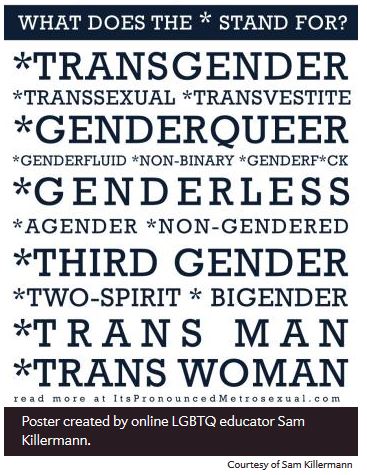
** “Trans*” is a way of indicating a wide variety of trans ways of being. As Slate explains, “the asterisk stems from common computing usage wherein it represents a wildcard—any number of other characters attached to the original prefix.”

Image: Graphic that reads, "Trans*. I recently adopted the term 'trans*' (with the asterisk) in my writing. I think you should, too. If it's new to you, let me help clarify. Trans* is one word for a variety of identities that are incredibly diverse, but share one simple, common denominator: a trans* person is not your traditional cisgender wo/man. Beyond that there is a lot of variation. What does the * stand for? *Transgender, *Transsexual, *Transvestite, *Genderqueer, *Genderfluid, *Non-binary, *Genderf**k, *Genderless, *Agender, *Non-Gendered, *Third gender, *Two-spirit, *Bigender *Transman *Transwoman" Poster created by online LGBTQ educator Sam Killerman.This can get confusing here, in light of the fact that the ThoughtSnax Style Manual calls for asterisks for footnotes.  We’ll muddle through.

*** The article noted that violence and threats have been directed toward TERFs, which is of course deeply offensive and wrong . . . except the graffiti “Real Women have Dicks,” which is just the sort of smartass, mind-opening civil disobedience I love.

**** Of course I read Bitch Magazine — it’s my trade publication!

Title III doesn’t [just] need damages; it needs a public shaming remedy. Update: I appear to have been punk’d.

Update:  While it’s true that Title III most definitely needs a public shaming remedy, this case may not be the vehicle for it.  Gawker reports that the whole thing was a hoax.  Not wishing to be equally credulous of the debunking as I was of the original bunking, I’ll leave the various links and let you decide.

Original post:

Family says girl scarred by pit bull attack asked to leave KFC restaurant.

Image:  Kentucky Fried Chicken logo.  Old white man with white goatee and red apron.


A 3-year-old girl who was attacked by pit bulls in April was asked to leave a restaurant in Mississippi because her scars scared customers, the girl’s grandmother told a television station there.

“They said, ‘We have to ask you to leave because her face is disrupting our customers.’ [The girl] understood exactly what they said.”

As you can imagine, this is pretty much an automatic violation of Title III of the ADA, which prohibits discrimination on the basis of disability in public accommodations, including restaurants.  But Title III has no damages remedy; the only thing the girl and her family would be entitled to would be an order permitting them to eat at the restaurant in question.

Second prize:  two meals!

Since there’s no damages remedy and the injunctive remedy is somewhere between less-than-useless and adding-insult-to-injury, I propose — in addition to the very-expensive-scotch remedy for hotel reservation violations — that Title III have a public shaming remedy.

Here, the remedy would include a requirement that (1) the waitstaffperson who made the request wear a sign saying “I acted like an asshole.  I’ve learned my lesson.  I will not act like an asshole — at least to people with disabilities in restaurants — in the future;” (2) the owner of the restaurant wear a sign saying, “I promise not to hire assholes and I promise to train my staff not to act like assholes,” and (3) the waitstaffperson and restaurant owner buy the entire family a meal at the best restaurant in town as well as a year’s supply of Popeye’s fried chicken, which everyone knows is the far superior take-out fried chicken.