Category Archives: Uncategorized

Remembering David

The family gathered at David’s memorial.

On September 22, 2024, we gathered to remember my stepfather, David Sterling North. We’ve set up a website with photos and remembrances: www.davidnorthmemorial.com which has most of the eulogies including the below. Posting separately here for my five or six loyal readers who may not have attended.

One note: for the service, I removed the paragraph about my gratitude to David for including my father in his life. I did this out of concern that it would be viewed as judgmental of situations that have not evolved in the same direction. It’s back in this version is it really is a remarkable testament to David, my mother, Ruth Blau, and my father, Peter Robertson, and the family they created.

My tribute to David:

It can’t be easy to be a step-parent, but David nailed it. He never tried to be my father – I already had one of those – but instead was a wise and supportive elder throughout my adult life.

I think it helped that we were both giant nerds. 

David became my step-father when I was a sophomore in college, so he missed out the annoying-adolescent years that my parents had to suffer through. So I don’t have childhood memories of David but rather memories sitting around our dining room table on visits or holidays, talking about whatever was in the news or whatever one of us was working on or arguing (gently, respectfully ) about immigration policy. 

He always wanted to hear about my latest case, and would follow along with intelligent, interested questions – good preparation for when I’d have to explain the whole thing to a judge. That connection through curiosity is a theme so many of my memories of David. For example, when I was in college, one friend – who had recently been to visit our home – warned another to be sure to know who her congressman was, as David would almost certainly ask her on the next visit. 
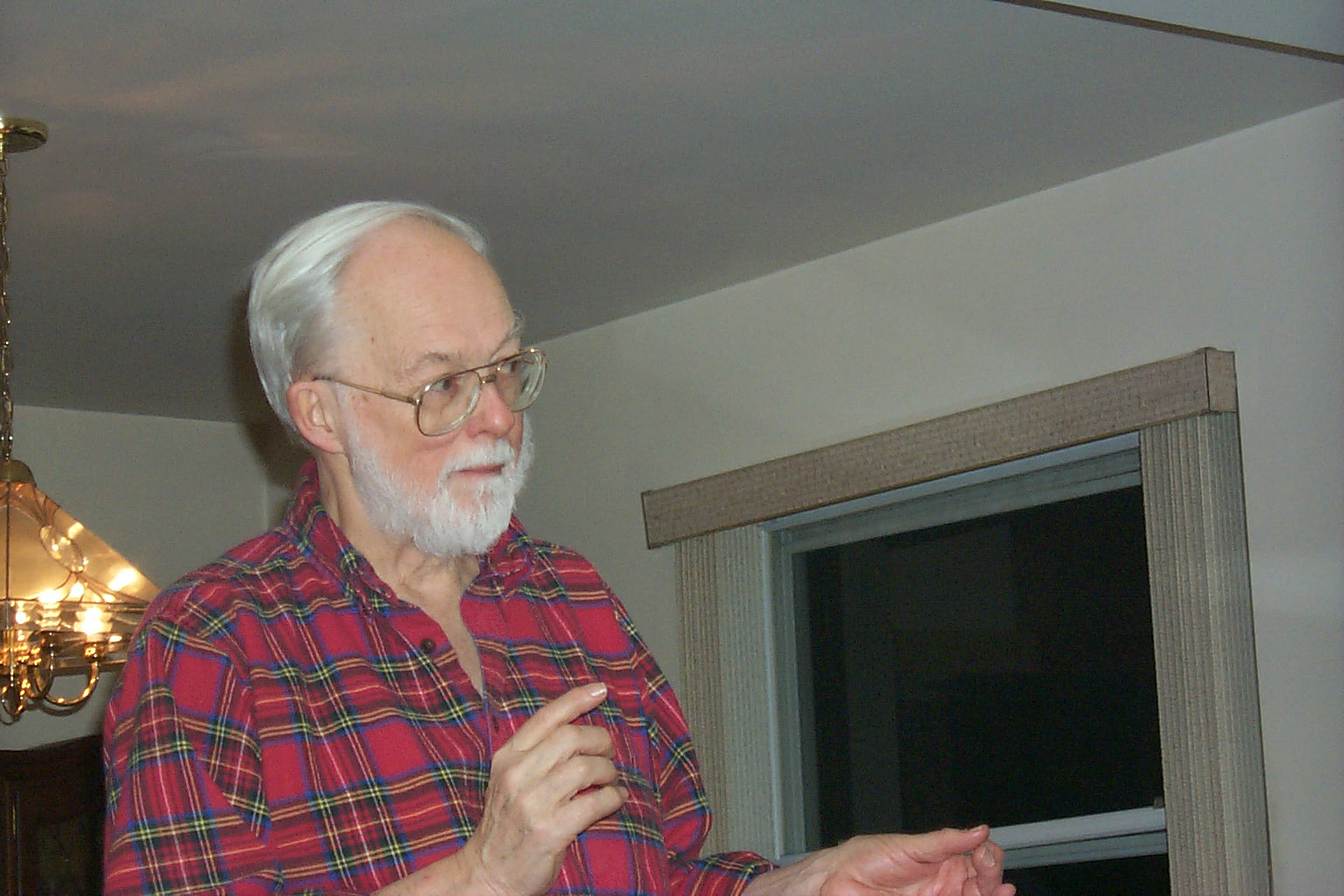
David: white man; white hair; beard; glasses; plaid shirt.
David in conversation mode.

I think anyone who has been in conversation with David will remember the twinkle in his eye when he had an interesting fact to explain. He clearly took joy in knowing things and in gaining and sharing knowledge about a wide range of topics.

And using that vast knowledge, his double-black-diamond-level research skills, and boundless energy, David took on many Goliaths. He’d dig into some reasonably obscure information source to uncover, expose, and attack abuses of power. From time to time, he would loop me in with emails that would start, “I think this would be a good class action lawsuit . . .” He would proceed to describe how his research had revealed some way in which some big guy was exploiting some little guy and then ask to brainstorm whether we could use the tools of the legal system to attack the problem.

These issues included – couple of examples over the years:  

  • Pregnant garment workers in Saipan being exploited by large garment companies. If you’ve been to Ruth and David’s house you may have seen the Doonesbury cartoon on the subject, signed to him by Garry Trudeau.
  • Abuse of a charter school system by a Turkish cult.
  • The corrupt system for unclaimed funds in Georgia, which (shockingly) favored the large company debtors rather than the individuals owed money. 
  • David’s last legal email to me came just three weeks before he passed, asking me to connect him to a lawyer who could assist an abused woman in California.

Though I never personally took on any of these cases – most were far outside my field – on several occasions I was able to connect him with attorneys to investigate the claims or make other, back-channel connections. David was always willing to work levers of power and knowledge behind the scenes. 

I’ll add – in the “we’re both giant nerds” department – we often bonded over – and shared tips for using – the PACER system, that is, the federal court system’s online docket. He was one of the only non-lawyers I knew who had his own PACER account – and assiduously tracked cases, large and small, against various Goliaths.   

David (white man; white hair/beard; trench coat) sitting at a Chinese typewriter, poised to select a slug of type.
David trying out a Chinese typewriter

Shaun Pennington, whose words Rodney just read, described David’s “superpowers: pen, intelligence, experience, trustworthiness and well-deserved respect.” I offer a friendly amendment: that’s a metaphorical pen – this David’s slingshot was his typewriter. The photos include several, from his old portable manual to the post-it covered monitor he used until a day or two before his death.  And my favorite photo:  David exploring a Chinese typewriter when he and my mother came to visit me in Taiwan. 
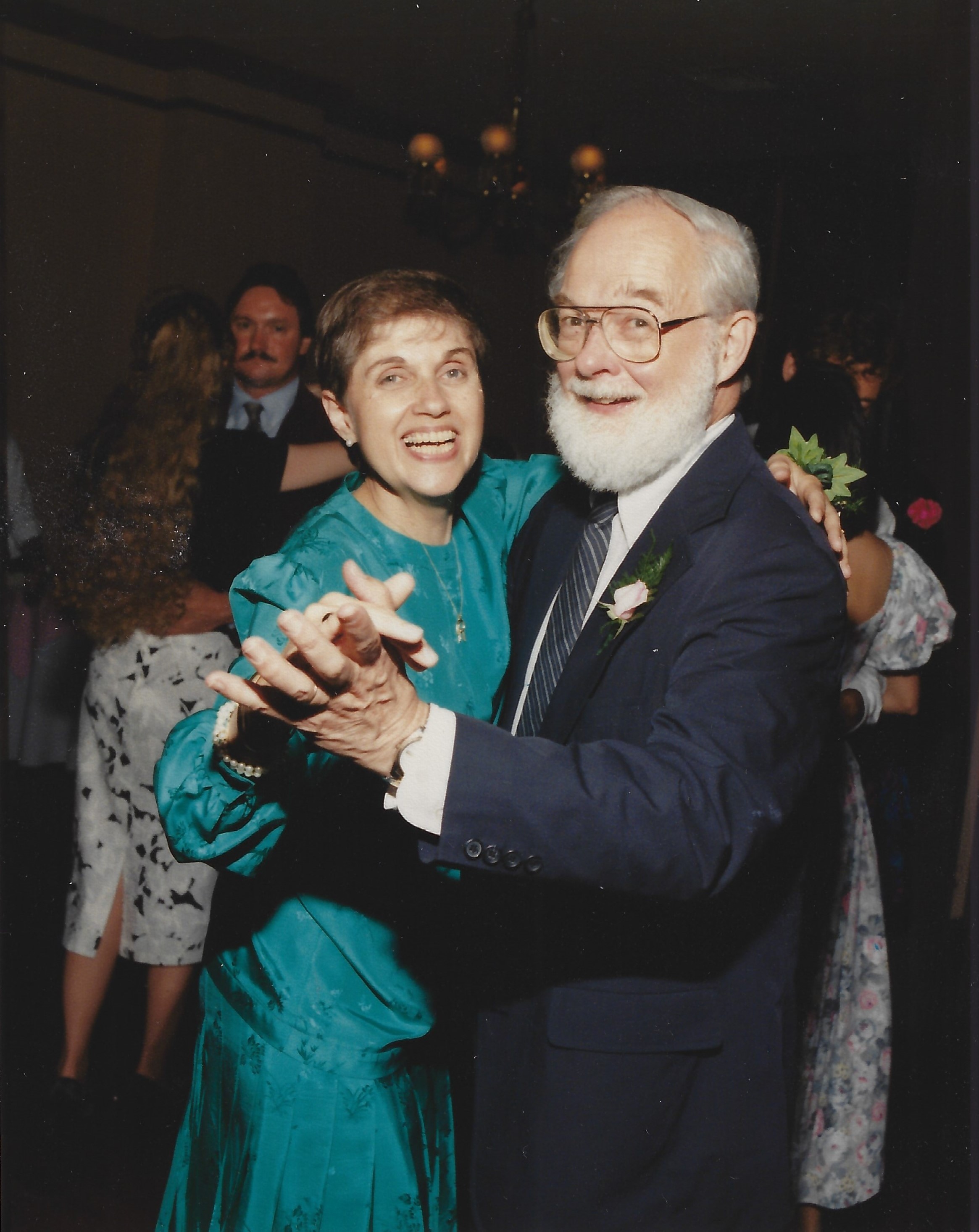
Ruth (white woman with brown hair and a blue-green dress) and David (white man with white hair and beard, wearing a suit and tie). They are dancing with beautiful smiles on both faces.
Ruth and David, dancing.

David and Ruth loved to travel – you’ll see in the photo montage a number of pictures from their travels. In fact, one of the things I noticed as I gathered and compiled the photos was their smiles:  Ruth and David clearly took immense joy in each other’s presence, whether traveling in China, Australia, the Philippines, or the Caribbean; or gathering for a meal with our wonderful, weird, ad-hoc family; or preparing lunch together in their Arlington kitchen.  Just as much as I celebrate David today, I also celebrate their wonderful, devoted, 45-year marriage.

And about that ad hoc family – I will always be grateful to David for the three additional brothers I gained through his marriage to my mother and for his willingness to welcome my father into his life and home. My parents separated in 1973 and by the late 1970s – a year or so into Ruth and David’s marriage – my father Peter was joining the crew on Kensington Street for Thanksgivings and Christmases and other random gatherings.  I’m grateful to all three of them for that. 

Image: four white men sitting outside on a deck; left to right: father Peter Robertson (white button-down shirt; glasses); husband Tim Fox (blond hair; dark sweater; wheelchair); brother Bruce Robertson (dark hair; white polo shirt); step-father David North (white hair and beard; blue polo shirt; holding wine glass).
Peter Robertson, Tim Fox, Bruce Robertson, David North

To hijack the words and metaphor of Buckminster Fuller – and trust me, I would not have known this but for the work of my friend Unyong Kim – David was a trim-tab. That is a very small piece of metal on the edge of a ship’s rudder that can change the direction of a very large ship. Fuller himself used it as a metaphor for the impact one individual can have on society’s problems. David, through all of his work, large and small, had an outsized impact on so many lives – and specifically mine, as a wonderful, smart, supportive stepfather. Miss you very much, David. 
Acheson Hotels v. Laufer: Revenge of the Data Nerds

[Cross-posted at the FoxRob Blog.]

Fox & Robertson along with a dream team of drafting partners filed an amicus brief today in the case of Acheson Hotels v. Laufer, currently pending in the Supreme Court. The case addresses the issue of “tester standing,” that is, whether people protected by civil rights laws have standing to sue when they intentionally investigate compliance and encounter discrimination.

Because tester litigation has been responsible for calling out and challenging widespread disability discrimination, businesses hate it. The amicus briefs they filed were full of hair-on-fire numbers — of pending ADA lawsuits — that they characterize as a “staggering,” “unrelenting tide” that is “clog[ging] federal court dockets.” Chamber of Commerce Br. 7, 11; Retail Litig. Ctr. Br. 4, 11, 20, 22. One business brief asserted that tester standing “threat[ened] . . . the cohesiveness of our union.” Ctr. for Constitutional Responsibility Br. 1. Drama much?

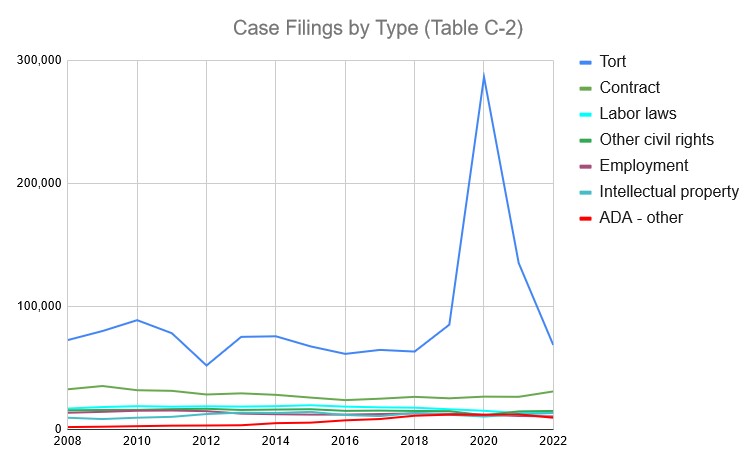
Of course numbers are catnip to the data nerds here at Fox & Robertson World Headquarters, so we decided to take a look at the actual numbers of ADA cases filed in federal court — based on data gathered by the United States Courts on its uscourts.gov website — and see how they looked in context. Here’s a chart comparing the “ADA-Other” category — roughly speaking, non-employment ADA cases, including the Title III cases that cause flaming hair on the business side — with six other common types of cases. Note the bright red ADA-Other line at the bottom.

Image:  a line graph titled “Case Filings by Type (Table C-2),” with the years 2008 to 2022 on the x axis and numbers 0 to 300,000 on the y axis. Seven colored lines cross the graph horizontally, each representing a type of case. The top line is a jagged line representing tort cases (varying between approximately 50,000 and 135,000). The line representing the category "ADA - Other" is in red.  It starts and ends at the bottom of the seven lines, intermingling with them in 2020.  ADA-Other cases vary from approximately 1,700 to approximately 12,000.  Other types of cases are as follows:  Contract cases, in green, vary from approximately 23,000 to 35,000. Labor law cases, in light blue, vary from approximately 13,000 to 19,000. Other civil rights laws, in dark green, vary from approximately 11,000 to 16,000.  Employment cases, in purple, vary from approximately 11,000 to 15,000.  Intellectual property, in blue, vary from approximately 8,000 to 14,000.

See? Not so bad after all! If business put half the effort into compliance that they put into whining, the world would be pretty damn accessible by now.

Be sure to check out our amicus brief with other fun facts and incisive arguments from the dream team: free agent disability rights rockstar Karla Gilbride, Michelle Uzeta at Disability Rights Education and Defense Fund, Tom Zito at Disability Rights Advocates, Justin Ormand at Allen & Overy and yours truly here at the World HQ.

Enough? (Not looking for yes.)

Rest is resistance.

Living well is the best revenge.

Find joy in small things.

Should we against whom revenge is fully justified, from whose depredations others need rest, find joy? Live well? Rest?

Do the small things I do, the cases I bring, the occasions I speak up (so few opportunities, I tell myself, because I’m an introvert) suffice? Do they make up for the cases not brought, the protests not attended, the reparations not made? The land I have not returned?

Not looking for yes. Looking for the wisdom and space to figure this out.

Happy Birthday, Bruce!

I won’t say this to you directly, because you don’t want to hear from me.  This makes me sad, but I don’t want to add to your stress with an unwelcome text or email.  But I miss you and I wonder sometimes, no matter how angry you are, whether you miss me.  Or whether you miss at least our shared past. 

Bruce’s 3d birthday in 1965. Seven small white kids at a picnic table; Bruce is at the far end of the table; I’m to my Dad’s left in a blue dress and red shoes. Dad stands at the head of the table in his Summer Nerd outfit: blue button down, sleeves rolled above his elbows; shorts in a different shade of blue; black socks and black business shoes.

One of the coolest things about having a sibling is making fun of your nuclear and extended family; the next coolest thing is the shared memory of stupid shit you did as kids. Remember Dad’s attempts at casual dress?  He was incapable of anything between a three-piece suit and ancient repurposed suit pants, often rolled up to his knees for a stroll on the beach, often (see left) paired with black socks and shoes. Remember making fun of Mom’s boyfriend’s name? (Sorry, Mom – I know you hated it, but we laughed our inconsiderate asses off.) Remember the way Aunt Martha would introduce you to anyone who had anything to do with something vaguely sciencey and assume you’d have a lot to talk about? Or Dad opening your Chemical Engineering PhD thesis to a random page and claiming to have found a typo – man he was proud of someone in our family doing sciencey things!  

Neither of us knew what “calvados” was when offered it at my graduation dinner, and spent the next few hours saying the word and laughing ourselves silly.  (It was my law school graduation, for the record.)  Remember when Dad tried to throw an ice cream cone at you, but hit the inside of the car’s back door. We’re still considering a plaque for that specific Dairy Queen in Brunswick, Maine.  Remember the trip to France in 1986 – three generations of stubborn, crabby Robertsons in a small car without much of a plan, where the conversations ranged from Granddaddy’s adventures in WWII to Granddaddy’s contemporary struggles with constipation. 

We laughed at it all – even the stuff we probably should not have laughed at (I think Granddaddy was actually pretty uncomfortable, though the TMI factor was pretty high). We laughed at some of the painful shit around the divorce, and laughed and cried around the really painful shit when Dad died.  (They buried him in the wrong grave?  One belonging to the cousin who hated him?  We tried to cry, but it was also fucking hilarious.) 

Well, Happy Birthday and thank you – it’s been cathartic to write just this sampling of hilarity and stupid shit.  But it was also a good reminder that I do, indeed, love you and miss you. 

Happy 60th, dear brother.

Thank you, Sen. Booker. I’m so sorry, Judge Jackson

I’ve been trying to process how I feel about the circus that is most of the confirmation hearings for Judge Ketanji Brown Jackson. No, that’s unfair to clowns. The middle school recess that the GOP bullies have turned these hearings into.

Before turning to the school bullies, I want to thank Sen. Cory Booker, whose words moved me to tears. This clip is about 20 minutes long and all very worth it, but if you don’t have the time, start around the 14-minute mark. I am deeply grateful for Sen. Booker’s speech – it was an act of healing to watch it and, I hope, to speak it.

[Image description: split screen showing Sen. Cory Booker (Black man in dark suit with red tie) on the left and Judge Jackson (Black woman in royal blue suit and black shell; she has shoulder-length braids and glasses) on the right. The video is captioned.]

But what to say of the white boys hurling ignorant insults at this brilliant, brave woman? I want to find a way to apologize to her, as if some ignorant, racist, drunken relative of mine had crashed a civilized gathering at which I had the privilege of listening to and learning from her. I’m grateful that she has a wonderful family and a supportive network of friends with whom she can process this bullshit. And I want to send her comfort food, maybe a big bowl of pasta and a chocolate chip cookie. Or whatever is her favorite when she can get home, kick off the heels, and feel safe amongst people who love her. You don’t deserve any of this, Judge. But you do deserve to be on the Supreme Court.

Godspeed.

In praise of work-life imbalance

Introductory note: I am a privileged, white, cis/het, abled woman, and this post is intended to address other privileged non-marginalized people. I don’t know and would not dare to guess or pontificate on the self-care or life-balance situation of people outside that category. YMMV.

***

I started my legal career in a large commercial law firm where we regularly worked 12-hour days and pulled occasional all-nighters. It wasn’t healthy. After Tim and I started our own firm, we pledged to have more control over our time. And we did. We’d close the office for a “weather emergency” when it hit 70 degrees in March and everyone had spring fever. We’d take off to a baseball game (remember those?) on a whim. But we had started a law firm dedicated to something we cared deeply about: disability rights. So there were also long days, weekend hours, and a general blurring of work/life boundaries.

Now, 26 years after we started that little firm, that imbalance still exists.  We set our own hours — a huge privilege — but we also work plenty of weekends and spend plenty of our off-time thinking and talking about our work. 

And that’s OK. 

Younger lawyers now demand work-life balance. They need time for self-care.  And that’s OK, too. 

But I’m concerned that that demand has become the same sort of brass ring/competition that long hours were to us in the 80s and 90s. Then it was cool to brag that you’d been at the office all weekend, or billed 250 or 300 hours that month,* sweeping into the competition folks who might have needed more time for themselves or their families.

Now if feels — at least from the perspective of this late-Boomer/Gen-X-cusper — that self-care has become as competitive as billable hours once were.  And that the quest for work-life balance can sometimes lose sight of clients with even more radically imbalanced lives.

I’m not suggesting we go back to defining our self-worth in billable hours.  Just that long hours on behalf of a cause you believe in may be the source not only of eye bags, caffeine jitters, and piles of unwashed laundry, but also great satisfaction and even joy. 

Work life balance/imbalance balance.

***

* I was actually present for a conversation among male attorneys comparing competitively who returned to work fastest after their wives gave birth.  Even for the early 90s, that was gross.


One Year

Everyone will have a One Year story right about now.

On March 10, 2020, I flew to Los Angeles for a two-day site visit. We were starting to get a sense that the coronavirus was serious, and — after a nerve-wracking few hours of wiping down my arm rests and drop-down table — my flight ended with a man being removed by ambulance in respiratory distress.

Throughout the day of March 11, I trooped around a large housing development in my Amtrak hard hat with a large group of opinionated architectural experts and took increasingly concerned calls from Tim back in Denver: This is looking really bad. Maybe we should give folks the option to work at home? And by the end of the day: please take your laptops with you and plan to work from home until further notice. Lunch that day in L.A. — Peruvian food with a couple of fair housing gurus from HUD — would be my last in-restaurant restaurant meal for over a year.

We cancelled the second day of surveys and I grabbed the first flight home the morning of March 12. One woman on our flight was wearing a full haz-mat suit and gas mask. Another man kept sneezing on people. When we landed in Denver, I drove home and — with these very few exceptions — didn’t leave:

  • Occasional trips to the office with Tim, though fewer as COVID cases spiked and it became clear that our doofus aging-Beach-Boy property manager was an anti-masker.
  • Four trips that took me inside a post office or UPS store.
  • Approximately three carry-out meals that required me to go inside a restaurant.
  • Two trips to the dentist.
  • One gathering with two other friends on an outdoor deck.
  • One adventure inside a Walgreens to get our flu shots.

I participated in my first virtual hearing on March 17. CREEC had its first virtual Happy Hour on March 20 and its first virtual event on September 17. We said farewell to several CREEC employees and welcomed several new ones, all without gathering in person. I argued virtual motions and participated in virtual conferences in a suit jacket, Blue Loom scarf (of course), and shorts.

We started isolating on March 12, 2020.  We got our first COVID vaccines on March 7, 2021. 

With the exception of the flu shot and our COVID shots last Sunday, I have not been inside a store since March 11, 2020. I’m fine with that.

I am beyond grateful for those who made it possible for an aging asthmatic and a quad to radically isolate for a year, especially Tim’s assistant Bob Wilson, who masked, scrubbed up, stuck by us, and kept his hilarious sense of humor through a very intense year, and every single person who delivered groceries and other things to our door. You had the interactions we were afraid to have.

My heart goes out to those who have lost loved ones to the pandemic and the incompetence of the last administration.  It really didn’t have to happen this way.

Putting the fence to even better use!

A couple of weeks ago, I posted about the #BlackLivesMatter sign that I put up on a long stretch of fence on the side of our property facing a pretty heavily traveled frontage-ish road. First, I’m happy to report that, almost three weeks later, it remains unvandalized. That is, it exceeded my “Kerry 2004” sign by two weeks and six days.  

Wooden fence with "#BLACKLIVESMATTER" and a blank poster board stapled to it, photographed from across a residential street.

But even better, a few days later, Olive Davis and Janie Reilly, two 11-year-old neighbors, asked if they could add their own posters.  OMG yes!  Check this out!  The kids are way more than OK.  For this and so many reasons, I have great faith that the next generation will take much better care of this country than we have. 

Olive (white girl; purple shirt; denim shorts) and Janie (white girl; black tshirt; denim shorts) working together to staple a sign under the #BlackLivesMatter sign. Two helmets and a skateboard are on the ground near their feet.

Pink sign reading We R = [equal sign], all in glitter with rainbow cotton balls dotted around

Orange construction paper sign with a heart outlined in white and filled in with rainbow colors.

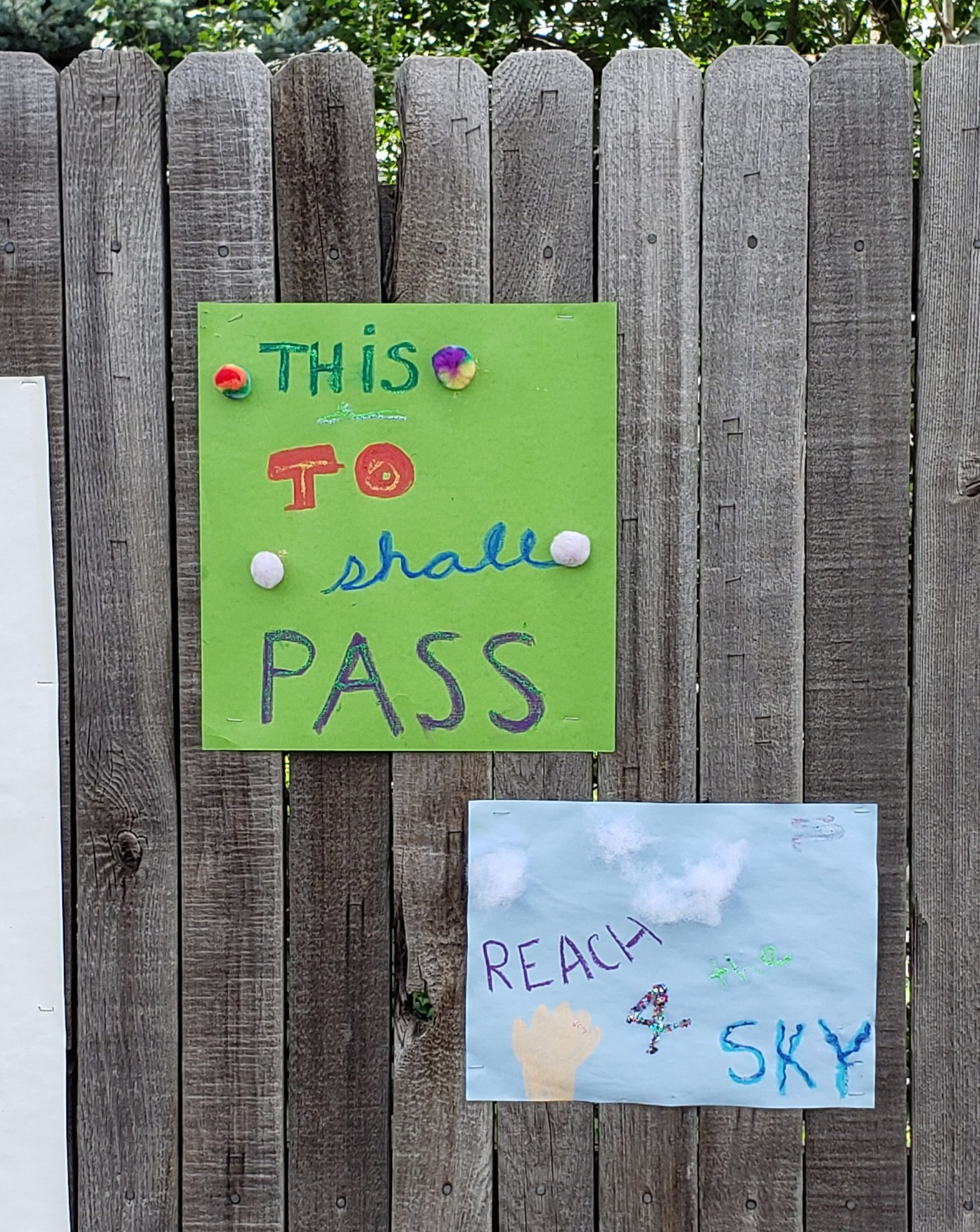
Two construction paper signs. One green that reads "This to shall pass," in various colors of ink with rainbow cotton balls dotted around. The second is on light blue paper and says Reach 4 the Sky with cotton ball clouds and a light-colored hand reaching up from below.

Purple construction paper sign that reads "Every Vote counts" in various colors and giltter, with two rainbow cotton balls.


Blue construction paper sign that reads, "Love is Love" in red and blue ink with glitter and two multicolored cotton balls.


Two construction paper signs. The top yellow paper with the words "Black lives Matter" in various colored inks with glitter. The bottom with the words "Be Your Best Self" with multicolored cotton balls.

Thank you Olive and Janie – you made my day!!!

Mourning the passing and celebrating the life of Judge Wiley Y. Daniel

Image: photo of Black man, balding with a mustache and wire-framed glasses, wearing a suit, a flowered bow tie, and a matching vest.

Photo credit:  David Zalubowski, Special to The Denver Post

Yesterday, we celebrated the life and mourned the passing of Judge Wiley Y. Daniel, a Senior United States District Judge in the District of Colorado. I have been privileged to practice before Judge Daniel from early in my legal career to earlier this year, and each time it was a delightful experience. He was always prepared, knowledgeable, practical, respectful, and funny. He worked hard to put everyone in the courtroom at ease so we could get to the business at hand, for example, carefully establishing out-of-state counsel’s college football and basketball allegiances before proceeding.

In one of my earliest appearances before Judge Daniel, I was arguing for wheelchair access to Denver’s Red Rocks Amphitheatre. Opposing counsel observed that Red Rocks was built into the side of a steep mountain.  Judge Daniel responded by asking (something to the effect of — unlike the below, we didn’t get the transcript), “That’s all well and good, but why should the burden of that geography fall only on people with disabilities?”  He has, from the get go, understood the fundamental premise of disability civil rights.

In June, 2018, we again appeared before Judge Daniel on the question of wheelchair access to Red Rocks, though this time it was to seek final approval of a class action settlement addressing ticketing and scalping problems that had excluded people with disabilities. Final approval hearings are always upbeat events, as the parties have settled and appear before the judge jointly requesting his blessing of the settlement. Judge Daniel quizzed us on the details of the agreement, indicated his intent to approve it, and then took the opportunity to talk about civil rights and disability rights:

I have had occasion, both as a lawyer, and more importantly as a Judge, to see the evolution of the [ADA]. … [T]here have been strides to make accessibility more an important ingredient of public access to facilities, transportation modes and anything else. So what I’m really saying is, since I have been around a long time, I’m pleased that we’re making strides, but I’m also disappointed that lawsuits have to be filed before anybody, such as the City and County of Denver or other public bodies have to do the right thing, and so I hope that this outcome here can be another further example of how the law can work in a proactive way, but hopefully it also sends a message that even without a lawsuit, I think entities such as City and County of Denver and other public entities have an obligation to, on their own, figure out what should be done to make it easier, rather than harder, for folks with disabilities to have the same access that everybody else has.

[T]hat’s why one of the wonders of being a practicing attorney is [that] practicing attorneys, if they are interested in social justice, if they are interested in being social engineers for justice, can still play a vital role in moving the needle more quickly.

[A]ll of that is what I am uplifting and raising as an illustration [that] we are making progress, but we’re a long way from perfection, and I say that parallels some of the issues that still exist in this country on racial issues, where we have civil rights laws that go back to the mid 60s, but we still have, today, the clear rise of white supremacy, we clearly have nationalists that are running for congress today, running hateful statements and awful things, but they will get votes. And so I think our country has a long way to go to, in effect, liberate us from the battles that have been in existence and will remain in existence, and to the extent that courts can help resolve them, I’m just gratified that I can play some small role in this, and hopefully we will reach a point, at some point, where these laws will become truly an integral part of the fabric of our life.

 Judge Daniel, we are surpassingly gratified that you played such a large role in advancing civil rights in Colorado and improving the fabric of our life. We miss you very much.

[Apologies for cross-posting.]

Tony Kronman: Black Lives Do Not In Fact Matter. 

In 2017, Yale University renamed Calhoun College (at Yale, they call dormitories “residential colleges” because … Yale) after Grace Murray Hopper, a “trailblazing computer scientist, brilliant mathematician and teacher, and dedicated public servant.”  John C. Calhoun was a prominent Yale alumnus and U.S. Senator and, of course, passionate defender of slavery as a positive good.

Yale Law professor and former dean Anthony Kronman objects, explaining that, in his view:

Hitler and Stalin would have to come off buildings, but he says “less egregious” cases like Calhoun are different.

This is literally valuing the millions of white lives lost to the Holocaust and to Stalinism more highly than the millions of black lives lost to American slavery. And by “literally,” I literally mean “literally.”

Kronman accuses those who supported renaming a Yale college (that is, a dorm) — discarding the name of a prominent supporter of slavery for the name of a pioneering female scientist — of the sort of historical revisionism practiced by the Soviet Politburo.

Kronman says that colleges and universities have a responsibility to “cultivate the capacity for enduring the moral ambiguities of life.”

What in the absolute fuck is morally ambiguous about slavery?  It is precisely this sort of academic arrogance that actively devalues and excludes students of color and prevents real intellectual discussion and evolution. It also requires a special sort of intellectual laziness to easily acknowledge other countries’ monsters while being unwilling to face up to our own.

I’m ashamed of my school’s former dean and proud of Prof. John Fabian Witt for his excellent point-by-point demolition of Prof. Kronman’s indefensible defense of the defense of slavery.