Tag Archives: ADA hypocrisy

Discrimination “in a manner consistent with Biblical principles.”

Hobby Lobby went to the Supreme Court to avoid covering contraception for its female employees because … Christian! Then they had their lawyers defend discrimination against a customer with an intellectual disability.  Christian?

The company told the Supreme Court that

Hobby Lobby’s statement of purpose commits the [owners] to “[h]onoring the Lord in all [they] do by operating the company in a manner consistent with Biblical principles.” Each family member has signed a pledge to run the businesses in accordance with the family’s religious beliefs and to use the family assets to support Christian ministries. … The businesses refuse to engage in profitable transactions that facilitate or promote alcohol use; they contribute profits to Christian missionaries and ministries; and they buy hundreds of full-page newspaper ads inviting people to “know Jesus as Lord and Savior.”1

I bet you’re all wondering how those Biblical principles applied to a Hobby Lobby customer with an intellectual disability. Fellowship? A bit of adaptive Bible study? Common courtesy? Nope.

Following a decade of friendly interaction and accommodation, the store got a new manager.2

[Plaintiff Charles] George asked a cashier to tally the cost of certain items and said that he would return later in the day when he had the money to pay. George alleges that [Manager Heather] Ford told him he could not do that because the “cashiers are wasting time on” him and that if he continued to ask for help she was going to call the police. Ford also supposedly stated that she wanted George “to stay out of this store and off of the property never to come back.”3

New manager Heather Ford, rather than continue to accommodate Mr. George’s intellectual disability, called the police. I’d love to hear from Hobby Lobby how this constitutes “operating the company in a manner consistent with Biblical principles.”

My fellow ADA nerds will be either shocked or relieved to know that the court held Mr. George had stated a claim under Title III:

George has alleged sufficient facts to state a Title III ADA claim and he has standing to pursue it. It is undisputed that George has a disability, and that Hobby Lobby is a place of public accommodation. And George has alleged that Hobby Lobby, through Ford, discriminated against him because of his intellectual disability by refusing to provide an allegedly reasonable accommodation (tallying items) that it had provided to him in the past. Further, George has alleged that he would return to Hobby Lobby’s store if he could, which is sufficient for standing.4

A very long time ago (2010) I suggested a new rule for the Federal Rules of Civil Procedure:  Rule 1.5 “Don’t be a dick.”  Given our current fraught legal times, I propose another addition:  Rule 30.1 “Deposition to Call Bullshit.”  Under Rule 30.1, any member of the bar can notice the deposition of a litigant in any case to make its hypocrisy a matter of record. 


  1. Burwell v. Hobby Lobby Stores, Inc., 573 U.S. 682, 703 (2014) (emphasis added; internal citations omitted). ↩︎
  2. Seasoned civil rights lawyers will now hear “Jaws” theme music in their heads. “Then they hired a new manager” is how the vast majority of civil rights intake interviews start. ↩︎
  3. George v. Hobby Lobby Stores, Inc., — F. Supp. 3d —, 2025 WL 721312, at *1 (E.D. La. Mar. 6, 2025). ↩︎
  4. Id. at *5. ↩︎

[Baloney] ADA Defenses

In my non-lawyer life, I’m a bit of a smartass, especially in the presence of what I’ll politely refer to as [baloney]. I’ve been unsuccessful at completely eliminating this tendency from my professional life — I once smirked so aggressively at an opposing counsel’s, um, inaccuracy that the judge asked me whether I was having a facial spasm — but, given its public nature, I’ve tried to limit case-specific smartassery on the blog. I’ve also been working on my in-court poker face.

But it’s hard to completely eliminate blogsnark, chiefly because we run up against so many defenses in our cases that are sheer, unmitigated [baloney]. Here’s one. And what’s special about this one is that events of the defendant’s own creation gave us a rare glimpse of just how full of [baloney] it was.

When we first moved into our current office, we were thrilled to learn that the empty corner space across the street would soon be occupied by what we anticipated would be an excellent Mexican restaurant.  Our office neighborhood is sort of mixed, by which I mean — as we point out on the main website — we are close to excellent restaurants, an independent movie theater, and a bondage and domination shop. And a couple of gay nightclubs, vintage bookstores, and a knitting shop. I really, really love our neighborhood.  A high-quality Mexican joint would be a great addition.

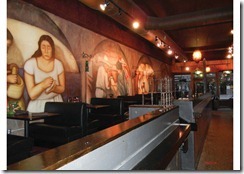
Anyway, the space across the street was completely gutted, but one day as we strolled past — you have to stroll at least once per work day if you have office dogs — we noticed that they were installing raised areas in the space. We chatted with the highest-ranking person we could find on site, and explained that this was not permitted under the ADA. Apparently didn’t matter: the El Diablo restaurant opened with most of its seating on inaccessible raised platforms, and a couple of — also inaccessible — high tables at grade.

003-Montalbano_thumb

Before renovation: flat; accessible.


P000276-long-shot-north-raised_thumb

After renovation: raised; inaccessible.

We called. We wrote. More accurately, Tim did both, trying to explain that we were really psyched about the restaurant, but not the lack of access. To no avail. So Tim did something he doesn’t usually do: became a plaintiff. Represented by our awesome colleagues at the Colorado Cross-Disability Coalition, and joined by several other would-be restaurant patrons who use wheelchairs, Tim filed suit alleging that El Diablo* was in violation of the alterations provisions of the ADA.

Drama ensued.** But through CCDC’s excellent legal work, Judge Matsch granted Plaintiff’s’ motion for summary judgment. Plaintiffs then requested an injunction requiring El Diablo to provide access to the raised areas, which it opposed on the grounds that that would be a hardship, a defense that was not actually legally available, given that the owners had created the problem by installing the raised areas in the first place.

The Court rejected the whining hardship defense and granted the injunction, with some pretty powerful words on discrimination:

The injury to the plaintiffs and those persons represented by the Colorado Cross-Disability Coalition is that when they patronize this restaurant, they must suffer the indignity of discriminatory treatment by their exclusion from 840 square feet of the dining area solely because they use wheelchairs. The elimination of that discriminatory treatment goes to the very purpose of the ADA and it can only be remedied by requiring such modification to those areas as to make them accessible to wheelchairs.

More drama ensued, as it turned out*** that the owners had received funding from the City of Denver, promised to bring the premises into compliance with a variety of applicable codes, and then [apparently] [allegedly] didn’t. So the City shut down El Diablo and Sketch, the bar next door, for code violations. Even more drama ensued, this time between El Diablo and the City, culminating with the owner filing for bankruptcy.

When a company files for bankruptcy, it has to tell the court and the public who its major creditors are. A review of the owner’s public (did I mention public?) bankruptcy filing revealed this, from the folks who complained that it would be a hardship to provide access to the raised areas they created when they renovated the restaurant.

Page-from-2012-12-14-1-Voluntary-Pet

The defendant, while complaining about hardship and refusing to consider installing a ramp — or even spending the money to hire an architect to analyze the feasibility of a ramp — owed the attorneys on that very case $318,455.53. We can probably assume that the defendant had been paying those lawyers for at least part of the case before it stopped paying them, so this over-$300,000 debt is likely only part of the legal fees the owner had decided to spend to fight against what would almost certainly be a far less expensive solution, one that would integrate people who use wheelchairs into the restaurant.

And of course, think how cheap it would have been to comply with the ADA in the first place!

**********

*Yes, we were suing The Devil. Many of you plaintiffs’ lawyers probably often *think* your opponent is The Devil, but ours actually was.

**I’ve previously blogged about one of the dramas: the defendant’s accusation that CCDC was defaming them by posting publicly-available legal pleadings on its website.

*** Please pay attention, journalism students, to the way it should be done. The Westword article at the link contains these gems of impartiality:

Danger. That’s the sign on the door of Sketch, which is supposed to host an opening for a showing of 9News reporter Kirk Montgomery’s photographs tonight.

and this, by the column’s author, a lion in the field of journalism here in Denver:

A few hours ago, I was sitting in [the owner’s] office on the second floor, which didn’t seem to pose any immediate hazard to me … except that [he] was about to blow his top.