
[The post below is an article written by Ruth Blau, my mother, and published in The Arlington Journal on November 25, 1986. The photos were not in The Journal; I’ve added them from my archives.]
Holidays are family times. And despite dire warnings from politicians and sociologists, the family is not dead. It is simply, in our fractured times, being redefined.
Take, for example, the family that gathers at my house for Thanksgiving dinner. It includes two or three grown children (some mine, some my husband’s), depending on who is in the country and who can get home from college.
Dinner also includes my mother, in her mid- 80s, and my father, 79. It includes my ex-husband and his elderly father. It includes some dear friends who are regulars, occasionally some new friends, and my husband and me.

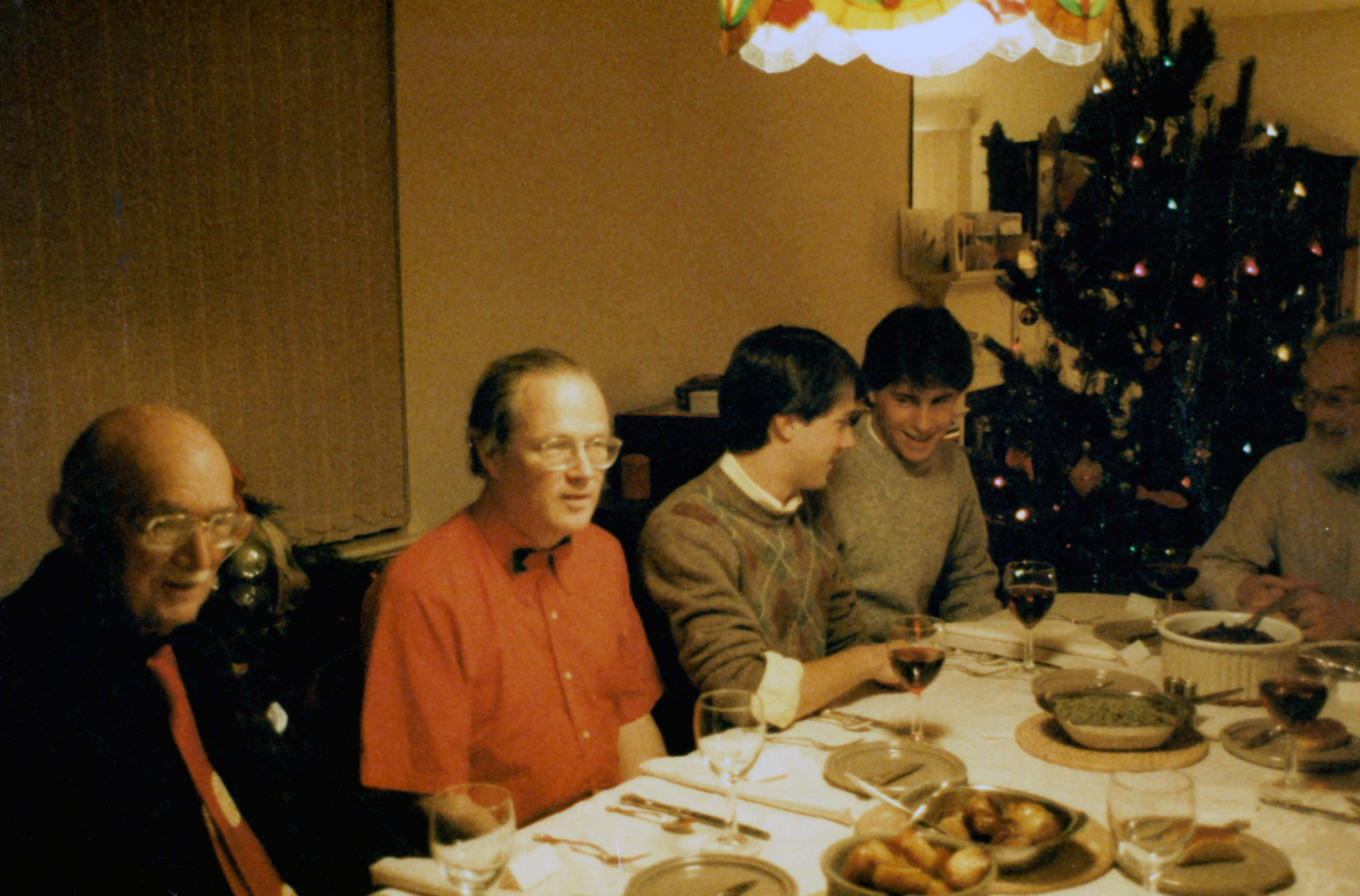
Strange, you might think, but it works and we have a wonderful celebration. We also mirror the way American families are changing.
Indeed, the more or less isolated nuclear family – mother, father, a couple of kids – is a 20th-century phenomenon. In earlier times, our own agrarian past, for example, large extended families lived near one another and often functioned as an economic unit. Industrialization and rapid transportation gradually changed all that.
More recently, safe contraception and the high cost of raising children have limited family size in the U.S. – children became more of an economic liability than a valued extra pair of hands on the farm.
Too, the easing of divorce laws in state after state has meant increasing numbers of divided families. As you can see from our example, however, a divided family is not an indicator that no family exists.
It’s just that families are changing, as the following statistics tend to show.
At a time when U.S. population is growing at about one percent per year, the number of divorces per one thousand population is going down from 5.3 in 1981 to 4.9 in 1984, the most recent year for which statistics are available.
Another encouraging statistic: in 1982, according to the 1986 Statistical Abstract of the United States, 48.5 percent of all divorced women remarried.
Further redefining the new family, in 1984 nearly two million couples – not including gay and lesbian couples – lived together without benefit of marriage. This is the famed POSSLQ crowd, Persons of the Opposite Sex Sharing Living Quarters, in the immortal prose of the Census Bureau.
Nearly half of these two million were in the prime child-rearing years of 25 to 44; about half (both men and women) have never married; and just under a third had children younger than 15 in the household.
What do these statistics mean? They mean that we are on our way to creating the new extended family. Or, if you prefer, “official” and “unofficial” families.
In her 1978 book “Families,” sociologist Jane Howard defines an “unofficial” family member as “anyone whose death or suffering would undo me as much as that of a relative.”
I, too, have an official and an unofficial family. While my official family (related by blood or law) gathers for Thanksgiving, my unofficial family comes together once a year for the Passover Seder.
It began about a decade ago, with a small office group, some of whom wished to participate in a Seder but lacked either time or money to go home for the holiday. Now, 10 years later, it is so important to us that we shape our lives around it.
Last spring, for example, my husband and I were to go to Australia (business for him, holiday for me). But, we agreed, we had to be back in time for the Seder – and not just back but enough recovered from jet lag to be able to enjoy the festival.
Our Seder family has a core of eight people who always attend; not all are Jewish. In addition, we include guests, who may come once or may repeat several years. We are never fewer than a dozen and have gone as high as 15.
I particularly enjoyed the year that our group included a young Vietnamese couple who had just become American citizens.
Like many official families, we have our in-jokes. We never, for example, warn guests that they are about to bite into a solid chunk of horse radish, a mind-clearing exercise if ever there was one.
My new extended (“unofficial”) family includes those people to whom people used to be related by marriage. I recall, for example, a Christmas dinner some years ago at Aunt Billie’s. She is not my aunt, but my friend Brenda’s ex-husband’s aunt.
Brenda, remarried and temporarily living in this area, had always been close to Aunt Billie, a widow in her 70s. Brenda’s ex-husband Bob lived on the West Coast, but was coming East with his new wife for the holidays. Brenda, a great organizer, invited us all to Christmas dinner at Aunt Billie’s.
The cast of characters that night looked like this: Brenda and her second husband Tracy; Bob and his new wife; Brenda and Bob’s son Brad; Brenda’s good friends Russell and Terry (who have since split and married others) and their son; myself, my ex-husband and our children (I had not yet remarried).
Presiding over it all was Aunt Billie, the matriarch. It was a memorable meal, not for any fireworks it might have produced, but for the sense of connection to friends, relatives and used-to-be relatives.
This brings me back to holiday time at my house, where three generations from at least five former and present nuclear families gather in harmony as one family.
Jeff, my husband’s middle son from his first marriage, and my ex-husband Peter – who is a permanent fixture at our holiday celebrations – have become good friends.
And when Amy and Bruce (my children from my marriage to Peter) are in town, Jeff is included when they go out to dinner or to the movies with their dad. These young people – all in their 20s – seem quite content with their multi-parent extended family.
Each year, as we sit down to break bread, we raise our glasses to give thanks that we are all again gathered to celebrate the harvest. And each year we understand that we are celebrating something else: family, regardless of how it is defined.
 Thought Snax