New rule: when we arrive at a hotel at 2:00 in the morning — a hotel that has confirmed by phone and fax that it has reserved for us a room with a roll-in shower — to find, after unloading our voluminous luggage (shower chair; giant duffel; garment bag; suitcase; suitcase; computer wheelie; backpack), checking in, and tipping the helpful bellman who has transported this unGodly collection of luggage to the room, that the room has only a tub and that, in fact, no room with a roll-in shower is available that night (“night”), there will be a member of the ADA defense bar available on-call to secure alternative accommodations and to provide a nightcap of very very expensive Scotch.
These are the facts:
1. The hotel had at least one room with a roll-in shower.
2. The hotel confirmed — several times* — that it had reserved a room with a roll-in shower for us.
3. This was incorrect. When we arrived, there were no roll-in-shower rooms available.
4. The hotel had at least one non-roll-in-shower room available — the one with the tub that they sent us to with our mule-train of luggage in tow.
5. At least one of the rooms with a roll-in shower was occupied by someone who did not need it (this fact related to us by the night manager).
This is the law:
1. Title III of the ADA prohibits discrimination on the basis of disability in places of public accommodation, including hotels. 42 U.S.C. § 12182(a).
2. Hotels are required to provide rooms with roll-in showers in proportion to the total number of rooms. DOJ 2010 Standards for Accessible Design, Table 224.2. I’m guessing that this hotel was required to provide at least nine such rooms; every hotel is required to provide at least one.
3. Hotels are required to
[e]nsure that accessible guest rooms are held for use by individuals with disabilities until all other guest rooms of that type have been rented and the accessible room requested is the only remaining room of that type;
and
[r]eserve, upon request, accessible guest rooms or specific types of guest rooms and ensure that the guest rooms requested are blocked and removed from all reservations systems.
28 C.F.R. § 36.302(e)(1)(iii) and (iv).
So there’s pretty much no question that the hotel violated the law. And there’s no question that the violation had consequences: after flying across the country and arriving at 2:00 in the morning, Tim would not be able to shower when he woke up later that day.
The problem is, while there were consequences for Tim, there will be no consequences for the hotel. Title III of the ADA has no damages remedy. Truth is, we would be fairly unlikely to bring a lawsuit for damages. We didn’t want damages; we wanted a useable hotel room. We wanted to be able to do what every weary traveler wants at 2:00 a.m. — to check in and go to sleep; NOT to travel up and down the elevator with our piles of luggage, have a long — pleasant but unfruitful — conversation with the night manager, wait through long sessions between the night manager and his computer terminal, finally settle for the (inaccessible) room at 3:00, and (Tim) be unable to shower the next morning.
In other words, we just wanted the system to work.
But wait!, you say, Title III has an injunctive remedy! The court can order the system to work, right?
Well first of all, of course, only after a lawsuit, which can take anywhere from two to 12 years. By then, we’d be home and Tim would have showered, repeatedly, in our very own roll-in shower.
But more importantly, the hotel, in a case like this, would almost certainly argue** that Tim has no standing to sue unless he can specify the date on which he will return to this precise hotel. And while many people travel repeatedly to the same hotel, many don’t. That’s the point, right? When you’re planning travel to a new city, you want to be able to pick up the phone or go online, make a reservation, show up, and have a room you can use. The problem is, under the current system, there is very little incentive for this system to work for people with disabilities: no damages remedy; and no injunction unless you plan to come back to the very same hotel AND have the time and energy for a lawsuit. Given this, the hotel knows that it doesn’t really need to comply.
So — new rule: every ADA defense lawyer who makes these bone-headed standing arguments must register on an ADA Compliance Resolution List and provide a number where they can be reached 24 hours a day. When one of these damagesless, standingless events occurs, they must be ready to solve the problem, provide the room, and send a nightcap of very very expensive Scotch.
Anyone want to help me draft the bill?
[Cross-posted at CREECblog.]
************
* When we make hotel reservations, we can’t just go online and request the room we want. We call, we have a long conversation about roll-in showers (“Are you sure? You’ve seen the bathroom in that room? Can you ask housekeeping to check? I heard you roll your eyes — just go check please.”), we often call back at least once, and we send a confirming fax, which we then have on hand when we arrive at the hotel. None of that matters if it’s 2:00 a.m. and there simply isn’t an accessible room available.
** Indeed, this hotel has made this precise argument with respect to violations known to exist in many of its hotels. The court held that the plaintiff “must assert an intent to return to the particular place (or places) where the violations are alleged to be occurring.” Scherr v. Marriott Int’l, Inc., 703 F.3d 1069, 1075 (7th Cir. 2013). So there is no standing to make them fix the problem in other hotels unless this plaintiff is planning to go to each of them? Which means, of course, that none of the other hotels in the chain will be fixed until other wheelchair-using hotel guests — in this case, 56 other guests at 56 different hotels — encounter the barriers and sue. Or unless one guest has the foresight to bring a class action, adding to the length and complexity of the suit and the elapsed time until a discrimination-free stay can be ensured.
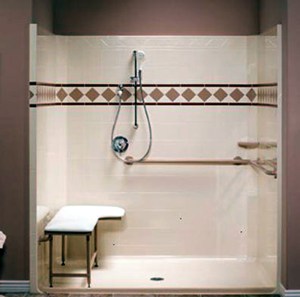
Image from the webpage of Fine Design Contractors of Somewhere, MN.
Like it? Hate it? Let me know!


 Thought Snax