
[For Ken Shiotani, so some of the photos will be illustrative of text and some will be random trains. Ken generously helped with the alt text for many of the train photos.]
During the summer of 1985, my mother, Ruth Blau, and I took the Trans-Siberian Railway from Beijing to Moscow. Here we are getting ready to board in Beijing. (I’m adding alt text to the photos. So I don’t have to repeat: Mom and I are both white women with short brown hair. In July, 1985, Mom is 48 and I’m 24.)
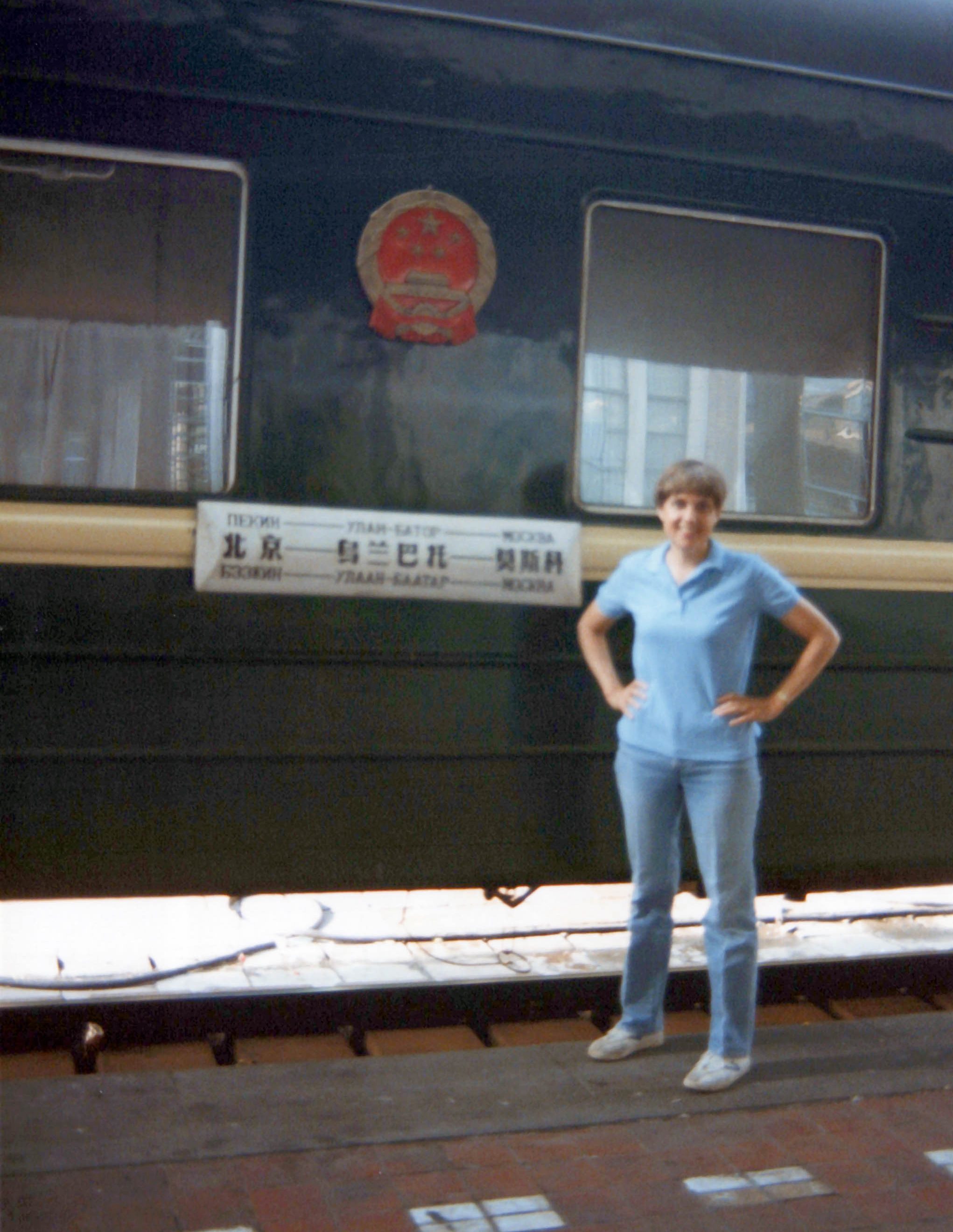

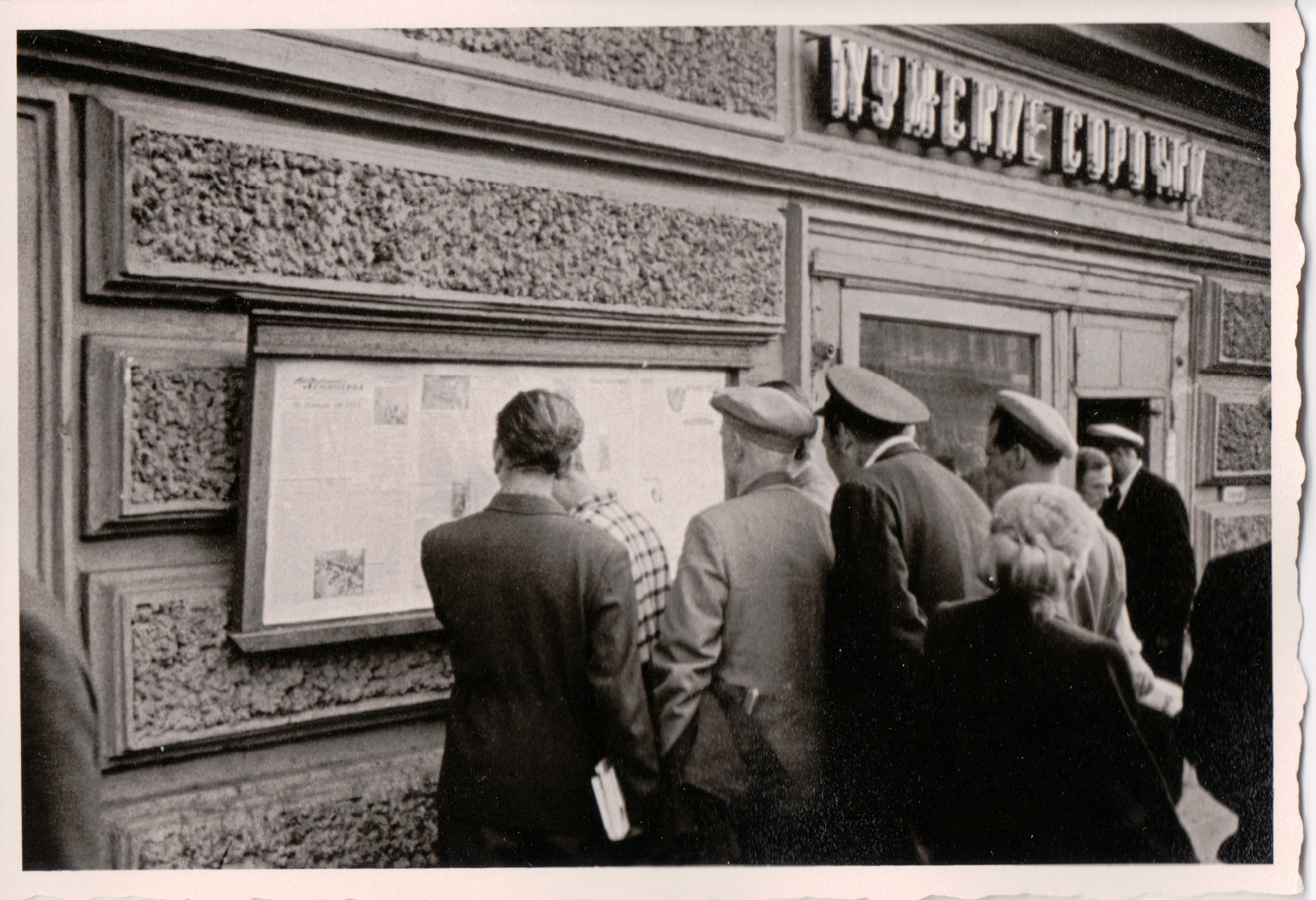
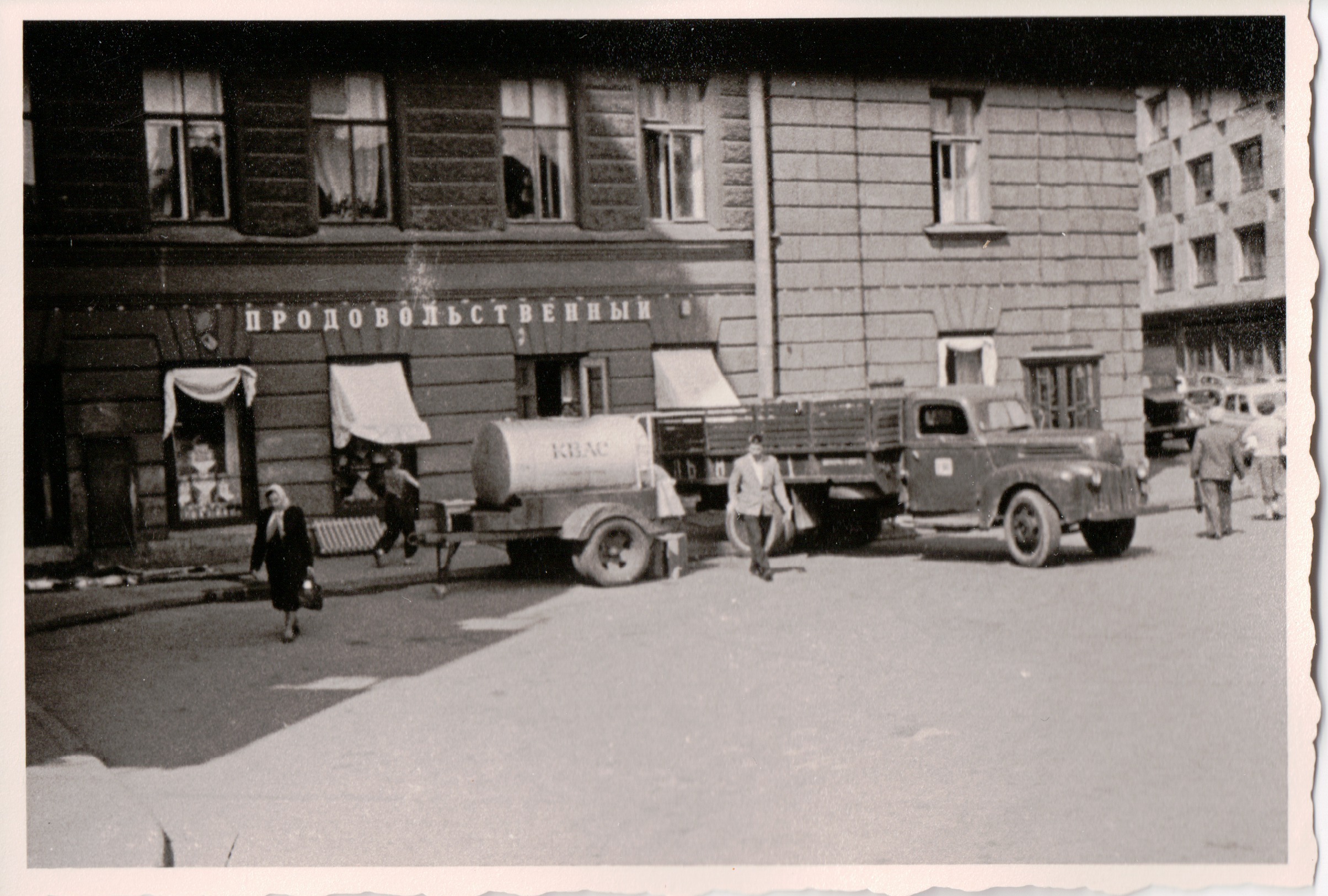
I had just spent two years (and three out of the last four) in Taipei, Taiwan, first as a gap year (which we called “taking a year off” or “not being ready to face your senior year”) in 1981-82, during which I took odd jobs teaching English, getting my head around the idea of my future, and eating extraordinary things from food carts, night markets, and the occasional restaurant. I came back to Taiwan after graduating in 1983, first on a one-year fellowship to study legal history at National Taiwan University, and then stayed on for another year of teaching, translating, saving for law school, and eating. In 1985, I was heading back to start law school at Yale, but took the long way from Taipei to New Haven through Hong Kong, Nanjing, Beijing, Ulan Batur, Irkutsk, Moscow (for about 2 hours, but that’s another story), Kyiv (which we called Kiev), St. Petersburg (which we called Leningrad), Helsinki, London, Edinburgh (for a friend’s wedding), and Arlington.
I met my mother in Hong Kong, traveled to Nanjing, somewhere along the way climbed Tai Shan at four in the morning (yet another story), and ended up in Beijing where we boarded the Trans-Siberian Railway for the trip to Moscow. I was at that point fluent in conversational Mandarin, and my mother had brushed up on her master’s-degree-level Russian from 1960.
These are mostly my mother’s photos, as I was still in the phase of my photography habit known as “I don’t have the money to develop a ton of 36-frame rolls” so I took photos pretty sparingly. Luckily my mother had a bit more money to devote to the photo counter at Drug Fair (the CVS of early 1980s suburban DC). In addition, both my mother’s and my photos sat in boxes in our respective attics/basements for the past 35 years, so the organization is not great. That is, I may call something “heading out of the station in Beijing” that is really “pulling through some other random station.” But you’ll get the gist.
First, the route, from the modern-day TransSiberian website (haha as opposed to what? the 1985 TransSiberian website?).
 Couple of photos in the station in Beijing and heading out.


 The dining car. We were, if I recall correctly, told that we were lucky to be riding from Beijing to Moscow rather than the reverse direction, as we had Chinese chefs most of the way and therefore far better fare than was offered by the Soviet chefs. After spending a week in the USSR – where the five year plan appeared to have focused on cucumbers – I’m guessing that was accurate.
 Also note that while my hair is grayer, my fashion choices and coffee addiction have not changed in almost 40 years.
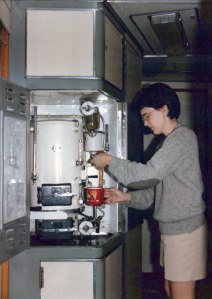 Although both of us are introverts, my mother and I somehow managed to occupy this space together for five days.


 Not far outside Beijing we crossed a portion of the Great Wall — not the well maintained, touristy part, but a part that gives a sense of what the builders were trying to do (and how silly, for example, a modern-day wall might be).


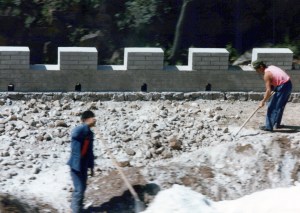 Also during the first day out of Beijing.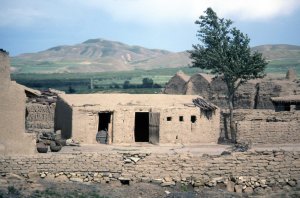
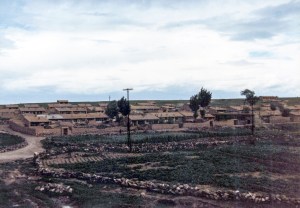 Somewhere between Beijing and Mongolia.


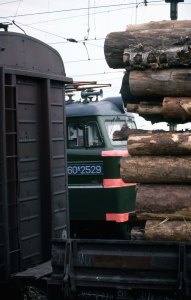
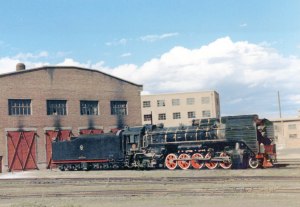 Mongolia:


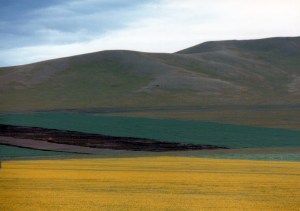 Yurts! For real!
 Though both Mongolia and the USSR were still communist in 1985, small-scale, babushka-based capitalism thrived along the railway.


 We would be allowed off the train very briefly at stops, though the stations were tightly patrolled.
 Although this was taken in the Beijing station, it is relevant to the end of our journey.
 As we got closer to Moscow, we were told to close the window in our compartment as the train had switched to a diesel engine. I managed to convince my mother that this was no big deal and that we should keep the windows open — it was, after all, July. The result – of which I don’t appear to have a photo – was that we arrived in Moscow covered in diesel soot.
Our arrival in Moscow marked the end of the Trans-Siberian part of the trip, but not the adventure. We were met by our Intourist guide who told us that “Moscow is closed,” and that she’d be transporting us to the airport for an immediate flight to Kyiv, the next stop on the trip, but one that was supposed to come after a couple of days touring Moscow. Turned out there was some sort of Communist youth festival in Moscow — the 12th World Festival of Youth and Students to be precise — and Intourist did not want rando Americans wandering around interacting with Youth and Students. So after all that, the entirety of my experience of Moscow is a cab ride from the train station to the airport. We continued our trip with an extended stay in Kyiv — which was cool, as my grandmother was born there — and then Leningrad. We took another train from Leningrad to Helsinki, but sadly I don’t seem to have photos. My memory is that that train ride was VERY tightly controlled, so it’s possible photography was not permitted?
It was truly the trip of a lifetime, and I’ll be forever grateful to my mom for making it happen and putting up with me in a small compartment for five days!
Extra bonus train photos for Ken – from the Beijing to Nanjing trip:


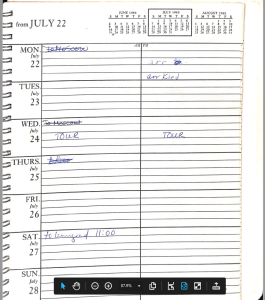
Update: In the process of scanning & tossing old documents, I came across my calendar for 1985, Here is the page for the week of July 22-28, 1985, reflecting the quick change in our itinerary.




 Thought Snax