Category Archives: Adventures

Travelogue 1984: Taiwan and China

My father was a prolific letter-writer. What follows is an excerpt from his letter to – of all people – my mother’s aunt and uncle in March 1984, describing his travel to visit me in Taiwan and then our travel together to Mainland China. The letter concludes with my brother’s news, which I leave to him to share verbatim but which details his upcoming college graduation, potential graduate program with showers of fellowship money, and his choice between that and a job offer “at an outrageous rate of pay.”


March 22, 1984

Dear Ben and Brenda:

It has been so long since I have had a chance to either visit with you or write but I thought it was about time to bring you up-to-date on our news. As you know, Amy is spending the year in Taiwan on her Fulbright/ITT scholarship studying Chinese law. I had a chance to visit her over Christmas for an excursion that took us to Hong Kong and the Mainland; and Ruth went for a somewhat longer visit at the end of January and they had an opportunity to go to half a dozen Asian countries.

I delivered a lecture at one of the law schools in Taiwan which Amy arranged. She and I had a great deal of fun working out the potential translation with the law professor who was both our host and our translator.

We decided to experiment to determine whether it is possible to visit Mainland China without either advance preparations or a formal tour; I am pleased to report that it is possible. A travel agent in Hong Kong (a friend of a friend of a friend of Amy’s in Taiwan) got us a visa in only 24 hours. We then went to the Hong Kong railroad station, and took a train to Canton.

In Canton we went to the airport and purchased an airplane ticket to Guilin. Actually this stage wasn’t quite that simple. We first went to the downtown ticket office which told us nothing was available. It was the cab driver who said that we should ignore those bureaucrats and go to the airport because “something is always available.” He was right, at the airport Amy walked right up to the counter, purchased two tickets, and we got on our Boeing 737 and were on the way to Guilin and some of the most picturesque scenery in all of China. (I have since learned that they hold half the seats for government officials and release them at the last minute if nobody shows.)

We arrived in Guilin at about 8 in the evening, took the local bus into town, got off the bus, and walked six or eight blocks in the darkness to a hotel which had been recommended to us; and walked in and rented a room.

We were only there three days but, frankly, it was one of the most fun adventures I have ever had on a foreign trip. We rented bicycles and spent two full days touring around the countryside. On the first day we stumbled into a small village which was actually a teachers training college for students who would teach English. We spent three delightful hours with several students eating rice and stew warmed over a small charcoal grill in the middle of their dorm room — 55 unheated degrees. They had seen us bicycling through the village and had stopped us in order to practice their English. One of the most moving moments was when one the students, after having shown us his standard text with its typical English language sentences such as “the neighborhood committee assures that all the peasants carry out the teachings of the party leaders” (why, I use that vocabulary at least twice a day), proudly took a paperback biography of George Washington out of the back of his desk. It was dog-eared and obviously heavily read.

The next day we bicycled in a different direction and ended up following a road that turned into a smaller road that turned into a smaller unpaved road that turned into an even smaller, smaller dirt road that turned into a path that turned into a narrower path that ended up winding us for three or four miles literally down a two foot wide path among the farmers’ fields and provided us with an excellent opportunity to observe the agricultural process at very close range.

I sometimes wonder what Chinese peasants must have thought when they looked up and saw this American on a bicycle with a three piece pin striped suit, white shirt and tie, riding down a path through their fields. Actually, my fantasies were even greater when we passed a railroad crossing. I thought of some American tourist on a packaged tour traveling first class through China babbling on to his/her spouse about the “picturesque little peasants” when suddenly he flashed by this grade crossing on one of these country lanes and saw this American male in a three-piece pin striped suit on a bicycle and turned to his wife (whose attention meanwhile has wandered) to describe what he had seen; and received a “that’s right, dear” in a Thurberesquet so-you-heard-a-seal-bark tone of voice.

I thought you might enjoy a miscellaneous collection of some of our more interesting photographs and I am enclosing several:

[Amy’s note – my copy of the letter did not include the photos, but I think I’ve identified them and include them here. I have not included alt text as my father describes them below. In each, I am a mid-20s white woman with a really bad perm; my father is a late-40s white man in, yes, a pin striped suit.]

1. Amy cooking New Years dinner in Taiwan.

Amy in gray sweater stirring something in a kitchen .

2. Amy buying plane ticket in Canton as we leave for Guilin.

3. Amy arriving Guilin — note the characteristic mountains in the background. They really do have mountains like we see in the paintings. But then New England Lobster Villages really do look like the paintings — I don’t know what I expected.

4. Biking in Guilin.

5. Street side library in Guilin. Brenda, as a librarian, I thought you would find this of particular interest. Note the books hanging on a clothesline, the rack of books in the back left-hand corner as you face it, and another rack of books up front. As near as we could figure out they actually pay a small fee for the privilege of sitting and reading these books.

6. Amy looking at typical Guilin scene. [Couldn’t find this one.]

7. Amy and friend Ben from Taiwan. [Editorial privilege not to include photo of long-ago ex-boyfriend.]

8. Amy and the students we met in Mainland.

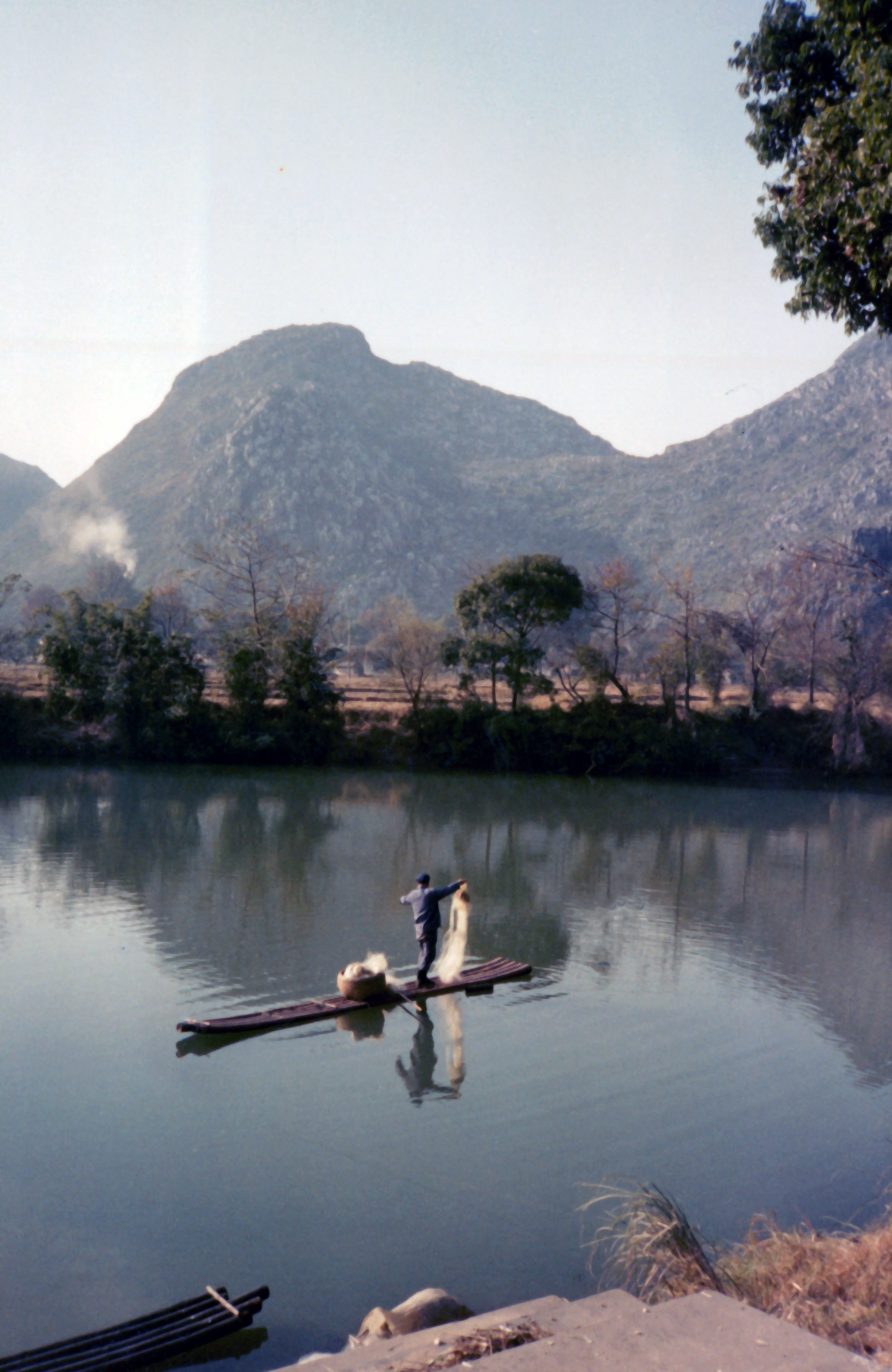
9. A local fisherman near Guilin balancing on his boat (which consisted of four long bamboo logs tied together and was not much different than balancing on a floating large sized diving board) as he strung out his nets. He sculled backwards with an oar in his right hand while feeding out some 200 yards of net from his left hand in a pattern that went back and forth across the river about eight times. Why, you might ask would one need eight separate layers of net. to catch fish coming down the river? Answer, the fish aren’t coming down the river.  The fish live in a cave on the bottom of the river and after the nets are strung out the fisherman makes noise and scares the fish out of the cave and they come up in between the various webs of the net rather than being trapped by swimming into the net end wise. I wished I could have taken a movie of this operation because the grace with which he sculled backward with his right arm, fed the mass of net out neatly with his left hand, while balancing on his diving board all the while was astounding.
Soon after I got back from China, Ruth went over and spent several days with Amy in Taiwan and they then spent close to two weeks traveling to a number of countries and ending up in Singapore on the Washington birthday weekend. Just as they were about to leave their hotel for the airport Amy’s pocketbook with tickets, money, passport, credit cards and camera was stolen and she had to remain behind to obtain replacements when Ruth headed out. Amy is apparently a miracle worker or, at least, has figured out how to function in the Asian culture. She was able to get replacement tickets without paying for them, (it usually takes four months); get the American Embassy to open up on Washington’s birthday and replace her passport (it usually takes three days and cannot start until after the holiday); and she made arrangements through the law firm where she works in Taiwan to get somebody who lives in Singapore to lend her $1000 cash American money. She spent three days dealing with these loose ends and then headed back to Taiwan — her adventure over. I think poor Ruth suffered worse — what with the imperative of her own plane schedule meaning that she had to go to the airport and leave Amy behind within an hour after the theft. Even though Amy was doing very well, Ruth was isolated on a plane for eight hours and she had no way to know that things were working out ok.


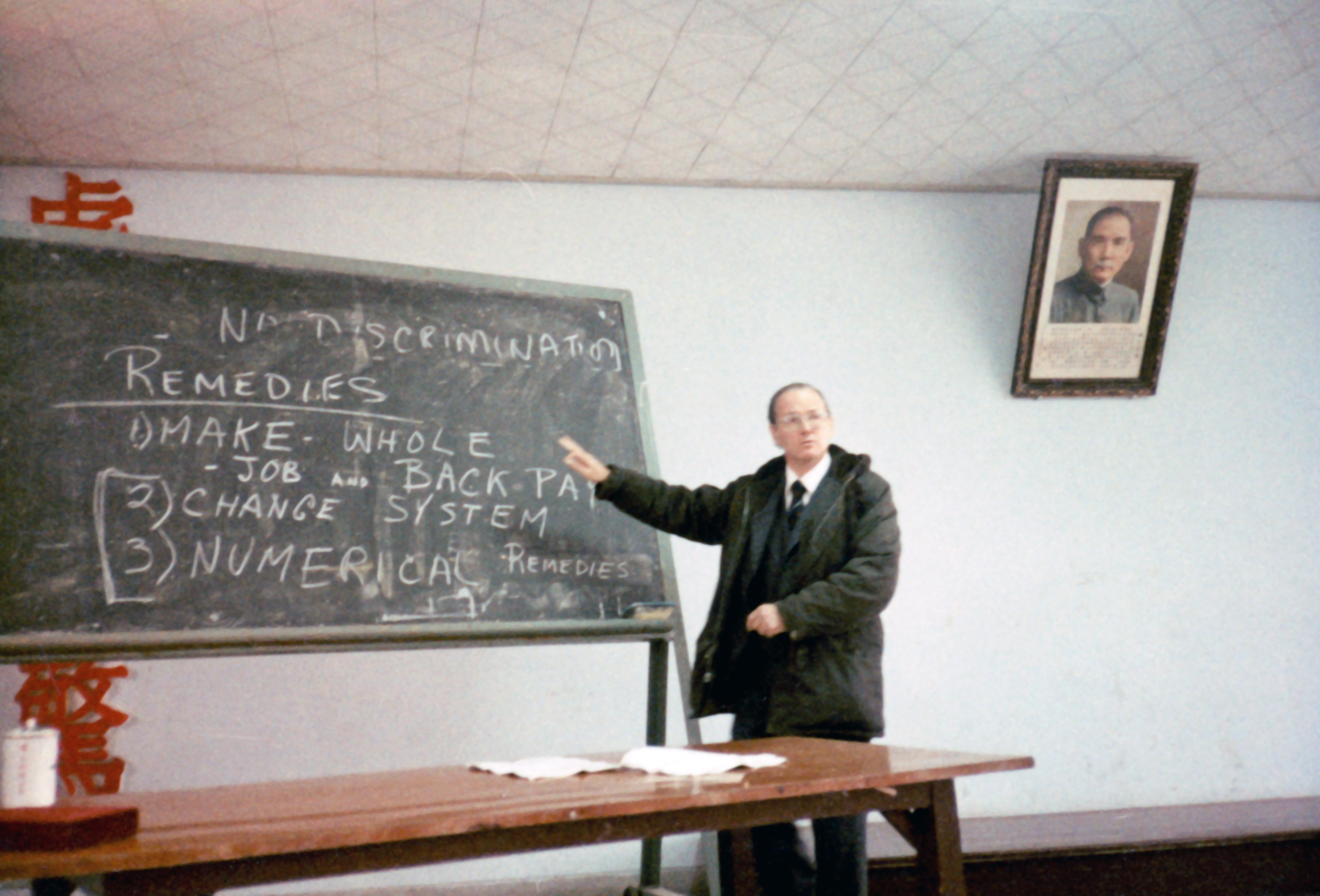
Amy here, adding two more photos. First, my father teaching the law school class he discussed in the letter. He is bundled in a winter coat, as Taiwanese classrooms were not generally heated, and is pointing to a blackboard with notes of anti-discrimination remedies. A photo of Sun Yat-sen is hanging high on the wall on the right. The second photo is of my father and me in Guilin, possibly the two dorkiest American tourists ever to visit China.
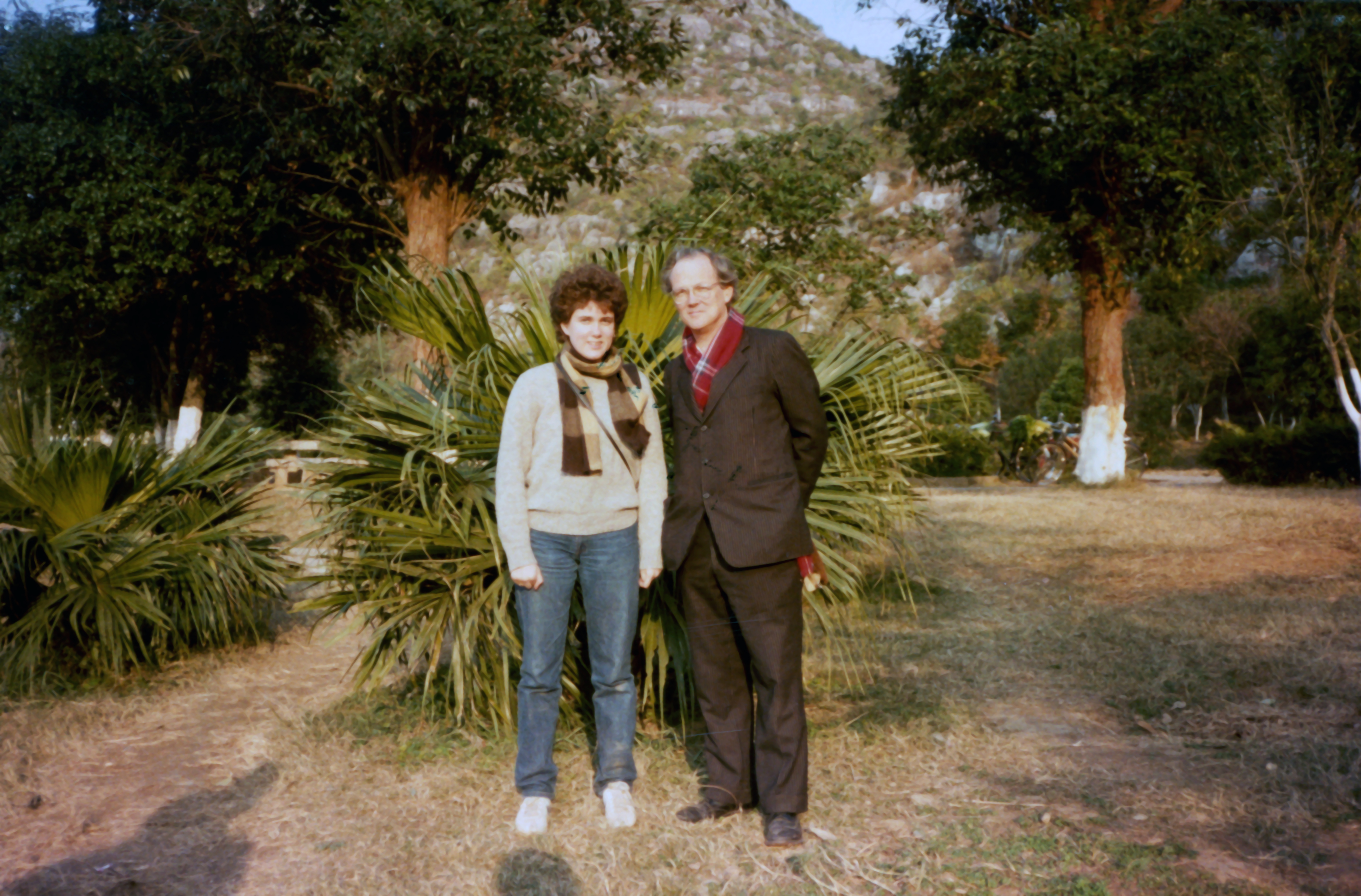
Amy and Peter posing in front of a tree.

A Brush With History or Driving Sen. Aquino

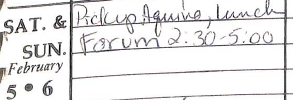
In my ongoing family scanning project, I came across my date books from 1978 to 1996. They’re a weird sort of bullet-point version of my life from college through the first few years of my legal career. Here’s one entry reflecting a day that has stuck with me ever since.

In February, 1983, during my senior year at Swarthmore, I worked with a bunch of other students to put on a forum on human rights in Asia with speeches by dissidents from Korea, Taiwan, and the Philippines.* One of the speakers was Benigno Aquino, a former senator and dissident from the Philippines.

Handwritten calendar entry for "Sat & Sun February 5-6" that reads "Pick up Aquino, lunch, Forum 2:30-5:00."

As it turned out, a student was needed to drive Sen. Aquino to and from the Philadelphia airport. I volunteered, borrowed a car**, and got to spend several hours with this brilliant and engaging man. Forty years later, I don’t recall what we talked about, but I recall his charisma and his determination to do right by his country.

Six months later, he would be dead, shot on the tarmac when he arrived back in his beloved country.

I’m so very grateful for the privilege of those couple of hours of conversation.


*H/t Matt Sommer for remembering details I had forgotten.

** I borrowed Adam Greene’s car and somehow managed to break an entire bottle of red wine in the backseat footwell. I can’t believe they would have given the extra wine to a student, but somehow I ended up transporting it, took a sharp turn and created a huge mess. I’m confident Adam is not among my single-digit readership, but 40 years later, I’m still very very sorry, Adam!

Adventures in Discrimination and Intimidation at the Marriott Courtyard Santa Fe

Below is the guts of the letter we sent to Marriott and Fine Hospitality Group, the management company at the Marriott Courtyard Santa Fe. We had reserved a room at the Santa Fe Courtyard Marriott for March 15 and 22, on our way to and from a vacation in Phoenix.  On the 15th, our request for an accommodation under the Americans with Disabilities Act resulted in a police response.

I want to preface this by recognizing that we have a weird sort of privilege — the “sitting in a hotel room waiting for the police to arrive without fearing for your life” privilege — that made this incident stressful and illegal but not, ultimately, fatal. This does not reduce the extreme danger hotel personnel were willing subject their guests to in pursuit of an ADA violation.

Update: The Fine Hospitality Group (not Marriott) reached out and the upshot was that they comped us that night and (in theory) a future night, and promised discipline for the manager and training for staff.

Here’s what happened:

After we checked in and got to the room, it became clear that the bed was too low for Tim to be able to easily transfer in or out from his wheelchair. This is a fairly common problem that can be solved by either putting blocks under the legs of the bed or adding a second mattress on top. We called the front desk, requested this modification and were told “no.” The staff member explained that the way the bed was set up did not permit adding anything to raise the legs of the bed. We suggested that a second mattress could be placed on top of the first; this suggestion was rejected out of hand (“no”). We asked if there were any extra mattresses in the hotel. “No.” (This seems unlikely but who knows.) We asked if there were any empty rooms from which a mattress could be moved. “No.” The staff person then asked if we wanted to talk with the General Manager. Yes, we said, we would.

The General Manager got on the phone and we went through a similar litany of requests and refusals, but the GM added that the room was set up precisely as required by the ADA and therefore could not be altered. As an initial matter, this is not true: ADA regulations and standards do not prescribe a minimum or maximum bed height. But it also doesn’t matter. In addition to requiring certain basic physical and architectural configurations, the ADA also requires that businesses provide reasonable modifications to policies, practices, and procedures. I explained this to the GM, who continued to insist that the room was as legally required and no changes could or would be made. We explained that we were lawyers who were familiar with applicable law, and that this simply was not true. He stood firm on his refusal to make the required modification. Sensing that this conversation would not result in the modification we needed, we said that we’d deal with the room as it was set up but would take up the matter with Marriott’s legal department. We all rang off.

The staff person, the GM, and both Tim and I were entirely calm throughout the call. We were all firm in our respective positions, but no voices were raised, no inappropriate language used, and no threats made.

Less than a minute after the call ended, the GM knocked at our door and told us we would have to leave the hotel. We said no, we did not intend to do that. He said he would call the police.

Approximately 20 minutes later, four fully-armed officers from the Santa Fe Police Department knocked at our door.  We invited them in and Tim explained the above interactions and expressed our desire – it was by that time around 9:10 p.m. – to stay in the hotel so we would not have to pack up and try to find an accessible hotel at that time of night. One of the officers asked what threats we had made. Tim explained that there had been no threats. The officer informed us that the GM had told the police that we had threatened to go door-to-door through the hotel, knocking on doors and harassing guests. There is no other way to characterize this than as a lie, and a dangerous one in that it was used to invoke police intervention in an otherwise calm albeit disappointing interaction. Tim explained to the police that we had not done this, and that it would make no sense for us to anger other hotel guests, who had nothing to do with the situation.

It was my impression that the police were somewhere between puzzled and bemused that they had been called out to discuss wheelchair accommodations. They were professional and friendly throughout.

After the officers had heard us out, one of the officers went to negotiate with the GM on our behalf. The officer returned to say that the GM would “allow” us to stay provided there were no further “issues or threats.” Although, given the exchanges that had brought us to this point, this was a pretty humiliating request, we agreed, the officers left, and we stayed the night.

This entire interaction violated both the requirement to make reasonable modifications to policies, practices, and procedures, 42 U.S.C. § 12182(b)(2)(A)(ii), and the prohibitions on retaliation for opposing discrimination and interference with and intimidation of people exercising or attempting to enjoy their rights under the statute, id. § 12203(a), (b). Indeed, calling the police is at the extreme end of interference and intimidation.

In our letter to Marriott and the management company, we proposed several measures to address this discrimination:

  1. Training for all staff of the Santa Fe Courtyard on the requirements of the ADA, and specifically the requirements for reasonable modifications;
  2. Communication to all U.S.-based Marriott and franchisee/licensee staff that, under no circumstances, are they to involve law enforcement in the discussion of the accommodations and modifications needed by guests with disabilities;
  3. Reprimand to go into the personnel file of the General Manager (whose name we never got); and
  4. Refund of our payment for the room on March 15 (we have, of course, cancelled our reservation for the return trip and will not be staying at that hotel in future trips to Santa Fe).

Stay tuned! I’ll update the post if we receive a substantive response from Marriott or Fine Hospitality Group.

Trans-Siberian Railway 1985: Ruth and Amy’s Big Adventure

[For Ken Shiotani, so some of the photos will be illustrative of text and some will be random trains. Ken generously helped with the alt text for many of the train photos.]

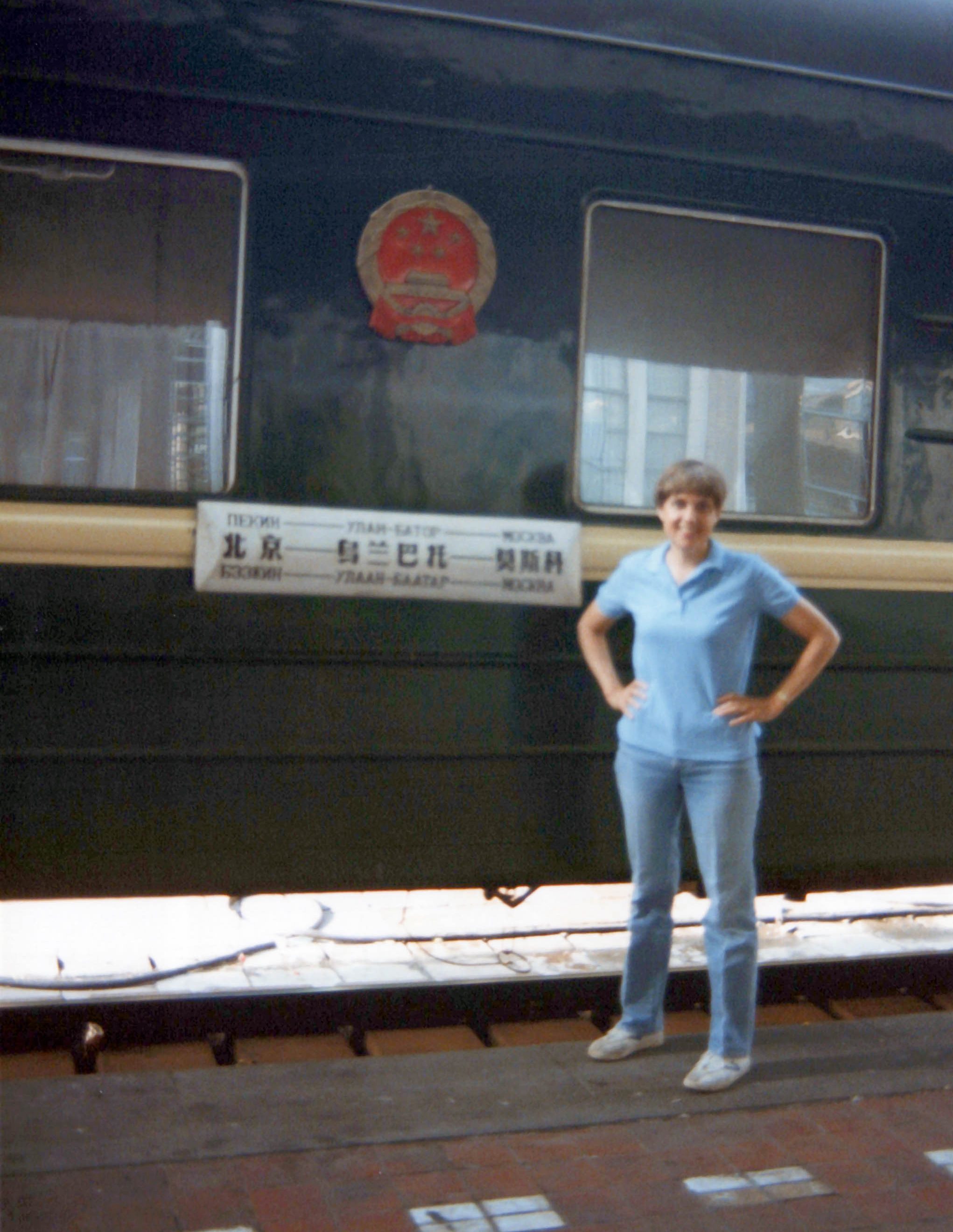
During the summer of 1985, my mother, Ruth Blau, and I took the Trans-Siberian Railway from Beijing to Moscow. Here we are getting ready to board in Beijing.  (I’m adding alt text to the photos. So I don’t have to repeat:  Mom and I are both white women with short brown hair. In July, 1985, Mom is 48 and I’m 24.) 

Ruth (white woman; blue t-shirt; jeans; short brown hair) standing in front of a train car with writing in Chinese, Russian and another language I don't know.
Amy (white woman; white short-sleeve shirt; jeans; short brown hair) standing in front of a train car with writing in Chinese, Russian and another language I don't know.

I had just spent two years (and three out of the last four) in Taipei, Taiwan, first as a gap year (which we called “taking a year off” or “not being ready to face your senior year”) in 1981-82, during which I took odd jobs teaching English, getting my head around the idea of my future, and eating extraordinary things from food carts, night markets, and the occasional restaurant. I came back to Taiwan after graduating in 1983, first on a one-year fellowship to study legal history at National Taiwan University, and then stayed on for another year of teaching, translating, saving for law school, and eating. In 1985, I was heading back to start law school at Yale, but took the long way from Taipei to New Haven through Hong Kong, Nanjing, Beijing, Ulan Batur, Irkutsk, Moscow (for about 2 hours, but that’s another story), Kyiv (which we called Kiev), St. Petersburg (which we called Leningrad), Helsinki, London, Edinburgh (for a friend’s wedding), and Arlington.

I met my mother in Hong Kong, traveled to Nanjing, somewhere along the way climbed Tai Shan at four in the morning (yet another story), and ended up in Beijing where we boarded the Trans-Siberian Railway for the trip to Moscow. I was at that point fluent in conversational Mandarin, and my mother had brushed up on her master’s-degree-level Russian from 1960.

These are mostly my mother’s photos, as I was still in the phase of my photography habit known as “I don’t have the money to develop a ton of 36-frame rolls” so I took photos pretty sparingly.  Luckily my mother had a bit more money to devote to the photo counter at Drug Fair (the CVS of early 1980s suburban DC).  In addition, both my mother’s and my photos sat in boxes in our respective attics/basements for the past 35 years, so the organization is not great.  That is, I may call something “heading out of the station in Beijing” that is really “pulling through some other random station.”  But you’ll get the gist. 

First, the route, from the modern-day TransSiberian website (haha as opposed to what? the 1985 TransSiberian website?).

Couple of photos in the station in Beijing and heading out.

Crowd of mostly Chinese people with luggage in front of an ornate train station.

Train cars seen from outside heading into a tunnel. Train cars rounding a bend photographed from the window of the fifth or sixth car back. Scenery is open green plains; no trees. The dining car. We were, if I recall correctly, told that we were lucky to be riding from Beijing to Moscow rather than the reverse direction, as we had Chinese chefs most of the way and therefore far better fare than was offered by the Soviet chefs.  After spending a week in the USSR – where the five year plan appeared to have focused on cucumbers – I’m guessing that was accurate.

Train dining car with two rows of tables: 4-tops on the left and 2-tops on the right. Occupied by diners of various genders and races. In the foreground, Amy sits considering the menu and looking to the right of the frame. Also note that while my hair is grayer, my fashion choices and coffee addiction have not changed in almost 40 years.

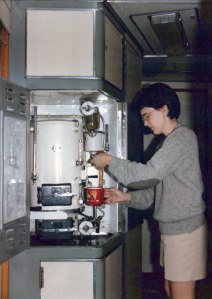
Amy in shorts and sweater getting coffee from the samovar.Although both of us are introverts, my mother and I somehow managed to occupy this space together for five days.

Train sleeping compartment with two cot-sized beds and about 3 feet between; at the end by the window a small table with two multi-colored metal mugs with lids.

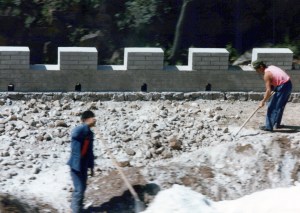
Amy sitting on one of the sleeping compartment beds reading a paperback book. Amy standing at the door of the sleeping compartment looking into the aisle. Another passenger (Asian man) stands at a window farther down looking out.  Not far outside Beijing we crossed a portion of the Great Wall — not the well maintained, touristy part, but a part that gives a sense of what the builders were trying to do (and how silly, for example, a modern-day wall might be).

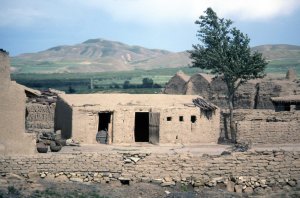
Portions of the Great Wall where it runs up and down steep hills. Portions of the Great Wall where it runs up and down even steeper hills. Two men in work clothes working on a portion of the top of the Great Wall that is entirely rubble.  The crenelated edge is visible in the background. Also during the first day out of Beijing.Adobe or mud houses with no windows or doors.  Unclear whether occupied.

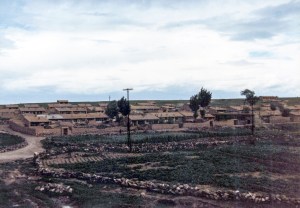
Village of low adobe-colored houses.  Somewhere between Beijing and Mongolia.

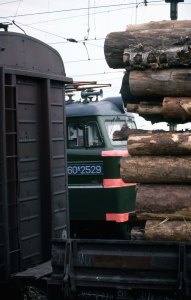
Electric locomotive powered by overhead wires; sitting in a station, photographed from just ahead of the engine.

Four open flatcars of logs.

Train engine viewed through a break in a closer train, the visible part of the closer train includes a closed freight car to the left and a bit of an open flatcar with logs on the right.

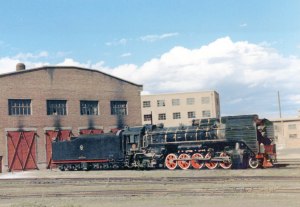
Steam freight locomotive (Chinese QJ class) with one car next to a train barn.  Mongolia:

Five camels photographed from the train running parallel to the train. Person on horseback photographed from the train  with a herd of horses.

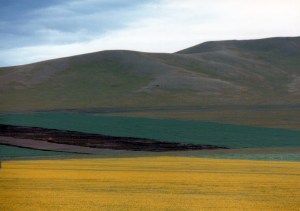
Scenery photographed from the train consisting of brown rolling hills and, in the foreground, a field of yellow flowers. Yurts! For real! 

Two white yurts with multi-colored doors photographed from the train; ordinary buildings in the background. Though both Mongolia and the USSR were still communist in 1985, small-scale, babushka-based capitalism thrived along the railway.

Older white woman in blue flowered shirt and white head scarf (babushka) sitting in front of baskets of strawberries she is selling.  Three older white women in head scarves (babushkas) and two older white men -- one in a flat cap, the other in a fedora -- sitting in front of baskets of strawberries and other produce they are selling.

Four older white women in head scarves (babushkas) sitting and standing in front of baskets of strawberries and other produce they are selling.

Three white women in head scarves near the tracks.  Two are between sets of tracks pushing baby carriages full of produce to sell; the other sits to the side of the further track. In the background, a young white girl in a red shirt and checked skirt.  In the background, a brick building with wooden doors and an old car. We would be allowed off the train very briefly at stops, though the stations were tightly patrolled. Two blue train cars in a station with a variety of people milling around near the doors. Ornate orange and white train station building viewed from our train with a variety of people sitting and standing on the platform. Although this was taken in the Beijing station, it is relevant to the end of our journey.Photo taken from outside our train car of Ruth leaning out the window of our compartment. As we got closer to Moscow, we were told to close the window in our compartment as the train had switched to a diesel engine.  I managed to convince my mother that this was no big deal and that we should keep the windows open — it was, after all, July.  The result – of which I don’t appear to have a photo – was that we arrived in Moscow covered in diesel soot. 

Our arrival in Moscow marked the end of the Trans-Siberian part of the trip, but not the adventure. We were met by our Intourist guide who told us that “Moscow is closed,” and that she’d be transporting us to the airport for an immediate flight to Kyiv, the next stop on the trip, but one that was supposed to come after a couple of days touring Moscow.  Turned out there was some sort of Communist youth festival in Moscow — the 12th World Festival of Youth and Students to be precise — and Intourist did not want rando Americans wandering around interacting with Youth and Students. So after all that, the entirety of my experience of Moscow is a cab ride from the train station to the airport. We continued our trip with an extended stay in Kyiv — which was cool, as my grandmother was born there — and then Leningrad. We took another train from Leningrad to Helsinki, but sadly I don’t seem to have photos.  My memory is that that train ride was VERY tightly controlled, so it’s possible photography was not permitted? 

It was truly the trip of a lifetime, and I’ll be forever grateful to my mom for making it happen and putting up with me in a small compartment for five days! 

Extra bonus train photos for Ken – from the Beijing to Nanjing trip:

Two Chinese women pushing a vegetable cart with two freight cars in the background.

Steam freight locomotive (Chinese QJ class) in a train yard.

Chinese men in white uniforms and hats (one white one blue) loading sacks onto a train.

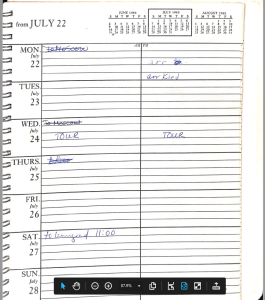
Update: In the process of scanning & tossing old documents, I came across my calendar for 1985,  Here is the page for the week of July 22-28, 1985, reflecting the quick change in our itinerary.

Page from a date book from July 22 to 28, 1985. July 22 has "to Moscow" crossed out, with "arr Kiev" written in later in the day. Wednesday July 24 also has "to Moscow" crossed out, and the word "tour" in the morning and evening. Saturday July 27 has "to Leningrad 11:00"

Remodel Timeline

Remodel timeline pt 1

Remodel timeline pt 2

{Image descriptions.  First is a simple vertical flow chart from “we sign a contract and pay a deposit” to “the contractor’s employees come to our house and remodel” to “we’re done.” Second is a scrambled and dysfunctional flow shart with aproximately 20 boxes connected with straight, overlapping, and squiggly lines. The contents of the boxes can be read (I hope) in this pdf.}

Freedom’s Engines

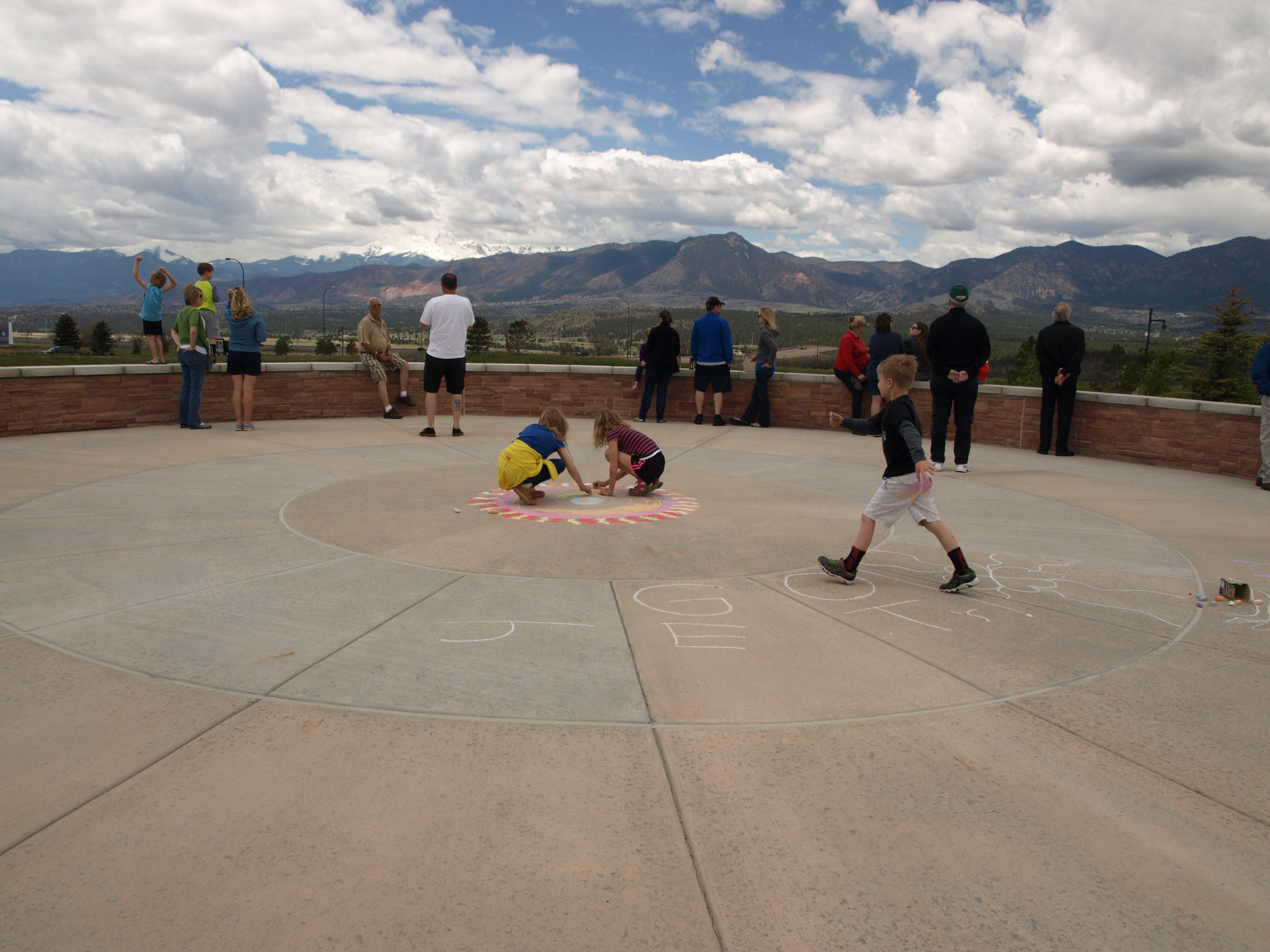
On May 26, I was driving from Colorado Springs back to Denver and noticed, as I neared the Air Force Academy, fighter jets flying in formation over my car.  After contemplating the pros and cons of trying to photograph them through the sunroof as I drove up I-25, I pulled into a restaurant parking lot to take photos and found that many other people had done the same.

Image: people congregate on a concrete patio area facing the mountains while two young girls draw in chalk on the concrete and a young boy strides toward them.

Turns out the Thunderbirds were practicing for an airshow. I had my camera and kit lens and managed to get a couple of OK shots. Memo to self:  if you’re going to drive around Colorado, bring the good lenses.

Image: six fighter jets flying in tight formation with contrails. Image: 6 fighter jets flying in close formation. Image: 4 fighter jets flying in formation seen from below with clouds as the background.

Image: zoomed in photo of underside of fighter jet.

It was breathtaking!  Back when I was a biglaw associate, our firm represented GE in some litigation or another, and a partner I worked with had a big poster of fighter jets on her wall, captioned “Freedom’s Engines.”  My first reaction was that that was sort of cloying — the aerospace engineering equivalent of a big-eye puppy photo — but when I thought more about it I thought, as I did last week watching these amazing pilots of these amazing machines do mind-blowing, stomach-churning maneuvers, I’m really glad these folks are on our side, protecting us.

ADA Defense Counsel Bingo

A hilarious Graduation Bingo card has been making the rounds of Facebook, with squares like “ethnic name is awkwardly pronounced” and “someone in your line of sight is wearing Canucks gear.”  Evidently, the graduation was in Vancouver.

This inspired me to compose ADA Defense Counsel Bingo.  (MS Word version here.)MS Word Version at https://thoughtsnax.com/wp-content/uploads/2015/06/opposing-counsel-bingo.docx  Some of these are more common than others; all of these are real.


A [completely fictional] fairy tale

Image: cartoon of Shrek (green ogre in leather vest) and donkey.Once upon a time, there was a young lawyer who was working with a slightly older and much cooler lawyer representing a plaintiff in a civil rights case. The young lawyer and the cool lawyer set out on a journey to a village to the south where the young lawyer and the cool lawyer defended the deposition of their client, taken by a man who was a Well Respected Member of the Bar. During the deposition, the Well Respected Member of the Bar threw a pencil at the cool lawyer.

Time passed and the young lawyer became an old lawyer. She still represented plaintiffs and even though she aged and acquired experience and gray hair, she remained a woman.

Recently, she came before an Elder of the village’s Judicial Tribunal. For the first time since she was a young lawyer, the other attorney was that same Well Respected Member of the Bar from the village to the south. He was older and grayer, and still a man. During the proceeding before the Judicial Tribunal, the Elder posed questions to the once-young-now-old lawyer about her case, using words that showed sympathy, ableism, sexism, and condescension.

After the preceding, the elder asked the Well Respected Member of the Bar about his golf game.

And the once-young-now-old lawyer thought to herself, “I wonder if the Elder of the Judicial Tribunal knows that Well Respected Member of the Bar once threw a pencil at my co-counsel during a deposition.”

The End.

The remodel begins (cue “Jaws” music).

Against all of the sage advice of my brother and sister-in-law, we are undertaking a remodel of our house.  We’ll get a new kitchen, I’ll get a new bathroom, the entire house will get new paint, and we may avoid dying a gory death at the hands of our basement.

We always knew that a previous owner had seriously overestimated his handyperson abilities, resulting in charming features like The Cardboard Wall and The Wood Paneling from Hell. These monstrosities lived in the basement, though, and since it’s inaccessible, we mainly interact with it when I do laundry or putter in the many boxes of documents I salvaged from my Dad’s house in 1997.  Very occasionally we have house guests who stay in the bedroom down there; understandably, not many have stayed twice.

Because we largely ignore our basement, it wasn’t until the remodel demo crew started taking apart the basement “walls” that we learned just how bad it was.

Instead of taking dramatic before

Image: cave entrance

and after

Image:  garish mansion

remodel photos, I thought I would take pictures of a couple of the more startling hacks.

Image:  close up of electrical casing attached by bent nails to hacked up 2x4

Image:  close up of several layers of pieces of wood nailed together - and splitting -- on the side of a wall.

Image:  several layers of pieces of wood nailed together - and splitting -- on the side of a wall.

The guy demo’ing the basement remarked, of one amateurishly framed wall, that we were lucky the ceiling had not fallen in.

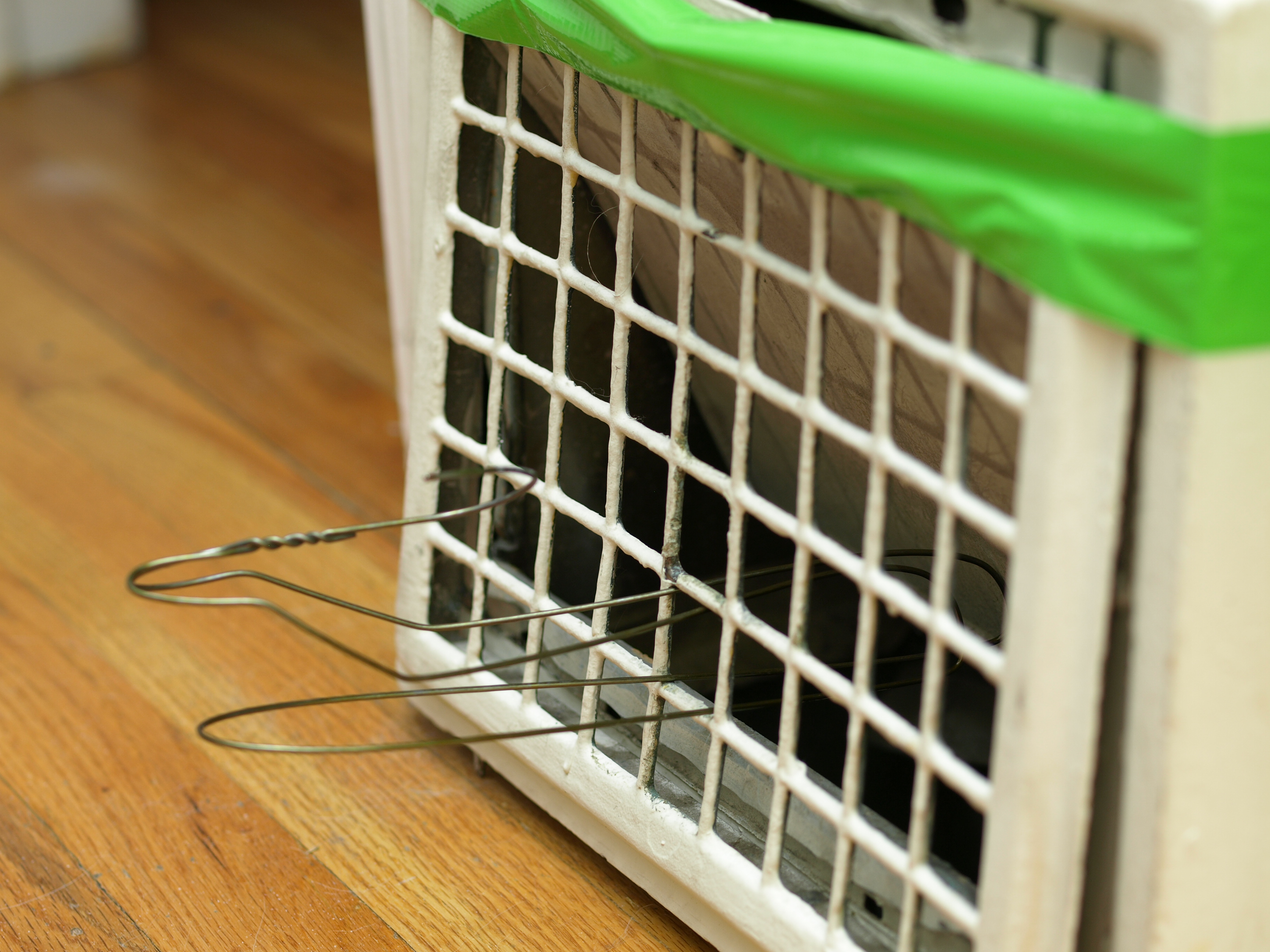
As if on cue, the level of entropy here generally is going through the roof.  It’s like the house knows help is on the way, and is shedding its old skin.  The vent in my office is coming apart.

Image:  an old metal heating grate, taped to the wall with green duct tape, held open with a wire coat hanger.

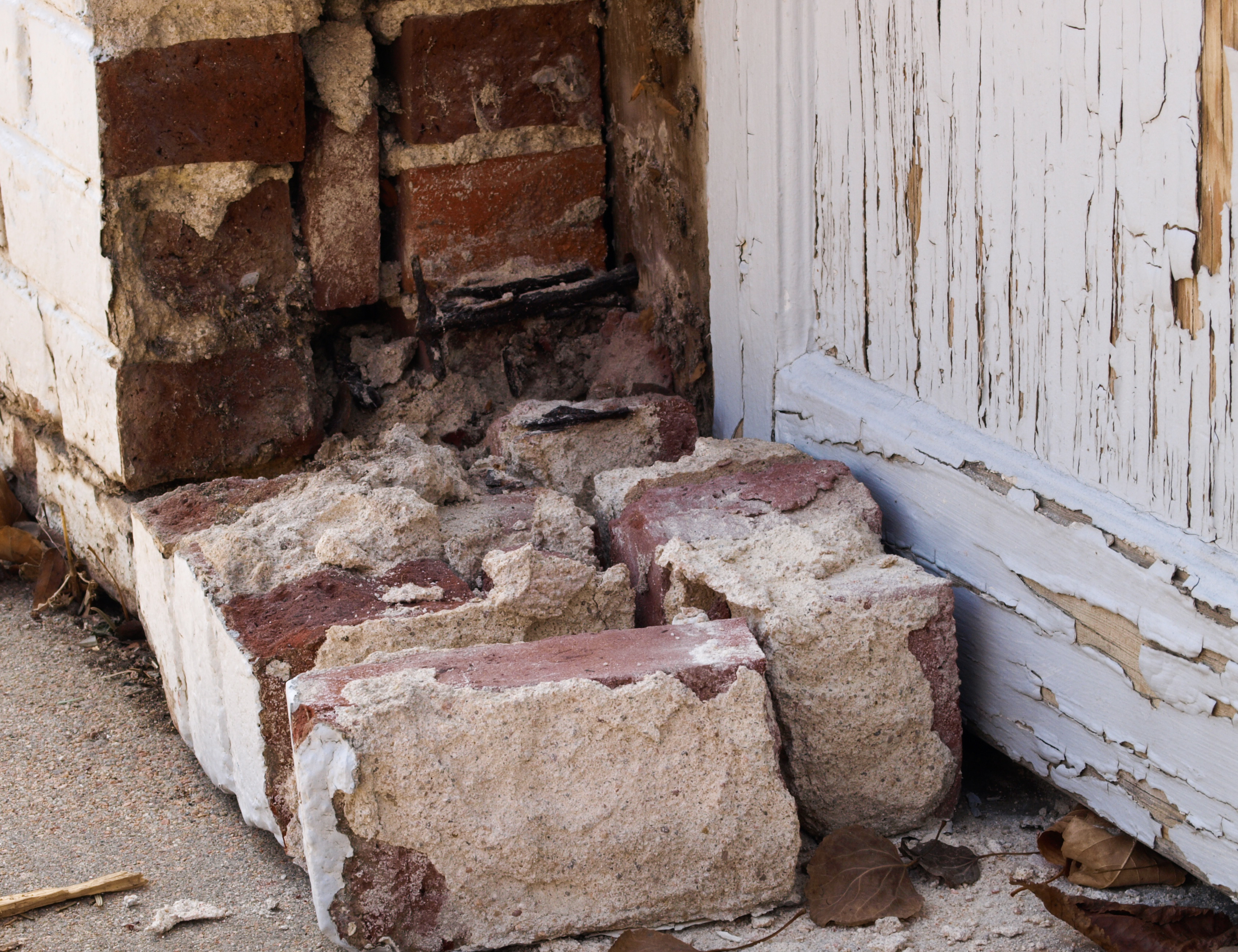
The bricks next to the garage, slated for repointing,* collapsed just a little yesterday.

Image:  Close up of 5 or 6 bricks with mortar attached, on the ground next to a brick wall.

And in a piece of sympathetic entropy, our toaster died today. I think we’ll soon be huddled in the middle of the living room, cooking over a fire made from burning our furniture.

*********

*Whatever that is.  Our contractor says it authoritatively when I ask for the bricks to look better, so I’m guessing it’s a procedure for making bricks look better.

Access success and fail in Helena, with random Helena photos

I spent part of last week in Helena, Montana on a new/old case in which CREEC is joining the ACLU National Prison Project and the ACLU of Montana as co-counsel on the case of Langford v. Bullock.  The Langford case was brought and settled in the early 1990s, but the implementation period is ongoing with respect to a claim under Title II of the ADA.  CREEC is lending its expertise in this area.

Image:  four people standing arm in arm.  From left:  a middle aged white man with red-blond hair and a gray goatee wearing a tan suit jacket and open collar shirt, an younger middle-eastern man with short hair wearing a button down shirt, a young white woman in a gray t-shirt and blue scarf, and a middle aged white woman in a yellow shirt and multi-colored scarf.

Jon Ellingson of the Montana ACLU, Ajmel Quereshi of the ACLU NPP, and CREECsters Sarah Morris and me.

Sarah and I flew into Missoula, met with Jon and Ajmel, and then all drove over to Helena.  The meeting went well, and left me a few hours of Wednesday afternoon for a leisurely stroll around Helena.  As I’ve mentioned — among other places, in my Ramps of Route 1 post — I love to observe the small ways that small town small businesses find to provide access.*
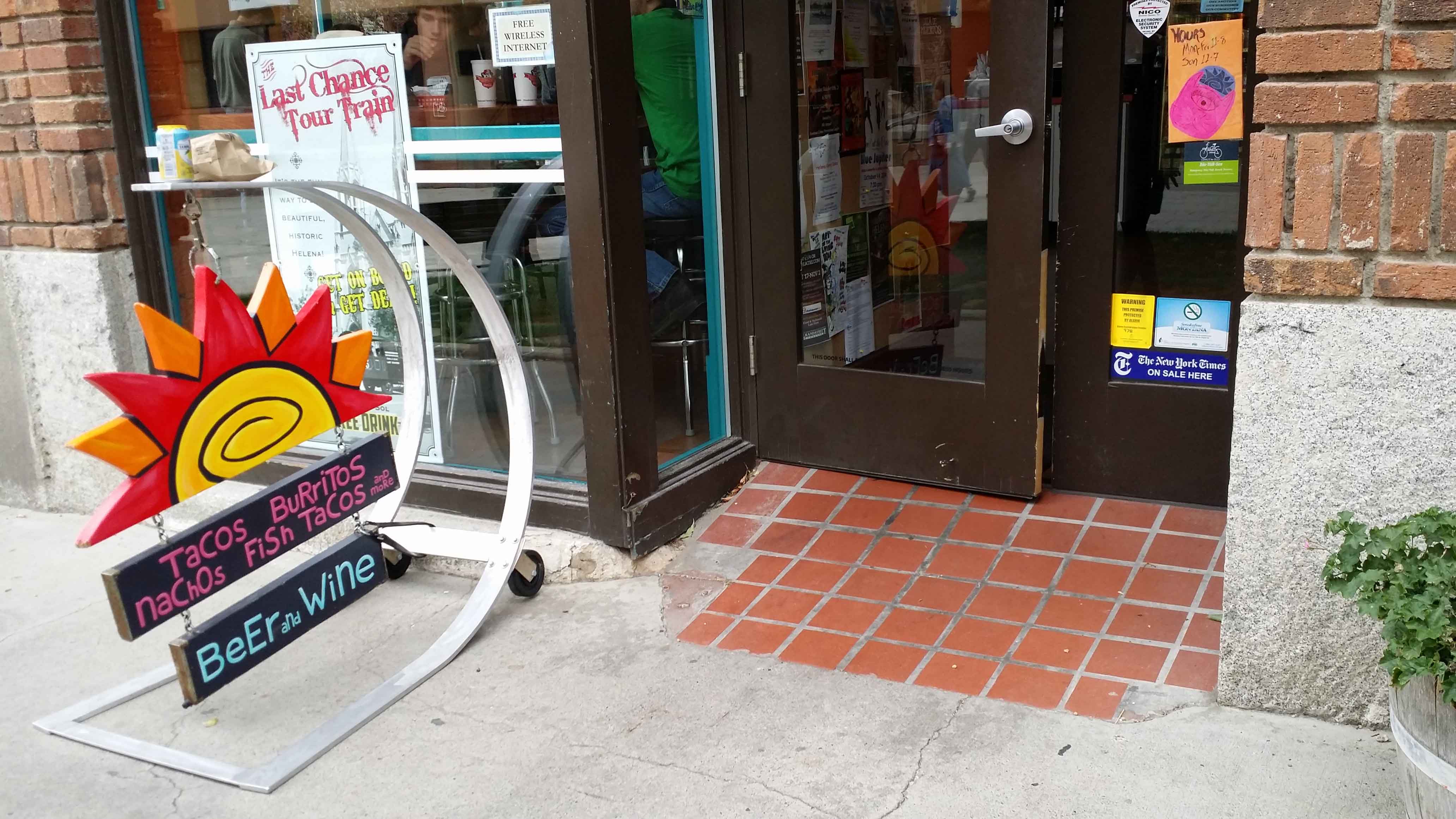
First up:  Taco del Sol on Last Chance Gulch Street.**  I love not only their tile ramp

Photo:  Sidewalk sign showing a big, wooden sun with attached smaller signs reading "Tacos Burritos Nachos Fish Tacos and more" and another reading "Beer and Wine."  Next to the sign, a door into a restaurant with a sloped tile ramp leading in.

but that, even as a small restaurant, they made Braille menus available.

Photo:  wooden box containing menus; a sign on the side reads "Braille menus are available for in-store use."

Also the carne asada burrito was fantastic!

Last Chance Gulch was a sort of pedestrian mall that did a great job ensuring the one or two steps of rise at most stores was ramped.  The giant plush bear added an extra touch at the Lasso the Moon toy store.

Photo:  front of a toy store with a large stuffed bear, accessible with a sloped entryway.

And accessible ice cream!

OLYMPUS DIGITAL CAMERA

Helena had a couple of hilarious access fails, as well.  Flower pot access fail:

Photo of two-way ramp in front of the door to an office building with a giant flower pot at the top of the ramp.

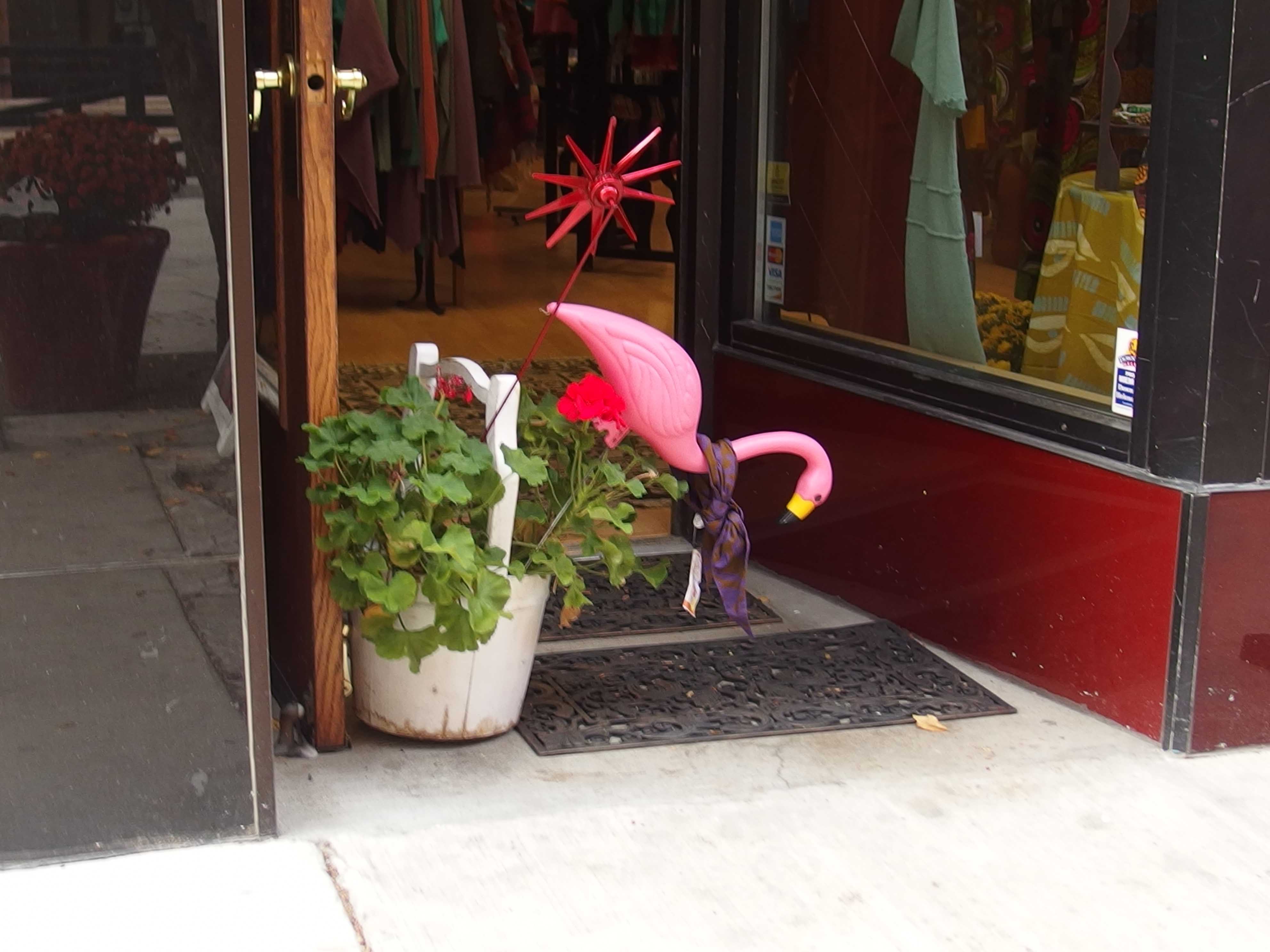
Pink flamingo access fail:

Photo of store with level entry, which put a flower pot in the door, and in the flower pot, a large plastic pink flamingo which is pitching face first into the door width.

And major design brain fart fail:

Photo showing ramp down to lowered area of pedestrian mall; there is a single step up to the ramp, however.

The photos below were just randomness from my walk:

Photo of moorish style design in an arch at the Civic Center. Photo of detail from a painted outdoor wall showing an ashtry with a half-smoked cigarette. Photo of a brick wall and text painted on the adjacent wall reading, "Memory Wall:  The Historic Chinese Community of Helena." Photo of large red pickup truck with the license plate "BG JNSN."

And my photos could not capture the beauty of the mountains, but I tried:

OLYMPUS DIGITAL CAMERA

********************

*  As with the original post, I have to offer this disclaimer, because every now and again some defense-side attorney (hi, guys!) may read this:  I did not evaluate these ramps for compliance with the Standards.  I don’t know their dimensions or slope.  If you try to introduce this as evidence in one of my cases, I will file a Motion for Judicial Notice of Completely Missing the Point.

** Not kidding!

Photo:  traffic light and street sign reading "Last Chance Gulch."