Category Archives: Disability Rights

Photo Essay

I know you’ve all been on the edges of your seats to see my photo essay, the final assignment for Digital Photography 201 at Illuminate Workshops.  The wait is over!  Of course, just in time for the final class, I had all sorts of legal adventures — trial prep! settlement! appeal! — and a major head cold.  So I didn’t actually attend the final class.  Or the make-up final class.  Or the make-up of the make-up of the final class.  What can I say – lawyers suck at non-law things.

The assignment read:

Decide on a subject whose story needs to be told.  … A story that is close and personal to you.

Shoot everything you can about your subject.

Make us see the subject from your perspective.

We were to edit down the photos first to 30, then to 12, print them on 11×14 paper, and present them at the last class.  But I missed the last class (twice) and I’m not good at following instructions anyway, so my photo essay has 20 photos, and is blogged, not printed.  It also reflects the fact that I ran out of time — even with an effective two-month extension — and had a cold.  Did I mention the cold?  So some of the photos reflect long walks around Denver thinking about my subject, while others reflect a bit of casting about my office last night for meaningful props.  But I think they show both my subject and some of the composition and developing skills we’re learning at (did I mention?) Illuminate Workshops.*

And the outtake … because nothing happens here without full canine supervision:

********************

* How’s that for apple-polishing?  And I’m not even getting a grade!

Whew!

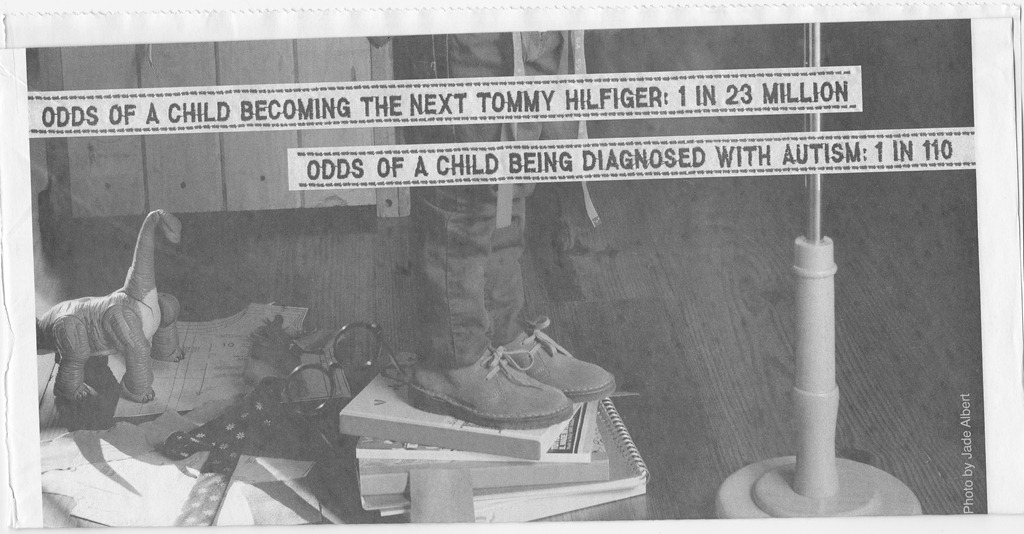
These ads always give me a great sense of relief, because God knows I’d rather my child* be in the company of

Matt Savage

or

grandin

or

Tammet

than these assholes

tommy-hilfiger-ss-2011-by-craig-mcdean-styled-karl-templar

********

* My theoretical child.  I don’t have kids.  But to be clear, I would rather be and/or hang out with people with autism than people in a Hilfiger ad.

Modesty glasses: finally, recognition that it’s their problem, not ours.

In Israel, new modesty glasses for Orthodox Jewish men blur women out of their line of sight – NY Daily News.

It’s the latest prescription for extreme ultra-Orthodox Jewish men who shun contact with the opposite sex: Glasses that blur their vision, so they don’t have to see women they consider to be immodestly dressed.

This is sheer genius!  With modern technology, if we can’t convince bigots to bring their thinking into the modern world, at least we don’t have to change our behavior to cater to their stone age views.  Bigot Glasses:  think of the uses!

  • Racist?  Here are glasses that make everyone’s skin tone look white.
  • Homophobic?  These glasses will portray, to the wearer, that any couple observed through the lenses consists of one man and one woman.
  • Islamophobic?  The glasses can be programmed to photographically superimpose members of the 4H Club overtop of any images of men with dark skin, beards, or turbans or women in headscarves.
  • Disabiliphobic?  There will be glasses to blur out wheelchairs, white canes, and sign language, showing instead those same people walking, seeing, hearing, and flipping you off.  (Still a few bugs in that technology.)

The ultimate genius, of course, is that Bigot Glasses only affect the bigot, so the rest of us can go about living our black, female, Islamic, gay, and/or disabled lives in peace.

There is, of course, one set of these glasses I’d invest in:  grumpy old lady glasses.   Technology that erases tattoos, pulls up pants, covers up exposed underwear, brushes hair, feigns respect, and edits out the word “like.”

Absurdity Slider

No, it’s not a small, tasty, metaphysical snack.  It’s a review of a review — big time-saver! — and a digression into the meaning of life.  The slider is explained below.  (Look!  A teaser!)

I minored in philosophy.  At Swarthmore.  You’d think this would have trained me to overthink almost anything.  And honestly, I can overthink important things like the font in my email or whether to get the 90 Shilling or the 1554.  But I recently* read a review in the New Yorker of a book that I think may represent the gold standard in overthinking: David Benatar’s “Better Never to Have Been: The Harm of Coming Into Existence.”  The thesis: since it’s worse to suffer pain than to forego pleasure and since — in the words of the reviewer, “[e]ven the best of all possible lives consists of a mixture of pleasure and pain” — it is better never to have been born.

Yes, you read that correctly.  As the review notes:

The volume is dedicated to his parents, “even though they brought me into existence,” and to his brothers, “each of whose existence, although a harm to him, is a great benefit to the rest of us.”  (It’s fun to imagine what family reunions with the Benatars are like.)

But I think I’ve found the Rosetta Stone of disability discrimination.  As the reviewer explains it:

Benatar’s case rests on a critical but, in his view, unappreciated asymmetry. Consider two couples, the A’s and the B’s .  The A’s are young, healthy, and rich. If they had children, they could give them the best of everything — schools, clothes, electronic gaming devices. Even so, we would not say that the A’s have a moral obligation to reproduce.

The B’s are just as young and rich. But both have a genetic disease, and, were they to have a child together, that child would suffer terribly. We would say, using Benatar’s logic, that the B ‘s have an ethical obligation not to procreate.

They have a WHAT?

The case of the A’s and the B’s shows that we regard pleasure and pain differently. Pleasure missed out on by the nonexistent doesn’t count as a harm. Yet suffering avoided counts as a good, even when the recipient is a nonexistent one.

And what holds for the A’s and the B’s is basically true for everyone. Even the best of all possible lives consists of a mixture of pleasure and pain. Had the pleasure been forgone — that is, had the life never been created — no one would have been the worse for it. But the world is worse off because of the suffering brought needlessly into it.

Is this guy an android?  Everyone suffers at some point.  In fact, how does life have any meaning without suffering?  Hell, without pain, how do you learn basic things like not to touch a hot stove and not to listen to the Beach Boys?  I suppose if you never existed, you wouldn’t have to go through any bothersome learning processes.  But then, what’s the point?  I guess that is his point.

“One of the implications of my argument is that a life filled with good and containing only the most minute quantity of bad — a life of utter bliss adulterated only by the pain of a single pin-prick — is worse than no life at all,” Benatar writes.

He acknowledges that many readers will have difficulty accepting such a “deeply unsettling claim.” They will say that they consider their own existence to be a blessing, and that the same goes for their children’s. But they’re only kidding themselves.

Ladies and gentlemen, this is not The Onion and as near as I can tell, this dude expects his theory to be taken seriously.  On one level, it merits only derision.  Or this year’s Hitchhiker’s Guide Philosophy Award, an award I just started for philosophical arguments that measure up to my favorite ever, from the Hitchhiker’s Guide to the Galaxy, explaining the existence of the Babel Fish:

Now it is such a bizarrely improbable coincidence that anything so mindboggingly useful could have evolved purely by chance that some thinkers have chosen to see it as the final and clinching proof of the non-existence of God.

The argument goes something like this:

`I refuse to prove that I exist,’ says God, `for proof denies faith, and without faith I am nothing.’

`But,’ says Man, `The Babel fish is a dead giveaway, isn’t it? It could not have evolved by chance. It proves you exist, and so therefore, by your own arguments, you don’t. QED.’

`Oh dear,’ says God, `I hadn’t thought of that,’ and promptly vanished in a puff of logic.

`Oh, that was easy,’ says Man, and for an encore goes on to prove that black is white and gets himself killed on the next zebra crossing.

But on another level, the concept that it is better to avoid all pain than to experience any pleasure explains disabiliphobia.  It explains why the non-disabled world regularly projects on to people with disabilities a far lower quality of life than the latter actually experience.  This, in turn, leads non-disabled windbags like Peter Singer to opine that it is better for infants with disabilities not to be born or to be killed in infancy.  Benatar’s theory is simply the apotheosis of Singer’s: If it’s better not to be born than to be born with quadriplegia, where do we draw the line?  Better not to be born than to be born and later in life get the sniffles.  Perhaps it’s helpful to imagine this scale as a slider of the type I’m just now learning to use in Lightroom.  We’ll call it the Absurdity Slider:

The Absurdity Slider


Benatar took the Absurdity Slider and dragged it all the way to the right — up to 11 — where not only is it best to euthanize disabled infants, but it’s best that none of us ever have been born.

Given the highly accurate “that’s bullshit!” response most people will have to Benatar’s theory, I think he’s done us a service in placing Singer’s arguments along this all-important scale.  If only I had control of the actual slider.  Any coders out there want to help me develop a working Absurdity Slider, one that could tone down the absurdity in an argument the way you adjust the contrast in a digital photo?

*************

* Yes it was in the April 9 New Yorker, but it is true that I only recently read it, as I have just now reached that archeological layer in the New Yorker pile next to my comfy chair.

Introducing The Cute Puppies’ Guide to Title III of the ADA

There have been two types of post that have driven most of the traffic on this blog:  photos of my dogs; and my attempt to start an internet meme with the photo of Gus Fring being blown up by the mobster who used a wheelchair (MWD?).   So I try to publish my deep thoughts about disability rights, the practice of law, and adventures in trial technology, and what my immense readership really wants to see is photos of cute dogs and guys with their heads blown off.

This reminded me of one of my favorite Saturday Night Live sketches:  Kevin Nealon with No Attention Span News.  Not the funniest perhaps, but one that was excruciatingly accurate in portraying what it feels like to try to talk about something important but boring.  (Sorry for the ad.  It’s worth it.  Keep watching.)

With these thoughts in mind, I decided that we needed a more attention-grabbing way of presenting the ADA.  Lacking the copyright to the image of Gus Fring, but blessed with two very cute dogs, I decided to inaugurate The Cute Puppies’ Guide to Title III of the ADA:

There now!  Don’t you feel inspired to learn more?  You can check in from time to time on the FoxRobBlog, which will also have scintillating news of our latest case adventures and legal developments.  And puppies!

Romney’s disability bullying

Anyone who has made his or her way to this backwater in the blogosphere must have seen the Washington Post article on Mitt Romney’s history of cruelty and bullying at his prep school.  The event that has gotten the most attention is Romney’s bullying of a nonconformist classmate — a kid with dyed blond hair — that had overtones of gay bashing and homophobia.  But what about this incident:

One venerable English teacher, Carl G. Wonn­berger, nicknamed “the Bat” for his diminished eyesight, was known to walk into the trophy case and apologize, step into wastepaper baskets and stare blindly as students slipped out the back of the room to smoke by the open windows. Once, several students remembered the time pranksters propped up the back axle of Wonnberger’s Volkswagen Beetle with two-by-fours and watched, laughing from the windows, as the unwitting teacher slammed the gas pedal with his wheels spinning in the air.

As an underclassman, Romney accompanied Wonnberger and Pierce Getsinger, another student, from the second floor of the main academic building to the library to retrieve a book the two boys needed. According to Getsinger, Romney opened a first set of doors for Wonnberger, but then at the next set, with other students around, he swept his hand forward, bidding the teacher into a closed door. Wonnberger walked right into it and Getsinger said Romney giggled hysterically as the teacher shrugged it off as another of life’s indignities.

How does this speak to Romney’s views on people with disabilities?   There are many measures of how far the Republican party has sunk — from William F. Buckley to Sarah Palin, say — but in my neck of the woods, it couldn’t be sharper than the contrast between the man who signed the ADA and someone with so little respect for people with disabilities that he would humiliate his own blind teacher.

Would any of us be elected if judged by our adolescences?  Perhaps not, though mostly due to lingering squeamishness with recreational drug and alcohol use.  I cannot think of any friends or classmates who did anything close to the cruelty of assaulting a fellow student to cut his hair simply because he was different or physically ridiculing a disabled teacher.

Two other things strike me.  First of all, of course, the homophobic bullying has received far more attention than the disabiliphobic bullying.  Part of that has to do with the fact that the article was published within a day of both North Carolina’s shameful vote enshrining marriage discrimination in its constitution and President Obama’s declaration of his support for marriage equality.  But I’m concerned that that casual tone of the quote above indicates a greater societal acceptance of disability-related “pranks” than homophobic “bullying.”

I’m also struck by just how uncivilized Romney’s behavior was.  And not just once, but apparently over and over.   We Democrats are supposed to be the party of the uncouth, unwashed hippies, and the GOP the party of Brooks Brothers, using the proper wine glass, and not wearing white after Labor Day.  But the behavior described in this article is deeply uncivilized, and the fact that it was laughed off at an elite prep school speaks volumes.

How on earth could we trust this man to run our country?

How not to settle a case with me

If you are in settlement negotiations with me, and it is your goal to make sure the case does not settle,* here are several things you can say:**

  1. My client is very emotional about having to comply with the regulations because he supports a disabled baseball team.
  2. My client is very emotional about having to comply with the regulations because he has Parkinson’s.
  3. I know you feel like you want to create a more enjoyable experience for the disabled, but that’s not what the statute requires.
  4. My client refuses to create an annuity for plaintiffs’ lawyers.
  5. With that damages demand, let’s just turn the state of California over to the disabled!

I realize I’m providing advice to my opposing counsel, but sometimes you just gotta reach out.

***************************

*  There are many reasons why this might be a defense counsel’s goal:     (1) Billable hours.  (2) Billable hours.  (3) Billable hours.  … (n) Billable hours.

** All of these are real.  Really.

Have I mentioned recently how much I love Michael Bérubé?

A new Bérubé post!  Just in time for Christmas!  Let there be joy throughout the land!  (As we’ve previously established, I’m a HUGE FAN.)  And he’s writing on one of my favorite topics:  universal design.  Let’s face it, the world is full of accommodations . . . for people with physically and psychologically typical bodies.   But they’re only really called “accommodations” when someone with a disability requests them.  Though try attending a meeting where you’re the only hearing person or the only person who doesn’t ride in her own chair, and it will be brought home to you that the typical are accommodated all the damn time.

Future post:  why our lack of wings requires the accommodation of stairs, elevators, escalators, and other ways of accessing upper stories without having to fly.

Anyway, Bérubé’s insight into how this worked in academic accommodations was wonderful:

So in response to my student with CP, I decided to distribute a take-home exam on the final day of class, and then give students 72 or 96 hours to write two essays.  That way, the exam itself would be turned in (and graded) during finals week, and students could devote as much (or as little) time to the exam as they desired.  I’ve done this ever since. . . .

Lastly, for even more extra extra upside, the students who need accommodations  . . . get to work at their own pace, like everybody else.  It’s like universal design … for final exams.

More on the “r-word”

Sam Bagenstos has written a thoughtful post on the use of the word “retard” in movies and our response as a community.  He was responding to this post, which was reacting, in turn, to the use of the word “retard” in the Alexander Payne/George Clooney movie, The Descendents.  I tend to agree — on general free expression and artistic license grounds — that we should not be in the business of telling writers what to write.  But I’m hoping for the day when the casual use of the word “retard” carries the weight that the casual use “nigger” or “cunt” would.  (For example, I’m predicting it was pretty jarring to read those words in my blog.  Was it equally jarring to read the word “retard”?)

Given the intersection of language nerdery and disability rights, this is a subject that interests me and that I’ve written about a couple of times.  Sam’s blog post makes excellent points, including that

People use the r-word in real life, just like they use slurs against other groups (and just like they do other harmful and wrongful things), and it would be wrong to say that movies and literature can’t depict that.  (And I think it’s a cheat to say that the use of the word can be depicted but only if the character who uses it “learns the lesson” that it’s wrong or is otherwise shown to be a bad and unsympathetic character.  That’s not any different than requiring purely idealized depictions of people.)

Very true.  In fact, if the word were restricted to movies, books, or tv shows in which lessons were learned, we’d only hear it in after-school specials, where the bully turns out to have problems of his own, reforms, and everyone has a group hug in the end.  No, rather than requiring lessons be learned or the word avoided, I’m hoping the movie-going public evolves to the point where the writer knows that putting that word in a character’s mouth will communicate something deeply negative about that character.  Right now, the choice to have a white character use the word “nigger,” without the quotes, directed to or about an African-American, communicates something very specific and negative:  the speaker is a racist asshole.  Same with “cunt”:  sexist bastard, or denizen of frontier Deadwood, South Dakota.

The truth is, I find it incredibly jarring and disappointing when a character in a movie with whom I sympathize (or perceive that I’m supposed to sympathize) uses the word “retard” as a casual epithet.  It’s similar to the phenomenon that Ta-Nehisi Coates has called “the John Mayer Rule,” and which I called “drinking with white people”:   that moment when someone you thought was cool says something bigoted  . . . and the concomitant urge to avoid situations (in my case, drinking with acquaintances who don’t get disability rights) where this might happen.  There are good reasons why George Clooney would not say a long list of offensive epithets in a movie of the type I understand The Descendants to be.  I’m hoping for the day when writers and actors will think that way about the word “retard” and use it accordingly.

One final thought:  a laser-focus on one word misses is the many ways movies and TV can be demeaning to people with disabilities while remaining pristine in language use.  One of my favorite examples is Law & Order, which has presented a long string of pathetic and/or criminal people with disabilities, without once (that I can recall) showing, say, an attorney, detective, forensic professional, or random witness in a wheelchair.  Two episodes stick in my mind.  In one, a mother is accused of killing her son, a quadriplegic.  The son is presented as unable to get out of bed and as a result we are asked to sympathize with the homicidal mother.  Scenery-chewing DA Jack McCoy tells the jury — as a fact, I promise, not as a negative comment on the mother’s narrow world view — “she knew he’d never grow up to be a doctor or lawyer.”  Seriously – how hard would it have been for the writers to figure out that there are all sorts of quad doctors and lawyers and other professionals?  The other episode I recall was where the hunt for the killer led toward the brother who was paralyzed and as a result bitter and murderous.  While I can’t recall others off the top of my head, I don’t recall any portrayals of people who use wheelchairs straying beyond vegetative and/or embittered.  I’d take 100 George Clooney “retard” utterances over this.  Although we keep watching the damn show,* we know to turn it off the instant there is mention of a character with a disability.  We know, to a 100% certainty, that L&O will screw it up.

********************
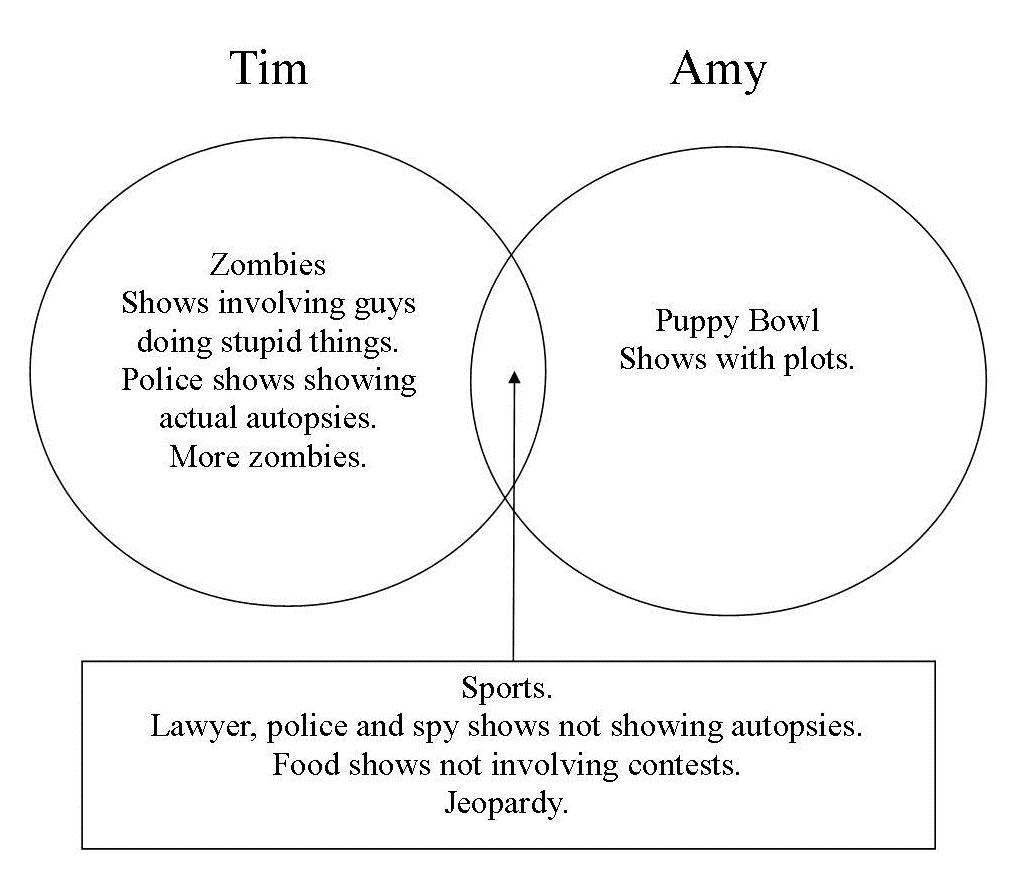
* L&O occupies the very small overlapping area of Tim and my taste in television:

Things that are inexplicably OK, part 2

The New Yorker recently published an article on premature birth that inspired this thoroughly appalling letter:

So let me get this straight:  Instead of ensuring that our educational system teaches all of our children, we should “accept death,” lest we be excessively sentimental to the detriment of . . . the special education students to whom we so desperately — but  apparently inappropriately? — want to cling.  What does Linda Bonin of Kirkland Washington think we should do instead?   Administer the PSAT prenatally?   What really frosts my shorts is that Ms. Bonin was almost certainly regarded as a good person — someone who liked to help people — possibly even by the parents of the special education students whose very existence she regretted, unsentimentally.

Who the hell is Ms. Bonin to decide that her students didn’t deserve to live.  Who are any of us?