Category Archives: Disability Rights

Defame This!

Remember just the other day I was ridiculing some over-caffeinated opposing counsel for accusing CCDC of defamation for posting, on its website, pleadings in case alleging that his client violated the ADA.  Highlight:


My position is that you and your clients have been defaming my clients by raising false allegations of discrimination . . .


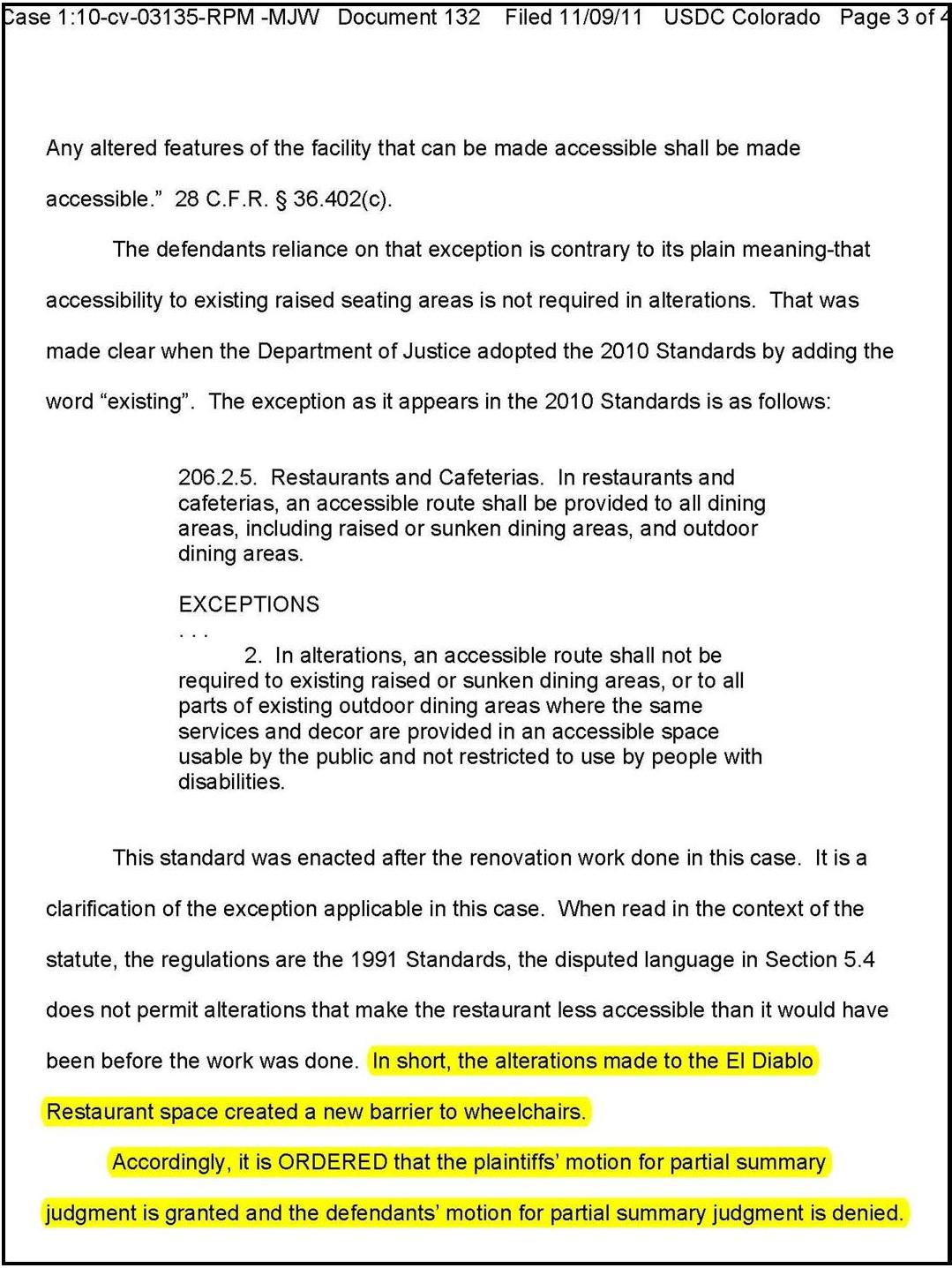
On Wednesday, we got the judge’s decision on our motion for summary judgment.  Here’s page 3 — the key portion: 


That’s right, Ladies and Gentlemen, summary judgment granted to plaintiffs!  Big thanks for the excellent legal work of Team CCDC:  Kevin Williams, Andrew Montoya, and Briana McCarten.


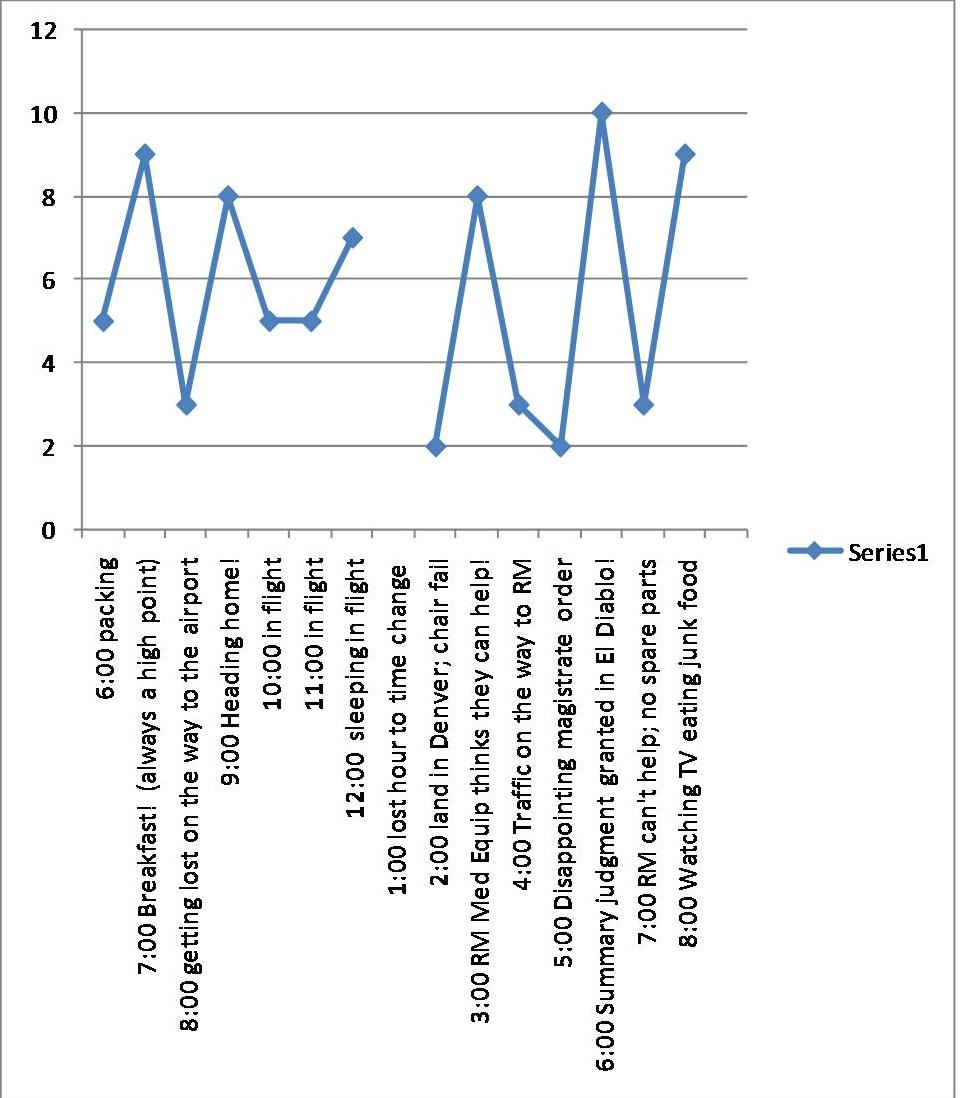
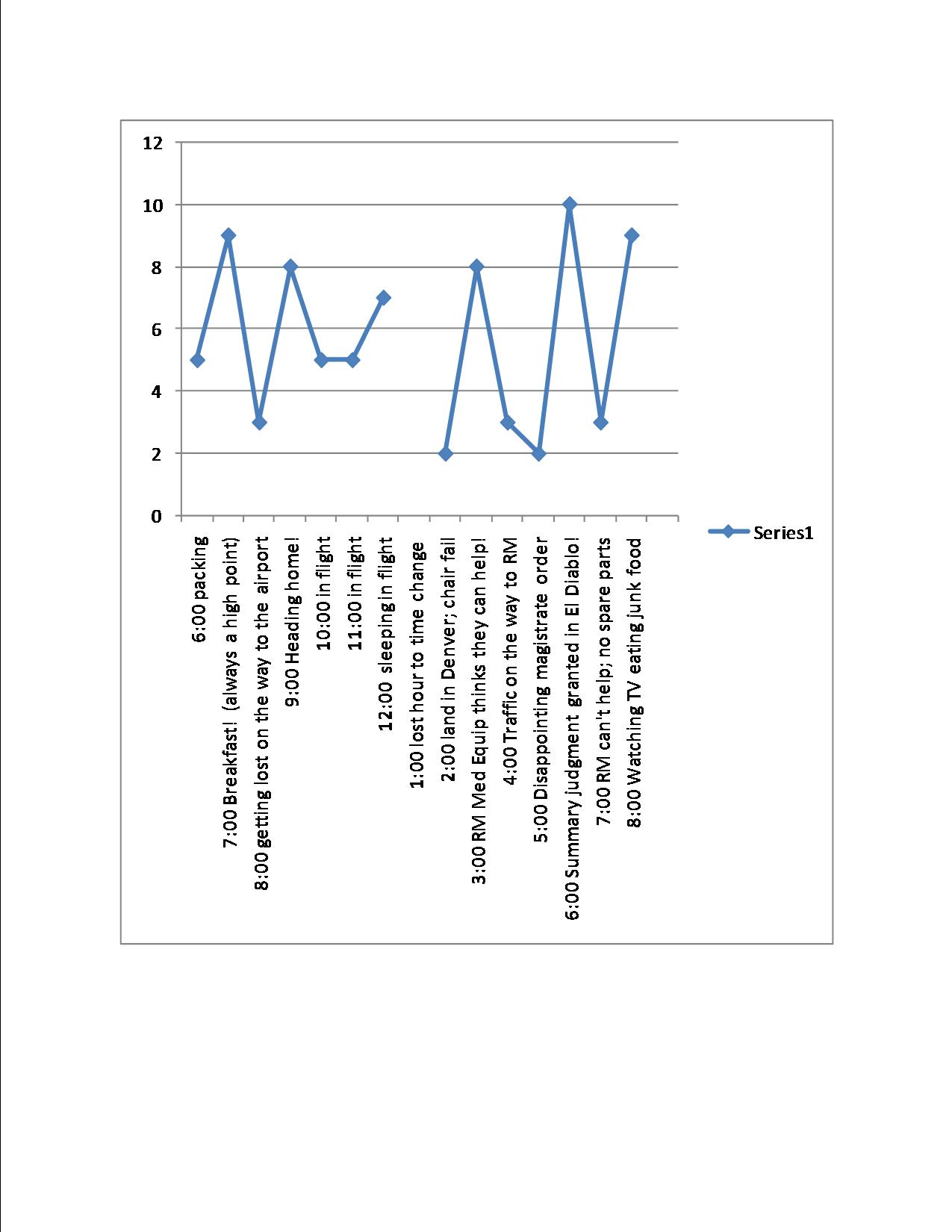
My Day: A Chart

Flew home from Portland, wheelchair fail, and two very different court decisions in a short period of time:


This Week In Random Media Hypocrisy

Breaking News!  Did you know that the mayor of a  major American city said that treating African-Americans equally was an “inconvenience” that was “unfair to average people” because it made them “uncomfortable”?  You didn’t!?  What a scandal – how did the media miss this?

Oh, right, sorry — it was just the civil rights of people with disabilities.  Silly media consumers — you know that’s not the same thing.  So no reason to expect 24/7 handwringing, apologies, and navel-gazing talk shows about the state of civil rights in response to the MAYOR OF OUR LARGEST CITY SAYING THAT RESPECTING THE RIGHTS OF HIS MINORITY-GROUP CONSTITUENTS IS INCONVENIENT AND UNFAIR TO “AVERAGE” PEOPLE.

In fact, I have to cut the intrepid reporters on the civil rights beat some slack on this because they were busy pursuing a much more important story.

Yes, leading liberal website ThinkProgress was far too busy tracking the astonishing news that  beauty queen got drunk and used a bad word.  In fact, the website was so on top of this story that they got an …

That’s right, an EXCLUSIVE.  You won’t read this important story ANYWHERE ELSE!   And in fact, ThinkProgress has the crucial details, too.  Miss Virginia’s roommate told the reporter that she was “extremely intoxicated” that night and seemed upset that she did not have the full house to herself, so she  “downgraded people based on their physical appearance and economic status.”  Now this is indeed breaking civil rights news:  college girl gets drunk, says something stupid and hurtful.

How on earth did ThinkProgress beat out The Onion to this important scoop?

Flourishing: Calling Bioethical Bullshit

Bioethics is much too important to be left to bioethicists.”  So sayeth Michael Bérubé.  Accurately.  And here’s why:  because they argue in bigoted tautologies.  That’s right:  loathsome and intellectually empty.

Digression/throat clearing:  I love reading anything by Michael Bérubé.*  Anything.  I would read the phonebook cover to cover if he wrote it.  One of the beauties of reading his writing is you don’t have to be an expert in cultural studies or criticism to get what he’s talking about (even if not all the references) and to enjoy his attitude of critical good humor.   Armed only with my vintage 1983 BA in linguistics and philosophy, however, the prospect of trying to respond to one of his posts has always felt like trying to jump on a merry-go-round** that’s going by very fast.

I have neither the time nor the skills to master the literature and vocabulary necessary to contribute a coherent comment.  But now I have my own damn blog, where I can say whatever I want without feeling too self-conscious that I’m interrupting a learned conversation.  Here goes.

This post responds to two Bérubé posts, one on Crooked Timber; the other on a site called “On the Human.”

Without attempting to summarize either the posts or the materials he’s criticizing, I’ll jump onto the carousel at the point I’d like to discuss:  the concept of “flourishing.”  Bérubé tees off of a book by Jonathan Glover (Choosing Children: Genes, Disability, and Design), which he is careful to credit with some level of disability consciousness:  

Choosing to have a child without certain disabilities need not come from any idea that disabled people are inferior.  Nor does it entail that the world, or the gene pool, should be cleansed of disabled people”  Id. at 28 (as we cite in the law biz).

But Glover also says

“I think that, other things being equal, it is good if the incidence of disabilities is reduced by parental choices to opt for potentially more flourishing children.”  Id. at 35.

Bérubé’s post then outlines a number of thought experiments designed to … do what I’m not sure.  For example:  you have to choose between two tests, one that detects and cures a disability in utero vs. one that detects the likelihood of disability pre-conception, so the parents can avoid conceiving a disabled child.  I think, in retrospect, that shit like this was why my phil minor focused on philosophy of mathematics.  Rather than discussing who should or shouldn’t be born, we discussed what it meant, in an absolute sense, to measure something.  This has come in freakishly handy in my legal career.  (ADAAG in-joke.  Sorry.)

Anyway, here’s another doozy — Glover quoting Frances Kamm who:

discusses a hypothetical case … of a woman who knows that, if she conceives now, her child will have a life worth living but will be mildly retarded. The woman also knows that, if she waits, she will be able to have a normal child. Frances Kamm accepts that, having a life worth living, the child with mild retardation will not be harmed by being created. But she thinks the woman will still have done wrong by not waiting. … She says “even if she could produce no child except a mildly retarded one, it might be better for her not to produce any” and that the woman “would do wrong to produce a defective child when she could have easily avoided it.”  Id. at 55.

Bérubé attacks these hypotheticals on the legitimate grounds that they make no sense.  “There is no scenario — I repeat, no scenario, none whatsoever — in which any woman knows that, if she foregoes conception now, she will have a normal child later on.”

Here’s where I jump into the middle of this discussion with what I really, truly hope is an obvious point that has been covered extensively in other literature that I’ve been too busy measuring toilets (in the absolute sense) to have read.  And that point is:

WTF*** DO YOU MEAN WHEN YOU SAY “FLOURISH”?

The question of what constitutes flourishing — and what parents do before, during, and after pregnancy to influence the flourishment of their child — is far far broader than whether the child has or does not have a disability.  That is, there are as many ways to flourish and not flourish as there are children, the vast majority of those ways (I would argue) uncorrelated with disability.

At the simplest, non-comparative AND MOST OBVIOUS level, there are multitudes of flourishing disabled people.  I’m tempted at this juncture to list a bunch of awesome pwds I know and know of and contrast them with a bunch of deeply non-flourishing non-disabled people I know and know of.  But that dignifies a question that does not deserve dignity.

OK so we’ve established that you can flourish with a disability.  But it’s also true that, in many cases, children (disabled and nondisabled) flourish in ways that parents (since that was the original thought experiment) can influence in greater or lesser degrees.  Do children with Down Syndrome, osteogenisis imperfecta, or cerebral palsy whose parents have inexplicably consented to give birth to them flourish more or less than children with parents who are:  drunk; abusive; divorced; helicoptery; rich; poor; strict; lax; human?

Can any child flourish in an abusive family?  How about one so coddling that the child never learns to fend for him or herself?  Can a gay child flourish in a homophobic family?  A curious child in a fundamentalist**** family?

I know, I know — the bioethicists would condemn parents who were alcoholic, abusive, homophobic, or fundamentalist.  BUT THEY WOULD NOT DENY THOSE PARENTS’ CHILDREN THE RIGHT TO EXIST.   They would not say to the homophobes or fundamentalists or overprotective parents:  hold on – your kid’s not going to flourish – don’t get pregnant!  It is bioethically wrong for you to have a child.  We can have whatever discussion we want about good and bad parenting; it’s only when a child might have a disability — with unknown effect on flourishment — that we talk about making sure the kid doesn’t even exist in the first place.

And here is where I’m glad I studied the unhip logical positivist philosophy that I did because what we have here, folks, is a simple problem of definition.  Bioethicists have defined “flourish” in a completely circular fashion.  “Flourishing” doesn’t mean “loving” or “loved” or “happy” or “curious” or even (not my definition, but maybe others’) “blessed” or “sacred.”   It means “physically and mentally typical in a way that bioethicists deem worthy of survival.”  Or it may in fact mean “physically typical with a high IQ” — that is, the sort of person that the average bioethicist would want his or her kid to be.

But the saddest thing of all is:  Bioethicists — or at least Glover — may already know this.  I’m not in fact pointing out something incisive or new.   Despite graciously (sort of) conceding that pwds are not “inferior,” Glover states, “in this book disability has been contrasted with human flourishing.”  Id. at 88.  That is, the entire discussion starts from a point of circularity.   And euphemism.  Instead of saying “parents shouldn’t have babies who are disabled,” which sounds sort of discriminatory, you say, “parents shouldn’t have babies who won’t flourish” and then, to address the fact that you really aren’t talking about, say, your colleague’s fucked up teenager or other mainstream, middle class, ways of not flourishing, you define “flourish” to mean “nondisabled.”

Here is my bioethics:

1. It is never OK to decide for someone else whether that person is flourishing, especially when

2. “flourishing” is defined based on a single, culturally-specific set of values, that excludes disability a priori, and especially when

3. the definition determines who gets to be born.

And here is the list of hard questions I’m ignoring:

1.  When is it OK to cure disability?

2. Is is ever OK to withhold medical treatment without consent, for example, when death is imminent?  (Even I am willing to define “dead” as “not flourishing.”)

3.  And what about war?  And that goddamned trolley?

************

* The only thing about Bérubé that pisses me off — and it *really* pisses me off — is that he stopped blogging.  He used to write at www.michaelberube.com, and if you check out some of his archives, you’ll see what I mean.  I’m guessing that writing 10,000 words a day on top of his professoring duties — not to mention husbanding, dadding, hockeying, lecturing, administering, and apparently wet-vaccing the basement every week or so — got to be a bit overwhelming, but couldn’t he just have cut back to 9,999 or so?  Or even 1,000?  Per week?  They’d still be the most enlightening and entertaining words you’d read all week.

** Why merry-go-round and not train.  I’m not sure, and it’s sort of bugging me.

*** That’s another reason, btw, to blog rather than write journal articles.  Besides the fact that it’s quicker, easier, and intellectually lazier, there is nfw they’d let me write “wtf” in a journal article, however appropriate it was — as it is here — to the point I’m making.

**** I’m going to define my own terms here.  By “fundamentalist” I mean any family that adheres to a single orthodoxy of thought and punishes or ostracizes the child for exploring or adopting other views.

Special Interest Groups

I finally have empirical proof that “Special Interest Group” just means “group that wants to do something conservatives oppose.”

I’ve always known this in a sort of episto-sarcastic way.  “Oh yeah right,” I’d say, sarcastically, “gays and lesbians are a special interest group because getting married, visiting your spouse in the hospital, and not having the crap beaten out of you are such special things to do.”  In contrast to companies that don’t have to pay taxes or answer in court when they violate the law – a very ordinary, unspecial approach to citizenship.

Indeed, any group advocating for civil rights – that is, the same rights that straight, non-disabled, white people take for granted – is a “special interest group” advocating for “special rights.”  For example, here’s Juan Williams,* with the standard line that people with disabilities are a “special interest group.”

But I finally found a naturally occurring example of the flexibility of the term “special interest group.”  To graduate from being a “special interest group” to “fine upstanding Americans,” you just have to find a group that annoys conservatives more.   Here is a Republican politician in New Hampshire, reacting to the fact that a liquor store has parking reserved for hybrid cars near the front entrance where the accessible parking usually goes:

To choose to display such blatant priority for special interests over seniors, wounded veterans and others who have mobility difficulty is deplorable.

Voila!

*******

*  This link contained a paragraph so classic I have to paste it in its entirety.  Here is Juan Williams making the all-important link between speaking respectfully about people with cognitive disabilities and the downfall of western literature:

That’s ridiculous. These special interest groups say you shouldn’t say retarded. You should say developmentally disabled. It’s silly to make a big deal about it. It’s like language police. You’re made into a villain. It’s being done to enforce a certain speech code. It leads to resentment, anger. It leads to people thinking we’re not allowed to read books by dead white men even if they’re great books. What a waste of time. Just have an honest conversation.

I’m grateful to those with the courage to tell their stories.

We recently went to trial against a fast-food chain for lack of wheelchair access.  In trial, three of the chain’s customers who use wheelchairs and the son of a fourth, now deceased, took the stand and described their experiences.  They described these experiences as a practical matter — a door that closed on an ankle, a queue line that was too narrow, employees who ignored them or told them they could not even wait off to the side of the line — and as an emotional matter — what it felt like to encounter these barriers, to be ignored, to be told to wait somewhere else. They talked about their own lives, too:  a lay pastor who counseled people with disabilities; an advocate who is working with the Smithsonian on a disability history project; a woman whose parents took her to see Martin Luther King, Jr. and taught her to stand up for her rights; a man whose mother had worked to integrate people with disabilities into her chorus.

The fast-food chain’s response was:  you’re lying.  You’re lying and you’re greedy.  The chain’s lawyers called the restaurant’s assistant manager to the stand to testify that she didn’t recognize any of them.  The lawyers pointed out — in cross-examining the customers — that they might recover damages, that they had filed other lawsuits to challenge other inaccessible conditions, that this wasn’t the closest restaurant to their homes.  The chain’s hired expert — who uses a wheelchair — took the stand to say he didn’t mind the barriers, that he didn’t consider it discrimination.

Four people who took time out of their day, their days, to be deposed, to take the stand in trial.  Work hours missed, long rides on public transportation.  Just to be accused of greed and dishonesty.  To be challenged on the fact that they had a life that took them farther afield than the restaurant closest to their homes.  To be accused — rather than celebrated — for standing up to other facilities and other defendants who had excluded them.

We defended them in the language permitted us by the law, by the rules of civil procedure and evidence.  Objections to relevance.  Quotes from the governing appellate court:  “[f]or the ADA to yield its promise of equal access for the disabled, it may indeed be necessary and desirable for committed individuals to bring serial litigation advancing the time when public accommodations will be compliant with the [ADA].”*

But as always, the late poet Laura Hershey says it best:

Telling**

What you risk telling your story:

You will bore them.

Your voice will break, your ink

spill and stain your coat.

No one will understand, their eyes

become fences.

You will park yourself forever

on the outside, your differentness once

and for all revealed, dangerous.

The names you give to yourself

will become epithets.


Your happiness will be called

bravery, denial.

Your sadness will justify their pity.

Your fear will magnify their fears.

Everything you say will prove something about

their god, or their economic system.

Your feelings, that change day

to day, kaleidoscopic,

will freeze in place,

brand you forever,

justify anything they decide to do

with you.


Those with power can afford

to tell their story

or not.


Those without power

risk everything to tell their story

and must.


Someone, somewhere

will hear your story and decide to fight,

to live and refuse compromise.

Someone else will tell

her own story,

risking everything.

A brilliant call to arms — to words? — for those who risk so much in speaking up.  It feels mundane to quote it in the context of a fast food restaurant.  But that’s the point:  in simply describing a visit to a restaurant, ordering food, interacting with staff, you risk being called a liar and having your motives and experiences questioned and belittled.

I devote my professional energies to disability rights law, but mostly I do that sitting at a computer researching or writing.  From that sheltered vantage point, it’s easy to lose sight of the courage it takes to tell your story in a courtroom and to be challenged, belittled, and accused of lying.  I am deeply grateful for those who are willing to tell their stories.

***************************

*  Antoninetti v. Chipotle Mexican Grill, Inc., — F. 3d —, 2010 WL 3665525, at *7, slip op. at 16016 (9th Cir. Sept. 22, 2010).

** Quoted with permission. Thanks, Robin!

What would you do for serrano-wrapped dates?

UPDATE (August 19, 2012):

Tim and I went  back to the 9th Door today and had a great time.   The seating had been improved significantly.  All of the low benches and sofas were gone, replaced by very accessible four-tops.  Spanish music had replaced the techno.  Everyone’s attitude was fabulous.  And of course the food remains spectacular.

ORIGINAL POST (May 22, 2011):

Turns out, Tim and I would put up with a fairly annoying level of discrimination and techno music for this tasty treat.  We went to our favorite tapas joint last night — Denver’s 9th Door.  We’ve always known that an evening at 9th Door is a trade-off between amazing food and a deeply annoying hipster-and-techno-music ambiance.  But we’ve been there many times and always been seated politely.  Last night, the manager decided we were a fire hazard.

You know how there are phrases that just signal discrimination, that members of minority groups hear often — each time from someone thinking he is original — demonstrating conclusively that you are different, outside, etc.  For example, saying an African-American is “articulate,” or an Asian is a “model minority,” or a Jewish name is “delightful.”*  Well, nothing says “other” better than calling you a fire hazard.

We got there at our usual old-fogie, early-bird-special hour and the manager showed us to a two-top — one we had occupied on a number of previous occasions — and then started vocally fretting about how she could arrange us so that neither Tim nor I would be a fire hazard.  In one arrangement, I would have been sitting in the aisle.  She rejected this, causing Tim to tell the rather chubby manager, “she’s only 105** pounds, she won’t take up the whole aisle.”  Oh snap!  Following much dramatic table-dragging and eye-rolling, we were seated, after which, of course, the entire length of the aisle she was worried about immediately filled up with annoying hipsters, posing a far more serious, non-wheelchair-related, fire hazard.

A word about techno music.  Does. Anyone. Like. That. Shit?  OK, 5 words.  It seems to me to have been composed by lab rats seeking revenge for whatever we’ve done to them in the name of science.  Hey, Rats – here’s your data:  techno music makes me want to rip my own ears off.  Now make it stop.

But I swear to God it was all worth it.

Dátiles: Crispy Serrano ham-wrapped dates stuffed with almonds and drunken goat cheese

Pimientos del Piquillo Rellenos: Fire-roasted piquillo peppers stuffed with fresh goat cheese and rosemary

Aged Manchego cheese with membrillo Cabrales blue cheese with almonds and honey Cabra cheese with dried fig chutney

Alcachofas a la Plancha: Crispy pan-fried artichoke hearts with lemon-thyme aioli

Croquetas de Hongos: Mushroom and rice croquette with sherry wine and mushroom sauce

Albóndigas: Traditional lamb meatballs served in a delicate Moorish mint almond sauce

Extra-bonus sexism.  See if you can spot it in their menu blather:

On Spain’s Costa del Sol, located between Malaga and Marbella, sits a quiet little mountain village called Mijas.

During the summer of 1969, after having been made famous by James Michener’s novel The Drifters, Mijas had become an expatriate community of writers and poets. On lazy afternoons, these expats would gather at their favorite bar – one without a name, recognizable only by the number nine that was carved into the door.

Behind the 9th door, they would imbibe on the local wine and brandy and share the tapas of the house, trading stories and reciting poetry to the local women until the early hours of the morning.

Raise your hands if the first time you read the words “expatriate community of writers and poets” you pictured a mixed group of men and women.  Ha!  Fooled you!  Or maybe I’m just being heteronormative:  male and female expat writers and poets could all have been seducing the local women.  Of this I’m confident:  no techno music was involved.

***************

* OK, this one might not make sense out of context.  Here’s the context:  I’m half Jewish, half, well, WASP.  When discussing a friend of mine with one of my older WASPy cousins, he responded to hearing the guy’s name by laughing out loud, repeating it over and over, saying “how delightful!”  Not an anti-Semetic bone in his body, but almost nothing could have made me feel more “other” at that moment.

** This reflects the historically accurate weight stated on my driver’s license.  Let’s just say:  it’s up for renewal this year.

Stupid Lawyer Tricks: ADA Defense Stupidity

An animated response to all the invective-filled, garment-rending articles about lawsuits against businesses that violate the ADA.  As with my earlier attempt, I think I succeeded only in cracking myself up.   Call it Animation Therapy.   Try it:  http://www.xtranormal.com

Couple of notes.  I love how the animated gestures are almost as awkward as the gestures I generate naturally.  On the other hand, I’m very disappointed that I could not make the automated voice render the word “law-nerd.”  This is a significant gap in the Xtranormal program.  And because I can overthink anything, I feel a tiny bit odd that my alter ego is African-American.  (Of COURSE she’s my alter-ego.  What did you think?)  Felt odd as in “in a post about civil rights what right do I have to speak from an African-American perspective?”  Truth is, of the characters available from Xtranormal in this set, I identified strongly with the obviously coffee-related superpower and did not think a minor difference in skin color should stop me.  In addition, my Caucasian choices were rather limited.  This one was not alter enough of an alter-ego:

This one perhaps TOO alter:

We’ve previously established that I’m no superhero in the kitchen.

And I basically didn’t know wtf this was:

So Super Coffee Woman it is!   Superpowers include:  high caffeine tolerance; overthinking; snark; wasting time she should be working playing with online animation programs.

Health Care Elites

I love a good Cultural Elitism Contest as much as the next guy, but after poking fun of white people in green golf pants calling other people elite, I’d like to get serious and talk about Elitism with Real World Consequences, for example, Health Care Elitism.  As in, do you even know anyone on Medicaid?  Charles Murray:   I’m looking at you.

Murray recently had a column in the Washington Post asserting that there is a New Elite taking over America.  The Tea Party is warning us about this, and they’re right.  Seriously — all of what I just wrote is in his article; I’m not satirizing it.  Now put aside the general hilarity of a billionaire-funded astroturf movement warning us about any other elites than the one that took over their movement.  And the specific hilarity of the man who believes that white people are a genetic elite warning us about other elites.  The whole thing is just wrong.  As in incorrect.  It’s a bunch of lazy-ass cultural stereotypes repackaged as opinion commentary.

For example, Murray seems to think it’s elitist to identify Jimmie Johnson as an NFL coach rather than a NASCAR racer.  Because the NFL is only watched in the salons of the Upper West Side.  Or that it’s more elitist to go mountain biking than RVing, when the latter costs several hundred times more than the former.

Murray used these and other cultural stereotypes to announce that “[t]he members of the New Elite may love America, but, increasingly, they are not of it.”

As one commenter noted:

Time and again, this essay describes as “mainstream” or “quintessentially American” things that the vast majority of Americans don’t do: living in a small town (80% of Americans don’t), reading Harlequin romances (85% don’t), watching The Price Is Right or Oprah (more than 90% don’t), belonging to Rotary or Kiwanis (99+% belong to neither.) It isn’t just “elites” who don’t do these things; the average person doesn’t do them. (Nor follow NASCAR.) They’re not even majority behaviors among the groups where they’re more prevalent: the rural-and-small-town, the poorly educated, the old. So Murray’s quarrel is actually with the REAL mainstream America, is it not?

In fact, the elites who are trying to take over the country — including the ones who just poured hundreds of millions into the last election — are the ones with no real experience relevant to many of their fellow Americans. The don’t know about, don’t care about, and largely disdain the experience of being African-American or gay, of risking everything to come to this country to find work and raise a family (can there BE a more quintessential American experience?), or of struggling with employment, health care, and other family crises that require a government safety net.

Herewith a set of questions to match Murray’s.  Test to see if you are a Health Care Elitist.

  • Do you know what DME is?
  • Have you ever had to choose between paying a doctor or paying for some other household essential?
  • Have you ever made a career choice based on the availability of health insurance?
  • Are you on Medicaid?
  • Do you know anyone on Medicaid?
  • Have you ever had to forgo paid employment to ensure that you don’t lose the benefits you need to function in the world?
  • Have you ever had to forgo marriage and shack up with your sweetie because your combined incomes would kick you both off benefits?
  • Have you ever had to hold a fundraiser to cover a loved one’s health care costs?
  • Have you ever gone to the emergency room with an illness that could have been addressed by a family doctor because you don’t have a family doctor because you can’t afford a family doctor?
  • Have you ever had to fight with an insurance company to get medical treatment you need?
  • Have you ever read the very common headlines about state budget cuts knowing that would directly affect your ability to get out of bed in the morning?  Perhaps to survive?

I would argue that if you don’t have any of these experiences or know anyone who does, you are too distant from the experience of Real America to be permitted to opine on health care policy.

Finally, just for laughs, my Murray Elitism Quotient revealed.  I’ll let you decide if I’m fit to try to take over America:

Do you know who replaced Bob Barker on “The Price Is Right?” Yes but only because I read People magazine every time I have to fly somewhere.

Have you watched an Oprah show from beginning to end? No.  I’d prefer to kill brain cells with alcohol.

Can you hold forth animatedly about mountain biking or skiing?  Mountain biking sounds dangerous and exhausting.  Love to ski — gravity does most of the work.  I generally prefer my sports spectator.

Does the acronym MMA mean nothing to you? Yeah – it’s that show where buff men in shiny underpants grapple with each other.  Tim claims it’s a sport.

Have you ever read a “Left Behind” novel or Harlequin romance? No – but only because my browsing is limited to the “Not Crap” section of the bookstore.

Would you be caught dead in an RV?   Tim and I talk all the time about seeing the country in an RV… if they made one that was accessible.

Would you be caught dead on a cruise ship?  No, but not because I’m elitist, because I hate being around other people.

Litigation animation, or, I crack myself up!

I don’t know if any of you caught the hilarious animation ridiculing the iphone, but the tag line at the end was “Xtranormal.  If you can type, you can make movies.”  Well, I’ve always thought that I’d be a great animator, but for my total and complete inability to draw, so Xtranormal seemed like a great service:  my deathless prose; their artistic renderings.

Here is my first attempt.   Possibly not funny outside our case team, but importantly, I totally cracked myself up.

I pondered whether it was a good idea to post this and concluded that it was OK:  I don’t name the defendant, and every last bit of it is in the public record.  True,  as a technical matter, no giant saw blade was involved, and I don’t generally wear my Coffee Woman superhero outfit to court.  But it is otherwise completely accurate.