Category Archives: Travel

I love the West

I flew to Albuquerque this afternoon.  Now hanging at the airport to meet my stepfather and drive up to Santa Fe for my stepbro’s 50th birthday.   Quick flight, but I chose a window seat on the right side of the plane so I could play with the camera.  The views reminded me why I’m such a happy immigrant to the Mountain Time Zone.

This accidental shot that turned out to be a good bookend for the start of the trip.

{Image: photo of the photgrapher's feet taken looking straight down.  Feet are in hiking shoes; jeans and the end of a scarf are also visible, as are two pieces of luggage.}

Fly Frontier! Until They Go Bankrupt!

{Image: photo taken from the window of a plane. In the right foreground is the engine with the legend "FlyFrontier.com."  In the background, snow covered foothills.}

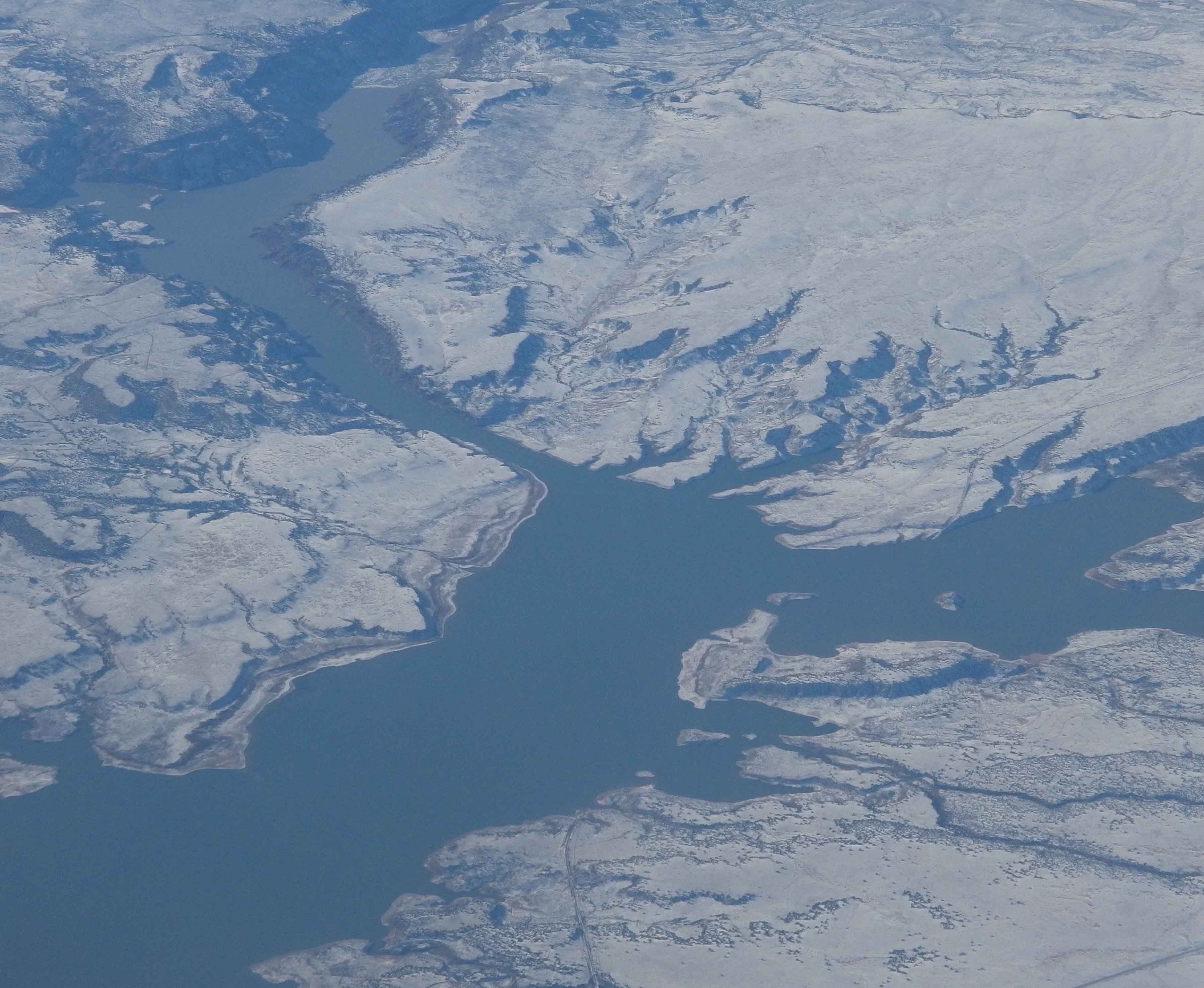
Couple of photos from the plane:

{Image:  photo taken from a plane of a river with snow-covered banks.}

{Image:  Photo of mesas taken from plane.}

{Image:  photo of mesas taken from plane.}

Little bit of a bumpy landing:

{Image: photograph of clouds taken from airplane.}

The Albuquerque airport.  The light and coloring in the west are so amazing, even the airport is beautiful.

{Image:  photo of airport taken from the runway.  The building is a light pink adobe and the jetways are all turquoise.  To the right of the jetways, the building contains large mirrored windows in the shape of New Mexico's  state symbol.}

Now ensconced in the Sunport’s faux western workspace, pretending to edit a brief (hi, co-counsel!) while in fact playing with photos and receiving regular Bronco updates from Tim.

More from the photo archive

This time, from my Dad’s experiences at the Sebago School and Camp Ironwood, run by Matt and Margaret Werner in St. Louis (school) and Harrison, ME (Ironwood).

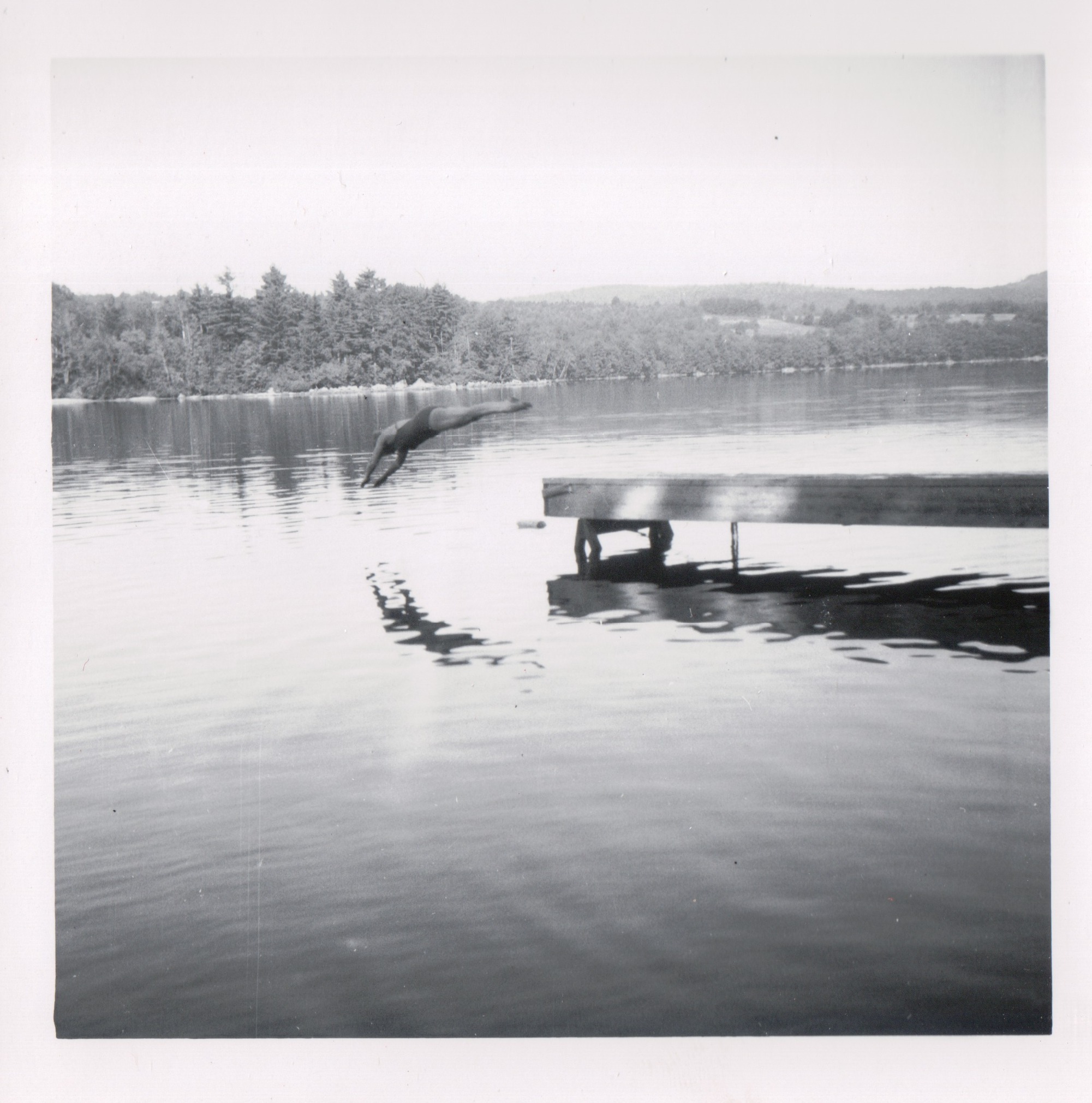
From the camp — I just loved these first two:

{Image: black and white photo of a person diving off of a dock into a lake.  The diver's image is reflected in the lake.}

{Image: black and white photo of a person diving into the water, but all we see is the person's legs, perfectly straight, angled from their toes at the center of the photo to the bottom right where their torso disappears off the edge of the photo. To the left are several canoes, and in the background, a boat.}

{Image:  black and white photo, taken from above looking straight down on two people sitting by the side of a stone building.  The person on the right is wearing saddle shoes and has their feet extended in front of them, with a plate of food on their lap.  The person on the left is wearing a sleeveless undershirt and holding a drink  (coffee?) in his left hand.  The photographer's feet on the edge of the building above are visible in the foreground.}

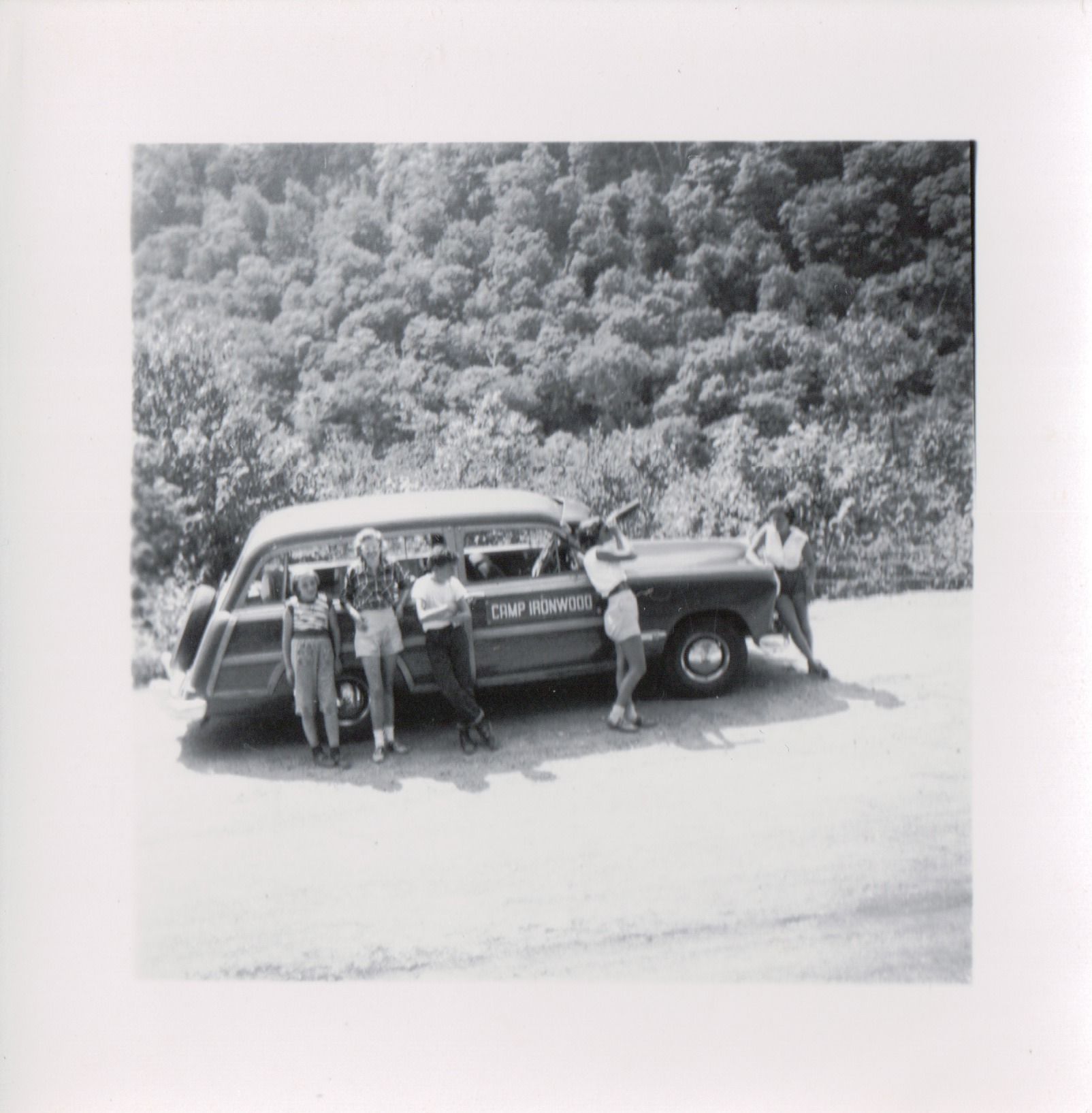
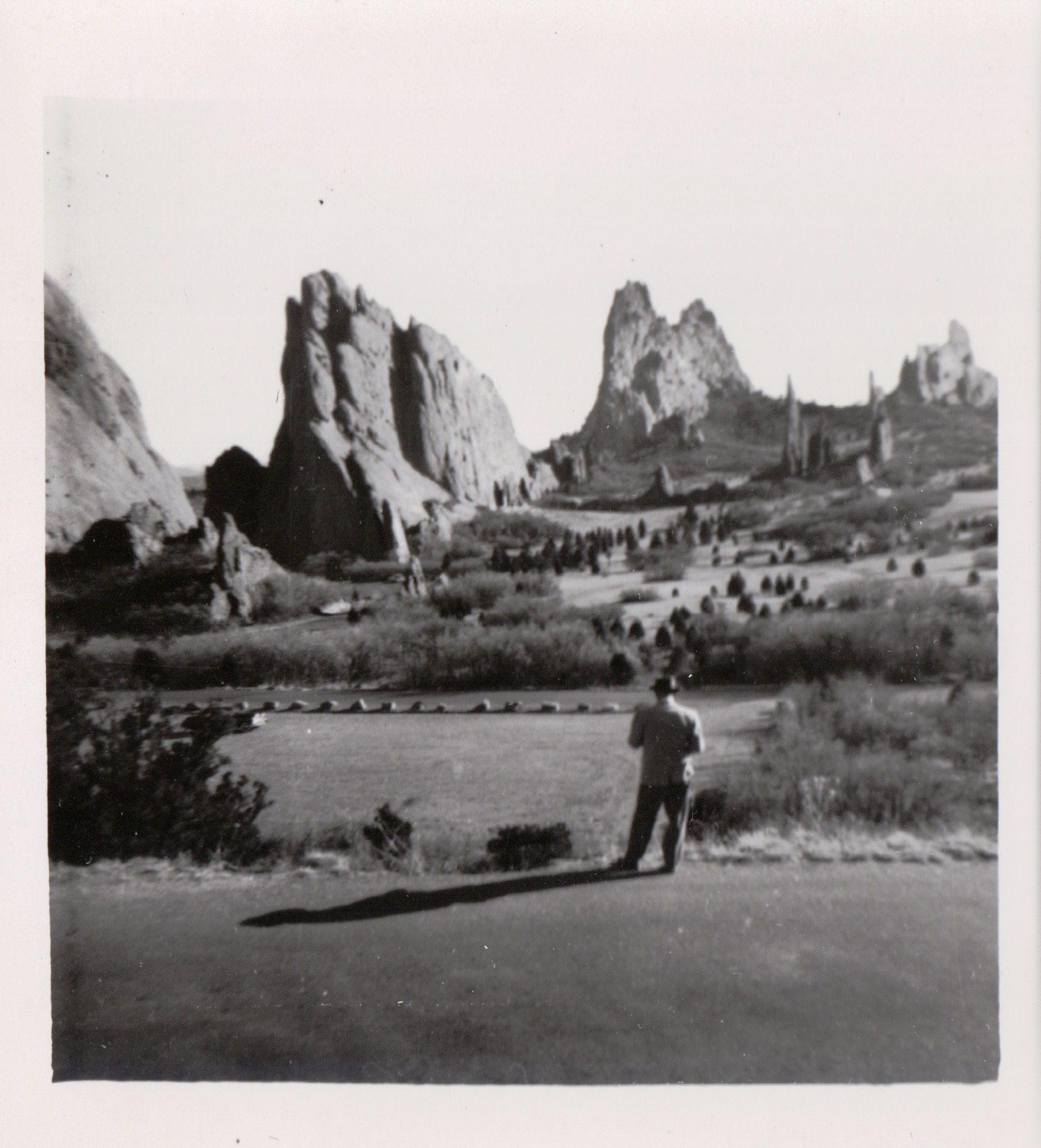
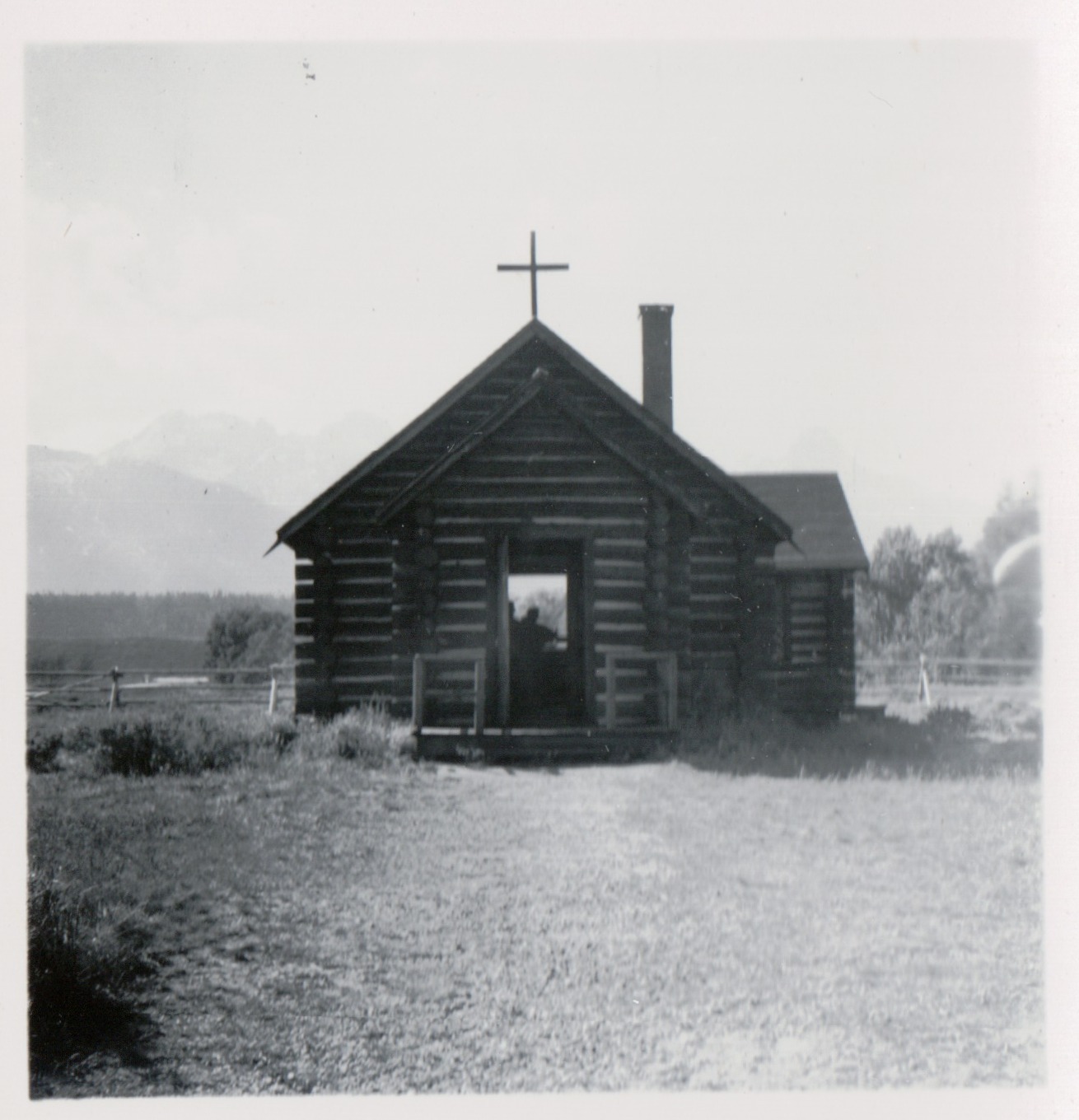
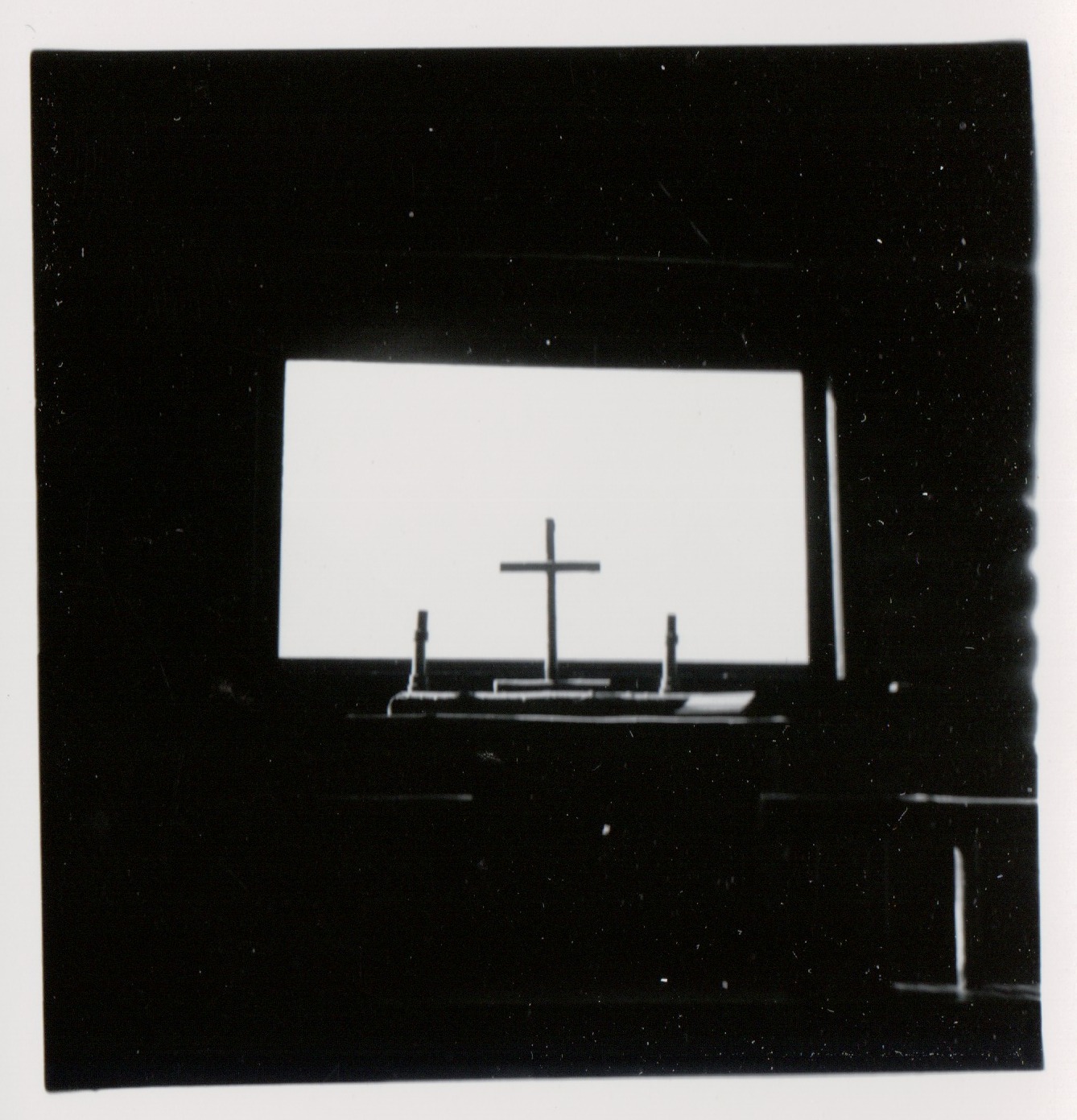
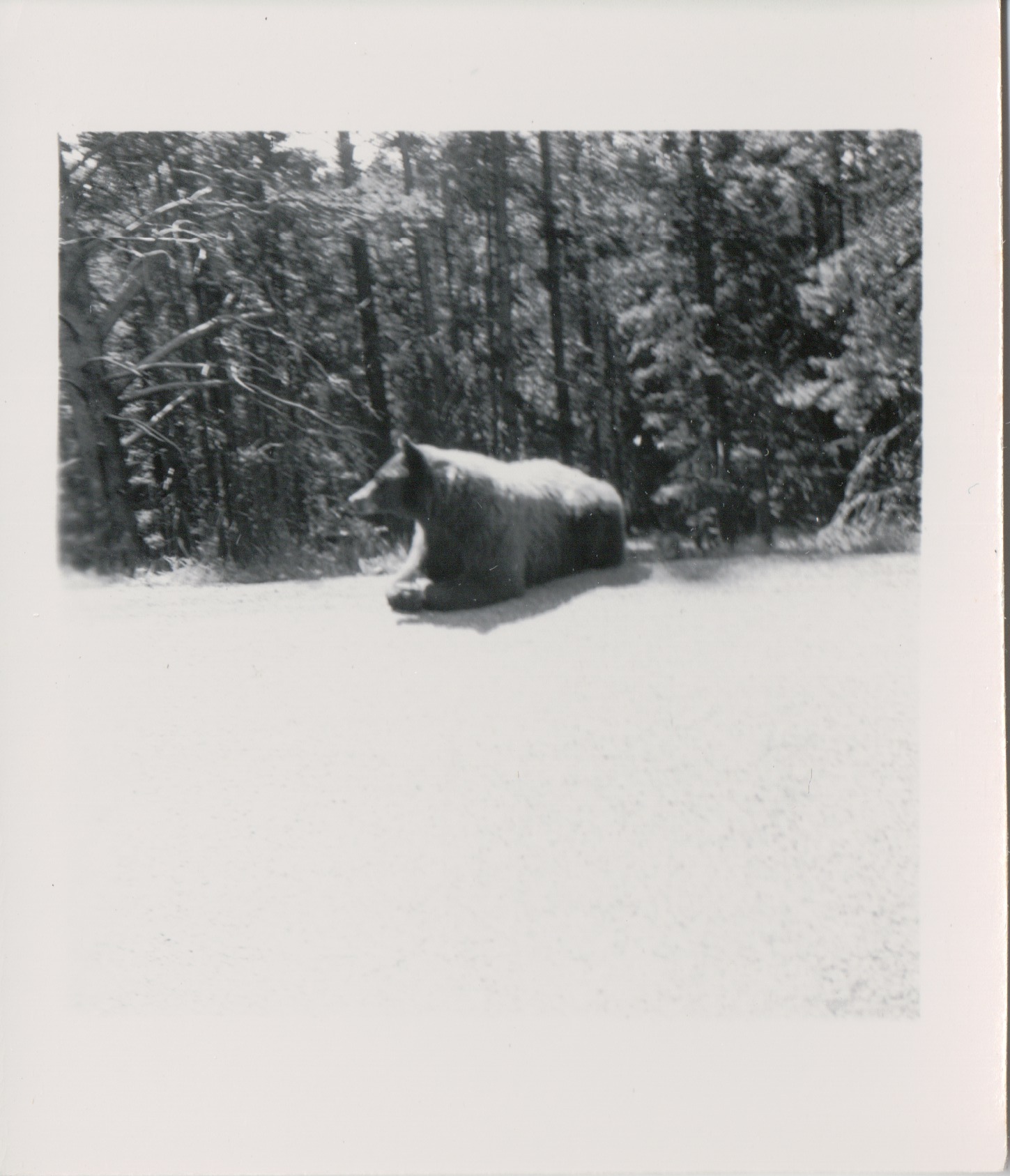
The next few are from a driving trip the school/camp took through the western United States:

{Image:  1940s wood-paneled station wagon parked at the side of the road.  Five teen agers lean against it, one of whom is looking through a lens of some sort; the others facing the camera.}

{Image:  black & white photo of Garden of the Gods, which is a series of rock formations in a high-desert landscape.  A man is in the foreground looking at the scenery.}

{Image: black & white photo of a narrow alley with brick buildings on either side and passageways overhead.}

{Image:  Black & white photo of a small log church with a cross on top.}

{Image:  black and white photo of a rectangular window with a cross silhouetted against the middle.}

{Image: black & white photo of a large bear crossing a road.}

{Image: black & white photo of a large bear resting by the side of a wooded road.}

To Russia With Love

I’ve been gradually scanning my father’s photos, posting them to Flickr, and encouraging my family — especially my mother — to comment so as to identify names and places that are unfamiliar to me.  I recently scanned the photos from my parents’ travels during the summer of 1959, including a trip to the Soviet Union.

I posted the photos and invited my mother to tag and comment . . . and ended up with mentions on a number of Russian websites, a couple of Russian commenters on Flickr offering their thoughts on the photos, and over 50,000 views since the photos went up a week ago.

With the help of Google Translate and my mother, who speaks Russian, I’ve been learning more about the photos and commenters.

For example, here is a Live Journal page by “Finnish Passenger

{Snip from LiveJournal page in Russian. Translated below.}

Google translates this as:

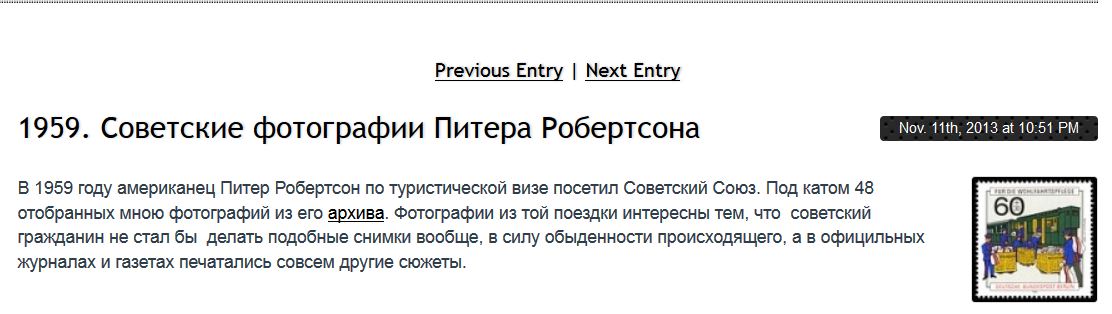
In 1959, the American Peter Robertson on a tourist visa to visit the Soviet Union. Under the cut I have selected 48 photographs from his archive. Photos from the trip are interesting in that a Soviet citizen would not do at all these pictures, because ordinary is happening, and in ofitsilnyh magazines and newspapers printed entirely different subjects.

Yeah, the translation is a bit rough.

Another Russian blogger turned the photos into a guessing game and then provided answers (in addition to the answers in the comments).

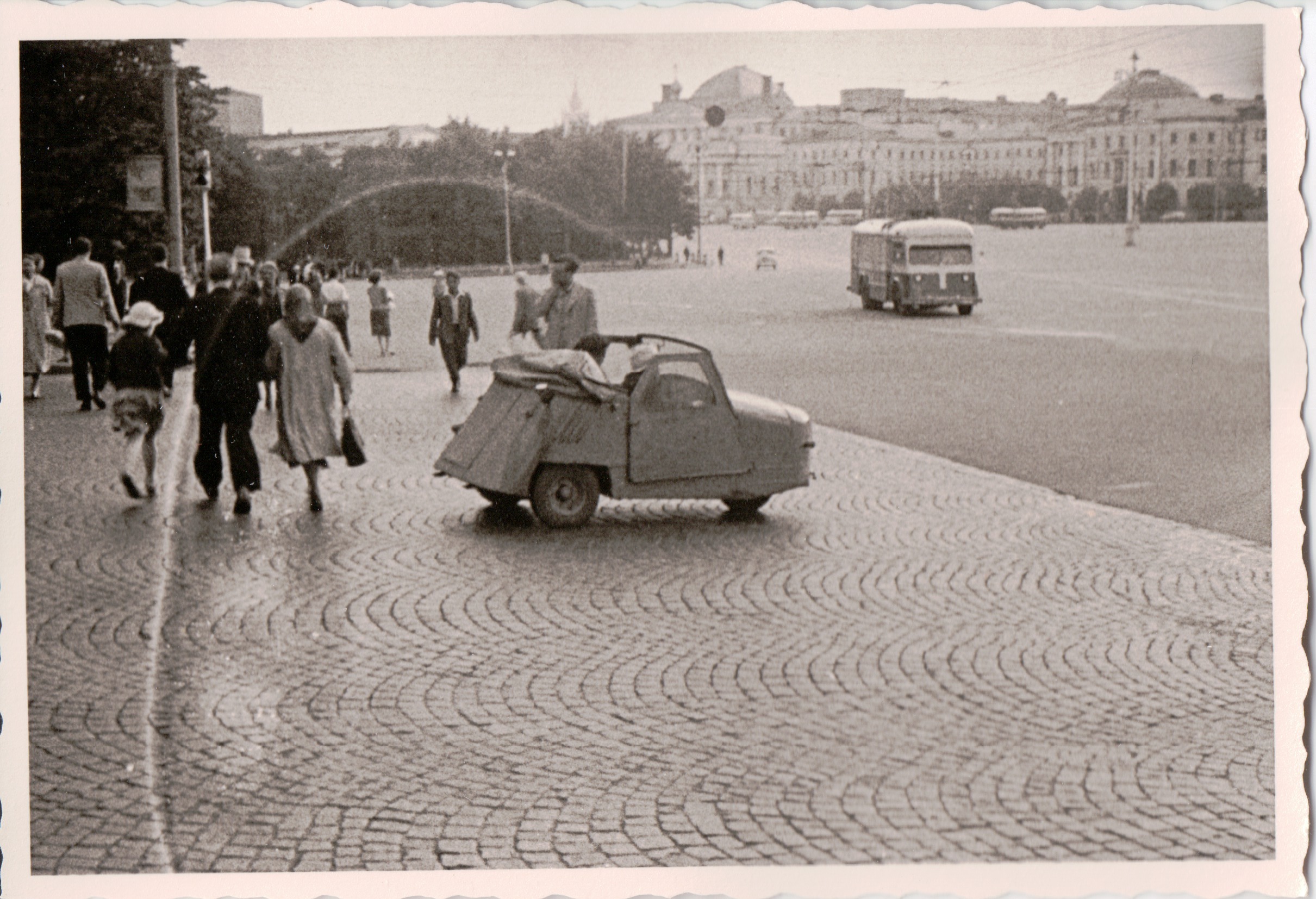
My favorite of the bunch is this photo and some of the commentary around it:

{Black and white photo of a cobblestone street and sidewalk.  In the foreground is a very small three-wheeled vehicle, suitable for at most one person, open on top and looking almost home-made out of pieces of welded steel.  In the background are pedestrians and in the far background, indistinct buildings.}

I had no idea what this was.  A Flickr commenter, Leonid Paulov, explained,

Machine for the disabled. When I was 8 years old living in Kazakhstan. Roads there was not. After the rain this car off the road. The driver of a war veteran with Germany very loudly berated those who made this car

Remember, this is Google Translate talking, so it’s not that everyone in Russia actually sounds like Boris and Natasha.  Mom did a better job with the translation:

It’s a machine for disabled people. When I was 8 years old, I lived in Kazakstan. There were no roads for automobiles. After it rained, this machine could go out on the shoulder. A bus driver who participated in the war with Germany loudly berated those who made this automobile.

I asked:

So this is car that would be used by a disabled person? Like a wheelchair with an engine?

Mr. Paulov responded,

Yes, this is the first vehicle for persons with disabilities in the Soviet Union manufactured 60 years ago.

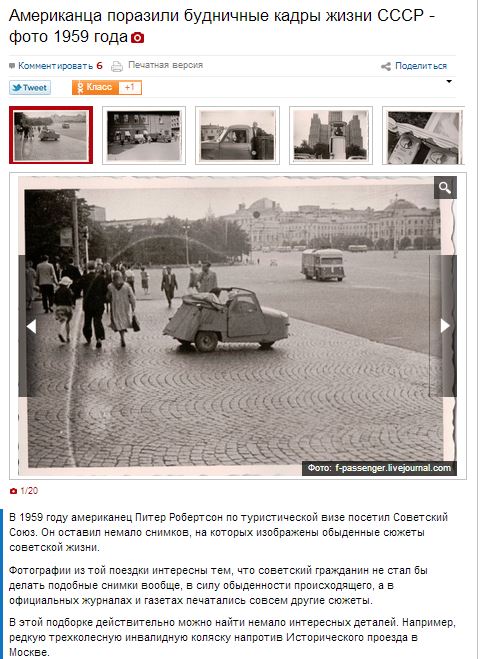
Still not clear on the role of the veteran/bus driver.  Here’s another Russian site commenting on the same photo.

Gazeta in Russian

The last paragraph reads,

In this collection you will actually find a lot of interesting details. For example, a rare three-wheeled wheelchair in front of the historic journey to Moscow.

There were a number of photos of women working on roads or in the fields.  One commenter noted  —  tersely but (to me) poignantly — that, because of the war, there was a dearth of men:

{Image snipped from a blog showing a black and white photograph of women working on a road and Cyrillic (Russian) letters in a caption above the photo.  The image also includes an icon representing the commenter, who looks like a buff comic book hero.}

(Pretty buff commenter, though, eh?)

A theater showing “War and Peace.”
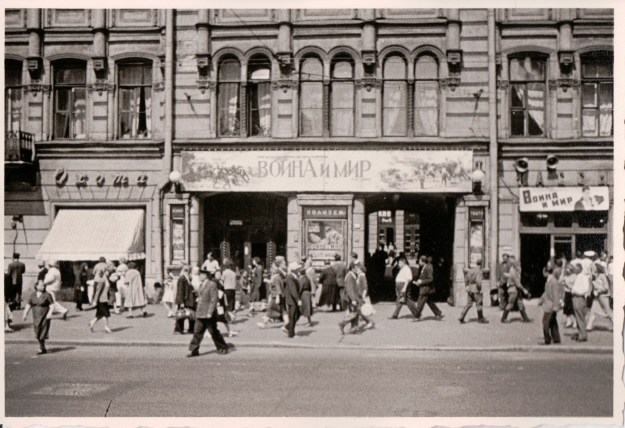
{Black and white photograph of people walking in front of a building with a large banner in Russian.}

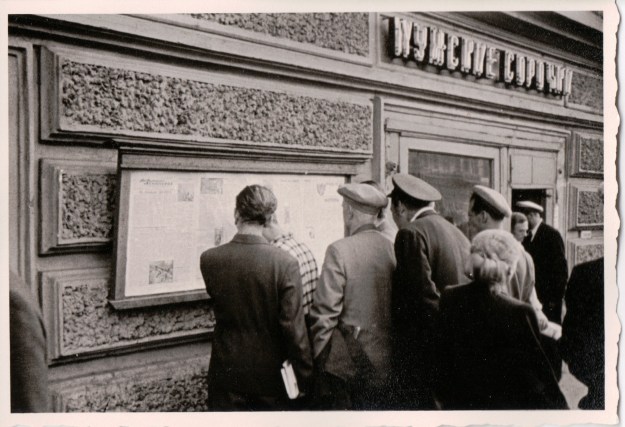
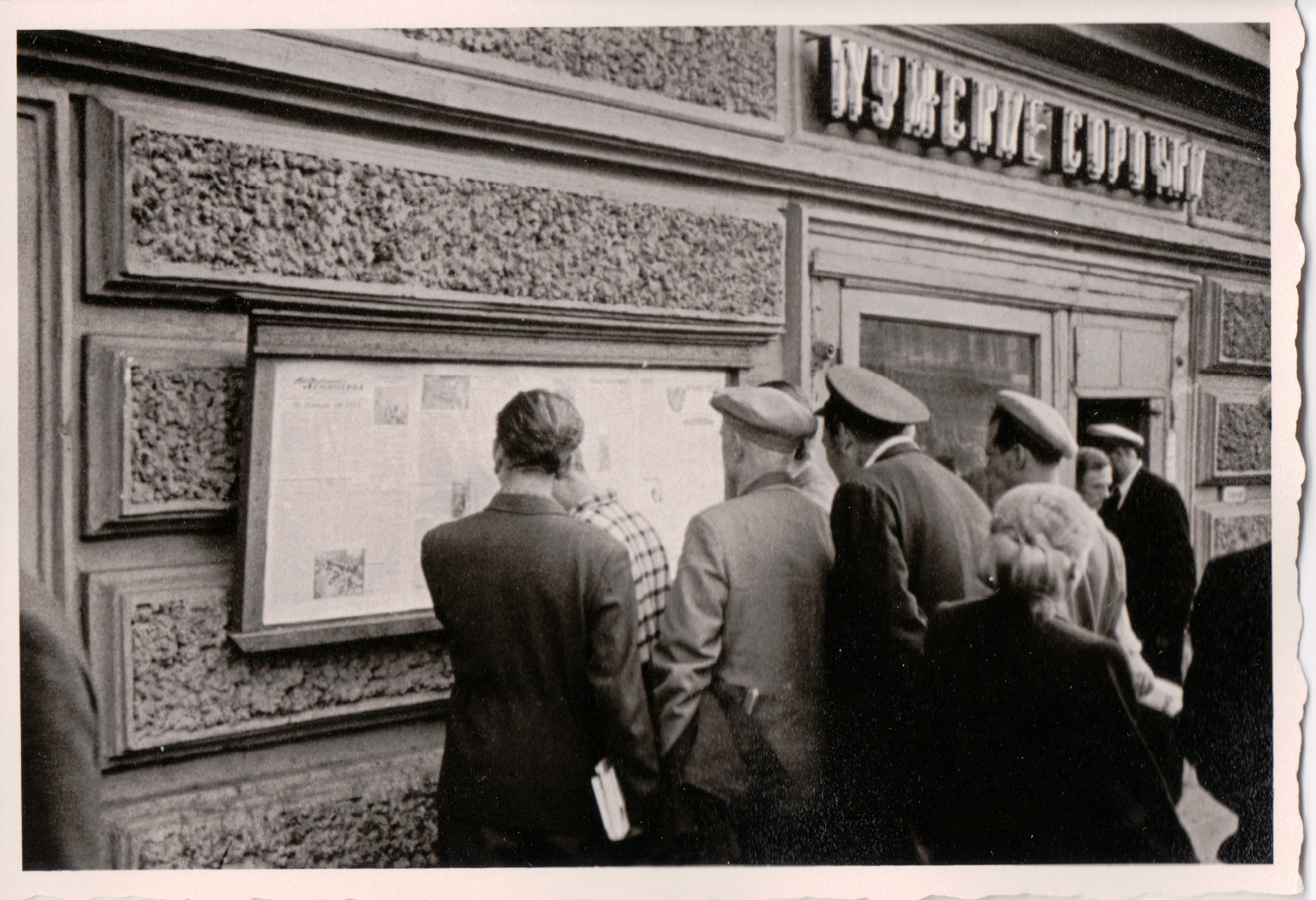
Reading the newspaper:

{Black and white photo of men gathered in front of a newspaper that is posted on the exterior wall of a building.}

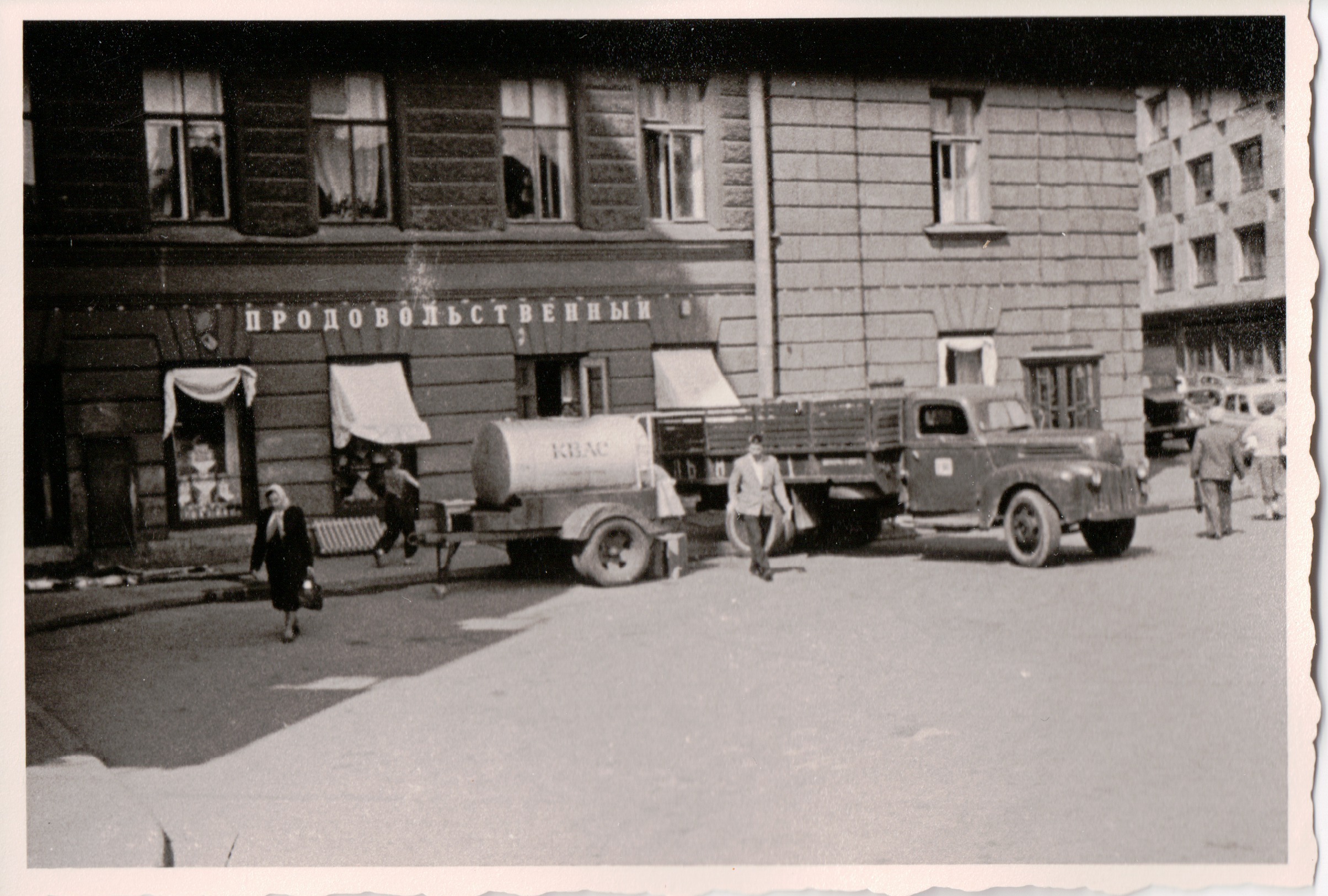
The photo below is apparently a tank of something called kvass, which my mother described as a drink made from fermented rye bread.  Truly a testament to the ingenuity that can arise from the combination of great deprivation and great thirst.
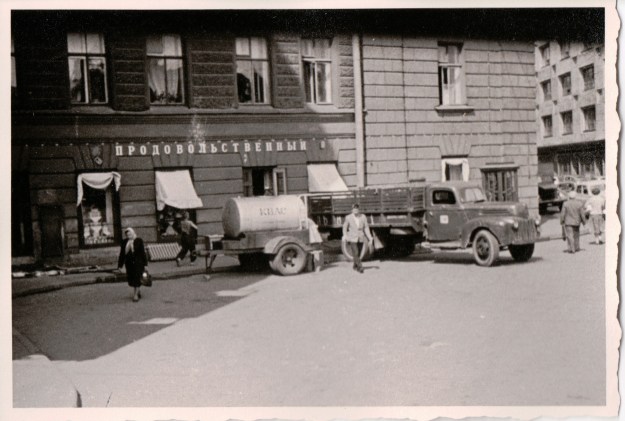
{Black and white photo of an old time pick up truck towing a small tank of liquid, parked in front of a building.}

The sign says “place for feeding pigeons.”  And that’s Mom — in her travel gear — a far cry from the jeans and hiking shoes I wore for my post-college travels.

PCR-1444

The requisite giant portrait of Khruschev.

{Black and white photo of a building with a giant portrait of Nikita Khruschev leaning against the columns in the front of the building.  The portrait is over twice the height of a man standing near it.}

and the people tasked with schlepping the giant portrait:
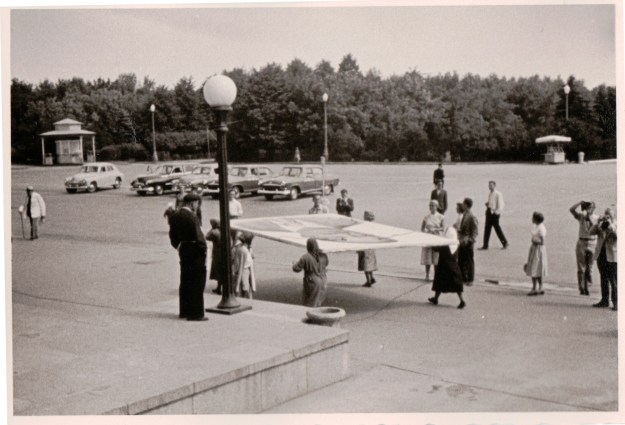
{Black and white photo of a giant portrait being carried horizontally by five women in scarves.}

More to come in a future post — by me or perhaps a guest post by Mom!

Photos from LA

I’m in LA for the Disability Rights Legal Center’s Disability Rights Summit.  Great event. Saw lots of old friends and put lots of faces to internet names.  Presented on fair housing with Fernando Gaytan, a wonderful attorney from the Legal Aid Foundation of Los Angeles.

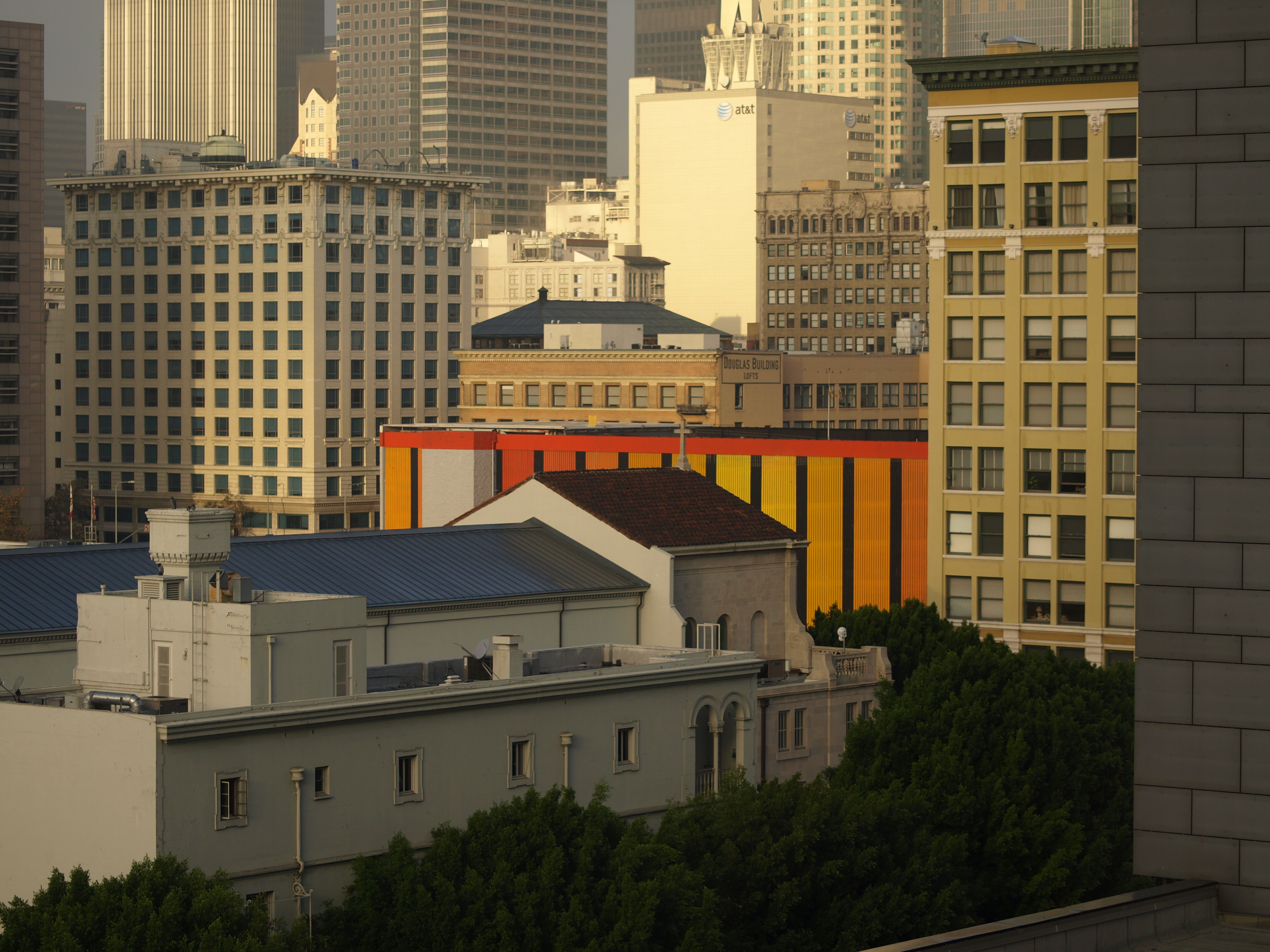
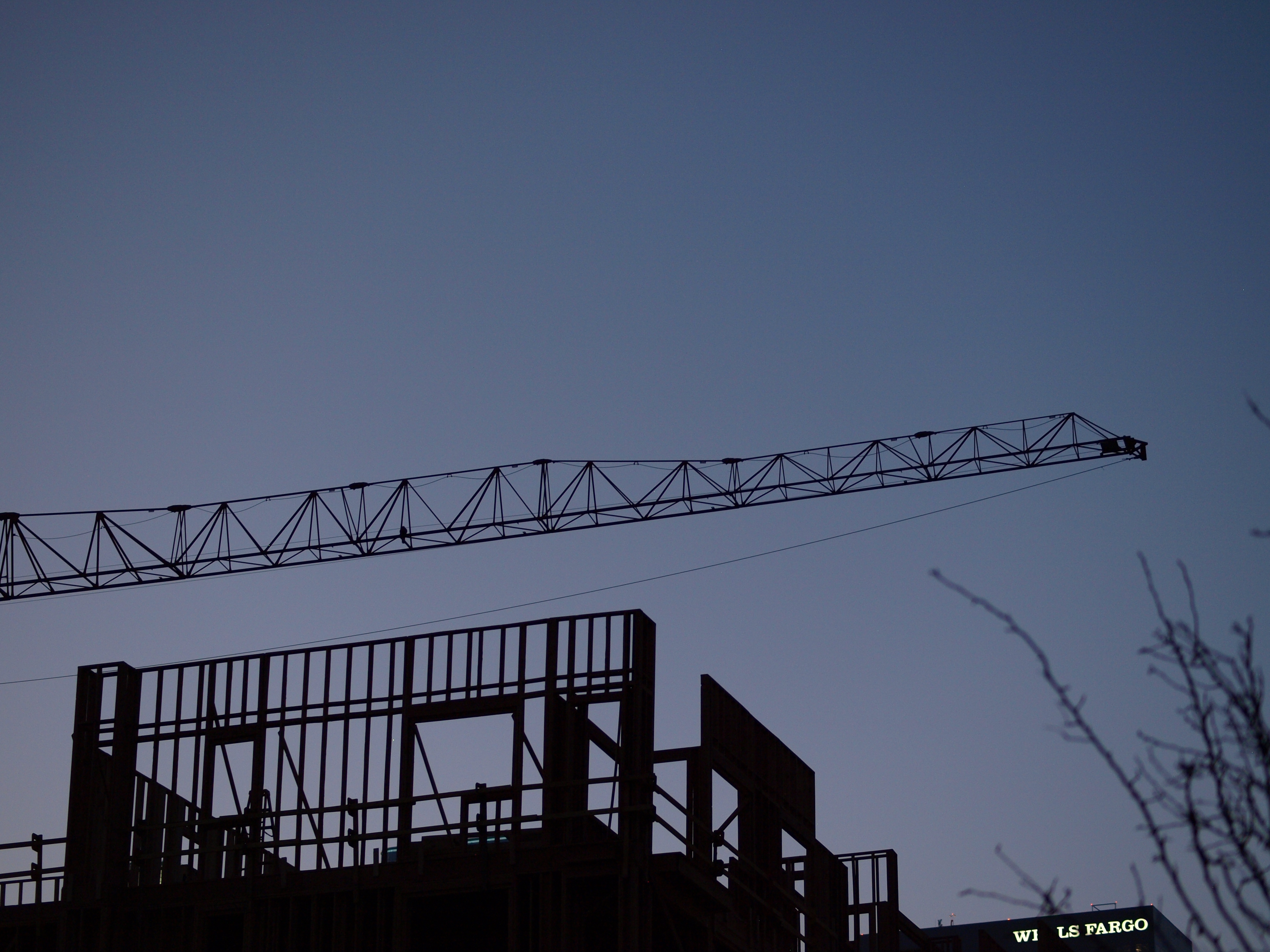
Couple of photos:

Photo of buildings. Most are beige. One low building in the center is bright red and yellow.


Photo of the side of a building with brick shaped windows, some of which are open and jutting out.


Photo of construction crane and building framework at dusk.


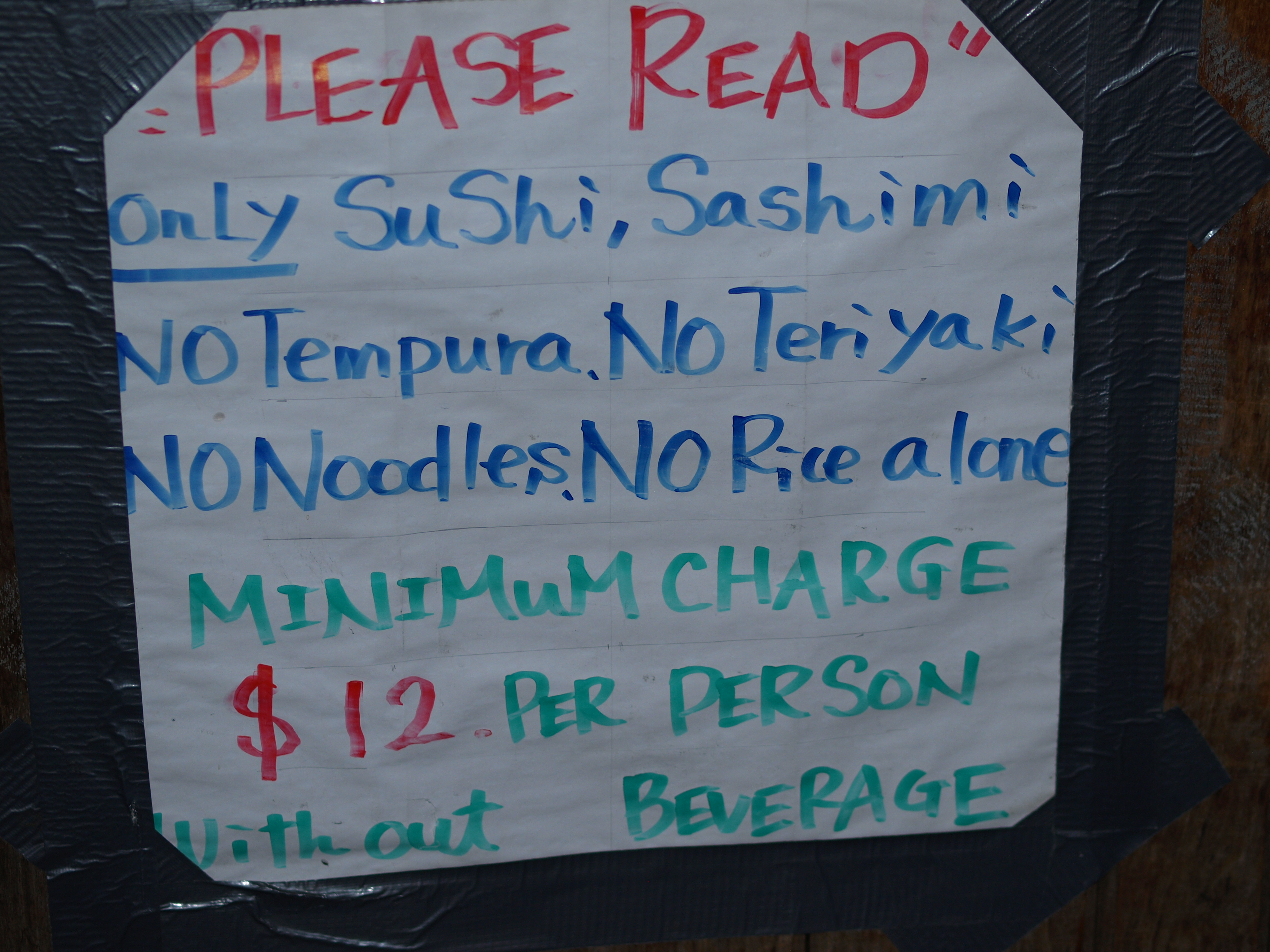
Had dinner at Hama Sushi, where they really really really only serve sushi.

Photo of hand-lettered sign that reads "please read. only sushi, sashimi. no tempura. no teriyaki. no noodles. no rice alone. minimum charge $12 per sperson without beverage."

And it was magnificent!!!

What is it about Mountain Time that confuses coastal peeps?

There are 4 time zones.  If you’re from the East Coast, they go -1, -2, and -3.  If you’re from the West Coast, they go +1, +2, and +3.  It’s as if east coasters say, “I can subtract 1 and I can subtract 3, but subtracting 2 just baffles me!”  And the equivalent for west coasters.

A woman stopped me in the Denver airport yesterday and asked the time.  I told her.  She reacted with great skepticism and confusion because the answer I gave (“4:15,” for the record) did not fall into one of the time zones of which she was aware.  So she demanded an explanation of how this bizarre Land of the Mountains related to other, better known, time zones.  Seriously, we had to have that discussion, while I justified the existence of our little chronological slice of the country.

And don’t get me started on the networks that tell you the show is at 9:00, 8:00 Central, and 6:00 Pacific.  Um, guys? Hellooooo?

If you can successfully count to 4 without missing any numbers, you can figure out Mountain Time.

Beautiful as our mountains are, I think we need a better name.  No one, but no one, will ever loose track of Craft Beer Time.

A Heartwarming Moment at DCA

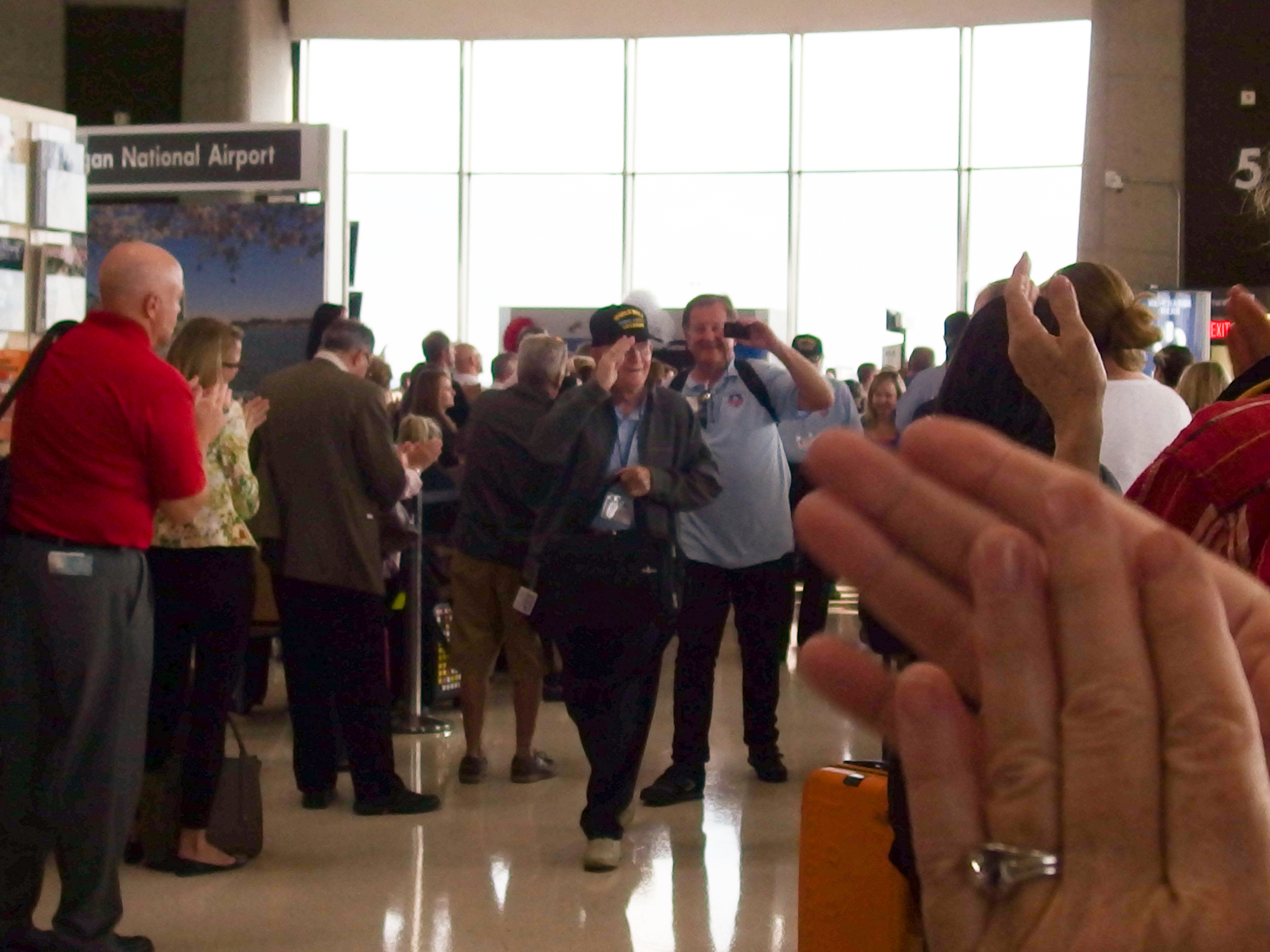
I was at the end of more than a week of travel — two separate trips, one frantic day of laundry and work in between, flying, driving, more driving, new people, familiar people, introvert-stressing PEOPLE all over the damn place.  Finally back at DCA ready to fly home, tired, grungy, grumpy … when I started hearing applause across the terminal.  Sustained, widespread applause.  Turns out a planeload of World War II veterans were flying in for some sort of ceremony.  The airline had announced this, and all of my fellow frazzled Friday-afternoon flyers had lined up on each side of the path the vets traveled from the gate all the way to security and were enthusiastically applauding.

 In the center of the photo is an older man with a ball cap showing he is a WWII vet. He is walking through an airport terminal surrounded on both sides by lines of people clapping for him. In the right foreground is a woman's hands, clapping. To the left are more people --- a man in a red shirt a woman in a green flowered shirt , a man in a suit -- all clapping.

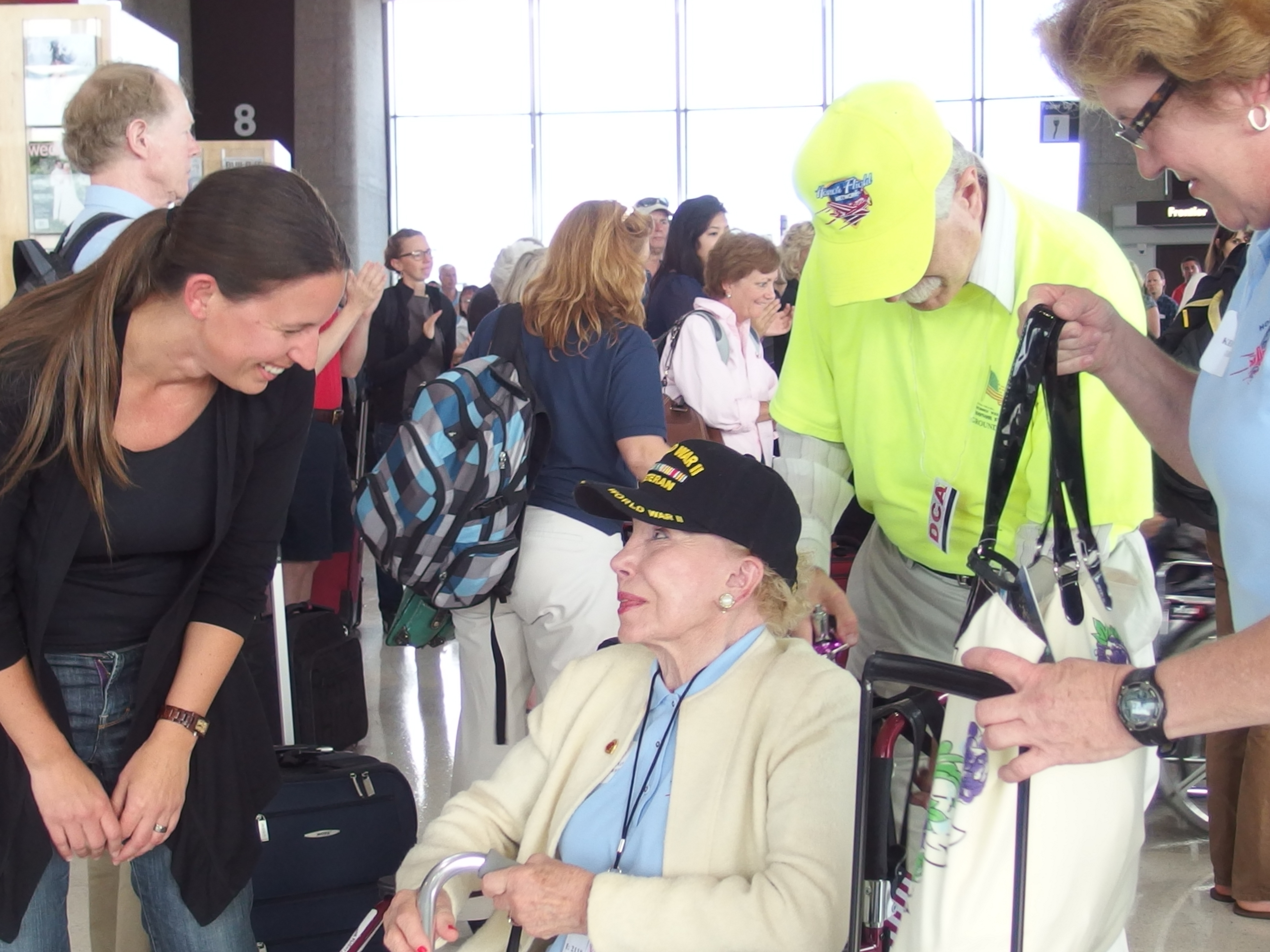
Some of the wildest applause came for the handful of female veterans.

An older woman in a wheelchair in an airport terminal.  She wears a ballcap that says World War II veteran.  She is beautiful and is wearing elegant make up, nail polish and jewelry, as well as a blue polo shirt and white sweater.  To the left of the photo, a younger woman leans in, smiling, to speak to the woman in the wheelchair, while a man in a bright yellow shirt and hat stands behind the wheelchair.  In the back ground, a crowd of people look toward an airport gate, clapping.

And they had a lone musician — a French horn player — playing in each group of vets with a patriotic — or at least jaunty — tune.

To the right of the photo, an older man in a straw hat with a red and blue hat band sits holding a French horn, looking toward a music stand with sheet music.  In the background, an airline terminal with passengers standing facing the same direction as the musician, some clapping.

After he had exhausted military and patriotic classics like High Flying Flag, that Marine tune that always comes through in my head as “Be Kind To Your Web-Footed Friends,” Battle Hymn of the Republic and — to my extreme joy — This Land is Your Land, he turned to random jauntiness:  She’ll be Comin’ Round the Mountain; I’m a Little Teapot; Oh Susanna!

It was a truly wonderful thing.  The vets were beaming, the crowd was smiling and — here and there — tearing up.  It took all of us out of our various travel modes (grumpy; hostile; exhausted) and brought us together for a few minutes, appreciating the hard work and real sacrifice of these amazing people.

Random signs

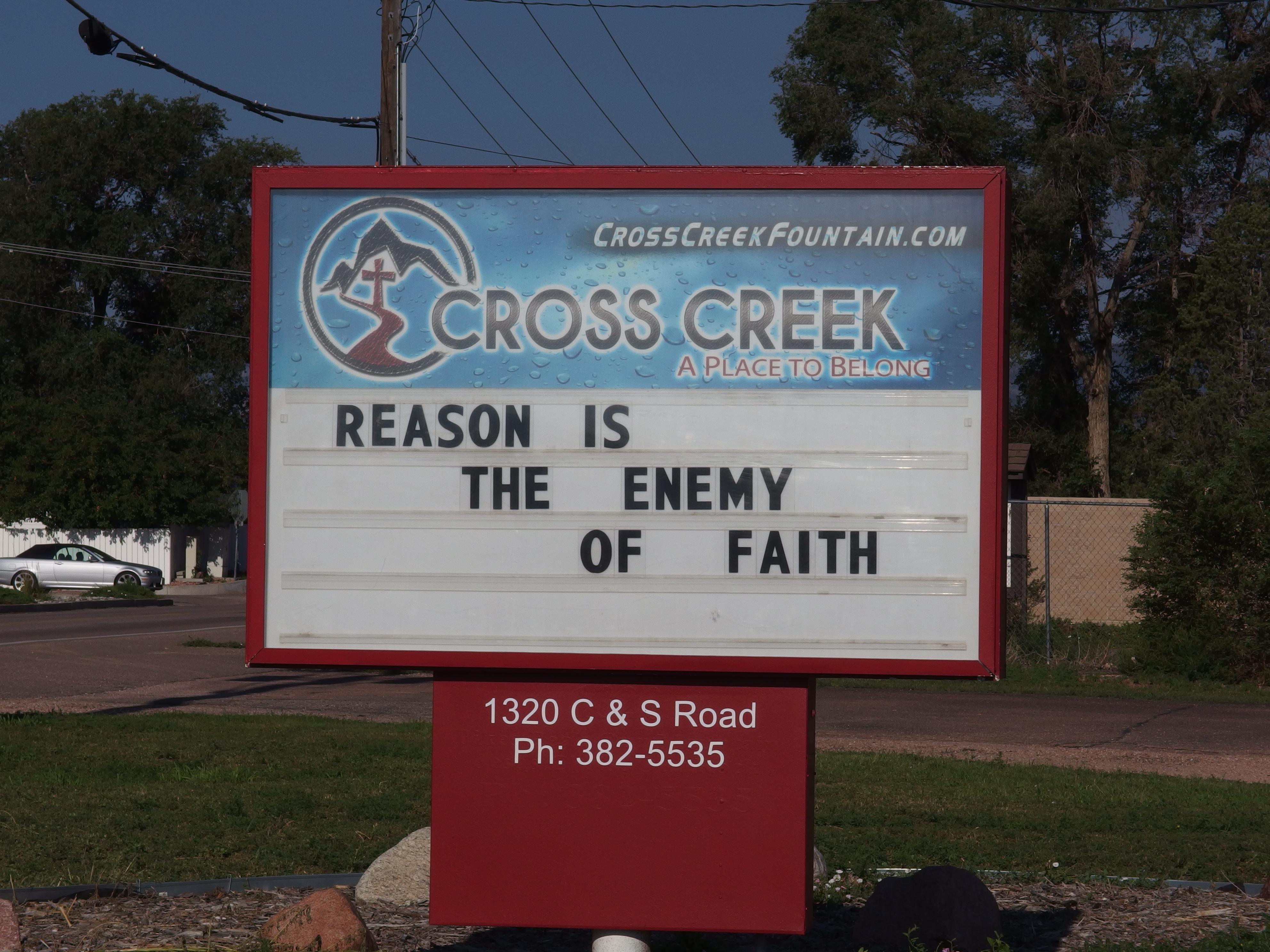
Drove to Fountain, Colorado, today.  I promise both of these signs are real.

Um, no:

{Image description:  Church sign reading “Reason Is The Enemy of Faith.”}

And, um, I’d never really thought about it but yes:

{Image description:  Green street sign against a blue sky, reading “A Dog Will Lick His Butt But Won’t Eat A Pickle Rd.”}

The ramps of Route 1

[Cross-posted at CREECblog.]

Every summer or so, we visit my brother and his family at their place in Maine.  To do this, we generally fly into Boston and then drive the four hours from Logan to mid-coast Maine.  The first three hours are on I-95; the last hour or so on Route 1 from Brunswick to Thomaston.  It has long struck me, as we meander up the barely two-lane road — often at 30 mph behind a giant RV or tractor — the amazing number of very small businesses that have ramps.

This past weekend I made the trip with no deadline and no one else in the car, so I had the time* to take some photos of these examples of readily-achievableness. (Ready achievability?)**

Disclaimer, because every now and again some defense-side attorney (hi, guys!) may read this:  I did not evaluate these ramps for compliance with the Standards.  I don’t know their dimensions or slope.  If you try to introduce this as evidence in one of my cases, I will file a Motion for Judicial Notice of Completely Missing the Point.

The first couple were actually near Manchester, NH, where I had taken a detour to visit a college classmate.

Small free-standing store with parking lot.  Store has steps in front and a ramp up the side starting from the back of the store and rising to the middle of the right hand side.
These next two are churches, which aren’t even covered by the ADA (unless they have some sort of commercial business on the side):

Front view of white building with three steps at the front entrance (in the middle of the front of the building) and a ramp extending from the entrance along the front to the left side of the building.  Ramp has a sign that reads, "Christ Died for Our Sins."


Photo of beige church building with the words "Saint Peter" on the front and a ramp curving around to the right side of the building.


Onward to Rte 1:

One story building with front porch accessible by a short ramp in front of the building.

This actually might have been someone’s house.  Along Route 1, the distinction between house and business is often sort of vague.

Gabled grey house with wooden ramp extending from the front door and curling around to the right in the front yard.  The base of the ramp is white lattice work and flowers grow along the front of the base.

Just north of Wiscasset.

Small free-standing red building with a ramp extending from the middle of the front off to the right.

Jean Kigel Studio, Damariscotta.

One-story building viewed from the side where a ramp provides access up onto the porch.

Cheap cigarettes in Waldoboro.

One-store store with a sign in the front reading "Cheap Cigarettes."  The front door is served by a short apparently level ramp with a slighly sloped portion at the end.

Somewhere south of Thomaston.

House or business with approximately five steps to the front door and a ramp to a side door on the left.

The Hair Loft, Warren, Maine.

One-story building with a sign reading "Hair Loft."  The front entrance is on the left side of the photo, served by approximately six steps.  The door is also served by a ramp from the door leading to the right of the photo.

Unidentified business, Warren:

Front of a two-story house or business with a wide metal ramp leading to the front entrance.

The famous Moody’s Diner, Waldoboro:

White building with neon sign reading "Moody's Diner" on the roof.  A ramp is positioned along the left side of the building leading up to the entrance in the middle.

Ralph’s Homes, Waldoboro:

Freestanding white building with a long switch-back ramp serving the front entrance, which is up approximately six steps.

Random business south of Waldoboro:

Red building with approximately 3 steps to a porch serving the front entrance.  A ramp serves the porch as well.

The Nobleboro Antique Exchange:

Blue two-story building with a switch back ramp serving the porch and front entrance.  Sign in front of the building reads "Nobleboro Antique Exchange."

So next time you hear some fancy store or chain claim that it’s not readily achievable to ramp their business, here are some examples to, in legal terminology, call baloney.***

*****************

* My leisurely pace turned out to have been a good plan for another reason:  when I got to my brother’s house, he and his family were out and their house was guarded by their snarling goldendoodle.  Seriously.  This dog

Benign-looking light brown dog, sized somewhere between a poodle and a golden retriever, with a multicolored color, sitting on a lawn looking to the right of the photo.

exiled me to the hammock until my hosts returned to chaperone my canine interaction.

I was not suffering:

Legs and feet of photographer on hammock, sunny Maine seascape in the background.


** Under the ADA, buildings built after January 26, 1993 were required to be accessible.  42 U.S.C. § 12183(a).  Those built before that date and not altered since must remove barriers — by, for example, ramping entrances that are only accessible by steps — where it is “readily achievable” to do so.  42 U.S.C. § 12182(b)(2)(A)(iv).

*** I might have used a different word if not for the cross-posting, but I’m trying to keep it clean on CREECblog.

No, I’m not “with the wheelchair.”

I’m “with the passenger in a wheelchair” or perhaps “with the passenger who uses a wheelchair,” or most accurately, “with the hot guy using a wheelchair.”

But I guess this makes the distinction clear:

IMG_1004


If you are a “wheel chair” or a stroller, you are not a “passenger.”  You are your equipment.

And airline people, you don’t have “two wheelchairs on the plane.”  As a matter of empirical fact, you have zero wheelchairs on the plane.  You have two people who use wheelchairs who are waiting patiently on your plane for the doofuses (doofi?) in your ramp crew to figure out how to get their wheelchairs to the jetway.

I realize there are other circumstances in which an object associated with a person comes to stand for the person.  “Suits” comes to mind, to mean the dweebs in the organization who are imposing rules on the real people who want to create/get things done/think outside the box.  It’s not a compliment.  “Brass” for officers, perhaps.  “Uniforms” to distinguish beat cops from higher ranking detectives.  I would put “wheelchair” as a substitute for the person in a very different category, though, largely because I only hear it from people in a position to treat the people themselves as objects.

I don’t take a position on the people-first language discussion, that is, whether it is better to say “disabled person” or “person with a disability.”  Both seem better than “the disabled,” but as my disabled friend/friend with a disability Laura Hershey would say, English puts its adjectives before its nouns, so “disabled person” puts the focus on the person, it just does so grammatically.

But once you’ve taken the person out of the equation completely and substituted the thing, you’ve left the realm of grammar and made a decision to depersonalize.

The funny thing is, I always respond — when I hear this — “no I’m not with the wheelchair, I’m with the guy in the wheelchair”  or to the airline peeps, “actually, you don’t have two wheelchairs on board, you have two people who use wheelchairs.”  But no one even gets the difference.

Sigh.

Happy Birthday, Dad

Miss you every day.

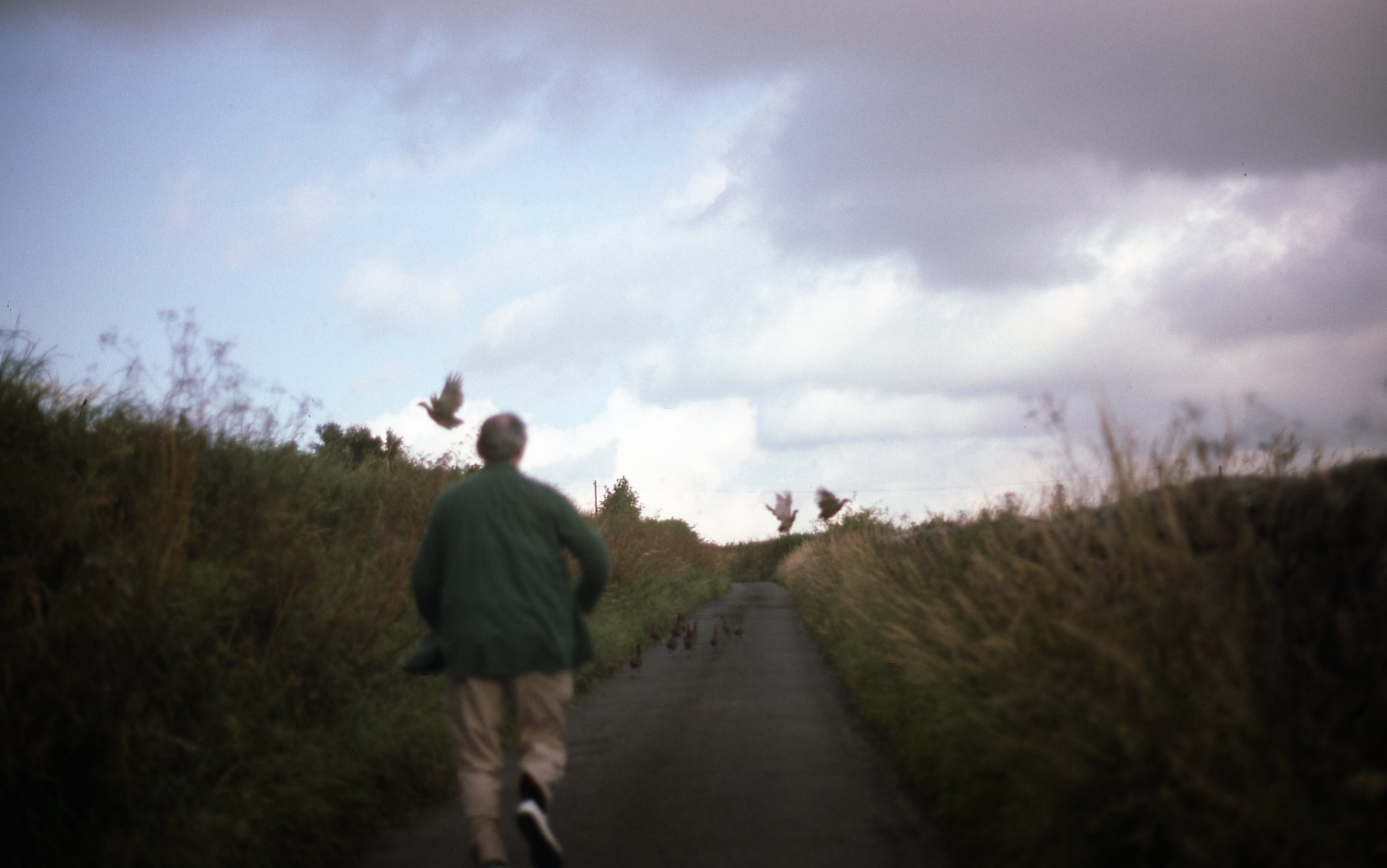
Photo from a trip to Scotland in 1985.  I was taking the long way home from Taiwan to start law school in the fall, and we met up in London, drove around England and Scotland, and ended up at a friend’s wedding in Edinburgh.  Driving was an adventure, including England’s almost impossibly narrow country roads, which we shared with all types of wild and domesticated animals.  Here’s Dad attempting to clear the road of flock of ducks who insisted on waddling rather than flying.

And where but Scotland could he find a store bearing his name: