We Did Not Build this Country on Sensitivities

I’m becoming a huge fan of Michael Bloomberg. He has the brains to understand our constitution, the balls to support it even when it’s complicated or hurtful, and the words to explain to the rest of us that

if we say that a mosque or a community center should not be built near the perimeter of the World Trade Center site, we would compromise our commitment to fighting terror with freedom. We would undercut the values and principles that so many heroes died protecting.

Amen. Read the whole thing.

The Muslim-community-center-somewhere-in-lower-Manhattan-just-around-the-corner-from-the strip-club-and-BBQ-joint controversy is quickly becoming one of my favorites of all time, and not only because I’m having so much fun reading Bloomberg’s latest rhetorical demolition of the chickenshits who would enshrine fear and prejudice so close to the site where our enemies tried send the very same message.

No, this one rocks — with apologies to the unfortunate African-American construction worker who got heckled for simply being Black in the vicinity of Ground Zero — because it is so rife with right-wing hypocrisy.

For example, one of the righties’ new talking points is that they’re not prejudiced (no! no!), they’re just questioning the source of the money. You know, it comes from that Arab guy, the one who, oops, owns a large chunk of News Corp, and hangs out with the Bush family.

OK, yes, I get my news from the Daily Show. Laughing at the news is the only way it’s bearable these days. But I challenge any mosque-fearing righties to explain why Saudi money is scary when it’s funding a community center but not when it owns a big piece of a major right-wing propaganda machine.

I’m also loving the fact that my gun-shop-near-Columbine example turned out to to be not only snarky but (almost) TRUE!! The NRA was asked to move its convention from Denver the year after Columbine based on (wait for it) sensitivities. Charlton Heston explained, correctly, that “American must stop this predictable pattern of reaction.”  (It’s at the 7:24ish mark, though Jon Stewart is pretty funny, t0o.)  We can’t blame the NRA for the acts of two disturbed kids, and we can’t blame an entire religion for the acts of thugs who profess its beliefs. And most of all, we can’t compromise our laws and values in the name of sensitivities.  We are tougher than that. We did not become a beacon to the rest of the world by whining every time someone did something that hurt someone’s feelings.

Update: No longer funny. “A city cab driver is in the hospital after being stabbed by a passenger who allegedly asked if he was Muslim, police tell NY1.” It’s a pogrom. Suck on that, Abe Fucking Foxman.

Update 2:  This appeared on the Facebook page of someone I don’t even know, but I thought it was cool.  After subjecting the question to quantitative analysis, the clear conclusion is:  Get A Grip!


Red Hook Road (with spoilers) and Parents with Disabilities.

Ayelet Waldman’s new novel, Red Hook Road, rang true and pissed me off at the same time. Given that she’s also a terrific storyteller, I guess that’s the definition of a good read. But I’m not sure the author even knows that she really stepped in it with respect to parents with disabilities.

The novel revolves around two families in Maine — one “local,” the other “summer people” — over the course of four summers. The protagonists are the Summer People mother-of-the-bride and the Local People mother-of-the-groom in the wedding that opens the book. Clearly one of the things that Waldman is wrestling with is the Local/Summer dichotomy. I think she gets that right, though I’m more Summer than Local. Interestingly, her Summer People are Jewish, while my Summer-People experience was as a half-Jewish kid in an enclave of WASPs. If you think I need more blog therapy about that, YOU’RE RIGHT! But not today.

So Waldman’s focus is the Local/Summer relationship, which I tend to think of in my judgmental way as sort of colonial: the Summer People bring necessary dollars and an appalling set of class distinctions to the Local community. But as with most things, it’s more subtle than I’m generally willing to expend the effort to understand. And I think Waldman goes a long way toward expending that effort. She also appears to credibly inhabit the head of the Local mother, though she has said elsewhere that her experience is as a Summer Person.

For all her sensitivity to the Local side of the equation, I was intrigued and pissed off by the way she portrayed the ultimately successful campaign of the Summer family to convince the Local family to permit Samantha — their adopted Cambodian niece and a violin prodigy — to live in New York. Given how hard she was working to balance Local vs. Summer, I kept expecting Local family ties to prevail over the pull of musical excellence. Was it easier to let New York prevail because Samantha had by definition already been uprooted from her birth country? Was it a determination to frustrate the reader’s expectation that family would prevail? Either way, Iris, the Summer mother who leads the campaign to bring Samantha to New York, has to work hard to convince the Local family that life in that city will be better for her — against the explicit objections of the Local mother (Samantha’s aunt) that family is more important. Yet the transition to New York from rural Maine is portrayed as cost-free to Samantha, who is simply thrilled to develop her musical gift and meet other Asian kids in the mix. “[Y]ears later, after she’d graduated from Juilliard, . . . Bach’s Partita no. 2 in D Minor became a staple of her own repertoire, and the basis of her first solo recording.” Without elaboration, we learn that the move is all good — for her and for the musical world.

This touches too glancingly I think on what it means to take a kid from her birth family and raise her somewhere that is judged to be better for her. It is interesting that Samantha has, by definition, been the object of two such decisions: to adopt her from Cambodia; and then to take her from Maine to New York. But I want to talk about another taking that I’m guessing Waldman had no idea she stumbled into: the fact that the last stop on Iris’s campaign of persuasion is with the Cambodian girl’s mother, Connie, a woman with a mental illness who “had been in and out of the psychiatric hospital.” Iris’s pitch centers around the girl’s incredible talent and the vast musical opportunities that she will have in New York that she could not possibly have in Maine. But — in what I perceived as a Local vs. Summer get-out-of-jail-free card — Waldman has Connie hand over Samantha to Iris with this blessing: “I have failed that girl. . . . . I took her in, I made her mine, and then I started to do her damage almost right away.” Iris objects: “You haven’t damaged her.” Connie: “But she will be if I keep her. She’s got a gift, and she deserves to be surrounded by people who understand how good she is. I owe it to her to give her to you.”

As a good liberal, Waldman would likely be aware of the appalling history of, say, Native American adoption — a history in which the state forcibly took Native America children from their families and placed them with white families in the name of providing a “better” upbringing. This program later came to be recognized as misguided and led to the passage of the Indian Child Welfare Act.

But she appears unaware of the fact that the state still forcibly takes children from parents with disabilities. As recently as last month, authorities in Missouri placed a newborn in foster care because her parents were blind.  A few years ago, Montana authorities investigated the ability of one quadriplegic mother to care for her child while the boyfriend of another, in Illinois, sued for full custody on the theory that she could not care for her child.

My friend Carrie Lucas has established a program called Center for Rights of Parents with Disabilities to tackle these and other issues stemming from the stereotype that people with disabilities can’t be good parents and to help such parents find the community support they need.  The links above show that this is by no means simple territory to write about.  My beef with Waldman is not that she portrayed Samantha’s mother as having a mental illness, but that she so blithely assumed it justified taking her kid. I predict she would not, in this day and age, have a Native American mom tell a white woman, essentially, “I’ve failed her; you take her.”  But that’s precisely what she did with a mom with a disability.

Extra bonus stepping-in-it:  Waldman’s evident ignorance of the independent living movement.  Connie says, of being institutionalized:  “You know why I like it here so much?  . . It’s an asylum.”  Her daughter corrects her:  “It’s a mental health institute . . .” not an asylum.  Connie:  “No, they don’t call it that no more.  But that’s what it is.  An asylum.  A place of refuge, like.  A sanctuary.  It’s a good word, asylum.  I wish people didn’t mind using it.  Most of us could use an asylum sometimes.  A refuge from the world.”    Um, no, but that’s another column entirely.

Office Dog Soccer

One of the advantages of having both office dogs and a long narrow office:  Dog Soccer.   In Dog Soccer, I try to get the ball all the way to the crates at the far end of the office, while Saguaro plays goalie, trying to prevent this.  As you can see, I often cheat and use my hands; either way, I score only very rarely.  He’s incredibly fast and completely tennis-ball-obsessed.

Law?  Oh, right.  Yeah, we find time for that, too.

And only one dog plays Dog Soccer.  The other helpfully holds down the carpet.

More on the proposed Islamic Center

Couple more thoughts on the Islamic center being built near the site of the 9/11 attacks. We can understand the emotions without letting them dictate policy.  And just asking: how many of the righties who would like emotions to dictate policy have, under other circumstances, have cried “oooo noooo! political correctness!” when asked to consider others’ feelings in so simple a thing as their choice of words.

First, I thought this passage below was one of the best analogies I’ve read. Now, I don’t want to discount my gun-shop-near-Columbine-High-School analogy for its sheer smart-ass irritation value.  But the analogy below is much more subtle and well-thought-out. Conor Friedersdorf — a fairly conservative guy – writing in Andrew Sullivan’s Daily Dish:

Imagine a suburban street where three kids in a single family were molested by a Catholic priest, who was subsequently transferred by the archbishop to a faraway parish, and never prosecuted. Nine years later, a devout Catholic woman who lives five or six doors down decides that she’s going to start a prayer group for orthodox Catholics — they’ll meet once a week in her living room, and occasionally a local priest, recently graduated from a far away seminary, will attend.

Even if we believe that it is irrational for the mother of the molested kids to be upset by this prayer group on her street, it’s easy enough to understand her reaction. Had she joined an activist group critical of the Catholic Church in the aftermath of the molestation, it’s easy to imagine that group backing the mother. As evident is the fact that the devout Catholic woman isn’t culpable for molestations in the Catholic church — in fact, even though we understand why her prayer group upsets the neighbor, it is perfectly plausible that the prayer group organizers never imagined that their plan would be upsetting or controversial. In their minds (and in fact), they’re as opposed to child molestation as anyone, and it’s easy to see why they’d be offended by any implication to the contrary.

Presented with that situation, how should the other people on the street react? Should they try to get city officials to prevent the prayer meetings from happening because they perhaps violate some technicality in the neighborhood zoning laws? Should they hold press conferences denouncing the devout woman? Should they investigate the priest who plans to attend? What if he once said, “Child molestation is a terrible sin, it is always wrong, and I am working to prevent it from ever happening again. I feel compelled to add that America’s over-sexualized culture is an accessory to this crime.” Does that change anything?

Emotionally, we understand where the mom of the molested kids is coming from, just as we understand how the families who lost relatives in the WTC bombings may be feeling.  Hell, my father died in an ICU in Orlando and I’ve basically been unwilling to return to the entire state of Florida for 13 years. I get the trauma of profoundly negative associations. But I also get that they’re irrational: I would not purport to dictate public policy or even private real estate decisions based on my own trauma avoidance emotions.  And nothing justifies a bunch of politicians who — on all other issues — don’t give a rat’s ass about New Yorkers suddenly placing the emotions of those elite east coast city dwellers at the top of their list of concerns.

But I’m also wondering — not enough to do any actual research — how many of the righties who are milking this situation for political gain are at the same time opposed to hate speech laws or campus codes? Remember:  “political correctness” is an epithet of the right, meant to disparage the over-reliance on feelings in judging speech.  Now for what it’s worth, I’m very much opposed to hate speech laws and campus codes, for largely the same reasons I have no problem with the proposed Islamic center: our emotions cannot be permitted to curtail others’ First Amendment rights. But you can’t ask the City of New York to ban or move the Islamic center for emotional reasons while trumpeting the efforts of right wing students, for example, to offend minority groups on campus. (Again, of course, I’m in favor of offending everyone — that’s why I started this blog.)

Stupid Lawyer Tricks – Episode One: Defensive Much?

Lawyers get a lot of shit.  Plaintiffs’ lawyers get even more shit.  We’re litigious. We’re greedy.  We bring frivolous cases — piping hot cup of McDonald’s coffee anyone?*   We prolong our cases to run up the fees.  Etc. Etc.  Defense counsel on one of our cases once told me he hated that settlements were “annuities for plaintiffs’ lawyers.”  But this same guy has dragged the case into its 8th year — long after we got a partial judgment in our favor — making the same arguments he’s lost before and happily billing his client by the hour along the way.   Eventually, his greed will be our annuity!

The truth is, plaintiffs’ lawyers work on contingency.  We have to select meritorious cases; otherwise, we’d starve.  And we have every incentive to litigate them quickly and efficiently, or we’d run out of money.  Defense lawyers get paid win or lose.  And they get paid by the hour, so they earn more the longer the case goes on and the more motions they file.  Now who has the incentive to raise frivolous defenses and file unnecessary motions?

So I thought I’d take this space from time to time to post examples of the silliness we encounter in some of our cases.  Not facts or law I disagree with — that’s what the profession is all about.  Two sides have a dispute and their lawyers craft legal and factual arguments to help the judge or jury decide who’s right.  No, what I’m talking about is the sort of baloney that gives lawyers a bad name.  Well, for example:

The defendants in one of our cases filed a motion to strike one of our exhibits for lack of authenticity, forgetting that it was authenticated by their own expert.  Even better, the exhibit is a 42-page report from the Department of Justice detailing their expert’s constitutional violations, so we get to use our opposition brief to rehash this guy’s, um, more stellar qualities as an expert.

The same defendants filed a motion to strike our expert for lack of qualification, and submitted to the court a version of her report that omitted her qualifications.

Same guys again.  We discovered a clerical error in one of the exhibits to our brief — we had accidentally**  attached the wrong photos.  Before filing the substitute exhibit, we made a courtesy call to the defendant’s attorney.  In 20 years of practice I have never objected to or received an objection to something so routine.   She objected.  And today we got her . . . wait for it  . . . motion for a two-week extension to draft their brief in opposition to our request to correct a clerical error.  She needs two more weeks?  To write a brief?  To oppose the submission of the correct photos.  Photos taken by the defendant and provided to us.

Maybe all this is too law-nerdy, but honestly that’s like composing a 30 minute oration on why the person with only a loaf of bread should not be permitted to cut in the grocery line.

Too law-nerdy, but, as always, very therapeutic to write.  Thanks for listening!!

****

* For a total debunking of this canard, click here.

**  Things got a bit, ah, hectic around the filing of this particular brief, leading to this Facebook update the day after:  Things I heard the day the brief was due: (1) I thought you were drafting that section (noon); (2) My computer won’t save any of my edits (7:30 pm); (3) Hold on, I just puked in my keyboard (10:30 pm).

A Bit of Disability History

My mother-in-law has posted to her blog (I know!  How cool is that?!) the obituary of her Uncle Oris who died in 1932 at the age of 29.  He had a disability — perhaps spina bifida — and his obituary is a truly amazing piece of writing.  Steeped in language we would never use today — “hopeless cripple” — it is also shows a respect for independence that we are still working toward over 70 years later.

His greatest earthly desire was that he should and would be self-supporting. Therefore, early in life (in fact when most normal boys of his age would have been depending solely upon parents for support) this little boy was planning ways and means for his own support, and in his almost helpless condition, was carrying his plans into effect. In addition to his pursuit of literary knowledge he studied the mechanism of jewelry and had become proficient in his knowledge of watches, clocks, etc., with the ability to correct the defects.

In conclusion I desire to express the hope that this community who knew him so intimately and loved him so well will profit by his life of application in the pursuit of knowledge and independency.

He was integrated into his family and community, even in small-town Kentucky in the early 20th century.  I think Nora captured this perfectly.  The writer

saw in Oris all the greatness of a life and the sadness of a system that did not allow for a formal education to everyone.

The religious language of the obituary is beyond anything you’d see in a mainstream newspaper these days, and initially made me cringe.  But as I read on I had increasing admiration for this writer’s unrestrained style.  He writes what he feels, no baloney, no spin.  Obviously, I can’t adopt this style in my work life, no matter how accurate.  (“Opposing counsel is a lying sack of shit, Your Honor.”)  But it feels like something to strive for in my recreational writing.  (“I feel like I hit some kind of in-law lottery jackpot.”)

My Brush with Celebrity: Miss South Africa 1984

I was going to title this “Photographic Proof of My Total Lack of Fashion Sense,” and it is most definitely that.  But it is also an interesting historic artifact.

I lived and worked in Taiwan for three years in the early 1980s.  For two of those years, I was a translator at Lee & Li one of a handful of local law firms serving the international business community.

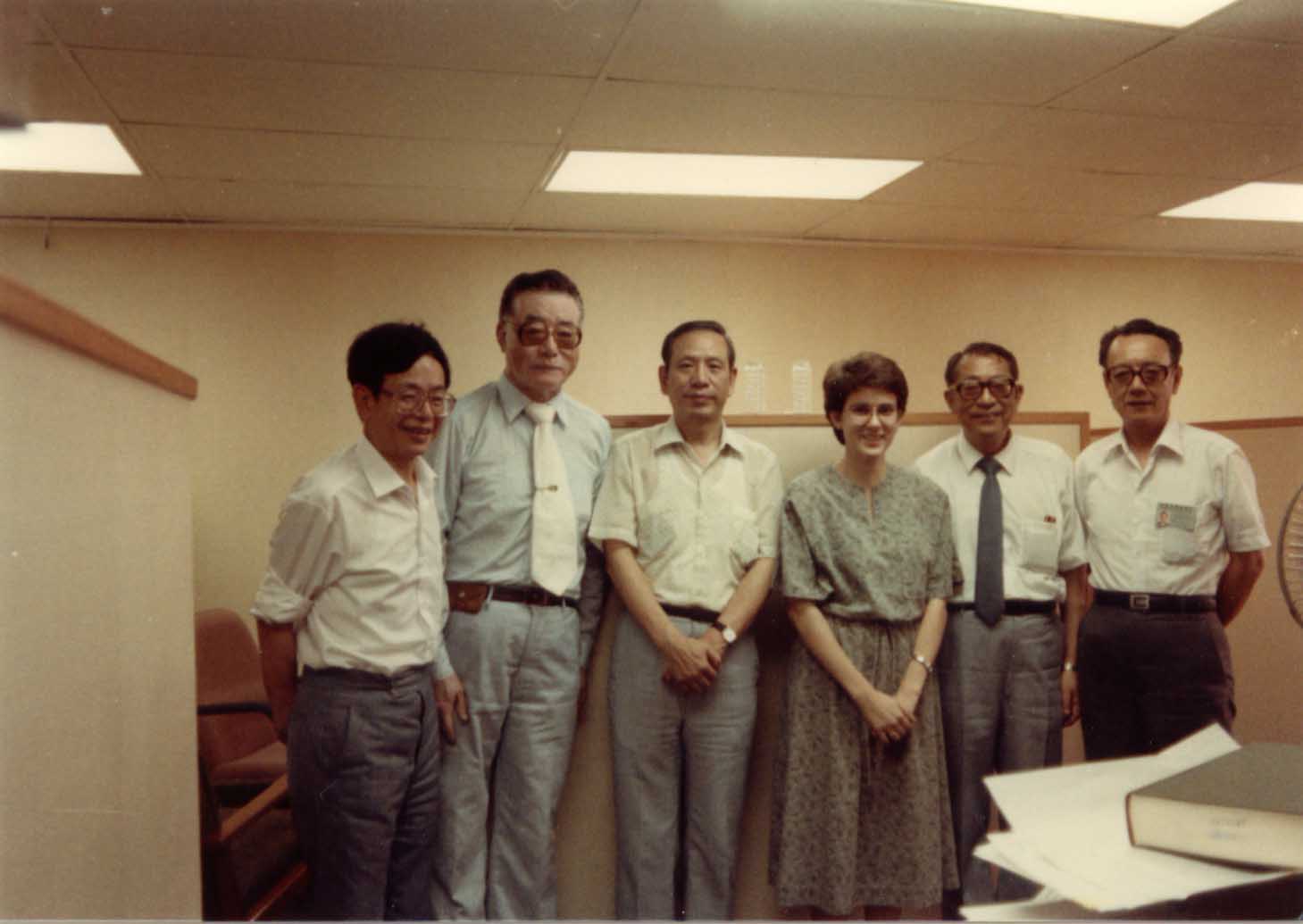
This was the Lee & Li translation staff ca. 1985.   As a 20-something with a regular, almost professional, job, I was in a bit of social limbo in Taipei:  neither scruffy world-traveling student nor privileged post-colonial white businessperson.  This social limbo may have been related to my tendency to see the rest of the world in mildly disparaging, internally-amusing, and completely accurate stereotypes, though I ultimately found an excellent group of limbo-dwelling judgmental 20-somethings — Chinese and Waiguo — to hang with.  By day we all had jobs; by night we hung out or explored Taipei’s unbelievably wonderful cheap restaurants.  Though many of the young lawyers at Lee & Li were friends, it was a huge place, and the senior partners barely knew we were there.

Until Molly.  Molly joined the Lee & Li staff as an editor in the summer of 1984.  She was sweet, hilarious, fun to hang with, and drop-dead gorgeous.  The senior partners suddenly noticed the hitherto motley now much cuter collection of gringo students who provided language services to the firm.  This was the state of play when the island was graced by a visit from Miss South Africa 1984.

Anyone remember 1984?  South Africa was not as, um, respected as it is now.  In fact, I’m thinking the number of countries Miss South Africa could visit that year was probably fairly limited.  We joked that she was in town for the Miss Pariah Nations finals.

Based I suppose on their fairly prominent position in the international social scene in Taipei, a couple of senior partners arranged to have dinner with Miss South Africa.  And — I’m speculating here — enjoying the idea of meeting MSA with another gorgeous blond on their collective arms, they invited Molly to attend.  And then, for reasons I cannot possibly fathom, but perhaps to avoid dissension in the American student ranks of Lee & Li, they invited me.  I thought this was hilarious in precisely the way a cynical post-apartheid-protest Swarthmore grad would.  I would go, but I would go ironically.  Access to a truly incredible, free, Chinese banquet was of course farthest from my mind.

But I still had to find something to wear.  I wish I could tell you that I wore the outfit below in some sort of ironic protest against the depredations of apartheid and objectification of women that Miss South Africa represented, but I can’t.  It was all I had.  I wore casual cotton dresses or skirts to work because of Taiwan’s intense heat.  (See photo above.)  And I guess some part of my brain said, I’m being taken out to dinner by senior lawyers, I should dress like a proto-lawyer.  I have no clue, but this was the result:

I’m not even going to caption this, because you know exactly who’s who.

Drinking with White People

I hate talking about disability with people outside our community.  Especially people I respect.  Especially for the first time.

I think this is similar to what  Ta-Nehisi Coates called “The John Mayer Rule.”  He called it that because he was posting in the wake of some profoundly vulgar remarks by that singer.

But then he went on to discuss his concern, as an African-American professional, about drinking with allegedly-enlightened white colleagues:  after a few drinks, someone would say something ignorant that would reveal them to have a layer of racism you wish you didn’t know about.

Coates gave two examples, from two perspectives.  First, he explained, he would often skip after-work gatherings at his first job for “fear of being the only black guy [and] fear that someone would get smashed, say something ignorant and I’d do something that would get me fired.”  But his second example came from the opposite perspective.

I had a dinner party when I first moved to Harlem with a bunch of friends. One of my homeboys was dating a mutual friend, who happened to be Korean. Anyway, after dinner someone pulls out blunt, rolls up and we all partake. One of my other friends, who was black, goes “Damn dude, your eyes are all chinky.” I laughed like nothing had happened. It never even occurred to me what had happened, until the young lady called both of us on it.

That was the end of the party–in more ways then one. What I was left thinking about was the power dynamic, and the trust factor. She was in an apartment surrounded by black people who she trusted were fairly enlightened. As it turned out, some us weren’t. Would she not be justified with her own John Mayer rule?

There is a disability equivalent of the “drinking with white people” problem:  listening to someone you respect — outside the community — talk about disability for the first time.

The most striking example I recall — both because of its egregiousness and because I was new to the community* — was Hillary Clinton’s speech on what must have been the third anniversary of the ADA.  There was a big event on the White House lawn and Tim and I worked at a Big Law Firm that frequently had spare tickets to random high-profile political events, which they would give away to associates.  Of course, the high-profile ADA event tickets went to the lone disabled lawyer and his fiancée.  So Tim and I were sitting there on the White House lawn surrounded by amazing people (whose amazingness I would not appreciate until years later), when the First Lady stepped up to speak.  And the theme of her address — to the collected disability rights royalty — was that if we provide sufficient funding for medical research, there won’t BE any disabled people!  (I’m doing this from memory — let’s see if the Internets have the actual address.  Nope.  Sorry.  We’re stuck with my July-in-DC-heat-addled memory.)

Anyway, this is why I never, ever, even for a nanosecond thought of voting for Hillary Clinton.  I’m confident with the right advisors, she eventually said more enlightened things about disability.  But deep down inside, to her, it’s a problem to be cured, not a natural part of the human spectrum to be embraced.  And she wasn’t even drunk.

On a more personal, no-drinking-with-white-people level, I have often had the experience of listening to a friend — or someone I know less well but (want to) respect — start talking about disability, only to hear something so ignorant I want to hit the rewind button.  And then the delete key.

Like the time a woman we had recently met asked to bring her son to meet Tim.  Career advice?  Male bonding?  No, the son had gotten a traffic ticket and she wanted to show her son “what could happen if he continues to drive recklessly.”  I was actually confused for a second, then realized that she was planning to simply exhibit Tim to her son as example of the horrible fate he would face if he continued his careless ways.

(Of course, I only sputtered, rather than saying, “you’d like to show your son a Stanford law school grad who co-founded a successful civil rights practice as an example of a horrible fate?  What would be the positive role model, Larry the Cable Guy?”)

Then there was the presentation I gave to a roomful of trial lawyers — supposed to be the good guys, right? — who were shocked and then angry to learn that they, too, had a legal obligation to make their offices accessible and hire sign language interpreters for deaf clients.

Another time a friend explained in some detail what a pain in the ass it was to make facilities accessible.

And then there are just the garden variety off-hand comments or usages:

“I sprained my ankle once — now I really appreciate what it’s like to be disabled.”

“That’s so retarded.”

“It’s so amazing that she’s out and about” or its close relative “she’s so inspirational.”  It sounds like praise, but it contains an assumption of incompetence as the default setting and no matter how well-intentioned, automatically distances the person from “the mainstream,” whatever the hell that is.

I don’t, per Coates, actually avoid drinking with people outside the community — and the experiences above show that people don’t need alcohol to say dumb things about disability — but I do have fairly sensitive antennae and have learned when to start steering the conversation quickly in another direction.

************
* I was almost completely ignorant of disability rights issues until I started dating Tim.  And God knows, I’m fully capable — in fact, expert — at saying stupid things.  I also have to acknowledge my own weird position here — I’m not disabled.  Hence the use of the vague word “community.”

Anti-Semitic Anti-Anti-Semitism vs. Patriotic Toughness

The Anti-Defamation League has just come out against situating an Islamic Center near the site of the World Trade Center.  The upshot of their statement is that it’s really emotional.  The ADL thinks freedom of religion is “a cornerstone of American democracy,” except where someone’s feelings might get hurt.

The bitchy half of me (ok, the bitchy 99% of me) wanted to ask whether we should object to Christian churches near the site of the Murrah Building or near any site bombed by Eric Rudolph?  After all, Timothy McVeigh and Eric Rudolph were motivated at least in part by their Christian white supremacist views.  Indeed, my bitchy side would ask: what is the diameter of the no-offense zone barring religious and other organizations that hurt the feelings of disaster victims?  Did you know there is a guns & ammo store just over a mile from Columbine High School?  How painful is that?

But (after unloading all that bitchiness) I’d like to urge a different way of thinking about it, for pissed off people on both sides.  I’d like to urge that we respond with pride our country, its First Amendment, and its history of religious tolerance.  And people who are feeling pissed off or hurt get to feel the proudest.  Respecting civil liberties isn’t easy or comfortable.  In a free country, feelings get hurt.  But what’s great about our country is that we’re tougher than that.  We have the ability to say, I’m hurt but my pride in my country outweighs my pain.

Indeed, our First Amendment and our religious tolerance is what makes us — say it loud and proud — better.  Better than theocracies and totalitarian regimes.  Better than the regimes and thugs who nurtured and sent the scum who attacked the World Trade Center.

My father had a great story he loved to tell about showing a Canadian friend around DC one day in the late 1970s not long after the Iranian hostage crisis began.  As they toured the monuments and museums, they were stopped at one point by a demonstration.  Standard fare for DC – someone’s always marching about something.  But on this day, the marchers were marching in support of the Ayatollah.  That’s right:  marching unmolested down a major thoroughfare in our capital in support of our enemy.  As my father would relate — with beaming pride in our country  — the Canadian friend was simply in awe of the strength and openness that this showed.

That is the country I love.

Talking back to Westlaw

Why is this image supposed to make me buy a more advanced legal research program?

When I started this blog, I warned you that part of the impetus was my tendency to talk back to the teevee.  I talk back to things like fundamental mathematical errors.  The Aleve lady who is so excited that she’s taking fewer pills than with Advil CLEARLY NEVER READ THE INGREDIENTS.  I helpfully inform her, “you’re getting the same amount of medicine, you dork; and your stomach will feel just as awful”  Or when 9News promises a full segment on some new store or product, I calmly explain to them, “THAT’S NOT NEWS; IT’S ADVERTISING.”

Today’s question is:  why should a photo of a woman with her eyes closed and wind-swept hair make me want to upgrade my legal research software?  Are they telling me I can now do legal research with my eyes closed?  On a wind-swept beach?  Candidly, her look is the one of resigned frustration I get when Westlaw tells me my search yielded 0 or 4,934 cases.  What are they trying to tell me about their new, improved version?

I know this probably sounds like I’m trying to be funny, or am desperate to post something to see if I can attract those 20 or so hardy souls who read this blog.  But I’m serious — why this photo?

Update:  The truly compelling image would be a middle-aged law nerd sitting in front of her computer, arms raised in the universal symbol for “touchdown,” a smile on her face that says, simultaneously, “I’m a genius, and I’m going to demolish the evil bastards on the other side of my case, and wow what cool software this is that both reveals my own genius to me and lets me engage in demolishment with such ease.”  If you’re listening, Westlaw:  use that image and I promise I’ll upgrade toWestlawNext.