Tag Archives: ADA

Discrimination “in a manner consistent with Biblical principles.”

Hobby Lobby went to the Supreme Court to avoid covering contraception for its female employees because … Christian! Then they had their lawyers defend discrimination against a customer with an intellectual disability.  Christian?

The company told the Supreme Court that

Hobby Lobby’s statement of purpose commits the [owners] to “[h]onoring the Lord in all [they] do by operating the company in a manner consistent with Biblical principles.” Each family member has signed a pledge to run the businesses in accordance with the family’s religious beliefs and to use the family assets to support Christian ministries. … The businesses refuse to engage in profitable transactions that facilitate or promote alcohol use; they contribute profits to Christian missionaries and ministries; and they buy hundreds of full-page newspaper ads inviting people to “know Jesus as Lord and Savior.”1

I bet you’re all wondering how those Biblical principles applied to a Hobby Lobby customer with an intellectual disability. Fellowship? A bit of adaptive Bible study? Common courtesy? Nope.

Following a decade of friendly interaction and accommodation, the store got a new manager.2

[Plaintiff Charles] George asked a cashier to tally the cost of certain items and said that he would return later in the day when he had the money to pay. George alleges that [Manager Heather] Ford told him he could not do that because the “cashiers are wasting time on” him and that if he continued to ask for help she was going to call the police. Ford also supposedly stated that she wanted George “to stay out of this store and off of the property never to come back.”3

New manager Heather Ford, rather than continue to accommodate Mr. George’s intellectual disability, called the police. I’d love to hear from Hobby Lobby how this constitutes “operating the company in a manner consistent with Biblical principles.”

My fellow ADA nerds will be either shocked or relieved to know that the court held Mr. George had stated a claim under Title III:

George has alleged sufficient facts to state a Title III ADA claim and he has standing to pursue it. It is undisputed that George has a disability, and that Hobby Lobby is a place of public accommodation. And George has alleged that Hobby Lobby, through Ford, discriminated against him because of his intellectual disability by refusing to provide an allegedly reasonable accommodation (tallying items) that it had provided to him in the past. Further, George has alleged that he would return to Hobby Lobby’s store if he could, which is sufficient for standing.4

A very long time ago (2010) I suggested a new rule for the Federal Rules of Civil Procedure:  Rule 1.5 “Don’t be a dick.”  Given our current fraught legal times, I propose another addition:  Rule 30.1 “Deposition to Call Bullshit.”  Under Rule 30.1, any member of the bar can notice the deposition of a litigant in any case to make its hypocrisy a matter of record. 


  1. Burwell v. Hobby Lobby Stores, Inc., 573 U.S. 682, 703 (2014) (emphasis added; internal citations omitted). ↩︎
  2. Seasoned civil rights lawyers will now hear “Jaws” theme music in their heads. “Then they hired a new manager” is how the vast majority of civil rights intake interviews start. ↩︎
  3. George v. Hobby Lobby Stores, Inc., — F. Supp. 3d —, 2025 WL 721312, at *1 (E.D. La. Mar. 6, 2025). ↩︎
  4. Id. at *5. ↩︎

Adventures in Discrimination and Intimidation at the Marriott Courtyard Santa Fe

Below is the guts of the letter we sent to Marriott and Fine Hospitality Group, the management company at the Marriott Courtyard Santa Fe. We had reserved a room at the Santa Fe Courtyard Marriott for March 15 and 22, on our way to and from a vacation in Phoenix.  On the 15th, our request for an accommodation under the Americans with Disabilities Act resulted in a police response.

I want to preface this by recognizing that we have a weird sort of privilege — the “sitting in a hotel room waiting for the police to arrive without fearing for your life” privilege — that made this incident stressful and illegal but not, ultimately, fatal. This does not reduce the extreme danger hotel personnel were willing subject their guests to in pursuit of an ADA violation.

Update: The Fine Hospitality Group (not Marriott) reached out and the upshot was that they comped us that night and (in theory) a future night, and promised discipline for the manager and training for staff.

Here’s what happened:

After we checked in and got to the room, it became clear that the bed was too low for Tim to be able to easily transfer in or out from his wheelchair. This is a fairly common problem that can be solved by either putting blocks under the legs of the bed or adding a second mattress on top. We called the front desk, requested this modification and were told “no.” The staff member explained that the way the bed was set up did not permit adding anything to raise the legs of the bed. We suggested that a second mattress could be placed on top of the first; this suggestion was rejected out of hand (“no”). We asked if there were any extra mattresses in the hotel. “No.” (This seems unlikely but who knows.) We asked if there were any empty rooms from which a mattress could be moved. “No.” The staff person then asked if we wanted to talk with the General Manager. Yes, we said, we would.

The General Manager got on the phone and we went through a similar litany of requests and refusals, but the GM added that the room was set up precisely as required by the ADA and therefore could not be altered. As an initial matter, this is not true: ADA regulations and standards do not prescribe a minimum or maximum bed height. But it also doesn’t matter. In addition to requiring certain basic physical and architectural configurations, the ADA also requires that businesses provide reasonable modifications to policies, practices, and procedures. I explained this to the GM, who continued to insist that the room was as legally required and no changes could or would be made. We explained that we were lawyers who were familiar with applicable law, and that this simply was not true. He stood firm on his refusal to make the required modification. Sensing that this conversation would not result in the modification we needed, we said that we’d deal with the room as it was set up but would take up the matter with Marriott’s legal department. We all rang off.

The staff person, the GM, and both Tim and I were entirely calm throughout the call. We were all firm in our respective positions, but no voices were raised, no inappropriate language used, and no threats made.

Less than a minute after the call ended, the GM knocked at our door and told us we would have to leave the hotel. We said no, we did not intend to do that. He said he would call the police.

Approximately 20 minutes later, four fully-armed officers from the Santa Fe Police Department knocked at our door.  We invited them in and Tim explained the above interactions and expressed our desire – it was by that time around 9:10 p.m. – to stay in the hotel so we would not have to pack up and try to find an accessible hotel at that time of night. One of the officers asked what threats we had made. Tim explained that there had been no threats. The officer informed us that the GM had told the police that we had threatened to go door-to-door through the hotel, knocking on doors and harassing guests. There is no other way to characterize this than as a lie, and a dangerous one in that it was used to invoke police intervention in an otherwise calm albeit disappointing interaction. Tim explained to the police that we had not done this, and that it would make no sense for us to anger other hotel guests, who had nothing to do with the situation.

It was my impression that the police were somewhere between puzzled and bemused that they had been called out to discuss wheelchair accommodations. They were professional and friendly throughout.

After the officers had heard us out, one of the officers went to negotiate with the GM on our behalf. The officer returned to say that the GM would “allow” us to stay provided there were no further “issues or threats.” Although, given the exchanges that had brought us to this point, this was a pretty humiliating request, we agreed, the officers left, and we stayed the night.

This entire interaction violated both the requirement to make reasonable modifications to policies, practices, and procedures, 42 U.S.C. § 12182(b)(2)(A)(ii), and the prohibitions on retaliation for opposing discrimination and interference with and intimidation of people exercising or attempting to enjoy their rights under the statute, id. § 12203(a), (b). Indeed, calling the police is at the extreme end of interference and intimidation.

In our letter to Marriott and the management company, we proposed several measures to address this discrimination:

  1. Training for all staff of the Santa Fe Courtyard on the requirements of the ADA, and specifically the requirements for reasonable modifications;
  2. Communication to all U.S.-based Marriott and franchisee/licensee staff that, under no circumstances, are they to involve law enforcement in the discussion of the accommodations and modifications needed by guests with disabilities;
  3. Reprimand to go into the personnel file of the General Manager (whose name we never got); and
  4. Refund of our payment for the room on March 15 (we have, of course, cancelled our reservation for the return trip and will not be staying at that hotel in future trips to Santa Fe).

Stay tuned! I’ll update the post if we receive a substantive response from Marriott or Fine Hospitality Group.

Acheson Hotels v. Laufer: Revenge of the Data Nerds

[Cross-posted at the FoxRob Blog.]

Fox & Robertson along with a dream team of drafting partners filed an amicus brief today in the case of Acheson Hotels v. Laufer, currently pending in the Supreme Court. The case addresses the issue of “tester standing,” that is, whether people protected by civil rights laws have standing to sue when they intentionally investigate compliance and encounter discrimination.

Because tester litigation has been responsible for calling out and challenging widespread disability discrimination, businesses hate it. The amicus briefs they filed were full of hair-on-fire numbers — of pending ADA lawsuits — that they characterize as a “staggering,” “unrelenting tide” that is “clog[ging] federal court dockets.” Chamber of Commerce Br. 7, 11; Retail Litig. Ctr. Br. 4, 11, 20, 22. One business brief asserted that tester standing “threat[ened] . . . the cohesiveness of our union.” Ctr. for Constitutional Responsibility Br. 1. Drama much?

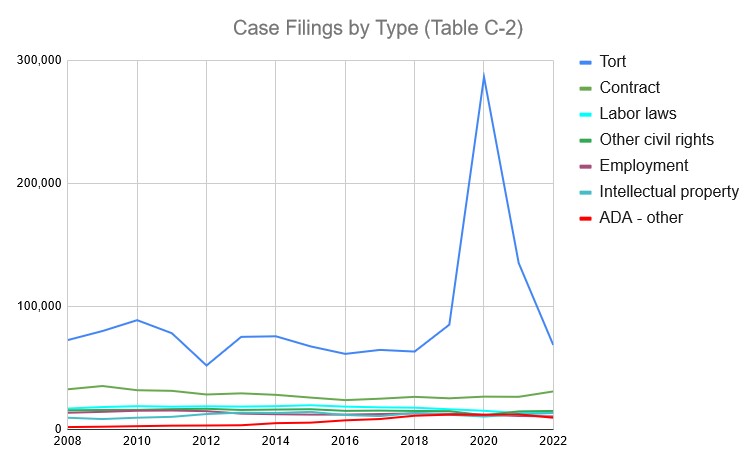
Of course numbers are catnip to the data nerds here at Fox & Robertson World Headquarters, so we decided to take a look at the actual numbers of ADA cases filed in federal court — based on data gathered by the United States Courts on its uscourts.gov website — and see how they looked in context. Here’s a chart comparing the “ADA-Other” category — roughly speaking, non-employment ADA cases, including the Title III cases that cause flaming hair on the business side — with six other common types of cases. Note the bright red ADA-Other line at the bottom.

Image:  a line graph titled “Case Filings by Type (Table C-2),” with the years 2008 to 2022 on the x axis and numbers 0 to 300,000 on the y axis. Seven colored lines cross the graph horizontally, each representing a type of case. The top line is a jagged line representing tort cases (varying between approximately 50,000 and 135,000). The line representing the category "ADA - Other" is in red.  It starts and ends at the bottom of the seven lines, intermingling with them in 2020.  ADA-Other cases vary from approximately 1,700 to approximately 12,000.  Other types of cases are as follows:  Contract cases, in green, vary from approximately 23,000 to 35,000. Labor law cases, in light blue, vary from approximately 13,000 to 19,000. Other civil rights laws, in dark green, vary from approximately 11,000 to 16,000.  Employment cases, in purple, vary from approximately 11,000 to 15,000.  Intellectual property, in blue, vary from approximately 8,000 to 14,000.

See? Not so bad after all! If business put half the effort into compliance that they put into whining, the world would be pretty damn accessible by now.

Be sure to check out our amicus brief with other fun facts and incisive arguments from the dream team: free agent disability rights rockstar Karla Gilbride, Michelle Uzeta at Disability Rights Education and Defense Fund, Tom Zito at Disability Rights Advocates, Justin Ormand at Allen & Overy and yours truly here at the World HQ.

Confiscating a Dynavox in the name of Christ.

Religious hospitals get a lot of press for denying healthcare to LBGTQ folks and the like, but a lesser known problem is that Title III of the Americans with Disabilities Act includes this language:

The provisions of [Title III] shall not apply to … religious organizations or entities controlled by religious organizations, including places of worship.  42 U.S.C. § 12187

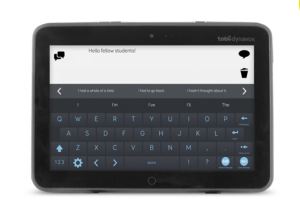
So, yknow, churches can be as inaccessible as they want and can’t be challenged under Title III of the ADA.  Fine.  Well, not fine, but we’re stuck with it.  But religious-themed hospitals are big business, and dominate the healthcare landscape.  Then they do this — to a psychiatric patient who used a Dynavox to communicate  — and claim immunity as a religious organization:

[The patient, Linda Reed] claims that she was denied the use of her Dynavox; that hospital staff attempted to give her medication she was allergic to; that she was denied timely access to her medical records; that she was denied the use of a telephone to call her case manager (about whom the record reveals little); that she was denied access to a chaplain; and that she was physically escorted off the premises by two security guards. Notably, the hospital’s corporate representative and nursing supervisor, William Fry, testified in his deposition that the Dynavox was locked up outside Reed’s room at night and that she had access to it during the day only “as long as her behavior was appropriate.”

Reed v. Columbia St. Mary’s Hospital, No. 17-1469, 2019 WL 494073, at *1 (7th Cir. Feb. 8, 2019) (emphasis added).*  Read that again:  she was only ALLOWED TO COMMUNICATE if her “behavior was appropriate,” apparently as assessed by Nurse Ratched.


Image: Dynavox speech generating device; similar appearance to a tablet; bottom half containing a QWERTY keyboard; top half a field showing the text being typed.

Dynavox


The hospital in question was Columbia St. Mary’s Hospital, now named “Ascension.”  It claimed, in seeking immunity, that it “will not perform medical procedures inconsistent with Catholic ethical directives.”  Id. at *6.  So I guess denying communication access — including communication with a chaplain — is fully consistent with Ascension’s Catholic ethical directives.

The Seventh Circuit denied the claim of religious immunity, but only because the hospital forgot to plead it.  The court “express[ed] no opinion on whether … the hospital might fit within the exemption for entities controlled by religious organizations.”  Id.  That is, if its lawyers hadn’t been so sloppy, the hospital might have been able to confiscate and control the patient’s only way to communicate, and gotten away with it . . . in the name of Christ.

*******

*I wanted to write “emphasis added, motherfucker” but didn’t find that in the Blue Book.

Saying/thinking

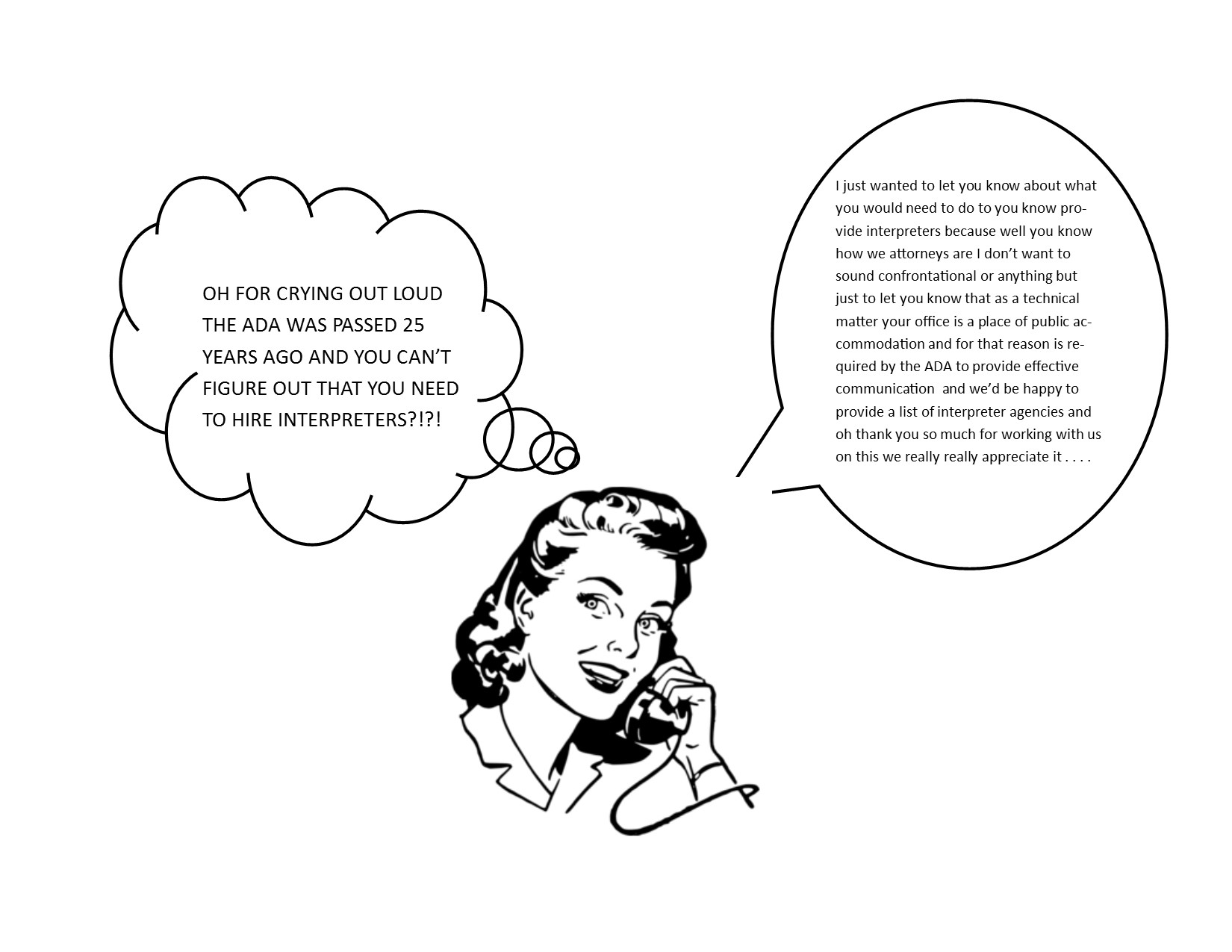
Dramatic re-enactment of an actual phone call with a business that will remain anonymous.

Image: Sketch of a woman on the phone with a speech bubble that reads, in small type, “I just wanted to let you know about what you would need to do to you know provide interpreters because well you know how we attorneys are I don’t want to sound confrontational or anything but just to let you know that as a technical matter your office is a place of public accommodation and for that reason is required by the ADA to provide effective communication and we’d be happy to provide a list of interpreter agencies and oh thank you so much for working with us on this we really really appreciate it . . . .”  while her thought bubble reads, in large, all-caps type, “OH FOR CRYING OUT LOUD THE ADA WAS PASSED 25 YEARS AGO AND YOU CAN’T FIGURE OUT THAT YOU NEED TO HIRE INTERPRETERS?!?!”


In which I get interviewed for the 25th Anniversary of the ADA

An interested and interesting reporter, Maeve Conran, from Boulder’s KGNU, interviewed me for their series on the 25th anniversary of the ADA.  It was delightful to talk to her and I appreciate, as you’ll hear, that she just sort of let me talk, rather than chopping it up into sound bites.

This . . . for every unpleasant restaurant/access encounter we’ve ever had.

The whole thing is about 1:50, but the fun part starts at 1:21, if you’re really impatient.

From the USA Network series “Complications,” Ep. 6.   Here is a captioned version — in a link, not the original, because I’m not very good at screengrabs and the audio is messed up.

ADA Defense Counsel Bingo

A hilarious Graduation Bingo card has been making the rounds of Facebook, with squares like “ethnic name is awkwardly pronounced” and “someone in your line of sight is wearing Canucks gear.”  Evidently, the graduation was in Vancouver.

This inspired me to compose ADA Defense Counsel Bingo.  (MS Word version here.)MS Word Version at https://thoughtsnax.com/wp-content/uploads/2015/06/opposing-counsel-bingo.docx  Some of these are more common than others; all of these are real.


Title III doesn’t [just] need damages; it needs a public shaming remedy. Update: I appear to have been punk’d.

Update:  While it’s true that Title III most definitely needs a public shaming remedy, this case may not be the vehicle for it.  Gawker reports that the whole thing was a hoax.  Not wishing to be equally credulous of the debunking as I was of the original bunking, I’ll leave the various links and let you decide.

Original post:

Family says girl scarred by pit bull attack asked to leave KFC restaurant.

Image:  Kentucky Fried Chicken logo.  Old white man with white goatee and red apron.


A 3-year-old girl who was attacked by pit bulls in April was asked to leave a restaurant in Mississippi because her scars scared customers, the girl’s grandmother told a television station there.

“They said, ‘We have to ask you to leave because her face is disrupting our customers.’ [The girl] understood exactly what they said.”

As you can imagine, this is pretty much an automatic violation of Title III of the ADA, which prohibits discrimination on the basis of disability in public accommodations, including restaurants.  But Title III has no damages remedy; the only thing the girl and her family would be entitled to would be an order permitting them to eat at the restaurant in question.

Second prize:  two meals!

Since there’s no damages remedy and the injunctive remedy is somewhere between less-than-useless and adding-insult-to-injury, I propose — in addition to the very-expensive-scotch remedy for hotel reservation violations — that Title III have a public shaming remedy.

Here, the remedy would include a requirement that (1) the waitstaffperson who made the request wear a sign saying “I acted like an asshole.  I’ve learned my lesson.  I will not act like an asshole — at least to people with disabilities in restaurants — in the future;” (2) the owner of the restaurant wear a sign saying, “I promise not to hire assholes and I promise to train my staff not to act like assholes,” and (3) the waitstaffperson and restaurant owner buy the entire family a meal at the best restaurant in town as well as a year’s supply of Popeye’s fried chicken, which everyone knows is the far superior take-out fried chicken.

New Rule: Remedial Scotch

New rule: when we arrive at a hotel at 2:00 in the morning — a hotel that has confirmed by phone and fax that it has reserved for us a room with a roll-in shower — to find, after unloading our voluminous luggage (shower chair; giant duffel; garment bag; suitcase; suitcase; computer wheelie; backpack), checking in, and tipping the helpful bellman who has transported this unGodly collection of luggage to the room, that the room has only a tub and that, in fact, no room with a roll-in shower is available that night (“night”), there will be a member of the ADA defense bar available on-call to secure alternative accommodations and to provide a nightcap of very very expensive Scotch.

These are the facts:

1.    The hotel had at least one room with a roll-in shower.

2.    The hotel confirmed — several times* —  that it had reserved a room with a roll-in shower for us.

3.    This was incorrect. When we arrived, there were no roll-in-shower rooms available.

4.    The hotel had at least one non-roll-in-shower room available — the one with the tub that they sent us to with our mule-train of luggage in tow.

5.    At least one of the rooms with a roll-in shower was occupied by someone who did not need it (this fact related to us by the night manager).

This is the law:

1.    Title III of the ADA prohibits discrimination on the basis of disability in places of public accommodation, including hotels. 42 U.S.C. § 12182(a).

2.    Hotels are required to provide rooms with roll-in showers in proportion to the total number of rooms.  DOJ 2010 Standards for Accessible Design, Table 224.2.  I’m guessing that this hotel was required to provide at least nine such rooms; every hotel is required to provide at least one.

Image: Roll-in shower.

3.    Hotels are required to

[e]nsure that accessible guest rooms are held for use by individuals with disabilities until all other guest rooms of that type have been rented and the accessible room requested is the only remaining room of that type;

    and

[r]eserve, upon request, accessible guest rooms or specific types of guest rooms and ensure that the guest rooms requested are blocked and removed from all reservations systems.

28 C.F.R. § 36.302(e)(1)(iii) and (iv).

So there’s pretty much no question that the hotel violated the law.  And there’s no question that the violation had consequences: after flying across the country and arriving at 2:00 in the morning, Tim would not be able to shower when he woke up later that day.

The problem is, while there were consequences for Tim, there will be no consequences for the hotel.  Title III of the ADA has no damages remedy.  Truth is, we would be fairly unlikely to bring a lawsuit for damages.  We didn’t want damages; we wanted a useable hotel room.  We wanted to be able to do what every weary traveler wants at 2:00 a.m. — to check in and go to sleep; NOT to travel up and down the elevator with our piles of luggage, have a long — pleasant but unfruitful — conversation with the night manager, wait through long sessions between the night manager and his computer terminal, finally settle for the (inaccessible) room at 3:00, and (Tim) be unable to shower the next morning.

In other words, we just wanted the system to work.

But wait!, you say, Title III has an injunctive remedy!  The court can order the system to work, right?

Well first of all, of course, only after a lawsuit, which can take anywhere from two to 12 years.  By then, we’d be home and Tim would have showered, repeatedly, in our very own roll-in shower.

But more importantly, the hotel, in a case like this, would almost certainly argue** that Tim has no standing to sue unless he can specify the date on which he will return to this precise hotel. And while many people travel repeatedly to the same hotel, many don’t.  That’s the point, right?  When you’re planning travel to a new city, you want to be able to pick up the phone or go online, make a reservation, show up, and have a room you can use.   The problem is, under the current system, there is very little incentive for this system to work for people with disabilities:  no damages remedy; and no injunction unless you plan to come back to the very same hotel AND have the time and energy for a lawsuit.  Given this, the hotel knows that it doesn’t really need to comply.

So — new rule: every ADA defense lawyer who makes these bone-headed standing arguments must register on an ADA Compliance Resolution List and provide a number where they can be reached 24 hours a day.  When one of these damagesless, standingless events occurs, they must be ready to solve the problem, provide the room, and send a nightcap of very very expensive Scotch.

Anyone want to help me draft the bill?

[Cross-posted at CREECblog.]

************

*  When we make hotel reservations, we can’t just go online and request the room we want.  We call, we have a long conversation about roll-in showers (“Are you sure?  You’ve seen the bathroom in that room?  Can you ask housekeeping to check?  I heard you roll your eyes — just go check please.”), we often call back at least once, and we send a confirming fax, which we then have on hand when we arrive at the hotel.  None of that matters if it’s 2:00 a.m. and there simply isn’t an accessible room available.

** Indeed, this hotel has made this precise argument with respect to violations known to exist in many of its hotels.  The court held that the plaintiff “must assert an intent to return to the particular place (or places) where the violations are alleged to be occurring.”  Scherr v. Marriott Int’l, Inc., 703 F.3d 1069, 1075 (7th Cir. 2013).  So there is no standing to make them fix the problem in other hotels unless this plaintiff is planning to go to each of them?  Which means, of course, that none of the other hotels in the chain will be fixed until other wheelchair-using hotel guests — in this case, 56 other guests at 56 different hotels — encounter the barriers and sue.  Or unless one guest has the foresight to bring a class action, adding to the length and complexity of the suit and the elapsed time until a discrimination-free stay can be ensured.

Image from the webpage of Fine Design Contractors of Somewhere, MN.