Tag Archives: travel

Travelogue 1984: Taiwan and China

My father was a prolific letter-writer. What follows is an excerpt from his letter to – of all people – my mother’s aunt and uncle in March 1984, describing his travel to visit me in Taiwan and then our travel together to Mainland China. The letter concludes with my brother’s news, which I leave to him to share verbatim but which details his upcoming college graduation, potential graduate program with showers of fellowship money, and his choice between that and a job offer “at an outrageous rate of pay.”


March 22, 1984

Dear Ben and Brenda:

It has been so long since I have had a chance to either visit with you or write but I thought it was about time to bring you up-to-date on our news. As you know, Amy is spending the year in Taiwan on her Fulbright/ITT scholarship studying Chinese law. I had a chance to visit her over Christmas for an excursion that took us to Hong Kong and the Mainland; and Ruth went for a somewhat longer visit at the end of January and they had an opportunity to go to half a dozen Asian countries.

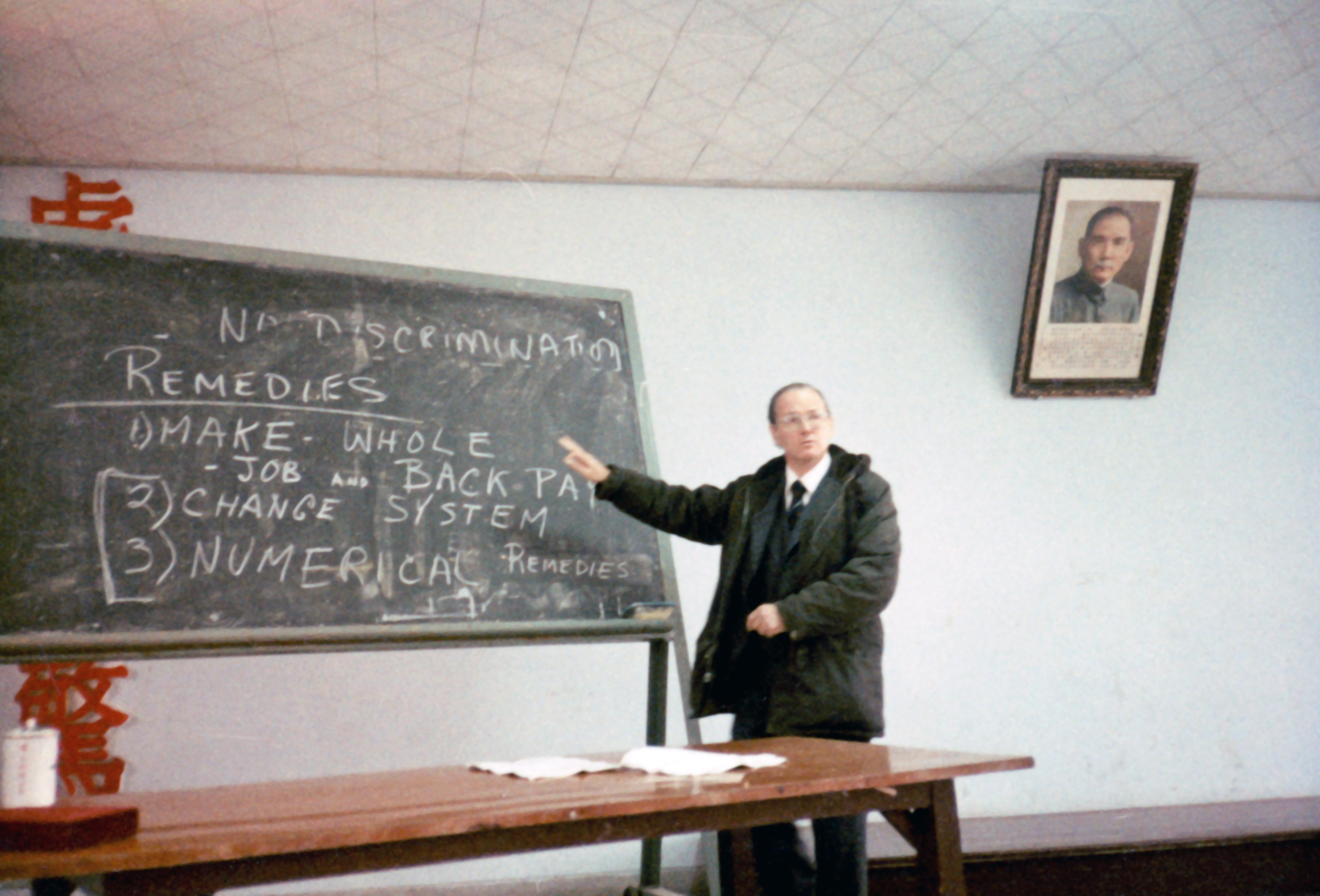
I delivered a lecture at one of the law schools in Taiwan which Amy arranged. She and I had a great deal of fun working out the potential translation with the law professor who was both our host and our translator.

We decided to experiment to determine whether it is possible to visit Mainland China without either advance preparations or a formal tour; I am pleased to report that it is possible. A travel agent in Hong Kong (a friend of a friend of a friend of Amy’s in Taiwan) got us a visa in only 24 hours. We then went to the Hong Kong railroad station, and took a train to Canton.

In Canton we went to the airport and purchased an airplane ticket to Guilin. Actually this stage wasn’t quite that simple. We first went to the downtown ticket office which told us nothing was available. It was the cab driver who said that we should ignore those bureaucrats and go to the airport because “something is always available.” He was right, at the airport Amy walked right up to the counter, purchased two tickets, and we got on our Boeing 737 and were on the way to Guilin and some of the most picturesque scenery in all of China. (I have since learned that they hold half the seats for government officials and release them at the last minute if nobody shows.)

We arrived in Guilin at about 8 in the evening, took the local bus into town, got off the bus, and walked six or eight blocks in the darkness to a hotel which had been recommended to us; and walked in and rented a room.

We were only there three days but, frankly, it was one of the most fun adventures I have ever had on a foreign trip. We rented bicycles and spent two full days touring around the countryside. On the first day we stumbled into a small village which was actually a teachers training college for students who would teach English. We spent three delightful hours with several students eating rice and stew warmed over a small charcoal grill in the middle of their dorm room — 55 unheated degrees. They had seen us bicycling through the village and had stopped us in order to practice their English. One of the most moving moments was when one the students, after having shown us his standard text with its typical English language sentences such as “the neighborhood committee assures that all the peasants carry out the teachings of the party leaders” (why, I use that vocabulary at least twice a day), proudly took a paperback biography of George Washington out of the back of his desk. It was dog-eared and obviously heavily read.

The next day we bicycled in a different direction and ended up following a road that turned into a smaller road that turned into a smaller unpaved road that turned into an even smaller, smaller dirt road that turned into a path that turned into a narrower path that ended up winding us for three or four miles literally down a two foot wide path among the farmers’ fields and provided us with an excellent opportunity to observe the agricultural process at very close range.

I sometimes wonder what Chinese peasants must have thought when they looked up and saw this American on a bicycle with a three piece pin striped suit, white shirt and tie, riding down a path through their fields. Actually, my fantasies were even greater when we passed a railroad crossing. I thought of some American tourist on a packaged tour traveling first class through China babbling on to his/her spouse about the “picturesque little peasants” when suddenly he flashed by this grade crossing on one of these country lanes and saw this American male in a three-piece pin striped suit on a bicycle and turned to his wife (whose attention meanwhile has wandered) to describe what he had seen; and received a “that’s right, dear” in a Thurberesquet so-you-heard-a-seal-bark tone of voice.

I thought you might enjoy a miscellaneous collection of some of our more interesting photographs and I am enclosing several:

[Amy’s note – my copy of the letter did not include the photos, but I think I’ve identified them and include them here. I have not included alt text as my father describes them below. In each, I am a mid-20s white woman with a really bad perm; my father is a late-40s white man in, yes, a pin striped suit.]

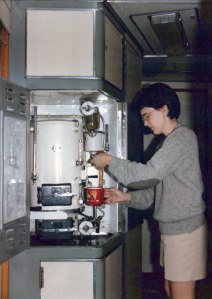
1. Amy cooking New Years dinner in Taiwan.

Amy in gray sweater stirring something in a kitchen .

2. Amy buying plane ticket in Canton as we leave for Guilin.

3. Amy arriving Guilin — note the characteristic mountains in the background. They really do have mountains like we see in the paintings. But then New England Lobster Villages really do look like the paintings — I don’t know what I expected.

4. Biking in Guilin.

5. Street side library in Guilin. Brenda, as a librarian, I thought you would find this of particular interest. Note the books hanging on a clothesline, the rack of books in the back left-hand corner as you face it, and another rack of books up front. As near as we could figure out they actually pay a small fee for the privilege of sitting and reading these books.

6. Amy looking at typical Guilin scene. [Couldn’t find this one.]

7. Amy and friend Ben from Taiwan. [Editorial privilege not to include photo of long-ago ex-boyfriend.]

8. Amy and the students we met in Mainland.

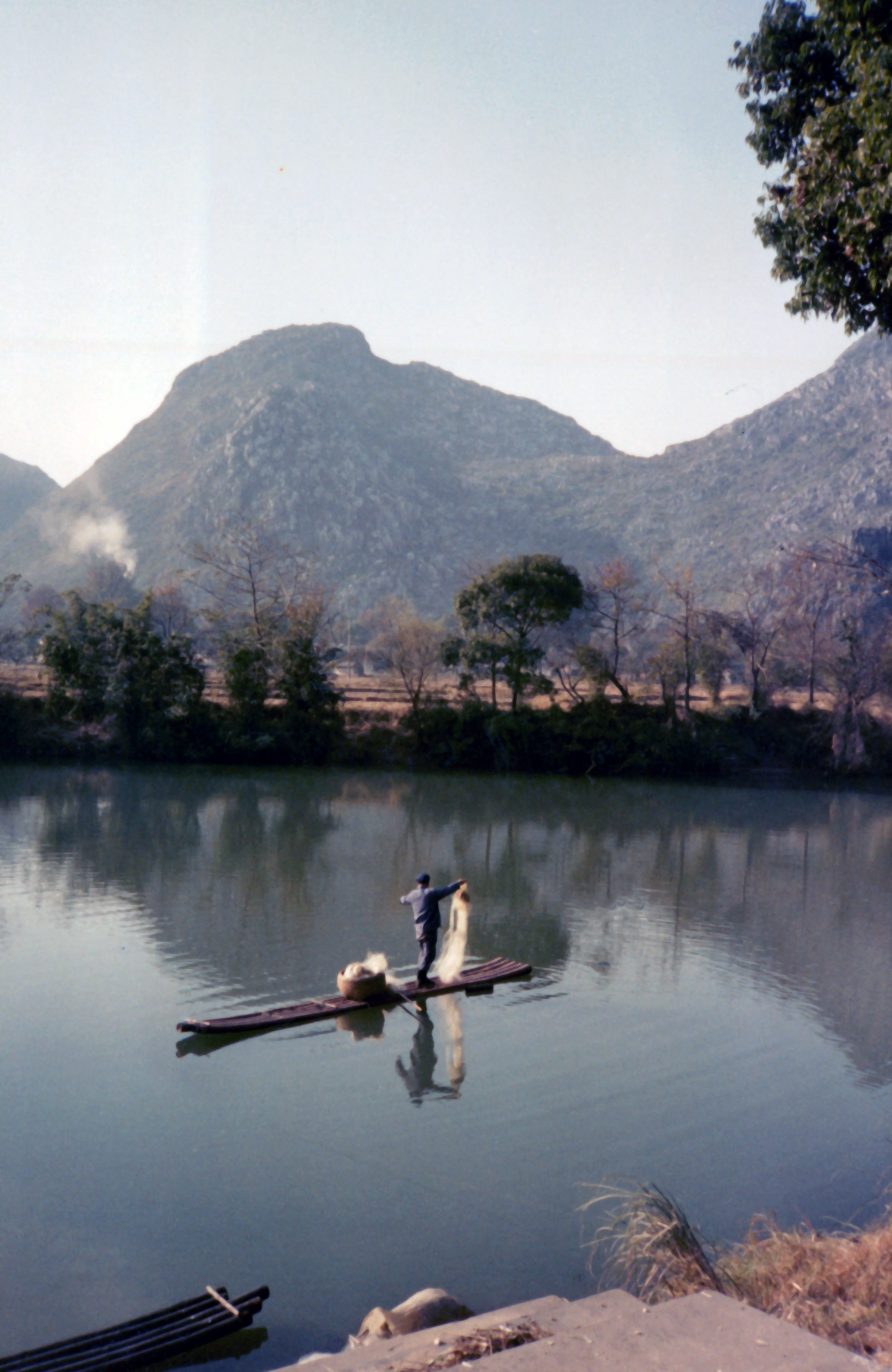
9. A local fisherman near Guilin balancing on his boat (which consisted of four long bamboo logs tied together and was not much different than balancing on a floating large sized diving board) as he strung out his nets. He sculled backwards with an oar in his right hand while feeding out some 200 yards of net from his left hand in a pattern that went back and forth across the river about eight times. Why, you might ask would one need eight separate layers of net. to catch fish coming down the river? Answer, the fish aren’t coming down the river.  The fish live in a cave on the bottom of the river and after the nets are strung out the fisherman makes noise and scares the fish out of the cave and they come up in between the various webs of the net rather than being trapped by swimming into the net end wise. I wished I could have taken a movie of this operation because the grace with which he sculled backward with his right arm, fed the mass of net out neatly with his left hand, while balancing on his diving board all the while was astounding.
Soon after I got back from China, Ruth went over and spent several days with Amy in Taiwan and they then spent close to two weeks traveling to a number of countries and ending up in Singapore on the Washington birthday weekend. Just as they were about to leave their hotel for the airport Amy’s pocketbook with tickets, money, passport, credit cards and camera was stolen and she had to remain behind to obtain replacements when Ruth headed out. Amy is apparently a miracle worker or, at least, has figured out how to function in the Asian culture. She was able to get replacement tickets without paying for them, (it usually takes four months); get the American Embassy to open up on Washington’s birthday and replace her passport (it usually takes three days and cannot start until after the holiday); and she made arrangements through the law firm where she works in Taiwan to get somebody who lives in Singapore to lend her $1000 cash American money. She spent three days dealing with these loose ends and then headed back to Taiwan — her adventure over. I think poor Ruth suffered worse — what with the imperative of her own plane schedule meaning that she had to go to the airport and leave Amy behind within an hour after the theft. Even though Amy was doing very well, Ruth was isolated on a plane for eight hours and she had no way to know that things were working out ok.


Amy here, adding two more photos. First, my father teaching the law school class he discussed in the letter. He is bundled in a winter coat, as Taiwanese classrooms were not generally heated, and is pointing to a blackboard with notes of anti-discrimination remedies. A photo of Sun Yat-sen is hanging high on the wall on the right. The second photo is of my father and me in Guilin, possibly the two dorkiest American tourists ever to visit China.
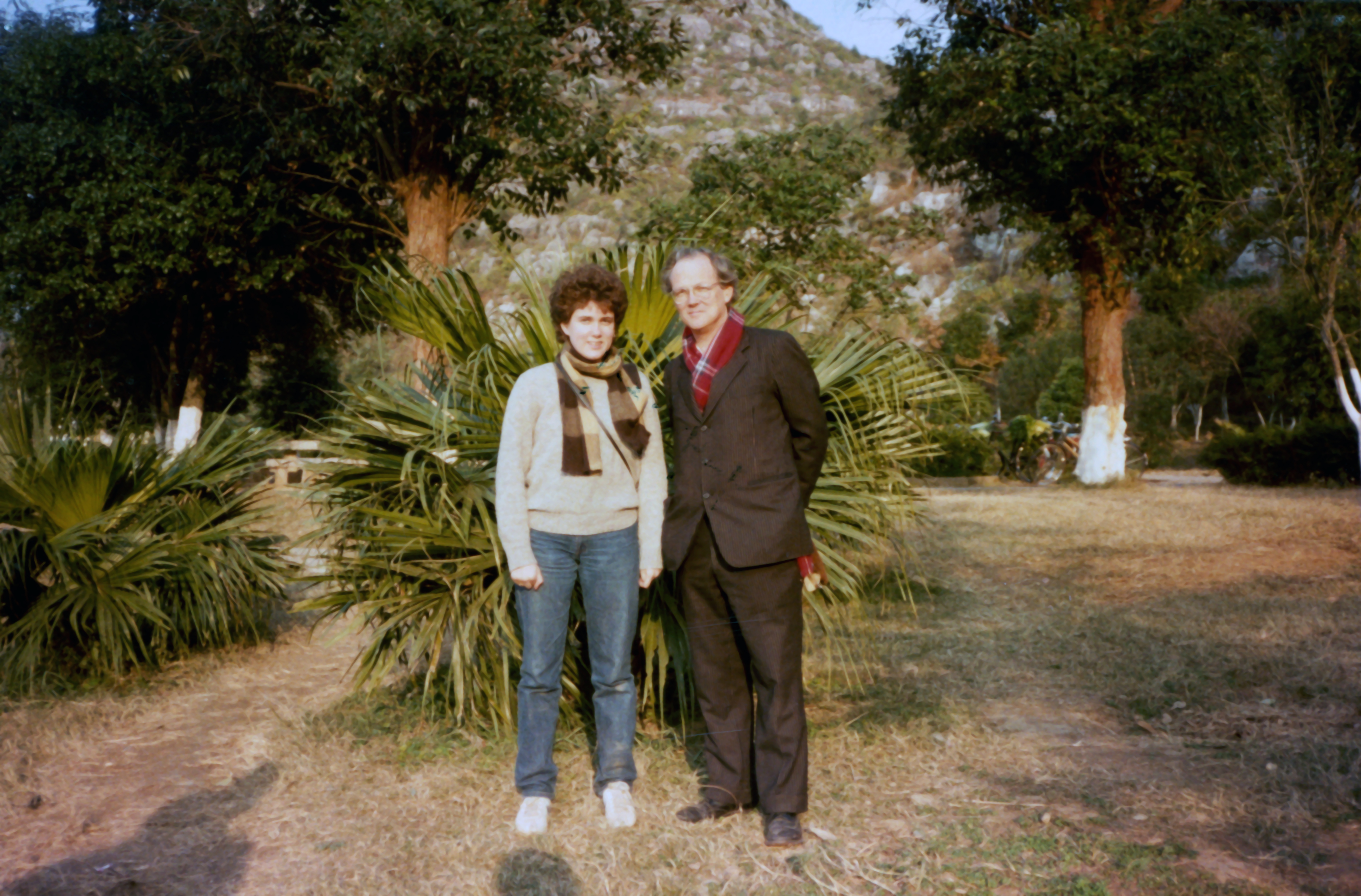
Amy and Peter posing in front of a tree.

Trans-Siberian Railway 1985: Ruth and Amy’s Big Adventure

[For Ken Shiotani, so some of the photos will be illustrative of text and some will be random trains. Ken generously helped with the alt text for many of the train photos.]

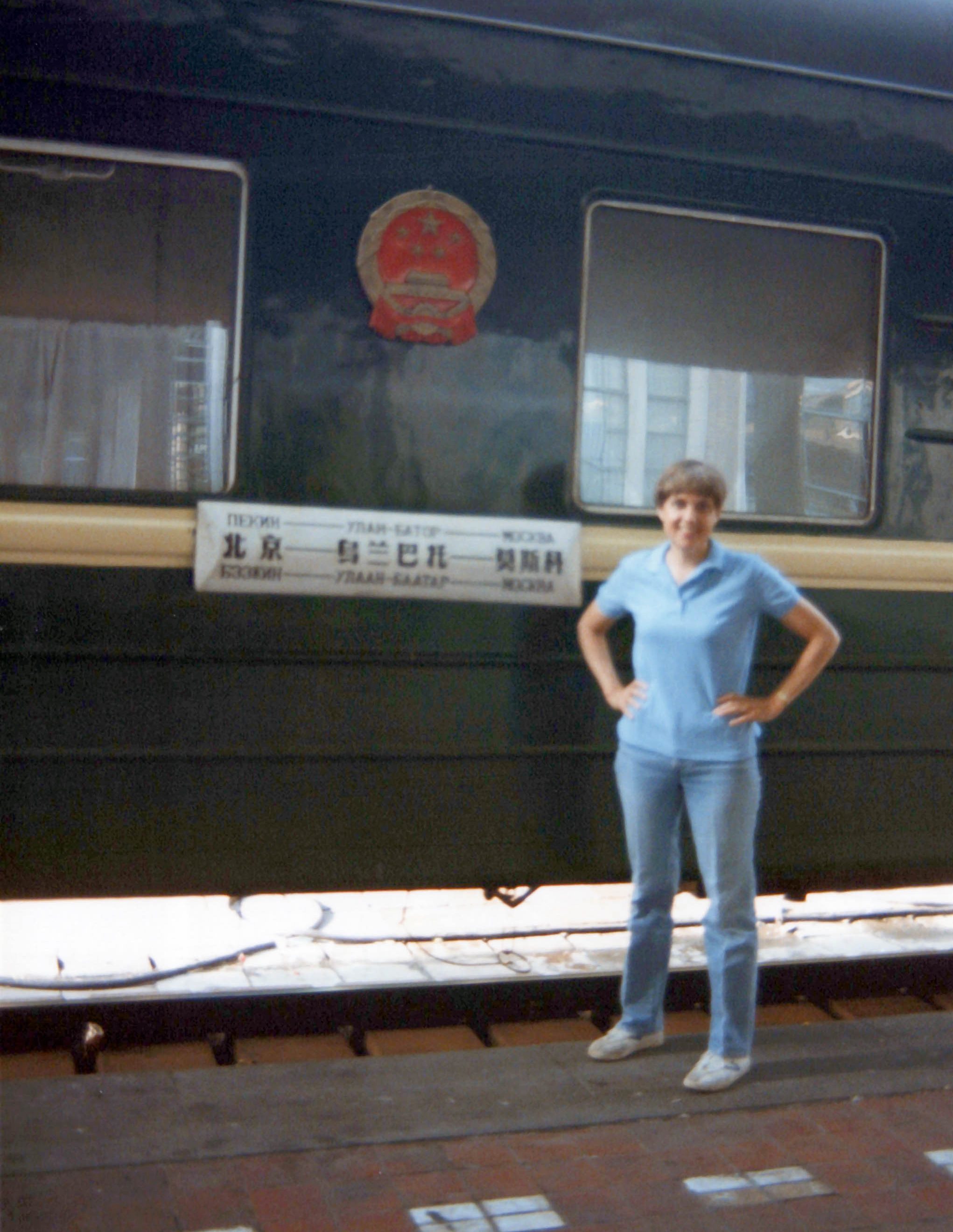
During the summer of 1985, my mother, Ruth Blau, and I took the Trans-Siberian Railway from Beijing to Moscow. Here we are getting ready to board in Beijing.  (I’m adding alt text to the photos. So I don’t have to repeat:  Mom and I are both white women with short brown hair. In July, 1985, Mom is 48 and I’m 24.) 

Ruth (white woman; blue t-shirt; jeans; short brown hair) standing in front of a train car with writing in Chinese, Russian and another language I don't know.
Amy (white woman; white short-sleeve shirt; jeans; short brown hair) standing in front of a train car with writing in Chinese, Russian and another language I don't know.

I had just spent two years (and three out of the last four) in Taipei, Taiwan, first as a gap year (which we called “taking a year off” or “not being ready to face your senior year”) in 1981-82, during which I took odd jobs teaching English, getting my head around the idea of my future, and eating extraordinary things from food carts, night markets, and the occasional restaurant. I came back to Taiwan after graduating in 1983, first on a one-year fellowship to study legal history at National Taiwan University, and then stayed on for another year of teaching, translating, saving for law school, and eating. In 1985, I was heading back to start law school at Yale, but took the long way from Taipei to New Haven through Hong Kong, Nanjing, Beijing, Ulan Batur, Irkutsk, Moscow (for about 2 hours, but that’s another story), Kyiv (which we called Kiev), St. Petersburg (which we called Leningrad), Helsinki, London, Edinburgh (for a friend’s wedding), and Arlington.

I met my mother in Hong Kong, traveled to Nanjing, somewhere along the way climbed Tai Shan at four in the morning (yet another story), and ended up in Beijing where we boarded the Trans-Siberian Railway for the trip to Moscow. I was at that point fluent in conversational Mandarin, and my mother had brushed up on her master’s-degree-level Russian from 1960.

These are mostly my mother’s photos, as I was still in the phase of my photography habit known as “I don’t have the money to develop a ton of 36-frame rolls” so I took photos pretty sparingly.  Luckily my mother had a bit more money to devote to the photo counter at Drug Fair (the CVS of early 1980s suburban DC).  In addition, both my mother’s and my photos sat in boxes in our respective attics/basements for the past 35 years, so the organization is not great.  That is, I may call something “heading out of the station in Beijing” that is really “pulling through some other random station.”  But you’ll get the gist. 

First, the route, from the modern-day TransSiberian website (haha as opposed to what? the 1985 TransSiberian website?).

Couple of photos in the station in Beijing and heading out.

Crowd of mostly Chinese people with luggage in front of an ornate train station.

Train cars seen from outside heading into a tunnel. Train cars rounding a bend photographed from the window of the fifth or sixth car back. Scenery is open green plains; no trees. The dining car. We were, if I recall correctly, told that we were lucky to be riding from Beijing to Moscow rather than the reverse direction, as we had Chinese chefs most of the way and therefore far better fare than was offered by the Soviet chefs.  After spending a week in the USSR – where the five year plan appeared to have focused on cucumbers – I’m guessing that was accurate.

Train dining car with two rows of tables: 4-tops on the left and 2-tops on the right. Occupied by diners of various genders and races. In the foreground, Amy sits considering the menu and looking to the right of the frame. Also note that while my hair is grayer, my fashion choices and coffee addiction have not changed in almost 40 years.

Amy in shorts and sweater getting coffee from the samovar.Although both of us are introverts, my mother and I somehow managed to occupy this space together for five days.

Train sleeping compartment with two cot-sized beds and about 3 feet between; at the end by the window a small table with two multi-colored metal mugs with lids.

Amy sitting on one of the sleeping compartment beds reading a paperback book. Amy standing at the door of the sleeping compartment looking into the aisle. Another passenger (Asian man) stands at a window farther down looking out.  Not far outside Beijing we crossed a portion of the Great Wall — not the well maintained, touristy part, but a part that gives a sense of what the builders were trying to do (and how silly, for example, a modern-day wall might be).

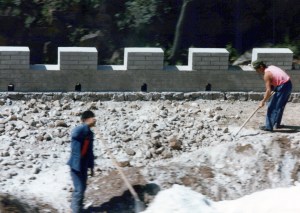
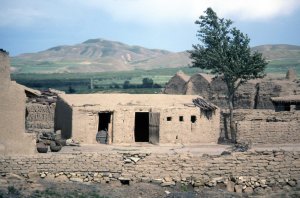
Portions of the Great Wall where it runs up and down steep hills. Portions of the Great Wall where it runs up and down even steeper hills. Two men in work clothes working on a portion of the top of the Great Wall that is entirely rubble.  The crenelated edge is visible in the background. Also during the first day out of Beijing.Adobe or mud houses with no windows or doors.  Unclear whether occupied.

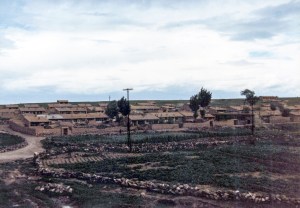
Village of low adobe-colored houses.  Somewhere between Beijing and Mongolia.

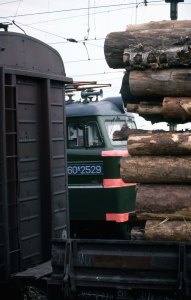
Electric locomotive powered by overhead wires; sitting in a station, photographed from just ahead of the engine.

Four open flatcars of logs.

Train engine viewed through a break in a closer train, the visible part of the closer train includes a closed freight car to the left and a bit of an open flatcar with logs on the right.

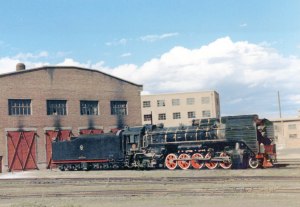
Steam freight locomotive (Chinese QJ class) with one car next to a train barn.  Mongolia:

Five camels photographed from the train running parallel to the train. Person on horseback photographed from the train  with a herd of horses.

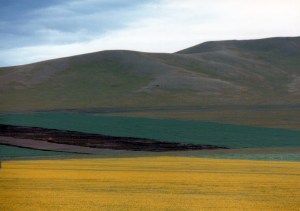
Scenery photographed from the train consisting of brown rolling hills and, in the foreground, a field of yellow flowers. Yurts! For real! 

Two white yurts with multi-colored doors photographed from the train; ordinary buildings in the background. Though both Mongolia and the USSR were still communist in 1985, small-scale, babushka-based capitalism thrived along the railway.

Older white woman in blue flowered shirt and white head scarf (babushka) sitting in front of baskets of strawberries she is selling.  Three older white women in head scarves (babushkas) and two older white men -- one in a flat cap, the other in a fedora -- sitting in front of baskets of strawberries and other produce they are selling.

Four older white women in head scarves (babushkas) sitting and standing in front of baskets of strawberries and other produce they are selling.

Three white women in head scarves near the tracks.  Two are between sets of tracks pushing baby carriages full of produce to sell; the other sits to the side of the further track. In the background, a young white girl in a red shirt and checked skirt.  In the background, a brick building with wooden doors and an old car. We would be allowed off the train very briefly at stops, though the stations were tightly patrolled. Two blue train cars in a station with a variety of people milling around near the doors. Ornate orange and white train station building viewed from our train with a variety of people sitting and standing on the platform. Although this was taken in the Beijing station, it is relevant to the end of our journey.Photo taken from outside our train car of Ruth leaning out the window of our compartment. As we got closer to Moscow, we were told to close the window in our compartment as the train had switched to a diesel engine.  I managed to convince my mother that this was no big deal and that we should keep the windows open — it was, after all, July.  The result – of which I don’t appear to have a photo – was that we arrived in Moscow covered in diesel soot. 

Our arrival in Moscow marked the end of the Trans-Siberian part of the trip, but not the adventure. We were met by our Intourist guide who told us that “Moscow is closed,” and that she’d be transporting us to the airport for an immediate flight to Kyiv, the next stop on the trip, but one that was supposed to come after a couple of days touring Moscow.  Turned out there was some sort of Communist youth festival in Moscow — the 12th World Festival of Youth and Students to be precise — and Intourist did not want rando Americans wandering around interacting with Youth and Students. So after all that, the entirety of my experience of Moscow is a cab ride from the train station to the airport. We continued our trip with an extended stay in Kyiv — which was cool, as my grandmother was born there — and then Leningrad. We took another train from Leningrad to Helsinki, but sadly I don’t seem to have photos.  My memory is that that train ride was VERY tightly controlled, so it’s possible photography was not permitted? 

It was truly the trip of a lifetime, and I’ll be forever grateful to my mom for making it happen and putting up with me in a small compartment for five days! 

Extra bonus train photos for Ken – from the Beijing to Nanjing trip:

Two Chinese women pushing a vegetable cart with two freight cars in the background.

Steam freight locomotive (Chinese QJ class) in a train yard.

Chinese men in white uniforms and hats (one white one blue) loading sacks onto a train.

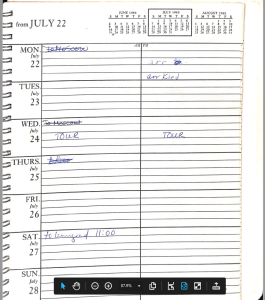
Update: In the process of scanning & tossing old documents, I came across my calendar for 1985,  Here is the page for the week of July 22-28, 1985, reflecting the quick change in our itinerary.

Page from a date book from July 22 to 28, 1985. July 22 has "to Moscow" crossed out, with "arr Kiev" written in later in the day. Wednesday July 24 also has "to Moscow" crossed out, and the word "tour" in the morning and evening. Saturday July 27 has "to Leningrad 11:00"

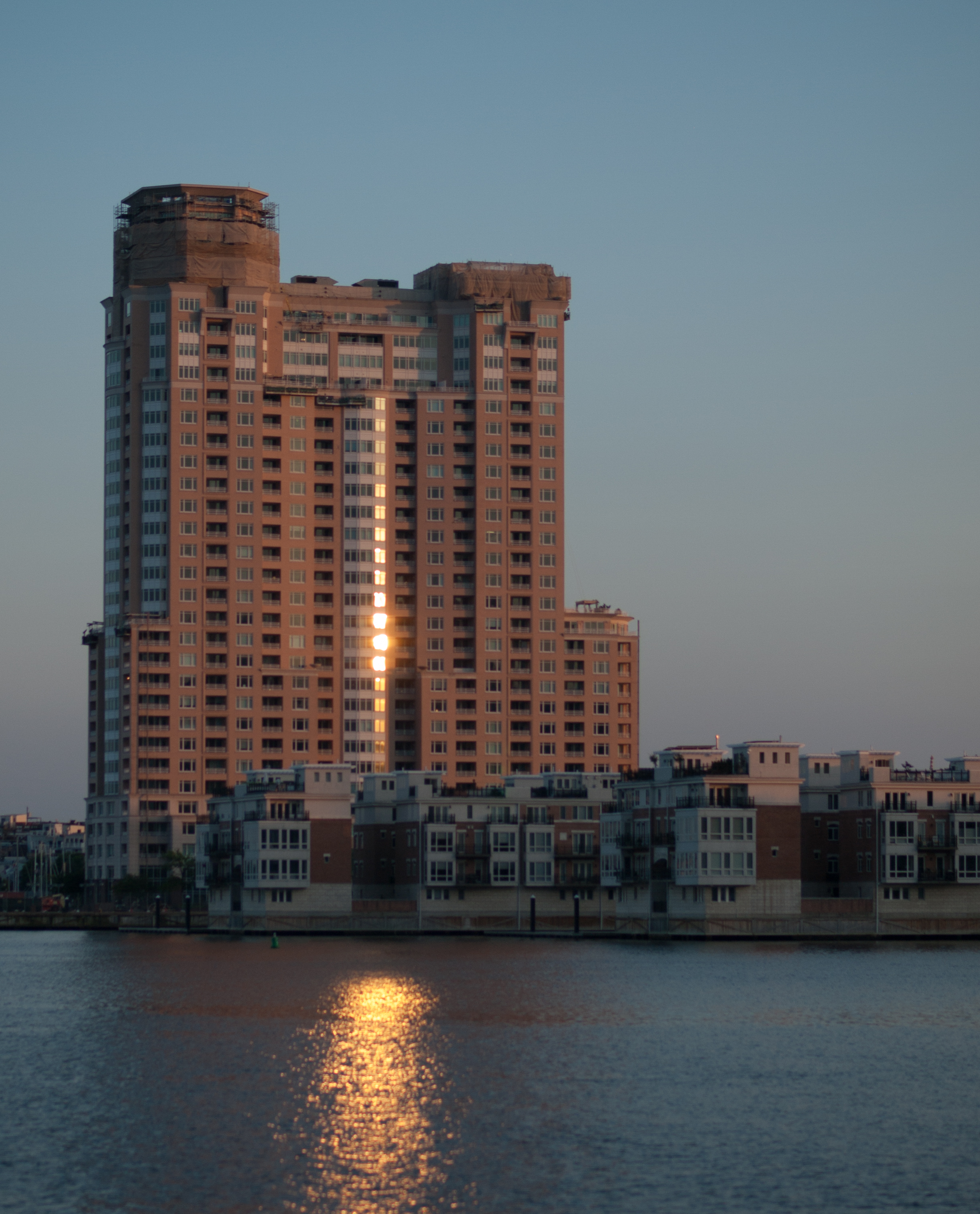
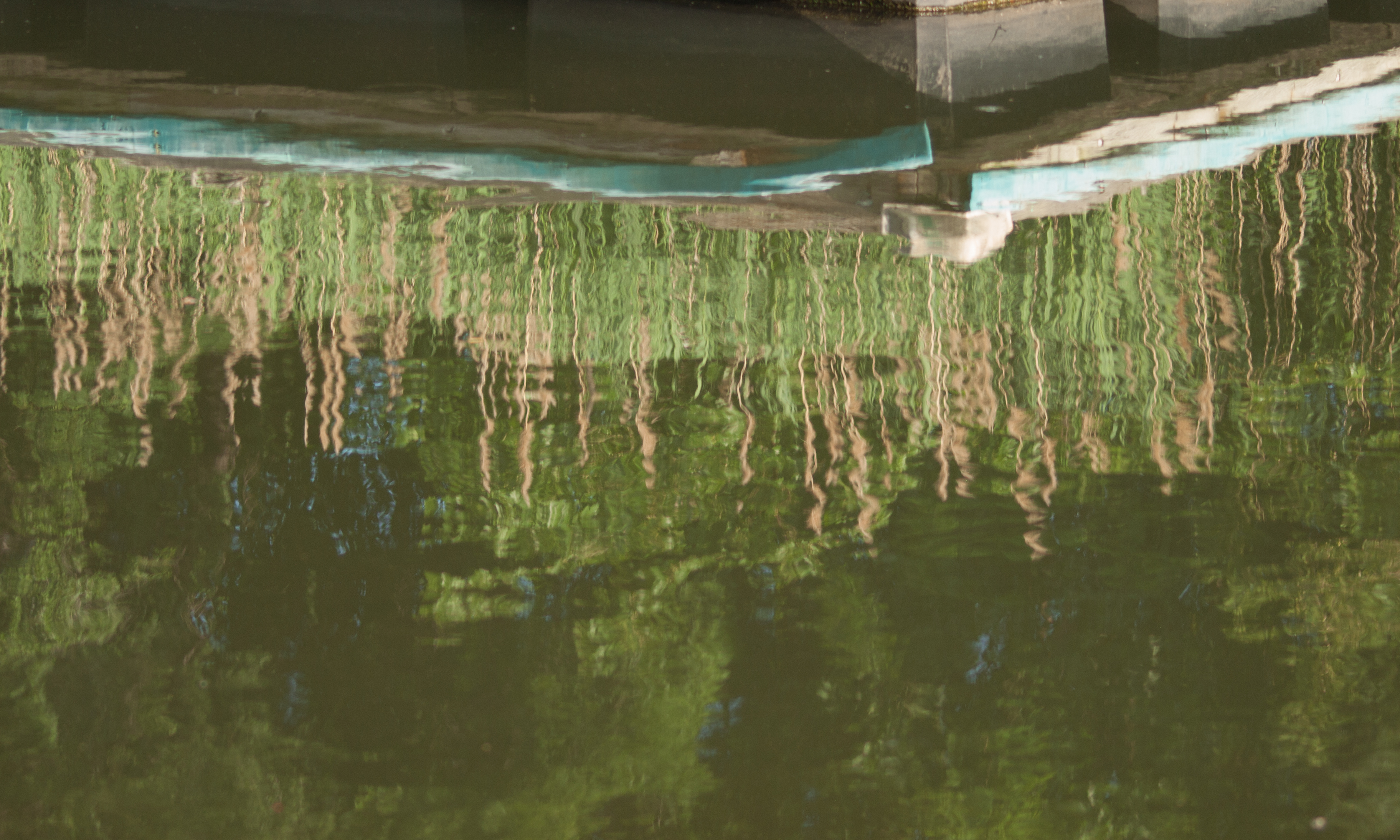
Photos from Baltimore

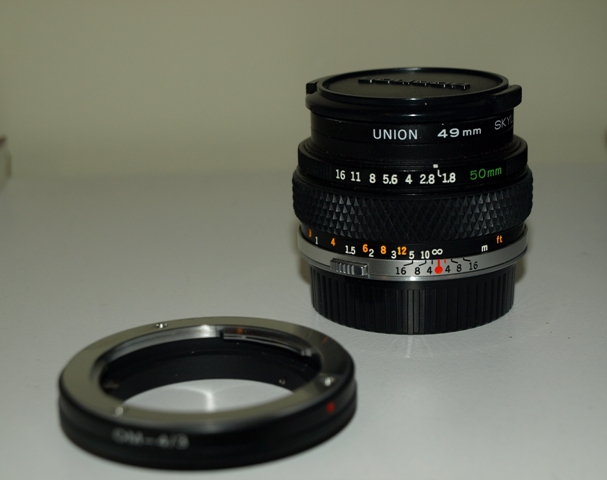
In Baltimore for the National Disability Rights Network conference and have been playing with a new lens.


Update:  More Baltimore photos on my Flickr page.


More from the photo archive

This time, from my Dad’s experiences at the Sebago School and Camp Ironwood, run by Matt and Margaret Werner in St. Louis (school) and Harrison, ME (Ironwood).

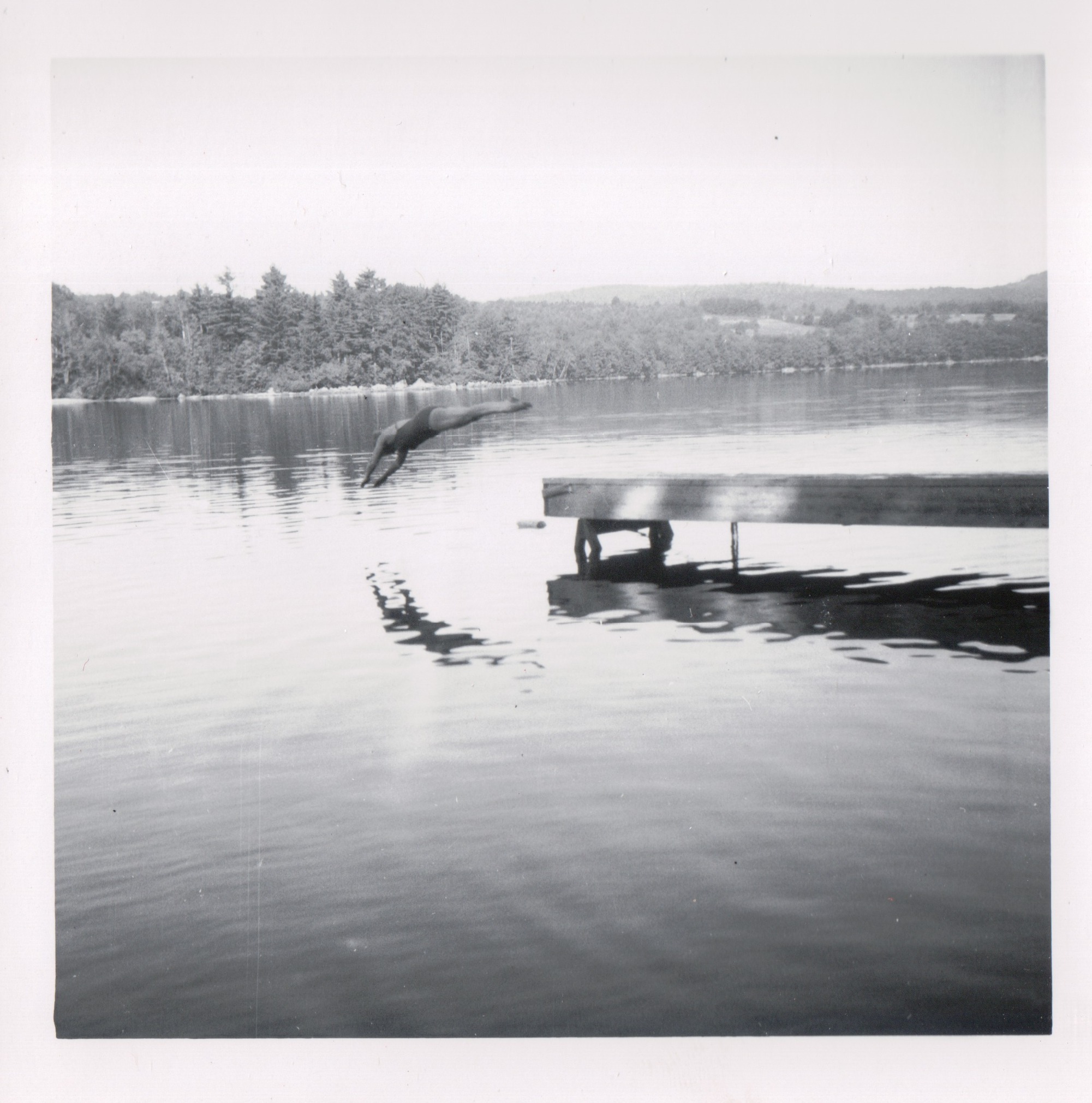
From the camp — I just loved these first two:

{Image: black and white photo of a person diving off of a dock into a lake.  The diver's image is reflected in the lake.}

{Image: black and white photo of a person diving into the water, but all we see is the person's legs, perfectly straight, angled from their toes at the center of the photo to the bottom right where their torso disappears off the edge of the photo. To the left are several canoes, and in the background, a boat.}

{Image:  black and white photo, taken from above looking straight down on two people sitting by the side of a stone building.  The person on the right is wearing saddle shoes and has their feet extended in front of them, with a plate of food on their lap.  The person on the left is wearing a sleeveless undershirt and holding a drink  (coffee?) in his left hand.  The photographer's feet on the edge of the building above are visible in the foreground.}

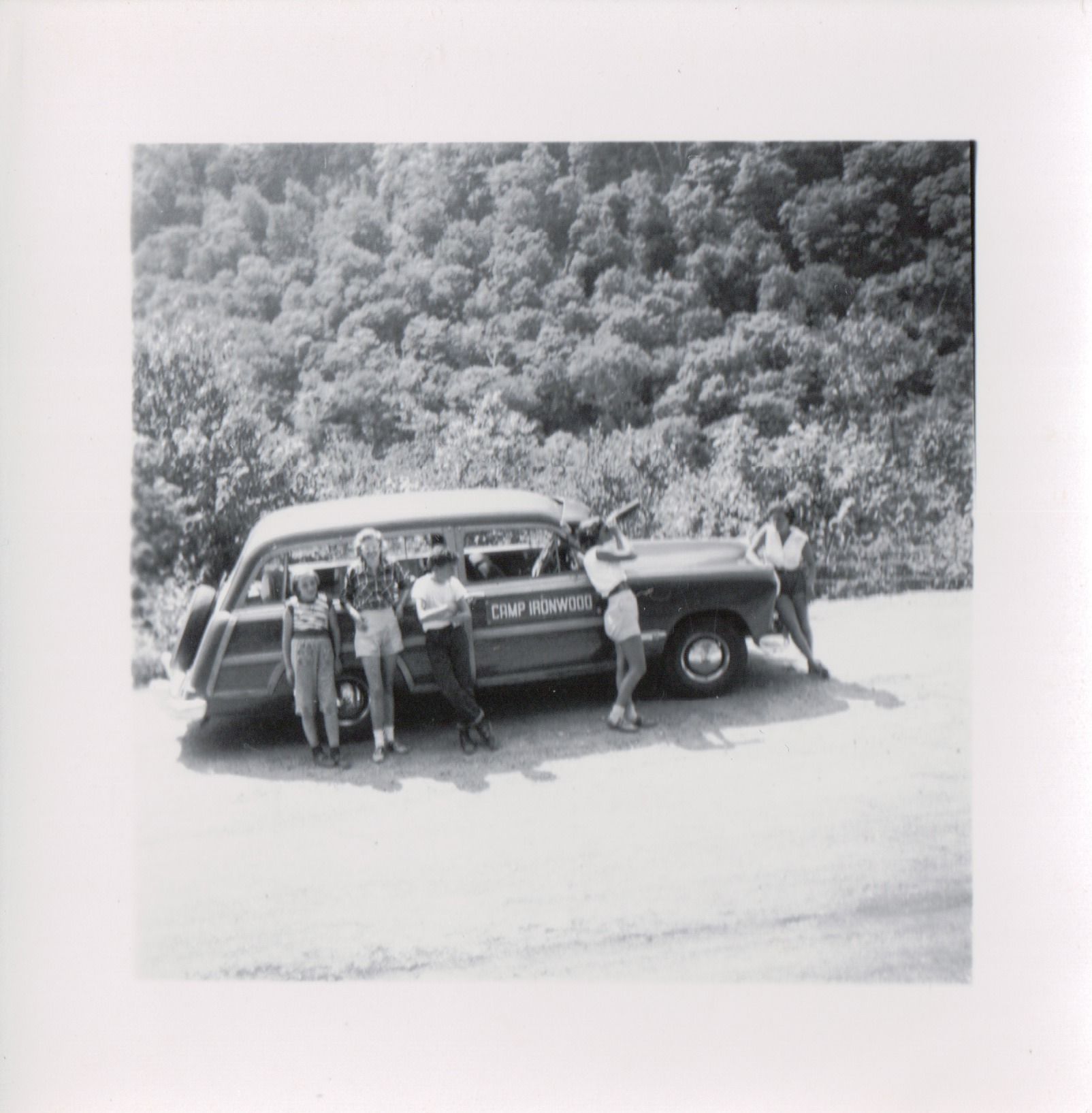
The next few are from a driving trip the school/camp took through the western United States:

{Image:  1940s wood-paneled station wagon parked at the side of the road.  Five teen agers lean against it, one of whom is looking through a lens of some sort; the others facing the camera.}

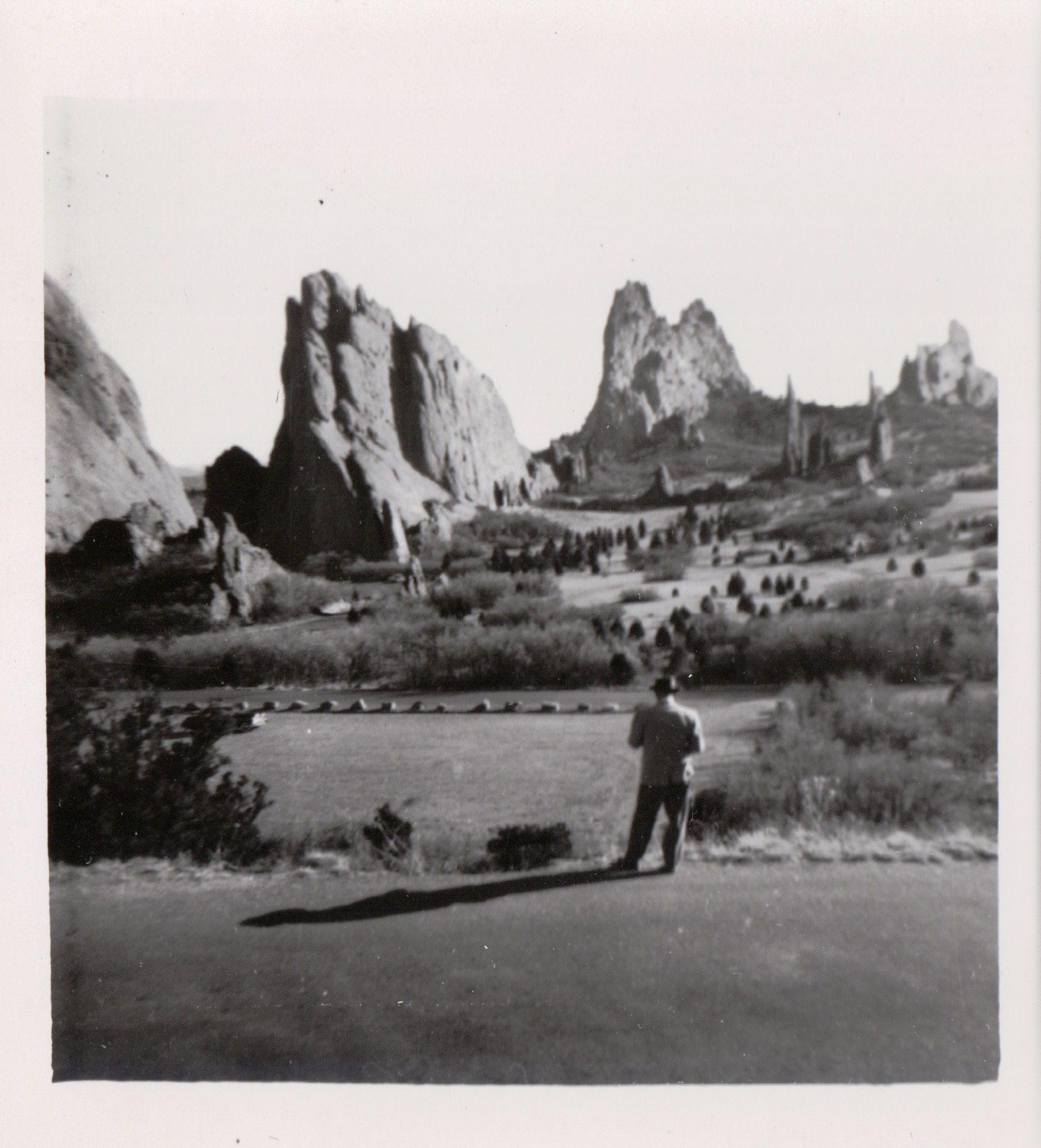
{Image:  black & white photo of Garden of the Gods, which is a series of rock formations in a high-desert landscape.  A man is in the foreground looking at the scenery.}

{Image: black & white photo of a narrow alley with brick buildings on either side and passageways overhead.}

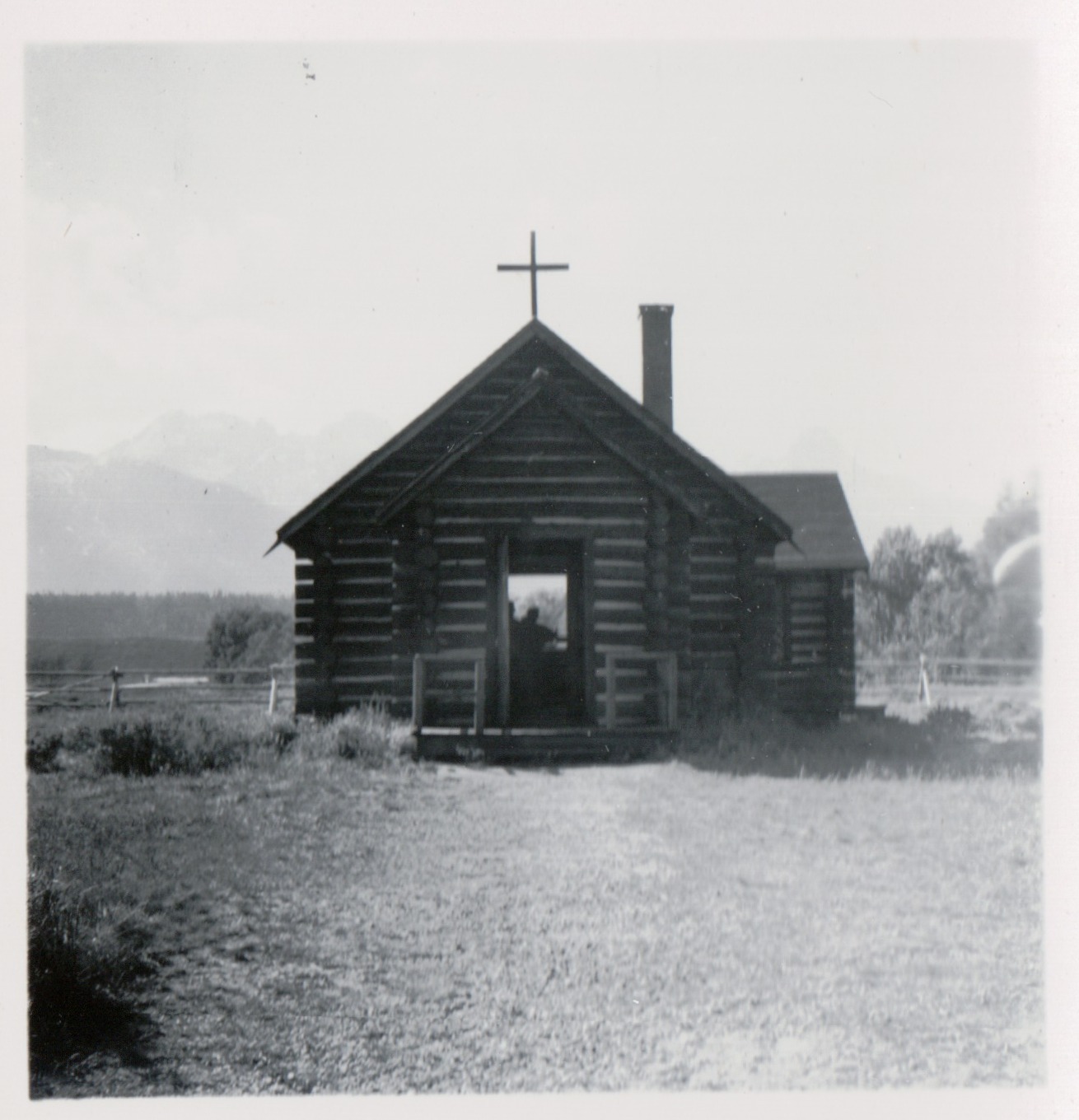
{Image:  Black & white photo of a small log church with a cross on top.}

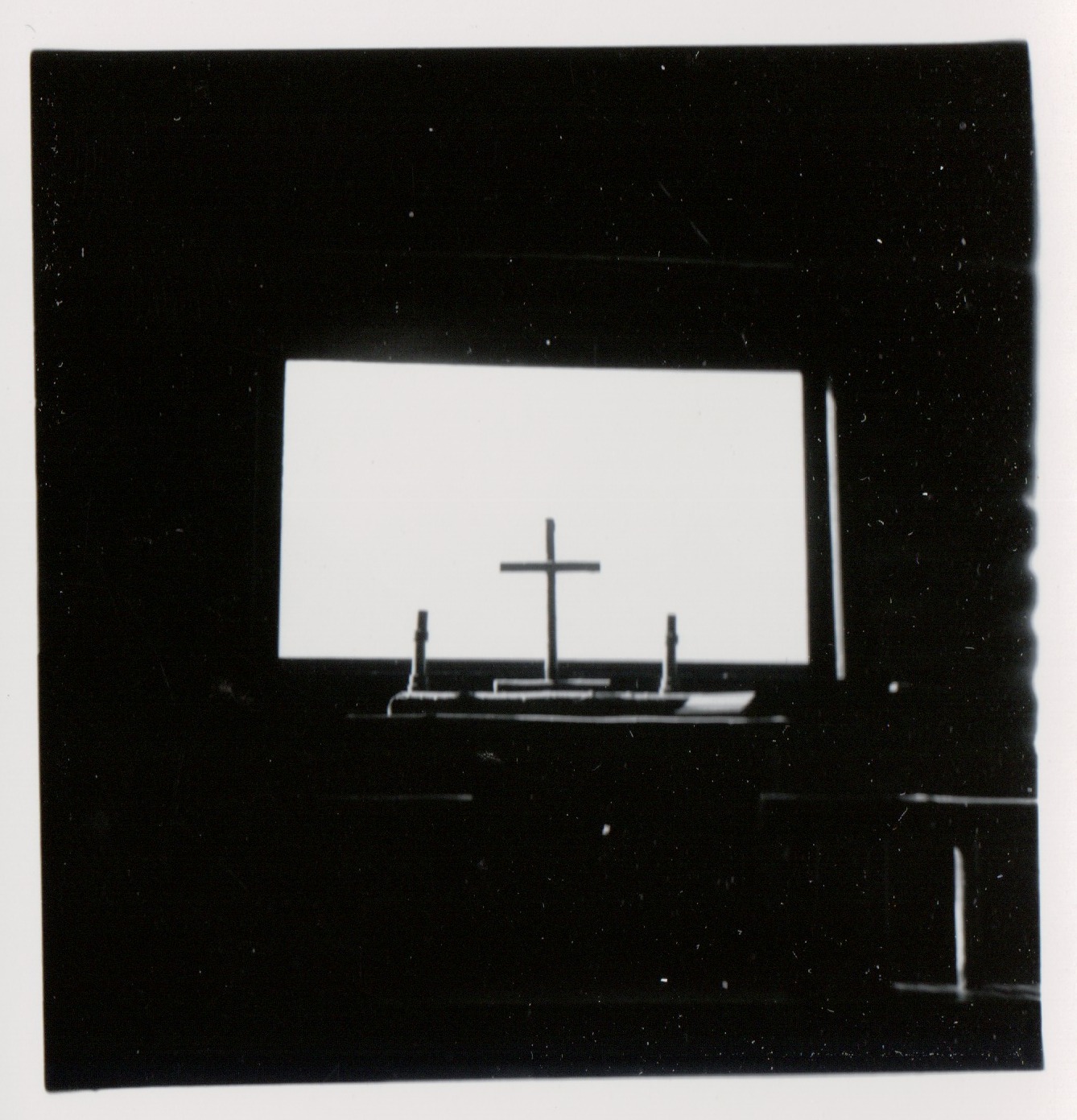
{Image:  black and white photo of a rectangular window with a cross silhouetted against the middle.}

{Image: black & white photo of a large bear crossing a road.}

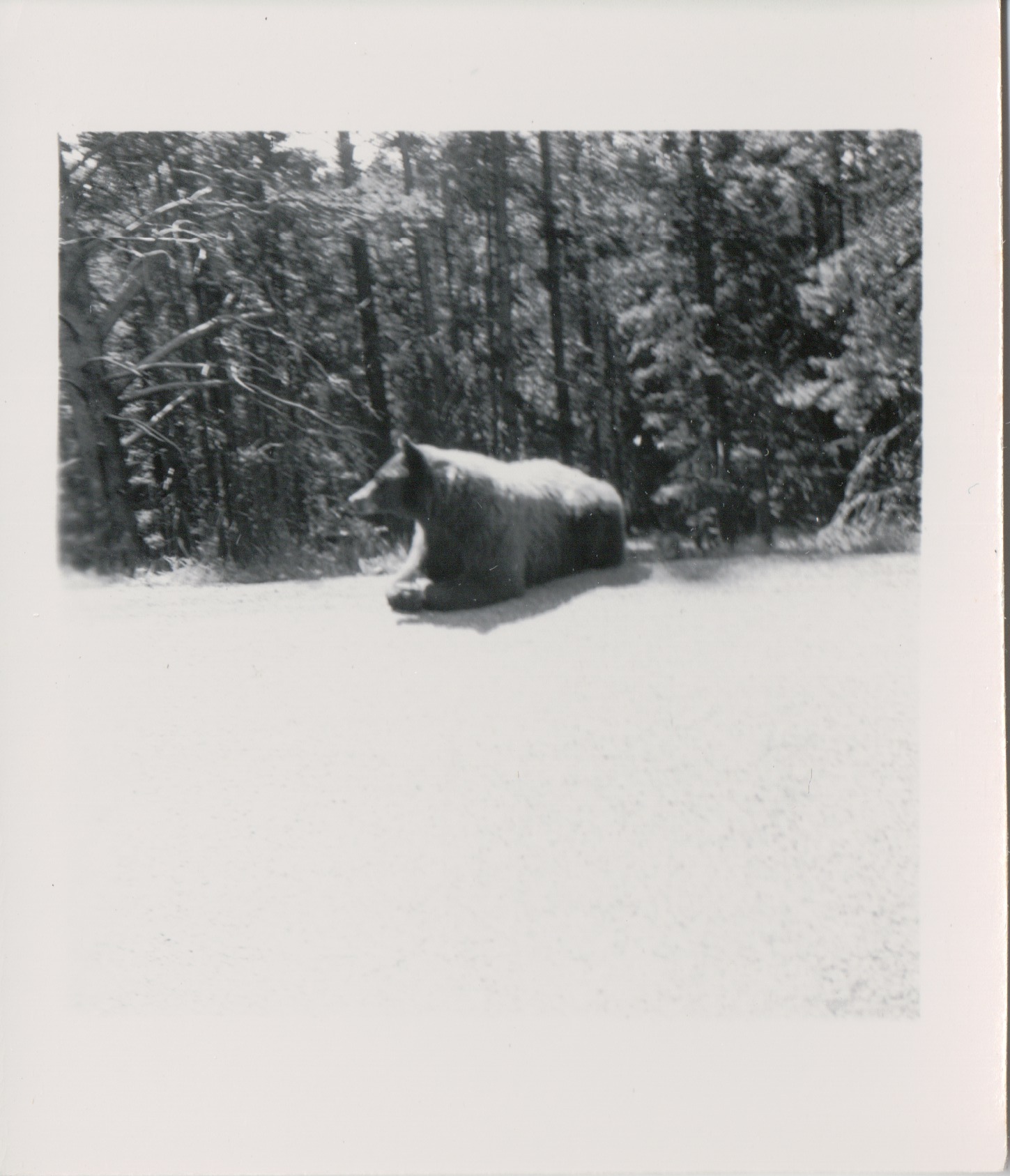
{Image: black & white photo of a large bear resting by the side of a wooded road.}

Nifty fifty!

While this could easily be a reference to my brother, who will soon be joining me on the other side of the half-century mark, it is in fact a reference to the lens that our photo teacher recommended as a great all-around lens:  the 50 mm with a wide aperture for interesting shallow depth of field photos.  He confidently asserted that it would not be expensive and would be a good addition to our camera bags.

Not sure what his definition of “not expensive” is but this did not gibe with mine:

At the same time I was pondering this advice, I was puttering around in our basement looking for the lenses from my ca. 1984* film camera  — which, like my dslr camera, is an Olympus — and found that I was already the proud owner of a 50 mm (ok, ok 49 mm) f/1.8 lens.

I started trying to figure out how to use it with my current dslr camera.  It didn’t fit directly, and the first two calls I made to photography stores that will remain anonymous resulted in the advice that (1) this was impossible and (2) that it would cost me $150 for an adapter.  Seriously:  just that contradictory.  But I went on ebay, ordered the adapter in the (blurry; damn!) foreground of the photo above — for $14 — and voila!  I have a nifty fifty!

Clearly I need to learn more about how to use it, but damn it’s going to be fun!

BTW, I actually grew this pepper.  But that is for yet another blog post.

*****************

* Faithful readers who are paying close attention and/or are related to me will say, “ca. 1984?  but didn’t you say you got your 35 mm camera for high school graduation?  And you graduated high school in 1978, so what gives?”  The full answer to that will have to await another post that I’ve been meaning to write about having my backpack stolen in Singapore with my camera, money, and passport from the lobby of the Sheraton, putting my frantic mother** on a plane back to the States, contacting the law firm I was working for in Taiwan,*** being put in touch with a Chinese pop star who happened to be a friend of one of the partners, who loaned me money and took me out to dinner****, which allowed me to scramble around Singapore in a taxi getting a new passport, visa and plane ticket.  I was cameraless until that summer when, back in the States and visiting friends in New York, I bought a new one almost identical to the graduation gift, and carried on with my untutored but enjoyable photographic career.

** You think I could have afforded the Sheraton on my own at that point??[UPDATE: ******]

*** And that is one of the other reasons for this post.  Just the other day, I found myself trying to explain what a telex was.  It was sort of 1984’s email in a way.  You typed into a teletype machine in (say) the Sheraton in Singapore and it would print out momentarily at (say) a law firm in Taipei.

**** If you think the style disparity between me and Miss South Africa was vast, I only wish I had a photo of my dinner with Theresa Teng.*****  But, alas, the thief had my camera.

***** Only when I googled her for this post did I learn that she passed in 1995 at a very young age.  RIP, Theresa.  You did a very good deed for a very lost and scruffy Waigwo student at the height of your stardom.  Above and beyond.

UPDATE:  ****** For the record — see Comment #1 — this was not my mother’s fault.  I violated Travel Rule #1:  Always Keep Your Backpack With You At All Times.  I’ve also violated Travel Rule #2:  Don’t Stay In A Hotel With A Preying Mantis on the Bed.  And #3:  Always Wear Sunscreen when Lying on A Beach Below the Tropic of Cancer, even in February.  And many more, I’m sure.  Live & learn!