
or: Where 5’2″ + the Sno-Brum (TM) couldn’t reach.

or: Where 5’2″ + the Sno-Brum (TM) couldn’t reach.
It should be obvious that whatever the ADA does or does not permit, it would not permit a business owner to DECREASE accessibility.
ADA 101: You’re supposed to build new facilities to be accessible and make old ones accessible when it’s “readily achievable” — that is, when the cost and your resources make it reasonable.* When you’re making alterations, you’re supposed to make them accessible “to the maximum extent feasible.” But fer Pete’s sake — a phrase that really should appear verbatim in the regs — don’t take something that’s accessible and make it inaccessible.
This is what the regs actually say about it: “No alteration shall be undertaken which decreases or has the effect of decreasing accessibility or usability of a building or facility below the requirements for new construction at the time of alteration.” ADAAG § 4.1.6(1)(a).
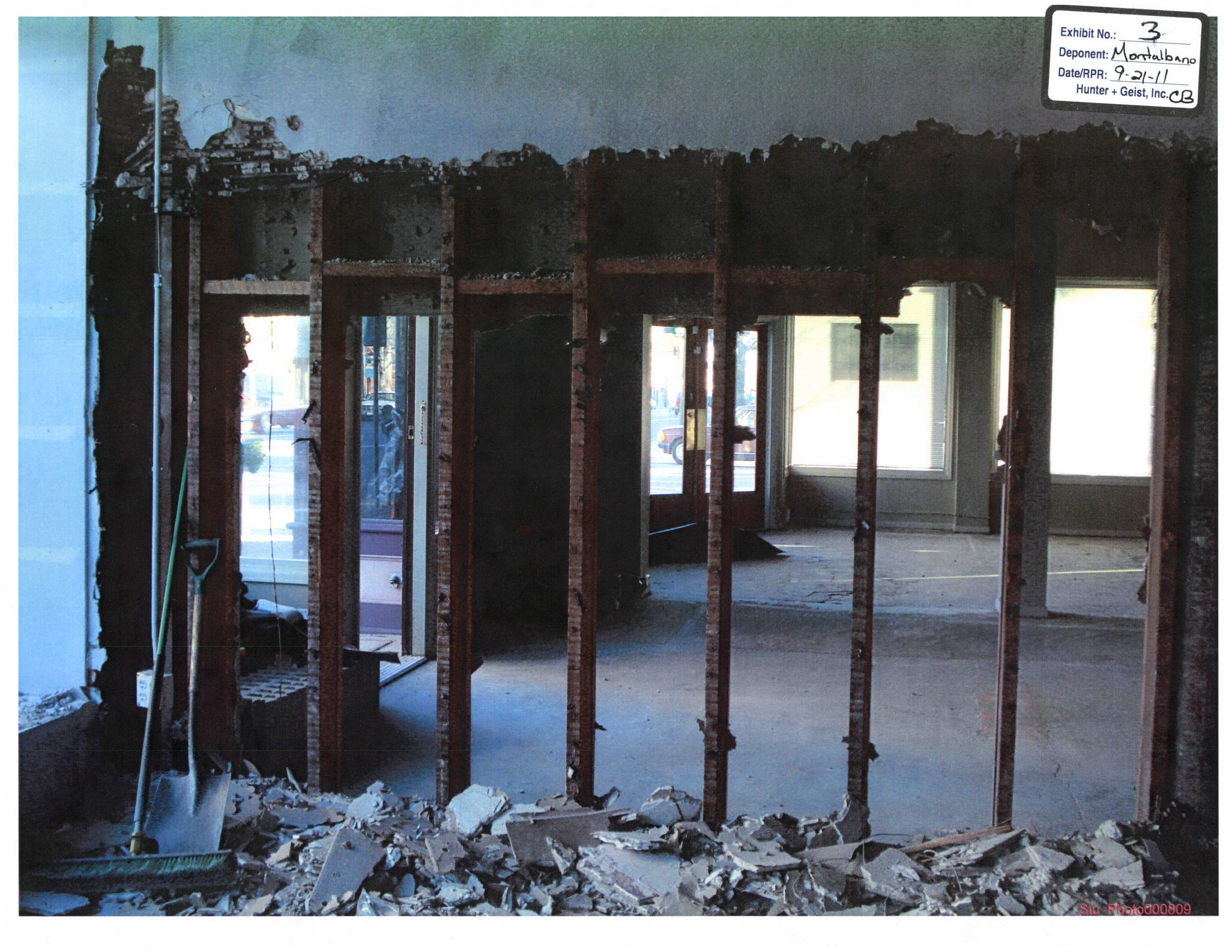
When we moved into our office space in February, 2008, the space across the street was empty and essentially gutted. Among other things: flat. The floor of the space was had no changes in level. Did I mention it was flat?
Hoping for another good restaurant in our neighborhood, we were psyched to learn that someone was opening a mid-scale Mexican restaurant & bar across the street. We looked forward to good food and after-work gatherings, especially with our friends & co-counsel at the Colorado Cross Disability Coalition, which is right up the street.
This is what the space looked like before:
 Here’s what it looks like now:

We don’t have a panoramic shot of the restaurant, but this is the newly constructed raised area on the north side — the mirror image of the newly constructed raised area on the south side. No ramps. Over half of the total floor area is now inaccessible, and most of the rest is occupied by a bar, leaving a couple of tables — often inaccessible high tables — on the ground level.
To summarize: The owners constructed two inaccessible raised areas in a previously flat, fully-accessible space. They took a space that could have been completely integrated and created — at best — a wheelchair ghetto.
In brief:
Before: flat.
After: inaccessible.
We tried hard to talk to them about this, with no success. So we got together with the Colorado Cross-Disability Coalition and filed suit.
Pause for a brief introduction to CCDC, as if all five of my readers aren’t already intimately familiar with them. On a shoestring budget, CCDC works with the legislature, conducts training, engages in outreach and advocacy and — when called for — files suit to ensure equality of opportunity for people with disabilities. During the legislative session, their volunteers are at the capitol every day. When people are having difficulty securing needed services or benefits, their volunteers are on the phone. And their advocacy and litigation have increased Denver’s physical accessibility from the Pepsi Center to Red Rocks, and … done a lot of other amazing stuff. I was going to give some more examples, but just click here and scan the list!
In response to the lawsuit, the restaurant retained Littler Mendelson, a nationwide employment discrimination defense firm. And by “nationwide” I mean, of course, “expensive.”** Instead of working with us to make the place more accessible — and saving everyone’s attorneys’ fees — it’s been scorched earth litigation. But I think what has been most entertaining for us is the Littler lawyer’s decision to accuse CCDC of defamation. Yup: the fact that CCDC posts, on its website, the pleadings — public documents — containing the undisputed facts above — took a flat space; made most of it inaccessible — constitutes defamation. Here is the Littler Mendelson attorney, verbatim, in a deposition of CCDC’s executive director:
5 ……My position is that
6 you and your clients have been defaming my clients by
7 raising false allegations of discrimination, repeatedly
8 accusing my client, both in this case, in judicial
9 filings, but also in Internet filings, which simply
10 reiterate the false allegations put into the court
11 record that my client discriminates against individuals
12 with disabilities.
13 You are trying to present a picture of my
14 client to the Court which is not true, and I’m entitled
15 to present a picture of your client which I believe
16 demonstrates its motives in pursuing this case. You’re
17 trying to present a picture of your client to the Court
18 of a noble organization just trying to obtain
19 additional access for people with disabilities.
20 I’m allowed to present to the Court a
21 picture of your organization as one which shakes down
22 and scourges local businesses and forces them to incur
23 tens to hundreds of thousands dollars in attorney’s
24 fees and costs in order to promote the organization’s
25 revenue and business, and I think I’m allowed to make
1 the same types of — I’m allowed to rebut the glowing
2 picture of your organization that you’re trying to
3 present to the Court . . .
That’s right: calling attention to the fact that the defendant took an accessible space and made it inaccessible is defamation. I suppose we should be glad that being accused of inaccessibility is at least regarded as a bad thing!
Just after we started our firm in 1996, I was talking to my Dad about some of the baloney we were already starting to get from defense counsel. He told this story. When he was the Executive Director of the Missouri Commission on Human Rights in the early 1960s, he decided to drive around rural Missouri testing the newly-enacted Civil Rights Act which prohibited discrimination on the basis of race in places of public accommodation, for example, restaurants. On at least one occasion, the restaurant he had just tested called ahead to the next one down the road, and the folks at the second place were waiting at the door with shotguns when he arrived.
I suppose it represents a sort of progress that enforcing the civil rights laws in 2011 requires only a thick skin and a high tolerance for bullshit rather than a up-armored ’64 Dodge Falcon and firearms.
************
* OK, the definition is slightly more complex than that, but I sense your eyes glazing over already.
** We haven’t seen their legal bills, but I’m fairly certain Littler Mendelson is not working for free. Our assumptions did lead to this dryly hilarious exchange in the deposition of CCDC’s executive director:
18 Q. All right. Then in the
19 next line, the next paragraph, second sentence, says,
20 “[The restaurant’s] owner is spending money, lots of money, on
21 a 17th Street law firm to fight providing access.” Do
22 you see that?
23 A. Yes.
24 Q. What is the basis of your knowledge
25 concerning the amount of money, if any, that
1 [the restaurant’s] owner is spending on legal fees?
2 A. I — I guess I don’t know exactly. It’s
3 an assumption. Maybe I shouldn’t have made that
4 assumption. Maybe you’re working pro bono and I don’t
5 know that.
If you are not rolling around on the floor laughing so hard you can’t breathe, you probably aren’t a plaintiffs’ lawyer.
I was just about to post a cranky post about opposing counsel in a case we’re involved in* and my last two Facebook posts have been
This is where we are on our Big Case: witness has to go back to doctor for urgent tests and possible exploratory surgery for cancer; Defendant refuses to withdraw the subpoena for her deposition at the same time as the medical appointment.
Mamas don’t let your babies grow up to be lawyers.
and
File under “K” for karma’s a bitch. Opposing counsel who refused to reschedule a deposition for the witness’s medical procedure now needs us to reschedule for *his* medical procedure. Must.Control.Sarcastic.Response.
so it hasn’t been a good week for Rule 1.5. But before I launch into my latest diatribe, I wanted to link to this, a wonderful meditation** by my friend and co-counsel Kevin Williams on how lucky we are to practice in the field we do.
As many of you know, CCDC’s offices are like many non-profit’s, but from my office, I can see the Colorado Rockies South and West. From Pike’s Peak…almost…(if you stretch)… to Long’s. This evening, as I wrap up today’s work (responding to letters from some lawyer telling me why he thinks I’m an a**hole), I was lucky enough to remember to turn around from my desk and look out my window. I just watched the magnificence of another spectacular Colorado sunset.
…
The sunsets keep coming. Fifteen years of being a disability rights lawyer has taught me one undeniable principle: When you represent people who have a righteous cause, you are doing the right thing. Although we have had a few let-downs over the years, and many, many contentious battles, the victories keep coming. I look forward to tomorrow’s sunset.
We are lucky. I’ll be ranting again soon — tomorrow, even — about the antics of our opposing counsel, but for tonight I’m thankful to practice in the field that I do, with a partner like Tim, co-counsel like Kevin and the rest of our incredible and various teams, and righteous clients, cases, and issues. And much as I love our coastal colleagues, with the amazing view of the sun setting over the Rockies.
**********
*Coming soon.
**I think Kevin will hate this word. I think he’d prefer something more like gin-fueled philosophizing.
Did I mention Rocky Mountain Medical Equipment? We love you, Alan!
**********************
* OK his etsy shop doesn’t have anything to do with wheelchair repair, but his designer messenger bags are very cool.
** Not strictly speaking a part of every wheelchair repair event, but made this one especially fun for Tim.
Update: Click here for the Breaking Bad meme. This page gets a lot of traffic based on the title; but I think if you’re looking for anything, you’re looking for this, not for my smartass Venn diagram.
Original post: I had high hopes for my little photoshopping* adventure in the previous post. Evidently, I did not do enough market research, because it appears that this is my potential audience:
 Anyone wanting to join the elite 4 who appear to have gotten the joke, here is the scene in question — not for the squeamish.
***********
*Truth is, Photoshop itself is too complicated for me to use for edits like that, so the actual work was done in MS Publisher. But “photoshop” is well on its way to becoming a verb. Sorry, Adobe!
As I’ve mentioned, I’ve taken up rollerblading.* This was the compromise I reached for the fact that (1) I have a manic golden retriever who is incapable of unaccompanied pooping; and (2) I hate exercise. Rollerblading is an excellent solution because the ratio of dog exercise to human exercise is much greater than with running. For example: I can cause Saguaro to run like this:
while I exercise like this:
I reckoned (read: was too proud to admit the alternative) that since I’d figure skated** as a kid, I’d be pretty good a rollerblading, and that has largely been the case. After two recent falls, though, I decided I should have at least some protective gear. Not wanting to look like something out of Mad Max a dork who didn’t know how to rollerblade, I was determined not to go all out, gearwise. Hence, the following analysis:
1. If I break my leg or skin my knee, I can still practice law. No need for knee pads.
2. If I get a head injury, I will be unable to practice law, and thereafter no one will yell at me through font changes about deposition scheduling. No need for a helmet.
3. If I break my wrists, I can still practice law, but typing will a pain in the ass. Wrist guards!
So I now wear wrist guards, especially after spending a couple of weeks with very sore wrists following the RUI incident I described earlier. That and a heinous yellow fleece for pre-dawn rolls are now my only concessions to safety.
**********************
*I know, that’s a brand name. I’m supposed to say “in-line skating” or something like that. But given that I skate in anything *but* a line, I find that sort of awkward. I also take a sort of perverse pleasure in companies that are so successful they have to talk us out of using their product names. Band-aid! Xerox!
** Not well:


We just got a 12-page brief from our opposing counsel. Here is the score:
Italics: 9
Italics + underline: 11
Italics + underline + bold: 1
I’m not talking about case names or other citations. I’m talking about entire sentences, frantically italicized and underlined. Important things like “two entire business days passed without any follow up response trom plaintiffs’ counsel as to the six (or seven) deponents’ availability to proceed with their depositions on any date.”
What I love about law: nerding out with Westlaw and a good, chewy legal question.
What I hate: being yelled at through font changes about deposition scheduling.
Everyone’s trying to solve the wrong voting problems. Conservatives are worried that people who can’t drive or people who go to college might vote. Liberals are concerned that conservatives make campaign claims that aren’t, strictly speaking, true. But checking driver’s licenses and bloviation accuracy isn’t going to solve the most fundamental problem: voters who don’t have any clue wtf they’re voting for. I’m not talking about whether your candidate will change this policy position or that. I mean fundamentally what sort of world you’re voting for when you pick the person who doesn’t “believe in” evolution or thinks the military should fund itself through bake sales.*
What we need is a technology that is not going to be perfected until at least the 2370s:** the holodeck. Before citizens are permitted to vote, they enter a holodeck, punch in the candidates or initiatives they’re voting for, and experience the world as it would be if these people or views prevailed.
I was inspired to propose this technology by the following photo:

Photo credit: Unreal Americans h/t Beau Weston.
So, for example, the Zero Taxes lady would enter the holodeck, type in “zero taxes” and have to spend, say, a week in a world with no police, firefighters, roads, sidewalks, or, of course (not that I’m making any particular assumptions) Medicare. Or she could rent Mad Max.
Even generic business-oriented conservatives would have to try to run their businesses without the public highway system, the police to keep marauding bands stealing everything from their factory,*** or an educated workforce.
The folks voting to protest the Affordable Care Act would experience a world in which they work at Wal-Mart and their spouse has cancer.
The folks hoping the military has to fund itself by holding a bake sale get a choice of the Third Reich or the Confederate States of America. Harsh? Yes – get a grip. Though honestly they can share a holodeck experience with the “cut taxes not defense” person in the photo. If defense is not going to be funded by taxes, I think a bake sale might be her only option, too.
Any liberal breathing the name “Nader” gets the holodeck of the Rick Perry administration.
The anti-regulatory crowd gets the holodeck where they navigate the world of 1990 in a wheelchair and test their own food and drugs. Toxic? Ooops! Now we know!
Tort reformers will incur expensive injuries due to a defective product — one that the company knew it didn’t have to improve or pull from the market because there was no financial exposure in maiming the occasional customer — but be unable to rely on the rule of law for recourse.
My usual half-assed humor aside, what do people think they’re voting for? Zero Taxes lady, Grover Norquist who wants to drown the government in a bathtub, even Eric Cantor — what is their vision? What does America look like in their minds? Rich people in gated communities and Mad Max for the rest of us? Besides political gamesmanship for its own sake, what do they want?
Even if they don’t know, with holodeck technology, at least voters could know before they vote!
*****************
* A word about equivalence: buttheadedness seems to me to be fairly evenly distributed along the political spectrum. Money and power, however, are not. So while I like to make fun of both sides, it’s pretty clear that the people who are very far removed from reality on the right are now calling the shots for their team, while the reality-impaired on the left are not. So, for example, there is a fair amount of evidence that the Koch Brothers underwrite the Tea Party, but most of the military-bake-sale bumper stickers tend to be on aging Ford Escorts. Not that there’s anything wrong with old cars.
** You just knew that if you googled “when was the holodeck invented” there would be an answer.
*** I love Elizabeth Warren! Preach it, sister!

 Thought Snax