Author Archives: Amy Farr Robertson

Unknown's avatar

About Amy Farr Robertson

Civil Rights Lawyer. Dog Lover. Smartass.

When is it OK to sympathize with terrorists?

When you’re a professor of ethnic studies at the University of Colorado?  or when you’re writing for the Wall Street Journal’s op-ed page?

Here’s my tentative answer:  if you agree with the political views of a terrorist, the immediate aftermath of his terrorist attack is an excellent time to STFU.  We can all wait to hear your views, perhaps in a rationally argued piece, after a decent interval, that does not manifest the simultaneously revolting and self-promoting need to tie your views to those of the terrorist.

Yes I know these guys have First Amendment rights.  I’m not suggesting the government prevent them from putting their feet in their mouths.  I’m just exercising my First Amendment right to tell them:  Seriously, Ward Churchill, Bruce Bawer, STFU.

****

[Update: edited for typos.]

I don’t think that word means what you think it means

Memo to media outlets reporting on things that go boom:  terrorists come in more than one color.  From the New York Times article about the bombing and shootings in Norway:

Initial reports focused on the possibility of Islamic militants, in particular Ansar al-Jihad al-Alami, or Helpers of the Global Jihad, cited by some analysts as claiming responsibility for the attacks. American officials said the group was previously unknown and might not even exist.

There was ample reason for concern that terrorists might be responsible.

Folks, a terrorist was responsible.  A white terrorist.  Like Timothy McVeigh.  Like Eric Rudolph.  Like Ted Kaczynski.   Like Scott Roeder.  Terrorism is defined as “[t]he use of violence and intimidation in the pursuit of political aims.”   When white conservatives shoot abortion providers or federal judges, or blow up gay night clubs, it’s terrorism.

Perhaps a more honest paragraph would have read:

Because of the pre-existing, race- and religion-based categories of the Official Journalism Verbiage List, we initially and mistakenly referred to the events in Norway as “terrorism.”  When it turned out that it was a white guy and not a brown guy blowing shit up, we returned to the Official Journalism Verbiage List, and concluded that the proper term was, instead, “extremism.”  You know, just an extremely pale guy, with some extremely conservative views that he held extremely passionately, leading him to commit extremely violent acts.  But not terrorism.  Glad we cleared that up.

For anyone questioning Rep. Bachmann’s ability to govern with migraines…

… would you be asking the same question if it were blindness, deafness, quadriplegia or diabetes?*

As you can imagine, I’m not a big fan of Michele Bachmann’s policy positions.  But I’ve been appalled at how quickly folks on both sides of the political aisle have decided that even the possibility of a physical disability might disqualify her from the presidency.  And what’s even odder, the only criticism of the question has come from a gender perspective:   is it sexist to point out migraines?  C’mon, folks!  Whether you agree with her or not, it’s pretty inappropriate to question her ability to govern based on a disability.

And this is different than the question whether it’s OK for the LGBTQ community to wonder whether Marcus Bachmann is gay.  I find that a bit awkward, given that it’s based on stereotypes, but at least its a community on some level claiming Mr. Bachmann as one of their own.  The pearl-clutching about Rep. Bachmann’s migraines is all from the outside:  allegedly concerned non-disabled people furrowing their brows about whether someone with a physical impairment could possibly govern the country.

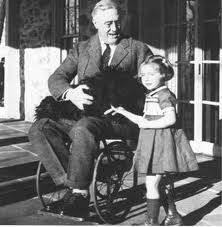
This does not bode well for the first time a candidate using a wheelchair runs for office.  Oh, wait:


*********

* If you answered “yes” to this question, please report immediately to your nearest qualified disability rights organization for enlightenment.

I’m grateful to those with the courage to tell their stories.

We recently went to trial against a fast-food chain for lack of wheelchair access.  In trial, three of the chain’s customers who use wheelchairs and the son of a fourth, now deceased, took the stand and described their experiences.  They described these experiences as a practical matter — a door that closed on an ankle, a queue line that was too narrow, employees who ignored them or told them they could not even wait off to the side of the line — and as an emotional matter — what it felt like to encounter these barriers, to be ignored, to be told to wait somewhere else. They talked about their own lives, too:  a lay pastor who counseled people with disabilities; an advocate who is working with the Smithsonian on a disability history project; a woman whose parents took her to see Martin Luther King, Jr. and taught her to stand up for her rights; a man whose mother had worked to integrate people with disabilities into her chorus.

The fast-food chain’s response was:  you’re lying.  You’re lying and you’re greedy.  The chain’s lawyers called the restaurant’s assistant manager to the stand to testify that she didn’t recognize any of them.  The lawyers pointed out — in cross-examining the customers — that they might recover damages, that they had filed other lawsuits to challenge other inaccessible conditions, that this wasn’t the closest restaurant to their homes.  The chain’s hired expert — who uses a wheelchair — took the stand to say he didn’t mind the barriers, that he didn’t consider it discrimination.

Four people who took time out of their day, their days, to be deposed, to take the stand in trial.  Work hours missed, long rides on public transportation.  Just to be accused of greed and dishonesty.  To be challenged on the fact that they had a life that took them farther afield than the restaurant closest to their homes.  To be accused — rather than celebrated — for standing up to other facilities and other defendants who had excluded them.

We defended them in the language permitted us by the law, by the rules of civil procedure and evidence.  Objections to relevance.  Quotes from the governing appellate court:  “[f]or the ADA to yield its promise of equal access for the disabled, it may indeed be necessary and desirable for committed individuals to bring serial litigation advancing the time when public accommodations will be compliant with the [ADA].”*

But as always, the late poet Laura Hershey says it best:

Telling**

What you risk telling your story:

You will bore them.

Your voice will break, your ink

spill and stain your coat.

No one will understand, their eyes

become fences.

You will park yourself forever

on the outside, your differentness once

and for all revealed, dangerous.

The names you give to yourself

will become epithets.


Your happiness will be called

bravery, denial.

Your sadness will justify their pity.

Your fear will magnify their fears.

Everything you say will prove something about

their god, or their economic system.

Your feelings, that change day

to day, kaleidoscopic,

will freeze in place,

brand you forever,

justify anything they decide to do

with you.


Those with power can afford

to tell their story

or not.


Those without power

risk everything to tell their story

and must.


Someone, somewhere

will hear your story and decide to fight,

to live and refuse compromise.

Someone else will tell

her own story,

risking everything.

A brilliant call to arms — to words? — for those who risk so much in speaking up.  It feels mundane to quote it in the context of a fast food restaurant.  But that’s the point:  in simply describing a visit to a restaurant, ordering food, interacting with staff, you risk being called a liar and having your motives and experiences questioned and belittled.

I devote my professional energies to disability rights law, but mostly I do that sitting at a computer researching or writing.  From that sheltered vantage point, it’s easy to lose sight of the courage it takes to tell your story in a courtroom and to be challenged, belittled, and accused of lying.  I am deeply grateful for those who are willing to tell their stories.

***************************

*  Antoninetti v. Chipotle Mexican Grill, Inc., — F. 3d —, 2010 WL 3665525, at *7, slip op. at 16016 (9th Cir. Sept. 22, 2010).

** Quoted with permission. Thanks, Robin!

Cousin Itt and Airplane Security

Although it is with some trepidation that I wade back into the airplane security discussion, I have to relate this short but bizarre tale, one that would indeed be have been ameliorated by profiling.

When we fly, which we do often, Tim likes to devote the flight time to catching up on the sleep he loses each night composing new and more complex databases in his head.  To create conditions conducive to sleep, he drapes a blanket over his head.  He has passed dozens of flights over the past few years next to me, doing his imitation of Cousin Itt.

On our flight out to San Francisco, however, he was informed that this was not permitted.  Post-9/11 security precautions prohibit covering your head while on an airplane.

Why?  We asked.

“Well, since the Detroit flight when a would-be terrorist covered himself with a blanket and assembled a bomb, it has been illegal to cover your head on a flight.”

That would seem to suggest that covering his HANDS would be prohibited.  Could he perhaps cover his head but leave his hands exposed?

“No — it’s just your head you can’t cover.”

So, under this rule, he could in fact cover his hands and assemble a bomb so long as his head was uncovered?

“Um, right”

But this makes no sense!  He can’t even *use* his hands.  He couldn’t assemble a bomb if he wanted to.

“I could have the police and airline security waiting for you when the plane lands.”

Seriously.  This was the flight attendant who had seen us board the plane and seen the power wheelchair be wheeled out the galley door onto the belt loader.  (Don’t ask!)  And she was telling Tim he couldn’t sleep in his preferred cocoon because he might assemble a bomb.

Hey, Bruce, this situation calls for profiling:  of people WHO CAN USE THEIR HANDS.

Turns out that won’t be necessary.  When we landed at SFO, I quietly asked a different flight attendant whether he could tell us where we could find that rule so we could look it up and read it.  He quietly told us that there was no such rule, and that he had quietly told the first flight attendant that, and gently suggested that she apologize.

That’s right, she had woken Tim up, argued with us about quadriplegic bomb assembly, and threatened to have us arrested, all based on a rule that she invented out of whole cloth on the spot.

Adventures in Trial Technology

We recently went to trial against a big-ass nationwide law firm.  To prepare for this trial, in addition to mastering the law and facts, we decided to take the additional step of freaking out about trial technology.  I’m hoping you can learn from our experience.

What I hope you’ll learn is:  most trial technology is expensive bullshit.  All you really need is a projector and Adobe Acrobat Standard.

We started our legal technology project as we start most projects:  by procrastinating.  After an appropriate period of procrastination, our project began with an email to opposing counsel at the big-ass firm, asking if he’d be willing to work together to share in-court technology.  He did what he usually does with our attempts to cooperate:  ignored it.  So we set off to acquire an arsenal of legal tech that could outshine anything a big-ass firm could put together.

The first thing we did was to update our document management software.  As I’ve previously blogged, this immediately hung up on the fact that the software vendor wanted us to pay several years in arrears before they were willing to update us.  More from stubbornness than cheapness — though let’s be honest, from a great deal of cheapness, too — we refused.  But we’re so clever we figured out a work-around.  The old version of the software would run on an old laptop with a giant external hard drive attached.  If this were a horror movie, the camera would now focus in on the old laptop, and ominous music would play ominously in the background.

We next decided that we needed trial software, and invested in three licenses for Trial Director, which promises that you’ll be able to do ALL KINDS OF INCREDIBLY COOL AND POWERFUL STUFF IN TRIAL like, you know, pop-outs.  And, um, …. well, pop-outs.  Which as near as I can tell are when you use your mouse to select some piece of text on the screen and it … you guessed it… pops out.  It was also supposed to have all sorts of amazing organizational features.  Notice the use of the past-disappointed tense.  After investing a couple thousand dollars in Trial Director, we spent the next week or so (and we didn’t, at that point, have a lot of weeks before trial) trying to get it to load, and then another week or so getting error messages.  Never!  Mind!  Our talented and persuasive paralegal called, returned our licenses, and got our money back.

But we did invest in a projector and screen.  You know, the sort of sophisticated equipment you’d expect from people who live less than a mile from a Best Buy and who are too cheap to upgrade their software.  More ominous music.

So that left us, on the eve of trial, with an ancient laptop, two new laptops (I forgot to mention how I was trying to master Windows 7 two weeks before trial — brilliant!), a projector, a screen, and Adobe Acrobat Standard 8.  And me, a lawyer with aspirations to graphic design, playing with PowerPoint and Publisher much like Stuart Little played with his little car.  (“Hey, what does this button do?  Aaaaaaaaaaaaaaaahhhhhhhhhhhhh shit.”)

We figured we’d just take the documents we wanted to display during trial, compile them into a pdf and then flip from page to page, occasionally using Acrobat’s editing features (highlighting, box-drawing) to draw attention to some significant piece of text.  And — spoiler alert — this is what we did and it worked fabulously.  If you’re here for the trial tech lesson, you can stop reading:  so long as you don’t need to show video, which we didn’t, Acrobat — plus the occasional pdf’d PowerPoint slide or Publisher graphic — is all you need.

But the road to our pdf nirvana was still a bit bumpy.  For example, confident as we were in our minimalist approach, it was still a shock to the system when Tim, our paralegal Caitlin, and our co-counsel Mari showed up at the courtroom the Friday before trial to set up.  We had our Best Buy projector — which we had purchased and tried out in our conference room in Denver — and a screen that we had ordered online and had delivered to Mari, which she had learned to assemble in her home office in Berkeley.  Crucially, prior to that Friday, the projector and screen had never before interacted with one another.

The big-ass law firm had:

  • a real projector;
  • a real screen;
  • an Elmo*;
  • extra monitors for the witness and the judge;
  • an extra table for their technology hub, staffed by a specially-trained technology dude; and
  • extra tables for all this fancy technology; with
  • table skirts.

I think that could be a new item in my growing Jeff Foxworthy imitation:  If the skirts on the tables supporting the courtroom technology of your opposing counsel are nicer than the skirt you’re wearing, you could be a plaintiffs’ lawyer!

I really should let Tim tell this part of the story, because I wasn’t there.  I was just receiving frantic updates on my cell phone.  Apparently the mail-order screen and the Best Buy projector were a match made in hell, the upshot of which was the courtroom was not big enough to give the projector enough distance to project an image of the proper size onto the screen.  Even more exciting, in attempting to find the proper distance and angle, Tim and Mari apparently projected into the security cameras, causing the court security officers to charge worriedly into the courtroom.

Meanwhile the big-ass law firm’s team of technology professionals (the firm, of course, just sent its technology team; no lawyers were present) were busy assembling equipment and putting skirts on tables when the judge’s deputy came in an announced that only one screen would be permitted — we’d have to share.  This was fine with our team and with their technology team — who were sweet and helpful — but we wondered how the news would go over with the big-ass law firm lawyers.  With a word on the side to the clerk to please back us up on Monday when we requested a link to their projector to project our pdfs onto their screen, Tim and Mari packed up our equipment and tucked it away in the back of the courtroom.  For those of you keeping score at home, the amount of fancy new hardware and software we brought to trial was precisely:  zero.

The weekend brought even more technology adventures and heroic last-minute repairs, which I have to tell in bullet point format lest this post last longer than the trial:

  • A motor in Tim’s wheelchair failed.
  • We found a wheelchair tech who made a house call  (hotel call?).  (Thanks, John!)
  • The old laptop screen failed — remember the ominous music?
  • We found a computer tech who made a house call . . . on Sunday.  (Thanks, Dean!)
  • Just in case, we borrowed our co-counsel’s daughter’s monitor.  (Thanks, Miya!)
  • The old laptop screen started working again.
  • Tim’s new laptop screen failed.  He spent the rest of the trial tethered to the borrowed monitor.

By this time, the case was starting to bear more than a passing resemblance to My Cousin Vinny:

My suits were only slightly less heinous than Joe Pesci’s:

My partner was much better versed in the rules of evidence than I was.

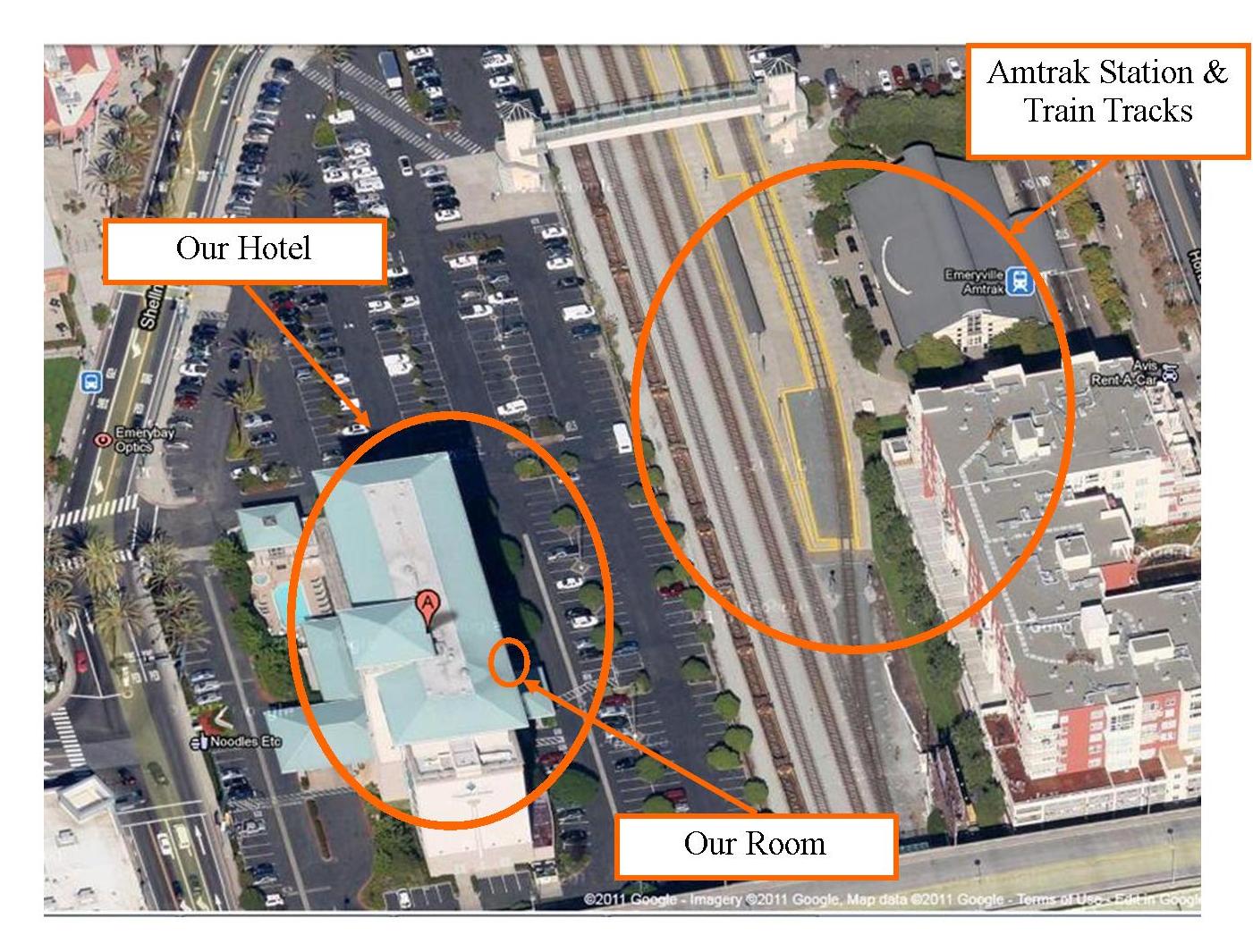
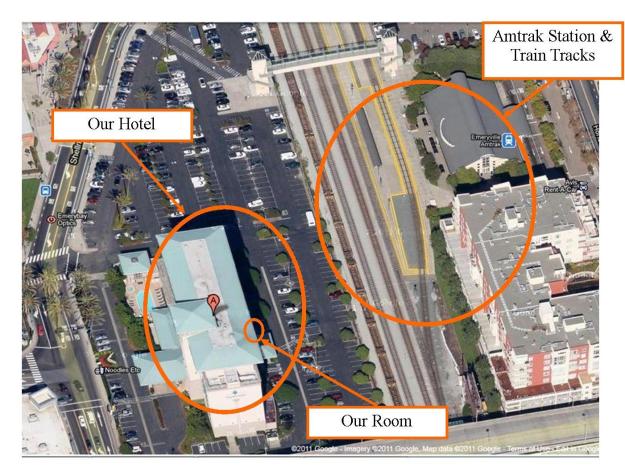
And we had train tracks right outside our hotel window.**  So not kidding:
But this is all building to the inevitable moment when the big-ass law firm lawyer learned he’d have to share his technology.  And let me assure you, [DESCRIPTION DELETED BY TIM’S BETTER JUDGMENT, AND MY BETTER JUDGMENT TO ASK HIM ABOUT HIS BETTER JUDGMENT].  The Court told the parties to work it out, and we figured it was worth it to pay half of his technology bill to be able to project our pdfs on a big screen and on monitors in front of the judge and witness.  I do think that our trial team owns one-half of a bunch of monitors and table skirts sitting in a storage room in a big-ass law firm somewhere.

************************
* Not the doll.  It’s like a modern-day overhead projector, taking the document or object you place on the illuminated surface and projecting it onto a screen.  I.e., ways in which we have not progressed much beyond my 8th grade geometry class.

**I have to add that we love the Hyatt Summerville Suites in Emeryville.  It’s perfect for our needs.  The staff knows us and is outstanding and friendly.  And we’re walking distance to both the Bay — for a relaxing stroll after a day in court — and a Trader Joe’s, which still doesn’t exist in Denver.  Most of our trips west are like some sort of ancient trading caravan:  we arrive laden with binders of legal documents and depart laden with Trader Joe’s condiments.

Tribute to the 88 Honda

I had an idea for a comedy routine that would include this derivative one-liner:  if your car is older than your paralegal . . . YOU COULD BE A PLAINTIFFS’ LAWYER!  I never came up with other humorous  Foxworthian indicia of plaintiffs’ lawyer status, so that was as far as I got.  But I would like to pay tribute to the car that inspired that hilarious line:  My 1988 Honda Accord.

January 1988:  Purchased.  At the ripe old age of 27, I had never actually owned my own car.   I had previously driven the family Fiat (in high school) and a hand-me-down Malibu — the quirks of which I have previously described — in law school.  In between, I lived on a self-contained college campus (where the Fiat was an occasional visitor) and then in Taipei, which had such an outstanding bus system that I spent three years not driving and not missing it.

Early Summer 1988:  Drove the Accord cross country to a summer associate position in Los Angeles.  For part of the journey, I was joined by the guy I was misguidedly dating at the time.  Advice for any young ladies reading this:  Young Ladies, do not attempt to teach your boyfriends* to drive stick shift cars.  If your guy does not know how to drive a stick shift car, my advice is just to dump him now, as it suggests that he is too coddled to make good boyfriend material.

Late Summer 1988:  Drove the Accord back across country to start my clerkship in VA.  Picked up step-brother in Santa Fe.  Based on fear of step-brother’s driving record (love you, Jeff!), undertook to keep the wheel to myself during a three-day dash from Santa Fe to Arlington, VA.  Another lesson learned:  you cannot get off the highway in Oklahoma and expect to get a good steak at a random steakhouse.  Yelp.com didn’t exist in those days.

1988-89:  Lived in Richmond for my clerkship.  The Honda acquired the trunk gash it still bears today from some klutz’s attempt to attach a bike rack and (what the hell) a bike to the back of the car.

September 1989:  Drove to Minneapolis based on misguided relationship.  See supra.

February 1991:  Escape vehicle from misguided relationship.  Driven at great speed from MN to VA.  Stopped in IL to visit law school roommate, whose two-year old painted me a picture, which I put on top of the worldly possessions stuffed into the car.  To this day, I think of that 2-year-old (who, I believe, just graduated from college) every time I look in the rear view mirror and see the glop of yellow paint that remains from the inevitable moment when the picture flew up from the worldly possessions and adhered to the back window.

January 1992: Spun out in the snow driving to first date with Tim.  I remain very grateful that the Honda righted itself and I made it to the date on time.  Tim received early warning of my driving skills.

Later in 1992:  Acquired a “Clinton for President” bumper sticker, which would, even later, be covered with an X of duct tape when . . .

1993:  I loaned the Honda to my conservative brother.  It spent several months as the vehicle of choice for my sister-in-law to transport my newborn nephew — who is now 17 — as it had four doors to her CRV’s two.  That meant I got to drive around in a sporty red CRV for a few months.

1995:  Traveled to Denver in the back of a moving van.  I think it is still pissed at me for that.

Since 1995, the Accord has seen a lot less driving time, as Tim and I commute in the van.  It is now missing its hubcaps and the trim on the passenger side, which largely means that no one — no one — ever challenges me when I want to change lanes.  A few years ago, when I parked it on the street in front of our house for one night — it usually lives in the garage — someone broke the driver’s side window and crowbarred the original equipment radio and cassette (cassette!) deck out of the dashboard.  This had to have been the single most pointless and annoying crime in the history of crime, as the criminal ended up with a P.O.S. sound system, and I discovered that the cost of replacing that part of the dashboard — even without a new radio — exceeded the book value of the car. Luckily the thief left the lighter socket, so sound now comes from a jerry-rigged system involving a DC to AC outlet adapter and my smart phone.

From time to time, we talk about replacing the 88 Accord, but it never gives us a good reason to do that , and honestly I’m not sure how I’ll part with it.  Although automotive technology has advanced considerably in the past 23 years, I think the only thing I really miss is:  a cupholder.

***************
* Upon rereading, I recognized the heterocentrist assumptions underlying this sentence.  So to clarify:  advice for any young ladies dating young men.  I do not have any data on the advisability of young ladies trying to teach their girlfriends to drive manual shift cars.

Important life options . . .

… presented through the medium of bathroom-stall advertising.

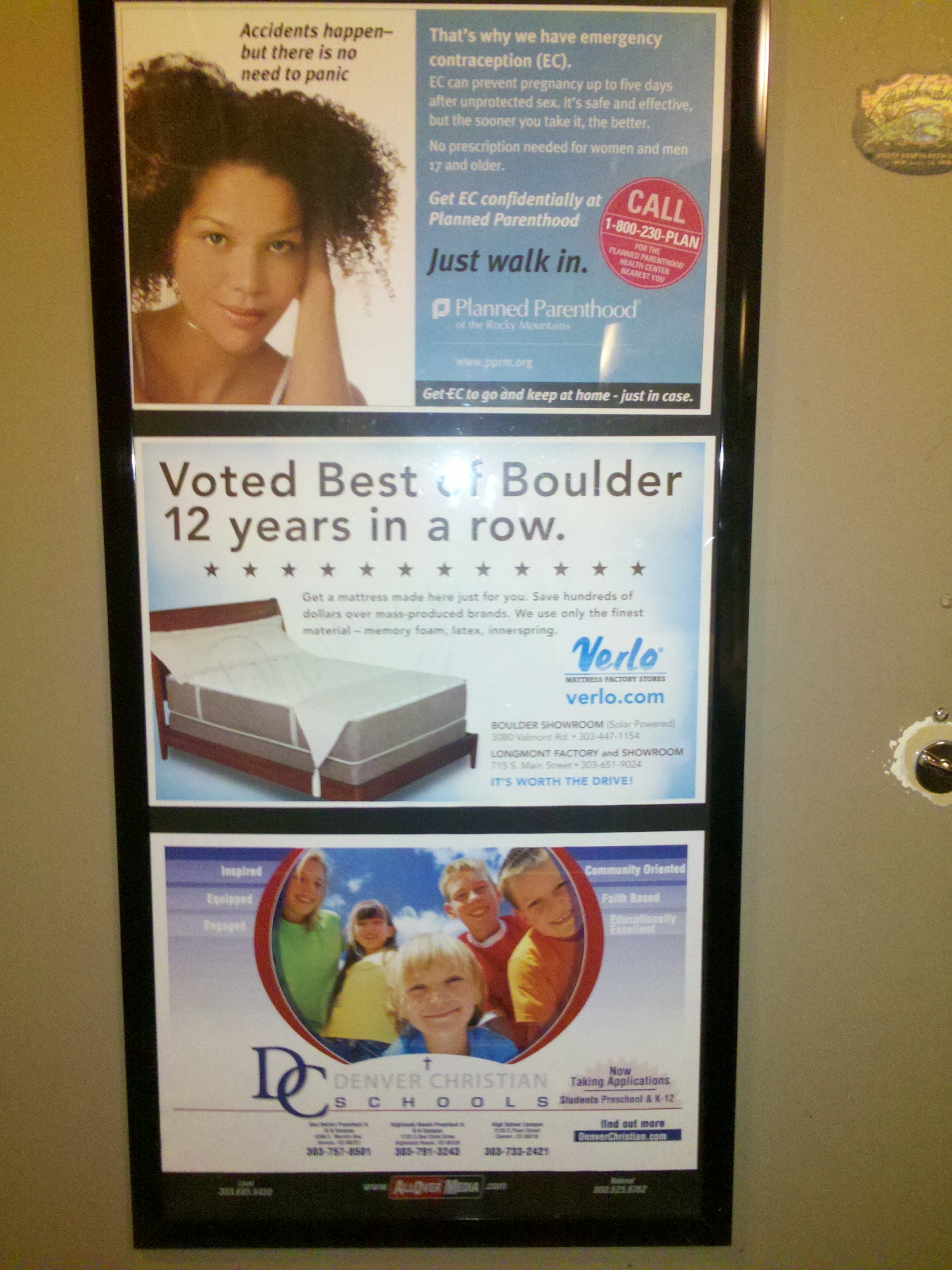
A bed (“Best in Boulder”), emergency contraception (“Accidents happen – but there is no need to panic”) or Denver Christian Schools (“the perfect place for your five tow-headed children”).  OK, I invented the last tag line, but you gotta love the juxtaposition of the bed, Plan B, and, um, Plan C.

This is an actual bathroom advertisement at The Pioneer Bar.   OK, it’s a total college bar, but if you avoid times that it’s full of college students, and go when it’s sunny so you won’t be exposed to the cheesy decor and can enjoy a pleasant patio, a good margarita, and freaking excellent quesadillas.  Also highly recommend the steak fajitas.  In other words, a great place to goof off.


Amycare: replace doctors with veterinarians

Anyone who has ever taken a pet to the veterinarian has probably thought:  geez, why can’t humans get health care like that?  I mean, at the most basic level, vets are just cooler than MDs.  Think of all the vets you’ve known in your life and then all the doctors:  who would you rather hang with? Case closed.

But it’s more than that.  Our older dog is now seeing a specialist, so we are having a good deal of exposure to the veterinary profession.  This has placed the differences in stark contrast.

Both our regular vet and the specialist call us a day or two after each appointment just to see how our dog is doing.  I’m not sure my PCP would know me if she ran into me at the Target the day after my annual physical.  And I really do like my PCP; it’s just not part of the human medical culture to follow up.

The vet specialist also faxes a report to the regular vet after each appointment, and calls *him* to follow up.  When I needed one doctor to send my file to another doctor a few years back — just send the damn file; no communication; no follow up — I had to make multiple phone calls and fill out multiple forms, and I still showed up at the second doctor’s office to find that no communication in any medium had occurred between the two doctors, their staff, or their file rooms.

And our vet appears to use computer technology from the post-1995 period.  At a recent human medical appointment, the receptionist handed me a form when I checked in.  I pointed out that none of the items on the form had changed since the last appointment.  No good:  “It’s a policy, we have to update our information.”  But there’s nothing to update.  “Sorry, it’s a policy.  We require this form.”  A form made of paper, from dead trees, which they expected me to interact with using primitive ballpoint technology.  I pointed out that they had also every single piece of information requested on the form having photocopied my driver’s license and insurance card only moments ago, but I was instructed to please sit down and just fill out the form.  After I filled out the top half, I handed it back and pointed out that since I was the insured, the information requested on the bottom half of the paper was already filled in on the top.  Nope.  Still not good enough.  “The two halves of the form go to different places,” I was told, “You have to fill out both.”  At about that moment, I looked at the receptionist’s computer and noticed:  DOS.  That’s right, green type on a black screen.  In 2011.  I can go up to a computer terminal at the Bed, Bath and Beyond and find out what wedding gifts my friends and family in distant cities have registered for, but MY DOCTOR is using DOS, and asking me to fill out identical information on the top and bottom halves of a piece of paper in much the way I filled out a field trip permission slip in 1971.

You can’t really do a head-to-head comparison of the financial aspect of human and dog care, because the veterinary industry lacks many of the important cutting edge features of the American human medical system:  astronomical insurance company executive salaries; palatial insurance company corporate campuses; and cubical farms staffed with adjusters trained to deny your claims.  So it’s not really fair to point out that the financial aspect of dog care is much simpler:  after each appointment, we hand them our credit card and we’re done.  But that is at least part of the point:  the vet industry doesn’t have to support legions of insurance executives, so the amount we’re paying is a very small fraction of what our insurance company pays our doctors.  And honestly, how different *is* a human body from a dog’s?  We seem to have many of the same internal organs.  Can human treatment really be that much more expensive?  (This is where my brother will blame the lawyers.  Love you, Bruce!)

Finally, of course, no matter how intrusive the medical procedure, I have *never* been offered a treat.  Not once.