Category Archives: Civil Rights

Dignify THIS!

I’m done. I’m done being polite.* I’m done shutting up about good liberals who seem to get every sort of civil rights and civil liberties except the equality of rights, respect, and dignity of our brothers and sisters with disabilities. I’m done with disability rights as a “when we get around to it” right. I’m done with people who are willing to use respectful terminology except — *big sigh* — avoiding using the word “retard” is just one step too far toward thought control.  And I’m done with “civil rights” law firms in inaccessible offices and “civil rights” lawyers who don’t hire interpreters. I’m done.

What pushed me over the edge was this voicemail, from a fellow attorney who would, I believe, describe himself as favoring civil rights. I suppose it’s my one last shred of not-yet-quite-doneness that leads me to keep him anonymous.

But who he thinks he is and who his words and actions show him to be should not be anonymous. It needs to be out there for good liberals — chock full of self-righteousness and non-disabled privilege — to observe and perhaps see themselves.  And become real civil rights lawyers by according people with disabilities the same rights and respect you accord other groups you work so hard for.

First let’s play the “protected class switcheroo” game. Imagine I got this voicemail:

Hey Amy, [Name Redacted] here. Trying to get in touch with you and/or Tim. I’m working with a group that is sponsoring legislation to increase penalties for disrespecting police officers. They got bogged down because of some African-American, ah, community concerns – said it would be used as a sword instead of a shield. Um, I think it’s miscommunication. I think the African-American community should be absolutely in favor of it and I wanted to hook up with folks, the right folks, in the African-American community and I thought you would know the behind the scenes politics of who best to contact. . . . .

Pretty gross, eh? No good liberal would talk that way, at least not in public in 2015. This is, in fact, the voicemail I received. Verbatim.

Hey Amy, [Name Redacted] here. Trying to get in touch with you and/or Tim. Um, I’ve done work in the past through when I was at the ACLU with the Hemlock Society; they’re now the Compassion and Choices organization and they sponsored some legislation about right to choose or to refuse treatment. They got bogged down because of some disability, ah, community concerns – said it would be used as a sword instead of a shield. Um, I think it’s miscommunication. I think the disability community should be absolutely in favor of it and I wanted to hook up the Compassionate Choices people with folks, the right folks, in the disability community and I thought you would know the behind the scenes politics of who best to contact. . . . .

And here is my response:

[Name Redacted] –

Thanks for your voicemail.  I think I can say with a fair degree of confidence that there was no miscommunication on the disability rights side.  The position of CCDC, Not Dead Yet Colorado, and a long list of prominent disability rights groups opposing physician assisted suicide is well thought out and thoroughly researched.  I can’t possibly improve on the information on NDYCO’s website, so I’ll provide a link:  http://www.notdeadyetcolorado.org/.

To be clear, Colorado’s bill was not about refusing treatment:  anyone can do that at any time without the proposed legislation.  It is also not about choices:  we can all choose to buy a gun and shoot ourselves; to drive in front of a train; to stop eating and drinking; etc.  Instead, the discussion revolves around getting a doctor to assist you in killing yourself to avoid — tracking the title of the bill — an undignified death.  What is characterized as “lack of dignity,” however, are conditions that many people with disabilities live and thrive with every day:  the need for a vent; a feeding tube; colostomy; urostomy; assistance with activities of daily living.  Statistics from Oregon, for example, a state that has legalized assisted suicide, demonstrate that people do not chose assisted suicide to relieve intractable pain — the purpose for which it has been sold to the public — but rather to address perceived loss of autonomy, inability to engage in activities of daily living, and loss of dignity.

These perceptions and the urge to kill oneself over them result directly from a society that does not value people with disabilities — and such perceptions are (circularly) reinforced by bills like these and the rhetoric that surround them.  Assisted suicide is urged in an environment in which people with disabilities do not have universal access to attendant care in their homes and communities, to assistive technology and mobility devices, to accessible vehicles or modifications, or to home modifications — hell, to accessible homes to start with.  These are all things that people need to continue to live — with dignity — in the community.  In the absence of this sort of support, many disabilities fit the bill’s definition of “terminal,” making it the worst sort of health care rationing:  cheaper dead than disabled.

A bill proposing that it was “undignified” to live as an African-American, an LGBT* person, or — to take an historical example — as a Jew, thereby justifying easy access to death would be rejected with horror.  Yet good liberals appear completely at home with providing a cheap and easy path to death for people with disabilities.

Furthermore, the concerns of people with disabilities reflect a great deal of thought and considered analysis; it is patronizing to suggest that they result from miscommunications.  I can’t imagine any other group active in the civil rights dialog that would be the subject of a voicemail like this.  When LGBT* groups oppose civil rights rollbacks, are they perhaps just victims of a miscommunication, which can be corrected by identifying the “right” groups?  How about African-Americans calling for law enforcement reform?  Shall we identify the “right” groups to support our men and women in blue?

The debate over physician assisted suicide has been plagued by this sort of condescension, as liberal and radical disability rights groups are accused of being pawns of religious conservatives, as if incapable of independent thought.  This infantilizing of our movement underscores our fears that disability is so stigmatized that ostensible civil rights champions would rather be dead than disabled.

Ultimately, if the ACLU is devoted to nondiscriminatory civil liberties, it should support a universal right to assisted suicide.  Anyone, anytime, can request a lethal dose, not just those in circumstances defined in terms of a protected classification.  This I would support, though I believe other members of the disability rights community are more compassionate than I am.

I would be happy to put you in touch with any of the groups on this list to help with any miscommunications:

  • Access & Ability Colorado
  • ADAPT
  • ADAPT Colorado
  • Assn of Programs for Rural Independent Living
  • Autistic Self Advocacy Network
  • The Center for Rights of Parents with Disabilities
  • Colorado Cross-Disability Coalition
  • Disability Rights Center
  • Disability Rights Education and Defense Fund
  • Justice For All
  • National Council on Disability
  • National Council on Independent Living
  • National Spinal Cord Injury Association
  • Not Dead Yet USA
  • Not Dead Yet Colorado
  • Patients’ Rights Action Fund
  • TASH
  • The World Association of Persons with Disabilities
  • The World Institute on Disability

Sincerely,

Amy

********

* Yes, I know, there is clear and convincing evidence that I was done with politeness, as a general matter, a long time ago.
What the fucking hell: “In U.C.L.A. Debate Over Jewish Student . . .”

In U.C.L.A. Debate Over Jewish Student, Echoes on Campus of Old Biases – NYTimes.com.*

I don’t have time for a well-thought-out blog post, so I’m going to express my views, even more than usual, though profanity.

What the fuck?  How did we get to the place where a bunch of entitled little shits at a prominent university, ostensibly full of smart people, could question a student’s fairness based on her religion.

I blame:

  1. The students.  Grow up, get your heads out of your asses, and think like decent human beings, not self-important Judgers of the Universe.  You’re 20ish.  Know, now, that you don’t know shit.  Think before you talk.  Maybe even consult a grown-up before you talk.
  2. A sound-byte culture in which it’s always less than a step from reasoned disagreement to ad hominem vilification.  Disagree with American policy?   You’re unpatriotic, a “fifth column.”  Disagree on middle-east policy?  You’re a suspected Mossad agent and/or ISIS sympathizer.**  Believe that women should control their own bodies?  You’re a baby-killer.  Think that we should perhaps consider the growing life inside the woman’s body?  You’re “fighting a war on women.”***  I’m sure there has always been plenty of invective to go around — since the invention of the swear word in prehistoric times — but it seems now that this the culture kids are steeped in.  They grow up on the internet perhaps thinking that the self-righteous, self-centered and generally nasty world of internet comments is normal or OK.
  3. Whatever passes for history teaching these days.  How the fuck could these smart kids get to their early 20s and not get — viscerally — that what they were doing was deeply, deeply wrong.  Any sort of reasonable instruction in the holocaust and the civil rights movement should have made this assaholic move impossible.

I’m concerned that these — and likely other — factors caused these kids’ brains to turn off and their sound byte/talking head/internet troll training to take over.   I sentence them to a intensive course in 20th Century History and a serious time out.

**********

* I truncated the headline in my blog title because once you get to “debate over Jewish student,” you’re in “what the fucking hell” territory.

** I guess the “and” side of the “/” is fairly unlikely.

*** I’m not suggesting false balance (“and now over to Dr. Schmuck, for the flat-earther position”), but merely that when discussing even those views we personally think are utter horseshit, we stop and think about the substance and keep the discussion on that level.  I’m just fucking tired of media talking shrieking heads and what it’s doing to the culture in which we hope to raise a rational next generation.


“Outdoor” “exercise” at the Colorado State Penitentiary

Since throngs of you* have been asking, “hey, what’s up with that outdoor exercise case you all were working on,” I thought today — the day after a massive two-brief filing** — would be a good time for an update.

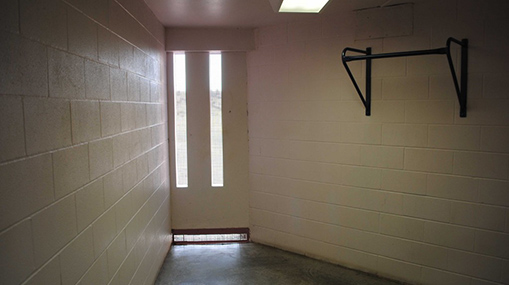
In 2010, we and the Civil Rights Clinic at the University of Denver filed a lawsuit against the Colorado Department of Corrections (CDOC) on behalf of Troy Anderson, who had been in solitary confinement at the Colorado State Penitentiary (CSP) for over a decade without outdoor exercise. Instead, he was permitted to exercise here for one hour per day five days a week.

Image:  Bare concrete cell with two tall slit-like windows at the far end.

CDOC called this “outdoor exercise.”  As it turned out, Judge Jackson did not.  In August, 2012, he held that this limited exercise violated the Eighth Amendment and ordered CDOC to provide Mr. Anderson with

access for at least one hour, at least three times per week, to outdoor exercise in an area that is fully outside and that includes overhead access to the elements, e.g., to sunlight, rain, snow and wind, unless inclement weather or disciplinary needs make that impossible.

Anderson v. Colorado, 887 F. Supp. 2d 1133, 1157 (D. Colo. 2012).

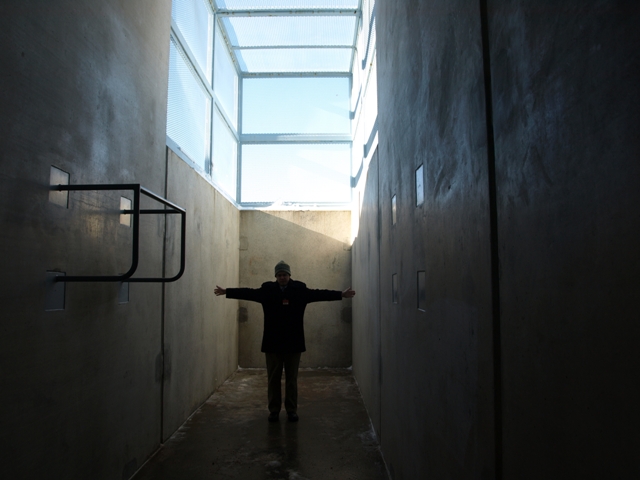
Instead of providing outdoor exercise at CSP, as the Eighth Amendment requires, CDOC moved Mr. Anderson to Sterling Correctional Facility where he exercised here:

Image:  Concrete enclosure approximately 6 and a half feet wide and 20 feet high. Concrete extends to eight feet high on all sides of the end of the enclosure, with mesh over the sides and top. A man stands in the middle, his back to the camera, with his hands extended out to each side. He can almost touch each side of the enclosure. The only other thing in the enclosure is a chin-up bar mounted on the concrete wall on the left just behind the standing man.

In September, 2013, Judge Jackson held that that wasn’t outdoor exercise, either, and believe it or not we’ve been jawboning with the CDOC ever since. That’s a whole nother post!

Meanwhile, back at CSP, inmates in solitary still weren’t getting outdoor exercise, so in December, 2013, we filed a class action lawsuit to essentially enforce the outdoor exercise holding in Anderson. This case — Decoteau v. Raemisch — is still pending before Judge Martinez. Six months after we filed, the CDOC announced changes in the regulations governing solitary, but still did not provide for outdoor exercise. A month after that — late July of last year — the CDOC announced a plan to seek funding from the legislature to build an outdoor exercise area at CSP by the end of 2016. Progress, right? Contingent on the legislature. Over two years away. But glimmers of progress, right? Not so fast: the plan still did not incorporate outdoor exercise for inmates in the status the CDOC now calls Restrictive Housing Maximum Security Status or “Max.”

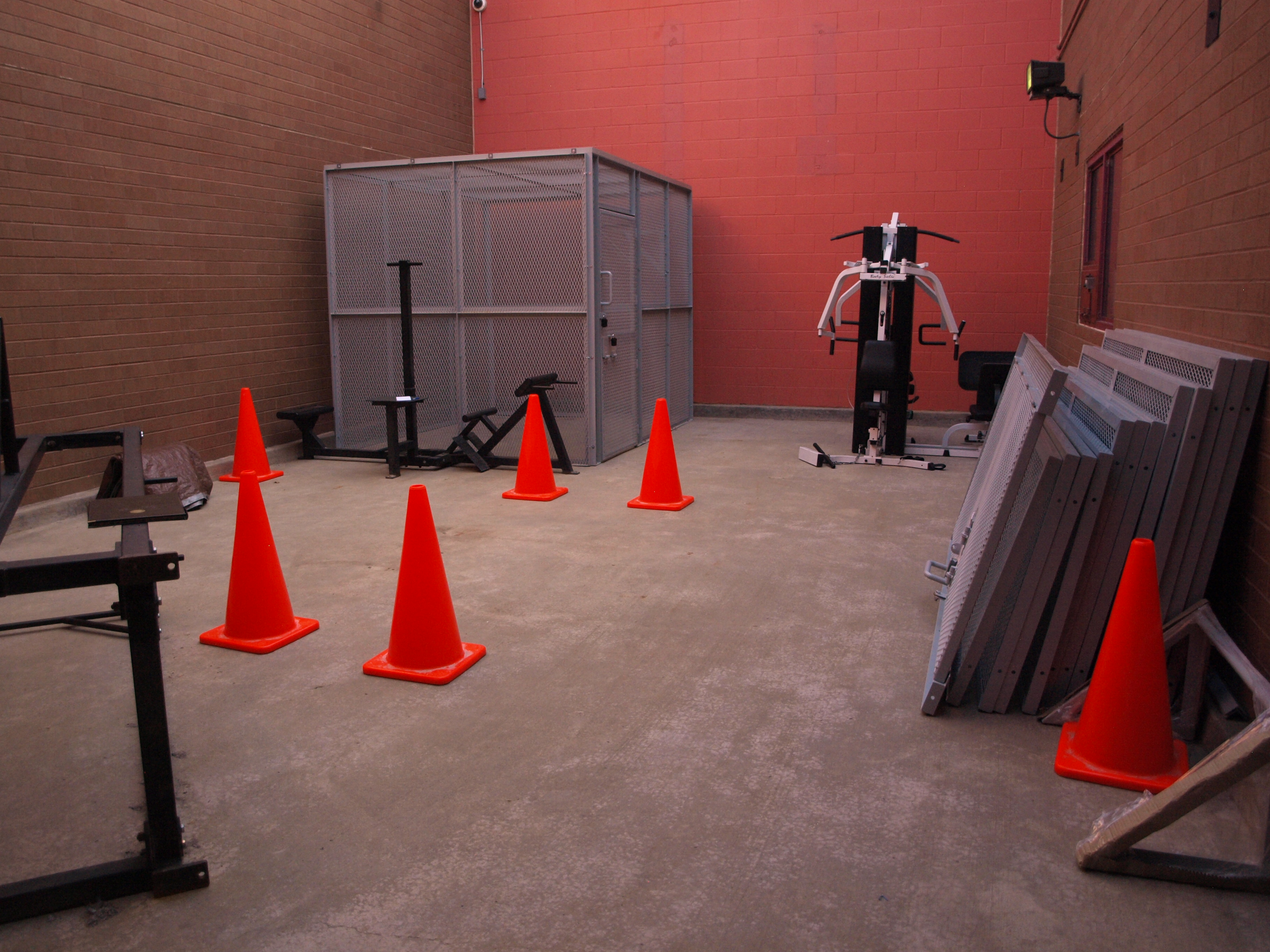
Last October, we filed a motion for partial summary judgment in the Decoteau case on the claim that inmates in Max were not getting outdoor exercise. In response, Defendants announced that they would provide outdoor exercise for Max inmates for one hour a day, three days a week. Here

 Image:  Two reddish-pink walls about 20 feet high, in the corner of which is an 8' x 10' by 8' high steel-mesh cage.  Orange traffic cones are laid out in the area between the camera and the cage to show the outlines of two identical future cages.

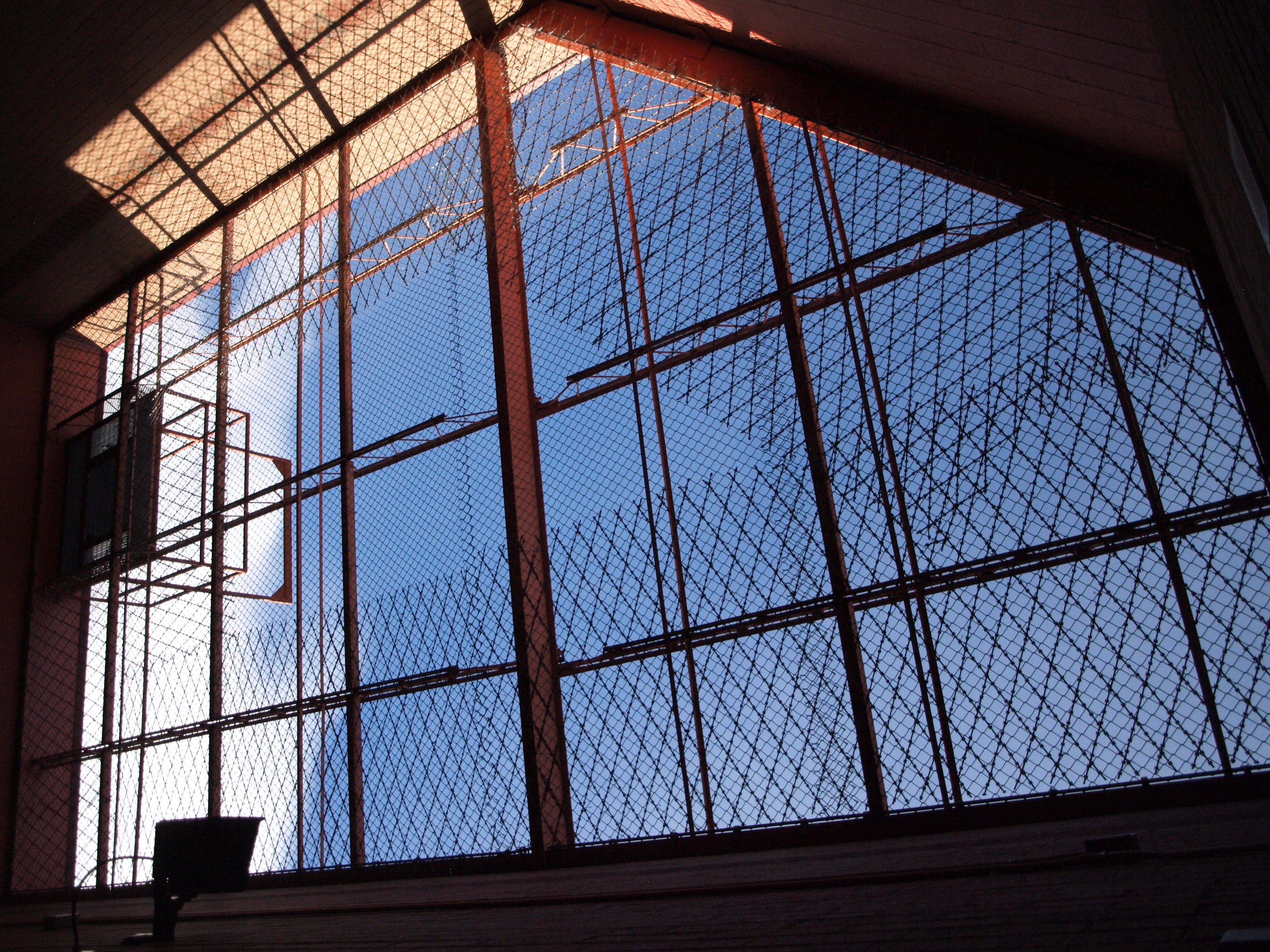
in that cage.   Or one of two others to be built where the cones outline their perimeters.  The ceiling of this slightly-less-than-700-square-foot area is 20 feet above the ground and made of steel mesh and (in part) razor wire.  Here is the ceiling

Image: four-sided opening covered with steel mesh and razor wire.

and here is an architect’s 3D rendering, as seen from above.

Image: sketch of an irregularly shaped space largely occupied by three steel-mesh cages.

Inmates who have been in Max for more than nine months will be allowed to exercise in one of the cages for one hour three times each week.  The remainder of the space around the cages constitutes the “outdoor exercise” available once each week to inmates in a status called “close custody transition.”

On Friday, we filed our reply brief, as well as a response in opposition to the CDOC’s motion for summary judgment.  Big kudos for all the great work by clinic students Jenny Vultaggio and Kevin Benninger and their professors Lindsey Webb and Lauren Fontana.  And stay tuned for further developments in “outdoor” “exercise”!

************

*  Actually, just my step-dad.  Hi, David!

**  Thanks & a shout out to our paralegal, Sophie Breene, a/k/a the PACER-whisperer, who discovered mid-filing that the CDOC had put such impenetrable security features on the pdf of its regulation that not only was she unable to add an exhibit sticker, but the federal court’s electronic filing system would not accept it.  Now that’s security!

[Cross-posted at the CREECblog.]

“Assisted” Suicide, Prologue

Compassion and Choices and Flowers and Rainbows,* aka Big Suicide,** is pushing bills  to permit people to kill themselves legally.  Not all people, just certain disabled people in danger of dying — and thus living? — in an undignified way.  They’re pushing this in Colorado and it will not surprise you to learn that I’ll have more to say about this when I’m not barreling into a day full of actual work-related tasks.

As a prologue, I leave you with this juxtaposition, which greeted me in my Facebook feed this morning.

Image:  Facebook feed with links by Stephen Drake and Dian Coleman to an article entitled "Opposing An Assisted Dying Law," and immediately below, a link by Prison Legal News to an article entitled, "CIA killed prisoners, made it look like suicide."

More to come.  Meanwhile, the source for calling bullshit on Big Suicide is the excellently Monty-Python-named Not Dead Yet.****

Update:  Not Dead Yet Colorado now has its own website.*****

******

* OK, it’s Compassion and Choices, but they used to be the Hemlock Society, which was at least honest about the fact that they are a bunch of privileged intellectuals who want to be able to off themselves in a philosophically elegant fashion.  Then they focused-grouped the name, I guess, and are now Compassion and Choices, two random nouns meant to make you feel good about them while not really knowing exactly what they do.

** If we can have Big Pharma, Big Agriculture, and Big Sugar,*** why not Big Suicide?

*** Actually, this turns out to be a Canadian blues band, and not a bad one, actually.   The unexpected benefits of blogging.

****  Best. Logo. Ever.

Image:  Logo:  Not Dead Yet -- the Resistance.

***** And badass logo:

Image:  Not Dead Yet logo superimposed on the Colorado state flag.

One of these is not like the other, part II

In an earlier post, I compared this [still living] white twerp who likes to march around with a [real, loaded] shotgun with the [now dead] black 12-year-old with a [toy] gun.

I don’t have a specific person to compare to the white dude described below; all I can offer are statistics like these showing massively higher arrest rates for Blacks in possession of marijuana, even though more whites use pot.

Image:  Bar chart showing percentage of 18-to-25-year-olds who used marijuana in the past year (2001-2010), showing that the percentage of whites was consistently several percentage points higher than the percentage of blacks.

and

Image:  Bar chart showing arrest rate per 100,000 for marijuana possession (2001-2010), showing a consistenly much higher number (500-700) for blacks compared to whites (around 200).

But  Ex-NASCAR driver somehow avoids jail after leading police on a three-state, 150 mph chase – The Washington Post.

Walker, who was cited in St. George, Utah, in 2013, after leading police on a chase that started in Nevada and went through Arizona, pleaded guilty to two felony counts of failure to stop for an officer and possession of a controlled substance. Even more unbelievable, Walker was also cited for impaired driving, possession of drug paraphernalia, including methamphetamine and marijuana, and having an open container of alcohol — vodka! — in his BMW. Oh yeah, and there was also nearly a car-jacking at attempt, according to one of the officers in pursuit.


Image Description and Identity

Sometimes I try to take on big questions; today we’re going to keep it light and only tackle the nature of identity and the relationship between author and reader in interpreting an image.

It all started with a question about image descriptions. Image descriptions are a way of making the images in webpages more accessible, primarily for readers with print disabilities. Screen readers will read accessible text, but when they encounter a photo, say (to take an image at random)

Image: Photo of golden retriever.

the screen reader can’t read it or render any useful information from it unless you add an image description. To make sure that print-disabled readers aren’t left out, I would add the description “Image: Photo of golden retriever.” I can put that either in the body of the blog, or in the “alt-text” field of the photo when I upload it. Here, I did both.

When adding image descriptions, I’m always challenged by how much detail to include. The photo above is easy: there’s one major feature and it’s quick and easy to describe. When I describe people, I’ve tended to describe them using a couple of basic characteristics: gender; age(ish); race; and perhaps an additional detail or two (color of clothing; glasses; sitting/standing). When someone is in a wheelchair, I say that; when they’re not, I don’t say anything.

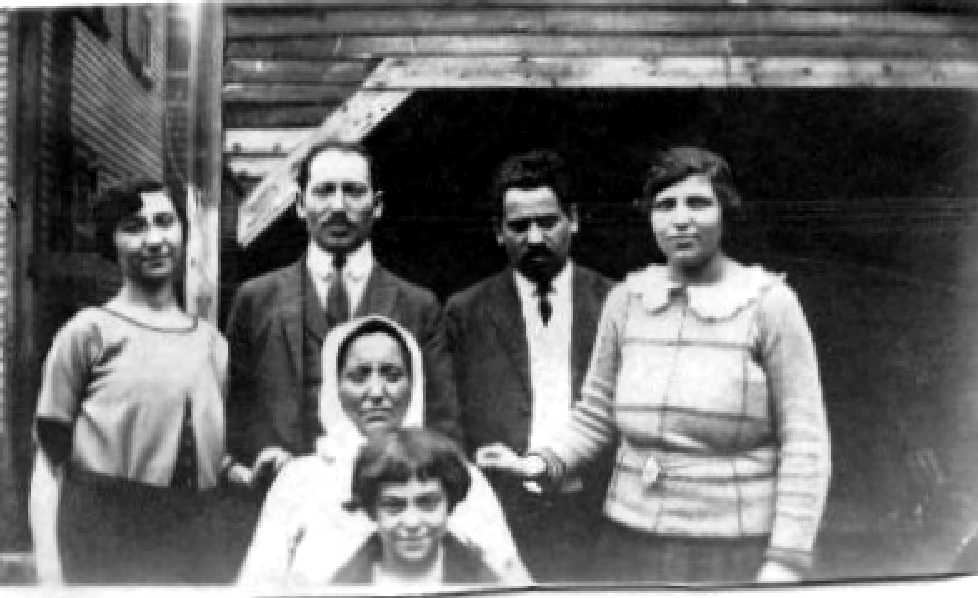
For example, I described this photo

Image: slighly blurry black & white photo of a group of 6 people. In back, a young woman, two middle aged men and a middle aged woman; in front of them, an older woman, and in front of her, a child of about 10.

as

slightly blurry black & white photo of a group of 6 people. In back, a young woman, two middle aged men and a middle aged woman; in front of them, an older woman, and in front of her, a child of about 10.

When I started adding image descriptions to the large number of people photos in the presentation we put together to introduce CREEC, I started tripping over the question of how — if at all — to describe race and ethnicity.  Many of the photos depicted people whose races were (1) obvious; and (2) known to me.  For example, this awesomely cliched photo that Tim and I had taken around 2002 as an Official Fox &  Robertson Photo:

Tim and Amy at a conference table ca. 2002.  (Tim is a white man with short blond hair who uses a wheelchair.  He is dressed in a suit.  Amy is a white woman with short brown hair and glasses.  She is sitting in a chair, also wearing a suit.  In the foreground, a table posed with law books, a speaker phone, files and mugs.

I described it:

Tim and Amy at a conference table ca. 2002.  Tim is a white man with short blond hair who uses a wheelchair.  He is dressed in a suit.  Amy is a white woman with short brown hair and glasses.  She is sitting in a chair, also wearing a suit.  In the foreground, a table posed with law books, a speaker phone, files and mugs.

That was easy:  I’m white; Tim’s white; I know our races.  Tim’s disability is visible.  All the props on the table probably aren’t that relevant, but my view is that the description helps convey the posed-ness of the photo.

But what about photos depicting people whose race or ethnicity was either unknown to me or not easily described?  This, in turn, raised the obvious question whether it is relevant at all. I felt torn between trying to achieve accuracy for print-disabled readers and adding unnecessary focus on race and ethnicity. I posed this question on Facebook, and deeply enjoyed the ensuing discussion.

When adding image descriptions to photos, what do you do about perceived vs. known vs. visible ethnicities? For example, if I’m in a photo with an African-American woman, I would say something like, “White woman in white shirt and jeans; African-American woman in dark shirt and skirt.”  Easy.  But what about describing someone whose ethnicity is likely neither white nor African-American but is not known to me? Or someone who “looks” “white,” but I know would be annoyed by being described as “white.” Describing degrees of skin tone seems weird.

A surprising number of people responded with something like, “I don’t describe race.”   From Andrew Montoya:

Generally I do not comment on race/skin tone in alt text unless it’s germane to the picture.

From Carrie Lucas:

I don’t describe skin color.  If race is important to the picture, or skin, hair, etc, then describe it.  Otherwise just say “person” or “people of multiple races.”

My response (edited for coherence):

But that would mean that (respectfully) I’m making the decision for the reader when race/color/ethnicity are relevant. I try to be complete and objective in descriptions, though completeness is never possible and there is always editorial discretion.

If you don’t mention race, do you say “woman in a wheelchair” “older woman” “young girl” or just “person”?   What matters?  Gender? Race? Age? Disability? Hair color? Skin color?  At what point are we short-changing a blind reader who just wants to know what the photo looks like.

Carrie:

  I wouldn’t say race; I would say “dark colored skin, light colored skin, olive colored skin.”

Me:

But if I say that [Chinese-American colleague] has “olive skin” don’t I leave out something important, that is, that he’s Asian?  Or do I have to anatomically describe his eyelids?

Andrew:

But then where do you draw the line? How much detail do you use to describe the individual’s clothes, type of glasses, how the hair swoops over an eye, where the person’s shadow falls against the all white background even? It seems a line must be drawn somewhere lest you lose the content to the details of the description. So unless race is part of the relevance of the picture, I prefer to let people be people.

I will state that a person is in a wheelchair or using other equipment if it’s relevant. I rarely mention age, unless it’s relevant to the description (i.e., saying “cranky man” doesn’t convey the image as well as saying “cranky old man” for the stock picture of the muppet in the theater box guy). I do often state gender, as it seems a natural descriptor, but generally only for pictures where there’s only one gender present. However, stating a race or skin color where it’s not relevant to the picture seems odd and forced to me. As for determining relevance, I think that I’m already editorializing by having used the picture. I intend it to convey a particular thing by using it, so that’s where I focus my alt text description.

Corbett:

Some descriptions I have seen include information that is visible such as describing the skin tone but not assigning racial identity. So the description might say: “a light skinned female appearing person sits in a wheelchair. A dark skinned male appearing person stands nearby wearing a dark suit with a light shirt and plaid tie.”

Good point:  you can’t assume gender either.

Carrie:

It depends on why you are including the picture; whether race is important to the purpose of the picture.

Me:

But I think that’s circular, in the sense that “importance” is created by the interaction of creator and reader.  Should my purpose be the be-all-and-end-all of the decision?  I totally agree you have to make choices or you’d spend 3 paragraphs describing the building in the background of the photo, etc. But the question of when race is relevant seems to me to be one that the reader should make.

Carrie:

Yes, you are the author.

Me:

Don’t you often see things in photos that the photographer or user didn’t see or intend? I think we’re heading into lit crit territory!!!

That is, it was starting to sound very vaguely like the discussions of author, reader, and text that my much smarter classmates were having in 1981.  Which, to me, meant that I was way in over my head, and thus could start making shit up with impunity!

Then my law school roommate, Kristin Robinson, chimed in.  She was a grad student in American Studies (IIRC) when the two of us and a med student shared a house in 1985, and we’ve only recently reconnected on Facebook.

Long descriptions include information that is relevant to understanding the reason (instructional goal) the image has been included. It highlights salient information. So, if race or other aspects of people’s appearance is salient, you would include it. If it isn’t, you wouldn’t.

So perhaps in a strictly educational context, the teacher’s purpose is more important than total transparency.  Kristin also provided a helpful link to guidelines for describing science and technology images in the educational context.  The very first guideline is

Brevity. The most frequent recommendation from respondents was for more brevity in description. Simply put, it takes people with visual impairments more time to read books and articles than people without visual impairments and the process should not be further slowed down by unnecessarily long image descriptions.

For all my pontificating about the need for enough detail to let print-disabled readers interpret the image, I may also be annoying the crap out of them with verbose image descriptions.

Here’s where I end up.  Once you start describing people — that is, going beyond something like “three people in the background” — you owe it to your readers to give a description sufficient to let them decide what features are relevant.  To my mind, that includes at least (perceived) gender, age, race/ethnicity/skin tone, and [visible] disability/lack.

There will always be filtering and interpretation in the descriptions and I realize that my perceptions (and thus descriptions) will not always be accurate.  That I may describe someone in a way that suggests the wrong identity, or that suggests an ethnic, gender or disability identity where the subject would prefer to be just “a person.”  So I’m making a decision that affects not only the reader but the subject.

Ultimately — perhaps by dint of what I do for a living — I don’t think I should be deciding for the reader that race and other identities don’t matter.  I may use a photo for one purpose, while my reader perceives other meanings.  When I see a photo, my eyes and brain (with its inevitable set of life experiences and preconceptions) conspire to give it meaning.  Sometimes that meaning may be different from what the photographer and/or author intended.  My goal in creating an image description should be to try — with acknowledged and inevitable limitations — to provide the opportunity for a print-disabled reader to have that same conspiracy of brain and ear to give their meaning to the image.

One of these is not like the other

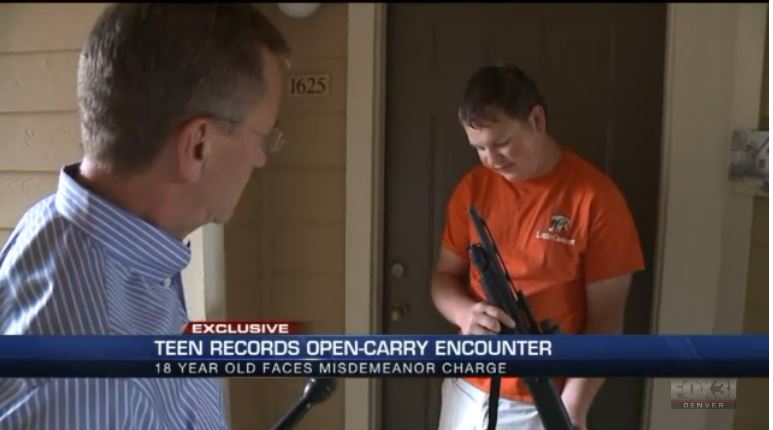
White 18-year-old walks up and down city streets with a loaded shotgun.

Result:  is approached and questioned by police, refuses to show ID to prove that he’s carrying legally, lives to make a total dick of himself on the evening news.

Image: snip from local news showing reporter on the left (white; male; salt & pepper hair) talking to white teenager with shot gun.  Caption reads "Teen Records Open-Carry Encounter.  18 year old faces misdemeanor charge."

Black 12-year-old plays with toy gun in a park.

Result:  shot dead by police 2 seconds after they arrive by car on the scene.

Image:  clip from newscast with photo of black boy with caption "Boy with toy gun shot 2 seconds after police arrived.  Police:  cop told boy 3 times to show hands before the shooting."

Come join us for a drink with this lady:


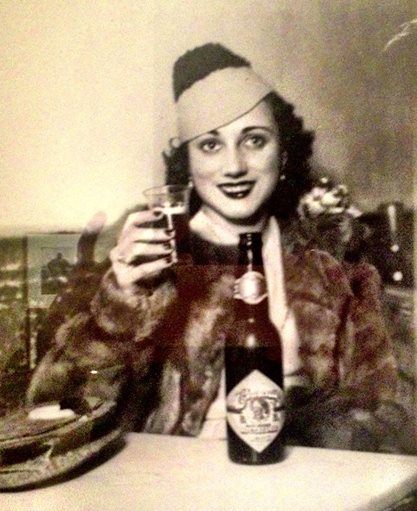
Photo:  [advertising exhibition]  Black & White photo of latina woman in a sleeveless dress, sitting with her elbows on a table, holding a shot glass.  The wall in the background painted with religious art.

We’ve been trying to convince you to come to CREEC’s Inaugural Event with promises of listening to civil rights lawyers talk about civil rights.  That’s how we get our thrills.  But we thought some of you might prefer to hang out with this lady — and many other photos in the current exhibition at Museo de las Americas, the amazing venue for next week’s CREEC event.

From the Museo’s website:

Museo de las Americas in collaboration with The Mexican Cultural Center & Mexican Consulate of Denver announce the Fall exhibit, EL Brindis Remixed. The exhibit features photography from the 19th & 20th century taking a lighthearted . . . look at drinking within the Mexican Culture.

Featured artists include: Manuel Alvarez Bravo, Agustín Víctor Casasola, Gabriela Iturbide, Juan Rulfo, Gabriel Figueroa, Mariana Yampolsky and several other creatives who comprised Frida & Diego’s personal inner circle.

In 2000 the exhibit was on display in Paris for the Millennium Celebration and will be featured for the final time in the United States at Museo this Fall.

We are very lucky to be able to use this beautiful space — right in the middle of Denver’s Santa Fe Arts District.  Come for the art, stay for the civil rights!   Or vice versa!

Photo of museum space with high ceilings, open rooms and painted warm colors of yellow and orange.  In the foreground, a table.

I think she’ll be there, too.

Photo: brown & white photo of well-dressed woman in make-up and a fashionable hat with a bottle in front of her holding up a shot glass.

An inspiring evening with the ACLU of Colorado

We went to the ACLU of Colorado’s annual dinner on Friday.  This is always a very energizing experience — to be surrounded by friends and allies who are working hard (and/or donating boatloads of money) to protect civil rights and civil liberties.   It was especially inspiring this year for a number of reasons.  Our friend Laura Rovner was honored with an award for her amazing work on behalf of inmates in solitary confinement and other extreme conditions.  We all cheered our behinds off for a trio of recent court victories in police abuse cases.  And I enjoyed hanging with the next generation of civil rights advocates.

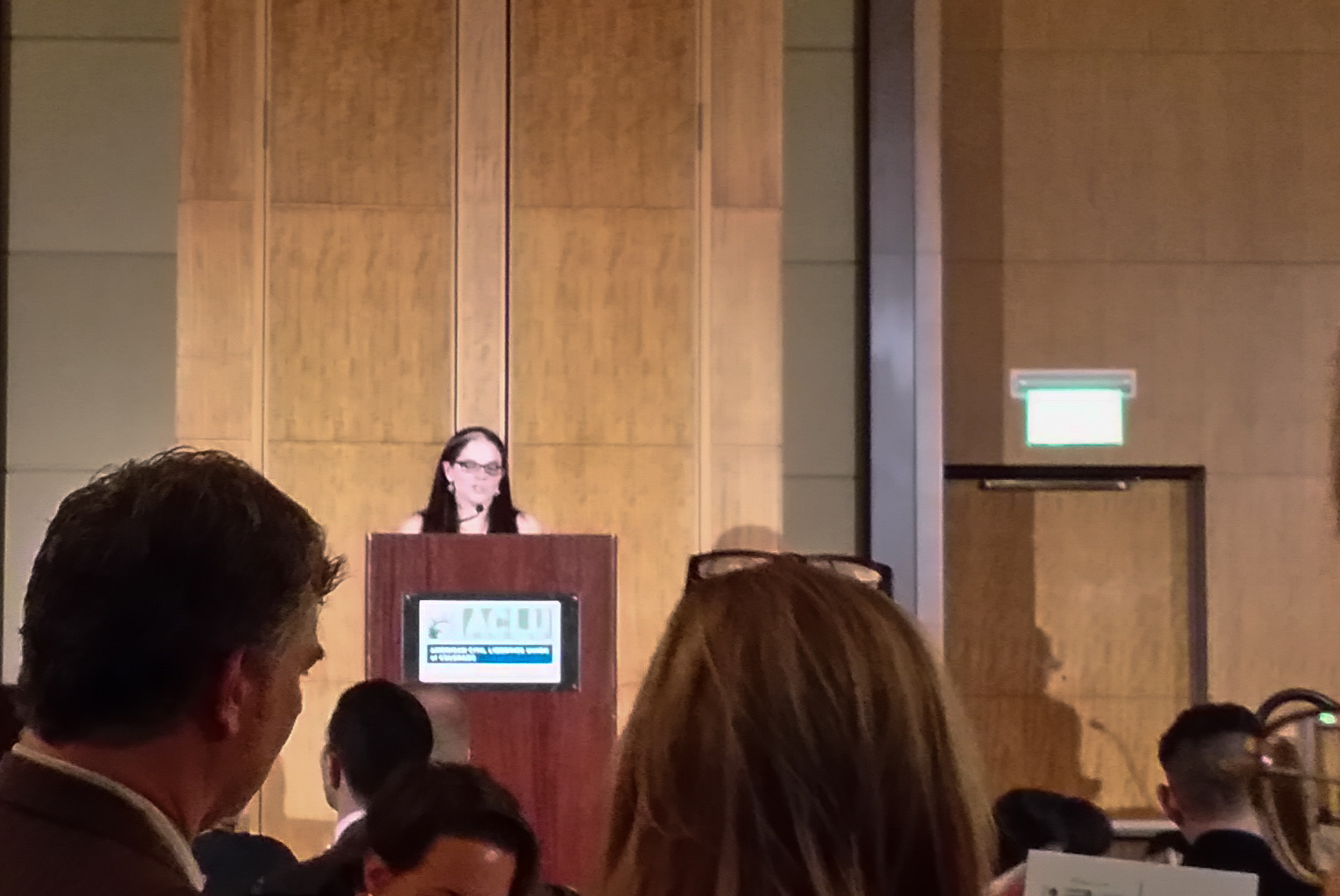
Laura’s friend and colleague Jeanne Theoharis introduced her, and spoke about the long struggle for civil rights and civil liberties.  Laura “walks in the shoes of Rosa Parks,” not because she is herself a Black woman standing up (sitting down) to racism, but because Rosa Parks was more than just a single moment in 1955.  She was an experienced civil rights worker, who had been advocating throughout the 1930s and 1940s as well, laboring for decades without much success.  Jeanne made me imagine a far more just future, in which Laura’s work will be remembered for the ground-breaking qualities it truly has.

Image: distance shot of white woman with black hair standing behind a podium addressing an audience.  The backs of several people's heads are visible in the foreground.

As an aside, I got into an interesting discussion after about the pros and cons of comparing a white lawyer to an African-American activist.  My thoughts, which probably need their own post at some point, are summed up much more eloquently by this graphic by Dan Wilkins:

Image: A circle the interior of which has been divided into 4 quarters.  Top left has the image of the sun rising over a mountain top with the words "I have a dream."  Top right has the symbol for "women"; bottom left has the rainbow stripes; bottom right has the international symbol of accessibility - white wheelchair against blue background.  Around the circumference of the circle are the words "Same Struggle. Different  Difference."

As the graphic says at the bottom, “There is power in knowing my struggle is your struggle and yours mine.”  If we are too quick to cordon off one set of struggles as the unique property of their protagonists, we miss the opportunity to perceive and fight the common enemies of fear, ignorance, and hatred of the unknown.

OK, where was I?  Oh right – the trio of amazing police abuse cases.  Our friends at Rathod Mohamedbhai achieved a $3.25 million settlement on behalf of Jamal Hunter against the Denver Sheriff Department, and our friends at Killmer, Lane & Newman, won back to back verdicts, first (with co-counsel Kate Stimson) $1.8 million against the Denver Police for a warrantless raid on the wrong house, resulting in wrongful prosecution, then $4.65 million against the Sheriff Department for the jail abuse death of homeless pastor Marvin Booker.  The first article stated that Denver had paid $16.7 million in damages since 2004 before these three cases; if my math is correct, the total now stands at $26.4.  And that’s just in damages — it doesn’t count the vast City resources (my tax dollars!) that go toward defending the indefensible.  It’s frustrating, after all those years and dollars, that the Denver Department of Safety can’t prevent these abuses.  It was satisfying to be able to congratulate breaking-news civil rights heroes Rathod Mohamedbhai and Killmer, Lane & Newman on Friday.

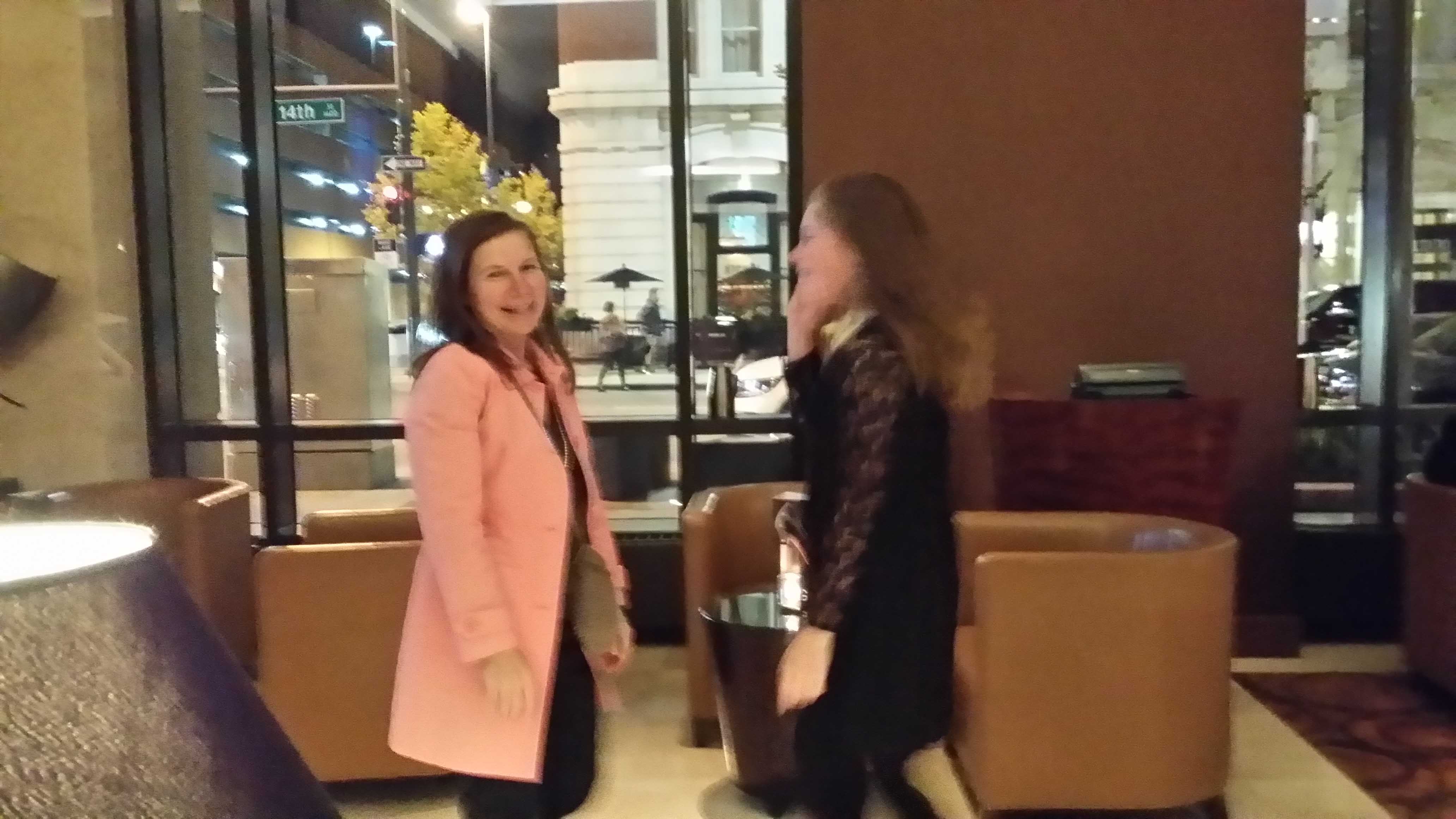
Now for the fun part (with apologies for incompetent phone photography).  I was so glad Laura brought her amazing daughter Claire

Image: white girl with blond hair and white woman with dark hair - with her arm around the white girl - facing the camera smiling.

and that we got to sit with Brittany Glidden and The Littlest Civil Rights Advocate, Ellie:

Image: white woman sitting at a dinner table holding a white toddler, both smiling for the camera.

And after the main event, dancing happened:

Image: slightly blurry photo of white woman in pink coat dancing with blond girl (from photo 2 above) in a black dress.

Suing to protest your child’s existence should be prima facie evidence of child abuse

Perhaps you’ve seen the articles about a white lesbian couple who are suing because the sperm bank they used to conceive their child gave them the sperm of Donor #330 instead of Donor #380.  Likely would not have been a problem, but Donor #330 turned out to be African-American, and the women are freaking out because they have to raise a mixed-race child.

This reminded me instantly of parents who bring “wrongful life” or “wrongful birth” lawsuits, [.pptx]* alleging that doctors failed to warn them of potential risks of disability that would have caused them to abort their unborn child.  The mixed-race case and the undetected-disability case share this in common:  they require parents to say they would not have had a child who is now born, is now here, is now A PERSON.

It always makes me think:  Don’t these parents realize their unwanted infants will grow up to be teenagers who can use Google?  Don’t they realize that even the youngest of children will understand an environment of unwantedness?

The request for damages is usually for the extreme distress of raising a disabled child (wrongful birth) or BEING a disabled person (wrongful life).  What it should be for is PREPAYMENT OF THE SHRINKS’ BILLS THE KID WILL INCUR BECAUSE HER PARENTS DECIDED TO TELL THE WORLD THEY DIDN’T WANT HER.

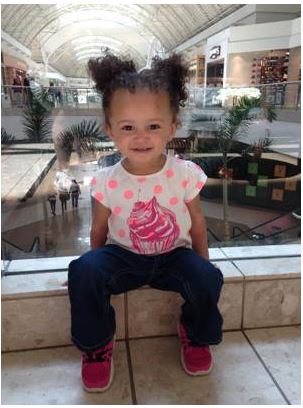
Image:  mixed race toddler girl in pick polka-dot t-shirt and jeans sitting in what appears to be a shopping mall.

Original caption:  “This undated family photo provided by Jennifer Cramblett shows her daughter, Payton.”   So not only is she telling the world that her daughter is a mistake, she’s publishing her name and photograph.  Do they think that their child alone in the world will never Google her own name?  W.T.F.?

This situation is so fucked up that my conservative brother and I — who agree about almost nothing except that his kids are awesome and the rest of our family is a clown car — are in complete agreement.  Take it away, Bruce!

Two white people decide to have a baby and, surprise, it comes out black (or half black). They’re lesbians so you’d think maybe they’d have some sensitivity to being a minority (and pay some lip service to that), but fundamentally they’re pissed that they bargained for a white baby and got a half-black one.

But, don’t people get surprises not of their choosing with babies all the time. I think this has been your mantra for a long time – that all life is equally valuable, etc. Interesting that therapists actually recommended they move out of a white neighborhood into a more “diverse” neighborhood.

Not sure, but this story seems to have about a million things wrong with it, none of which have to do with the mistake made by the sperm bank.

Sadly I learned early in my career in civil rights law that being in one minority does not guarantee you give a rat’s ass about any other minority or civil rights in general.  In an investigation not long after we started Fox & Robertson, we were interviewing people with disabilities whose personal care assistants were managed by a company who we thought might be committing Medicaid fraud.  The primary complaint of one of the first people I spoke with was that, despite her request, the agency would not stop sending Black people to her house.   Sigh.  This recent post by our friend Corbett describes a similarly depressing lack of rat’s-ass-giving by a group of non-disabled feminists.

Working hypothesis:  Humans are selfish, insular, and thoughtless, except the ones who are generous, compassionate, and funny.  It’s hard to say.

But back to parents who sue because their child exists.  As Bruce says:  having a kid is always full of surprises.  My parents — dyed-in-the-wool liberals — could not possibly have predicted they’d have a gen-u-ine Republican son.  But then, my dyed-in-the-wool Republican/WASP grandparents could not possibly have predicted they’d have a Democratic son who married a Jewish liberal, either.  Generations of parents — to the beginning of time — cope with children who aren’t what they expect them to be, yet the law does not recognize a right to compensation for parental disappointment unless the child is disabled or — I guess we’ll soon learn — of a different race.

Meanwhile, I’d like to set up shop as the lawyer representing the grown kids of these hateful lawsuits, bringing suit against their parents for the child abuse of publicly rejecting their very existence.

**********

* Link is to an excellent PowerPoint presentation on the subject by Samantha Crane, Public Policy Director at the Autistic Self Advocacy Network.