 ‘
‘
Note the warning at the beginning. Nevertheless, countdown to FoxNews meltdown in 3, 2, 1….

‘
Note the warning at the beginning. Nevertheless, countdown to FoxNews meltdown in 3, 2, 1….
[Cross posted at FoxRobBlog, which is involved in some sort of DNS attack. Whatever that is.]
In Yates v. Sweet Potato Enterprises, Inc., 2013 WL 3662645 (N.D. Cal. July 12, 2013), the plaintiff — a guy who uses a wheelchair — alleges that he encountered barriers at a Popeyes restaurant. In the order, the judge addresses questions from both the plaintiff and the defendant about what evidence can be used at trial. In so doing, she does two things that are stunning individually, but that — taken together — turn the plaintiff into the defendant, defending his right to equal access to the businesses that non-disabled people patronize everyday without a second thought.
First, the court grants the defendant’s motion to exclude “sympathy-inducing evidence regarding Plaintiff’s disability” that is not directly relevant to his experience at Popeyes, including “testimony regarding his day-to-day hardships.” The court just doesn’t see how that’s relevant.
Second, the court denies the plaintiff’s motion to exclude evidence that he has filed a large number of other access lawsuits.
Pause.
If people who use wheelchairs filed a lawsuit challenging every illegal barrier they encountered each day, most would file — I’m guessing — five to ten lawsuits each day. Instead, most people go about their days, swearing at the illegal and thoughtless barriers, but without the time or resources to file those tens and eventually hundreds of lawsuits. A brave and energetic few take the time to bring the lawsuits that remain necessary — twenty years after the effective date of the ADA’s architectural provisions and thirty years after California’s — to achieve a modicum of compliance. For their trouble, these people are dubbed — in the press and in court — “serial litigators.”
The Ninth Circuit — the court with appellate authority over the Yates court — has recognized the role of these brave and energetic people in enforcing the law:
Courts must tread carefully before construing a Disability Act plaintiff’s history of litigation against him. As we have noted more than once, “[f]or the [Disabilities Act] to yield its promise of equal access for the disabled, it may indeed be necessary and desirable for committed individuals to bring serial litigation advancing the time when public accommodations will be compliant with the [Disabilities Act].” We must therefore be “particularly cautious” regarding “credibility determinations that rely on a plaintiff’s past [Disabilities Act] litigation.”
Antoninetti v. Chipotle Mexican Grill, Inc., 643 F.3d 1165, 1175 (9th Cir. 2010) (internal cites omitted; emphasis — though not nearly enough — added). One of the cites I pulled out to make that quote more readable was Sam Bagenstos’s excellent article The Perversity of Limited Civil Rights Remedies: The Case of “Abusive” ADA Litigation, 54 UCLA L.Rev. 1 (2006).
So despite the fact that the Ninth Circuit has instructed courts to be particularly cautious about credibility determinations relying on past litigation, the Yates judge — without citing Antoninetti — holds that
Plaintiff’s filing of well over a hundred disability lawsuits in which he alleges identical injuries bears directly upon his credibility. . . . Plaintiff’s alleged scheme to generate income through the serial filing of lawsuits in an effort to extract settlements from businesses, may, in fact, be probative of his credibility.
More than simply disregarding controlling precedent, this decision has the very immediate and apparently intended effect of converting Mr. Yates from a real, live person who navigates his day to day world in a wheelchair to a greedy serial litigant, judged on the fact that he has filed other complaints, the legitimacy of which he will likely not be able to prove before the jury. (This question is not addressed in the decision, but my strong guess is that the defendant will be allowed to show the fact of hundreds of lawsuits, while the plaintiff will not be permitted to show that, in each one, the facility in question was indeed out of compliance. That would, in essence, require hundreds of mini-trials within this single trial.)
On another level — about which I’ll write more later, as I have to get back to the other outrages on my desk — this is part of the broader scheme on the part of the business world to spin the fact that — 20-30 years after the federal and state standards took effect — there is still massive noncompliance. When you’re really really wrong, accuse the other guy of “serial litigation” to correct your many many failures.
Following up on my post of a couple of days ago, I was very happy to learn that Gov. Hickenlooper granted an indefinite stay of execution to Nathan Dunlop. While I wish it had been a full commutation, this is a good result.
Hey, you guys! Check it out! We made Jezebel! OMG OMG!
Surprise, Surprise: Hollister Discriminates Against the Disabled
A federal judge has ruled that Hollister is in violation of the Americans with Disabilities Act. Hollister’s stores are supposed to resemble Southern California surf shacks. Most Hollister stores in the U.S. feature entrances that are built to look like front porches. Front porches with stairs. And that’s where the problem lies.
And UK’s Daily Mail, in a section with the unfortunate name “Femail,” as well as Salon, and The Gloss:
Hollister Spent Four Years Refusing To Accommodate People With Disabilities Because Of Course They Did
If you’ve ever been near a Hollister store, you know that it reeks of mildewy cologne spilt in a hot bathroom. But you also may know that its storefront is inaccessible to those with disabilities, as they are made to look like porches to “surf shacks,” stairs included (as you can see above). After a four-year class-action lawsuit against the company for discrimination, a judge has ruled that Hollister’s stores violate the Americans With Disabilities Act.
With fee shifting.
Consider the following case:
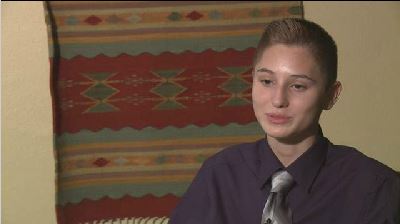
This case, although likely tough to bring under current antidiscrimination law, would be resolved on a plaintiff’s summary judgment motion under the Anti-Butthead Act, the key provision of which reads, “Don’t be a butthead.” The high school, although fully entitled to implement whatever religious principles it wants,* is being buttheaded about a very simple thing. Let the kid wear whatever damn gown he wants.
His family says
they’re not expecting the school to change policy by next week, but hope the school would consider eventually having all students wear the same colored gowns to avoid the situation all together.
Laudable non-buttheaded thinking!
**********
*I am completely unqualified to opine on Christian doctrine, but I thought it had more to do with loving your fellow human than what color gown he’s wearing.
Arapahoe County DA George Brauchler lives in an upside down world where strapping someone to a gurney and injecting him with lethal chemicals is “courageous” and deciding not to do this is “cruel and unjust.”
In a letter to the governor supporting the execution of Nathan Dunlap, Mr. Brauchler
questioned the motives and ethics of those who have argued on Dunlap’s behalf, and those who diagnosed and treated him for mental illness.
“Questioned the motives”? Questioned? The motive is, um, to keep Colorado from executing Mr. Dunlap. Not sure what’s in question. It’s right out there in the open.
Pause for disclosure of my motive: My view is that the death penalty is wrong and that my state should not execute Mr. Dunlap. Even if you generally favor or are undecided on the death penalty in the abstract, however, there are many, many reasons why it would be wrong in this case. You can read the clemency petition here, write to Governor Hickenlooper, or call him at 303-866-2471. 5280 magazine published a long article in 2008 that spelled out the history of the case.
Back to snarking on the DA.
Mr. Brauchler decries the “abandonment of professional ethics.” The ethics of trying to keep someone alive? I don’t think that word means what he thinks it means. I have scoured the Colorado Rules of Professional Conduct and can find nothing suggesting it is unethical to urge the governor not to kill someone.
The DA characterizes as “convenient ‘scientific’ epiphanies” — the scare quotes around “scientific” are his — the now widely-accepted conclusion that Mr. Dunlap had a severe, undiagnosed mental illness when he committed the crime for which he is to be executed. The diagnosis at which Mr. Brauchler sneers is one that has, since Mr. Dunlap’s sentencing, been confirmed and treated by Department of Corrections doctors.
More scare quotes. Can’t you just see him wiggling the first two fingers of each hand when he complains that
our state’s leaders are asked to accept as ‘objective’ evidence the conclusions of the anti-death penalty movement’s ‘best and brightest’ experts, and to ignore their obvious collaborative biases . . .
Well, the movement does have some excellent (“best”) and very smart (“brightest”) people, who work together (“collaborate”) to do what they think is right (“bias”?). Ouch!
And his letter
called assertions by the defense that race plays a role in imposing the death penalty in Colorado “vile, disgusting and offensive.”
Those are the adjectives you use when you don’t have facts. In fact, as of 2010, 41% of prisoners under sentence of death in the US were black, while only 13.6% of the population as a whole is black. There are three people on Colorado’s death row; all three are black. Studies in other states have shown that blacks killing whites are much more likely to get the death penalty than any other permutation, and that prosecutors are much more likely to seek the death penalty for black defendants.
Ultimately, it is the racism in our criminal justice system that is vile, disgusting, and offensive; not the act of calling attention to that fact.
The clemency petition provides measured, fact-based arguments why it would be a very bad idea to execute Nathan Dunlop. Many people, of many different faiths and backgrounds, agree with this:

All the DA has to offer in return is a salad shooter of insults: cruel; unjust; slap in the face; questionable motives; unethical; “objective” “scientific” evidence; collaborative bias; vile; disgusting; offensive. And the unsupported pronouncement that Mr. Dunlap “took the lives of four Colorado citizens, and justice requires he now pays with his own.”
There is no good reason for this execution; just the satisfaction of the primitive desire for revenge. Guess that’s my bias.
This may be the strangest charitable donation request you’ve ever gotten. I’m asking you to donate to the Colorado Cross-Disability Coalition because the El Diablo restaurant closed.*

Huh?
CCDC’s legal team of Kevin Williams and Andrew Montoya represented CCDC and several Mexican food enthusiasts who use wheelchairs in challenging the fact that the owners of El Diablo took an accessible space — in, btw, a beautiful old building in a booming neighborhood — and turned it into a largely inaccessible restaurant by adding raised areas that were not originally there.
Two years, summary judgment for plaintiffs, and a couple hundred thousand in legal fees later — just at the point where the judge was about to order El Diablo to restore accessibility — the city shut it down for (unrelated) code violations. It reopened, reshut, reopened, reshut, declared bankruptcy, reopened, and — after the latest violation notice from the city — closed for good.
Bottom line: CCDC spent a lot of attorney time on this case, won the case on summary judgment, and will not see a dime in attorneys’ fees. Please join us in contributing to CCDC.**
If you’ve heard enough, just click on through to the donation page and send them some cash. If you want to know more about this case, here are some links:
This part of the ADA — requiring businesses to be accessible — has no damages remedy. The only way lawyers can bring these cases is because the ADA makes defendants pay the plaintiffs’ attorneys’ fees when they lose. But lawyers like the great team at CCDC always work under the threat that they’ll spend years on a case — and achieve excellent legal results — only to have it disappear. That happened here.
Please support CCDC’s excellent legal work. Thanks!
**********
* This photo is actually from January, but it’s more dramatic than anything I could find for the Final Shut Down.
** If you’re not comfortable with the online donation site — which seems highly unlikely if you’re reading a cutting edge blog like this one! — you can send a check to CCDC at 655 Broadway, Suite 775, Denver, Colorado 80203.
The Colorado Independent has an article up about our Scott case. The journalist had previously written about our Ulibarri case, and was thus able to put Mr. Scott’s situation in this astonishing perspective:
Scott isn’t the first deaf prisoner whose disability has gone ignored by Denver’s jail. Even as the city failed to provide Scott with an interpreter, it was defending itself against a lawsuit brought on behalf of three other deaf prisoners – one of whom hanged himself in his cell. Shawn Vigil spent a month in jail without an interpreter before his suicide in 2005. The Sheriff’s Department knew Vigil was deaf but apparently didn’t take note that he was functionally illiterate and unable to understand a question on his intake form asking if he needed accommodations for his disability.
We’re hoping this lawsuit will finally get some effective policies in place for deaf people detained or incarcerated by the City and County of Denver.
I know you’ve all been on the edges of your seats to see my photo essay, the final assignment for Digital Photography 201 at Illuminate Workshops. The wait is over! Of course, just in time for the final class, I had all sorts of legal adventures — trial prep! settlement! appeal! — and a major head cold. So I didn’t actually attend the final class. Or the make-up final class. Or the make-up of the make-up of the final class. What can I say – lawyers suck at non-law things.
The assignment read:
Decide on a subject whose story needs to be told. … A story that is close and personal to you.
Shoot everything you can about your subject.
Make us see the subject from your perspective.
We were to edit down the photos first to 30, then to 12, print them on 11×14 paper, and present them at the last class. But I missed the last class (twice) and I’m not good at following instructions anyway, so my photo essay has 20 photos, and is blogged, not printed. It also reflects the fact that I ran out of time — even with an effective two-month extension — and had a cold. Did I mention the cold? So some of the photos reflect long walks around Denver thinking about my subject, while others reflect a bit of casting about my office last night for meaningful props. But I think they show both my subject and some of the composition and developing skills we’re learning at (did I mention?) Illuminate Workshops.*










And the outtake … because nothing happens here without full canine supervision:

********************
* How’s that for apple-polishing? And I’m not even getting a grade!
It’s the latest prescription for extreme ultra-Orthodox Jewish men who shun contact with the opposite sex: Glasses that blur their vision, so they don’t have to see women they consider to be immodestly dressed.
This is sheer genius! With modern technology, if we can’t convince bigots to bring their thinking into the modern world, at least we don’t have to change our behavior to cater to their stone age views. Bigot Glasses: think of the uses!
The ultimate genius, of course, is that Bigot Glasses only affect the bigot, so the rest of us can go about living our black, female, Islamic, gay, and/or disabled lives in peace.
There is, of course, one set of these glasses I’d invest in: grumpy old lady glasses. Technology that erases tattoos, pulls up pants, covers up exposed underwear, brushes hair, feigns respect, and edits out the word “like.”
 Thought Snax