Category Archives: Guest post

Family Food: Giving thanks for a meal that redefines kinship. (Guest post by Ruth Blau; originally published in 1986.)

[The post below is an article written by Ruth Blau, my mother, and published in The Arlington Journal on November 25, 1986. The photos were not in The Journal; I’ve added them from my archives.]

Holidays are family times. And despite dire warnings from politicians and sociologists, the family is not dead. It is simply, in our fractured times, being redefined.

Take, for example, the family that gathers at my house for Thanksgiving dinner. It includes two or three grown children (some mine, some my husband’s), depending on who is in the country and who can get home from college.

Dinner also includes my mother, in her mid- 80s, and my father, 79. It includes my ex-husband and his elderly father. It includes some dear friends who are regulars, occasionally some new friends, and my husband and me.

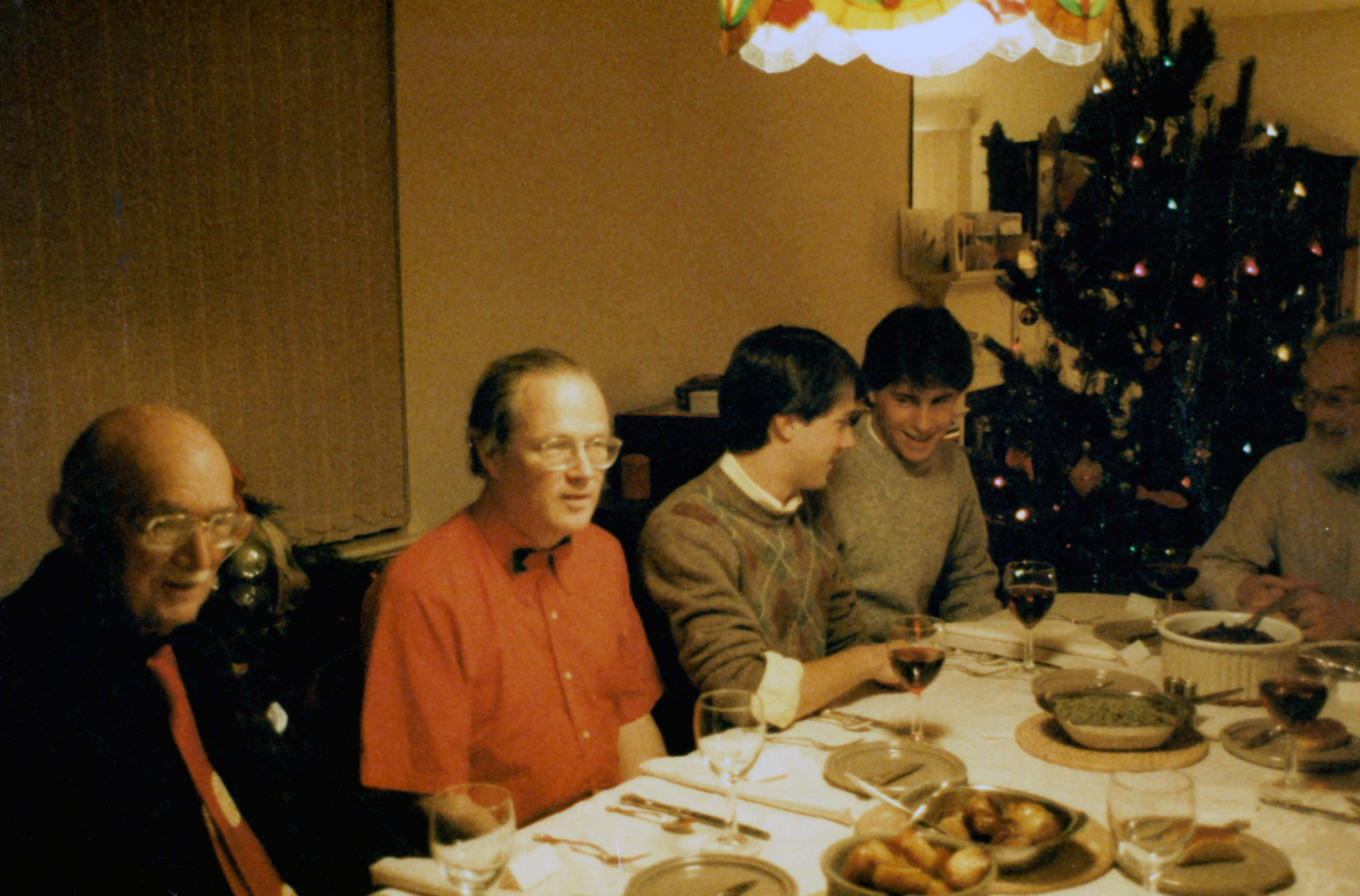
Strange, you might think, but it works and we have a wonderful celebration. We also mirror the way American families are changing.

Indeed, the more or less isolated nuclear family – mother, father, a couple of kids – is a 20th-century phenomenon. In earlier times, our own agrarian past, for example, large extended families lived near one another and often functioned as an economic unit. Industrialization and rapid transportation gradually changed all that.

More recently, safe contraception and the high cost of raising children have limited family size in the U.S. – children became more of an economic liability than a valued extra pair of hands on the farm.

Too, the easing of divorce laws in state after state has meant increasing numbers of divided families. As you can see from our example, however, a divided family is not an indicator that no family exists.

It’s just that families are changing, as the following statistics tend to show.

At a time when U.S. population is growing at about one percent per year, the number of divorces per one thousand population is going down from 5.3 in 1981 to 4.9 in 1984, the most recent year for which statistics are available.

Another encouraging statistic: in 1982, according to the 1986 Statistical Abstract of the United States, 48.5 percent of all divorced women remarried.

Further redefining the new family, in 1984 nearly two million couples – not including gay and lesbian couples – lived together without benefit of marriage. This is the famed POSSLQ crowd, Persons of the Opposite Sex Sharing Living Quarters, in the immortal prose of the Census Bureau.

Nearly half of these two million were in the prime child-rearing years of 25 to 44; about half (both men and women) have never married; and just under a third had children younger than 15 in the household.

What do these statistics mean? They mean that we are on our way to creating the new extended family. Or, if you prefer, “official” and “unofficial” families.

In her 1978 book “Families,” sociologist Jane Howard defines an “unofficial” family member as “anyone whose death or suffering would undo me as much as that of a relative.”

I, too, have an official and an unofficial family. While my official family (related by blood or law) gathers for Thanksgiving, my unofficial family comes together once a year for the Passover Seder.

It began about a decade ago, with a small office group, some of whom wished to participate in a Seder but lacked either time or money to go home for the holiday. Now, 10 years later, it is so important to us that we shape our lives around it.

Last spring, for example, my husband and I were to go to Australia (business for him, holiday for me). But, we agreed, we had to be back in time for the Seder – and not just back but enough recovered from jet lag to be able to enjoy the festival.

Our Seder family has a core of eight people who always attend; not all are Jewish. In addition, we include guests, who may come once or may repeat several years. We are never fewer than a dozen and have gone as high as 15.

I particularly enjoyed the year that our group included a young Vietnamese couple who had just become American citizens.

Like many official families, we have our in-jokes. We never, for example, warn guests that they are about to bite into a solid chunk of horse radish, a mind-clearing exercise if ever there was one.

My new extended (“unofficial”) family includes those people to whom people used to be related by marriage. I recall, for example, a Christmas dinner some years ago at Aunt Billie’s. She is not my aunt, but my friend Brenda’s ex-husband’s aunt.

Brenda, remarried and temporarily living in this area, had always been close to Aunt Billie, a widow in her 70s. Brenda’s ex-husband Bob lived on the West Coast, but was coming East with his new wife for the holidays. Brenda, a great organizer, invited us all to Christmas dinner at Aunt Billie’s.

The cast of characters that night looked like this: Brenda and her second husband Tracy; Bob and his new wife; Brenda and Bob’s son Brad; Brenda’s good friends Russell and Terry (who have since split and married others) and their son; myself, my ex-husband and our children (I had not yet remarried).

Presiding over it all was Aunt Billie, the matriarch. It was a memorable meal, not for any fireworks it might have produced, but for the sense of connection to friends, relatives and used-to-be relatives.

This brings me back to holiday time at my house, where three generations from at least five former and present nuclear families gather in harmony as one family.

Jeff, my husband’s middle son from his first marriage, and my ex-husband Peter – who is a permanent fixture at our holiday celebrations – have become good friends.

And when Amy and Bruce (my children from my marriage to Peter) are in town, Jeff is included when they go out to dinner or to the movies with their dad. These young people – all in their 20s – seem quite content with their multi-parent extended family.

Each year, as we sit down to break bread, we raise our glasses to give thanks that we are all again gathered to celebrate the harvest. And each year we understand that we are celebrating something else: family, regardless of how it is defined.

What Did Donald Trump Imply? (Guest post!)

I’m not a lawyer. I’m a mom. More specifically, I’m Amy’s mom. She’s swamped with work, so I’m pinch-hitting.  [Thanks, Mom! – ed.]

Like many people I was appalled by Donald Trump’s apparent incitement to violence as part of the speech he gave in Wilmington, N.C. on August 9. On August 10, both the Washington Post and the New York Times led with reports on the implications of this speech, and both papers editorialized about it.

With a hat tip to linguists professor Geoffrey Pullum for the context, here’s what Mr. Trump said:

Hillary wants to abolish
— essentially abolish —
the Second Amendment.
By the way,
if she gets to pick her judges… [long pause]
Nothing you can do, folks. [long pause]
Although the Second Amendment people, maybe there is, I don’t know.

Many people, myself included, felt that this was a call to assassinate Hillary Clinton. In political speeches, as in stand-up comedy, timing is everything, and Professor Pullum’s insertion of the pauses is important. After Mr. Trump says, “Nothing you can do folks,” he pauses, as if he were thinking about what he had just said. As if he were saying to himself that possibly there is something that can be done [about his ridiculous claim that a president can single-handedly abolish part of the U.S. Constitution]. He then says, “Although the Second Amendment people, maybe there is [something you can do], I don’t know.”

The Trump campaign says that interpreting this as incitement to violence is nonsense. He was merely saying that people who value their Second Amendment privileges should be sure to vote in November. But if you watch the video of this passage of the speech (there are dozens on YouTube), you will see someone (red t-shirt or polo shirt) sitting behind and to the left of Mr. Trump whose jaw drops. He can’t believe Trump just said that. If you keep watching, you’ll see that this same guy breaks into a big smile and turns, laughing, to the woman sitting next to him. What’s Mr. Red Shirt thinking? “Wow! Did Trump just give us permission to go out and shoot Hillary?” Or is he thinking, “Yeah, he’s right. We gotta remember to vote on November 8.” As the sportscasters sometimes say, “You make the call.”

The Washington Post editorialized as follows:  “If Mr. Trump were not a major-party presidential candidate, his comment Tuesday might have earned him a stern visit from the Secret Service.”  The New York Times’s editorial reminds us of the New Hampshire delegate to the Republican Convention, Al Baldasaro, who said that Ms. Clinton should “be put in the firing line and shot for treason.” “That comment,” says the Times,” wound up on the Secret Service’s radar. Mr. Trump’s comment should as well.”

What does the law say about these kinds of remarks? Check out 18 U.S.C. § 879, which says

(a)Whoever knowingly and willfully threatens to kill, kidnap, or inflict bodily harm upon-  [(1), (2) and (4) a former President, member of the former President’s immediate family; President, Vice-President, President-elect and immediate families; a person protected by the Secret Service…]

And then there’s subsection (3):

(3) a major candidate for the office of President or Vice President, or a member of the immediate family of such candidate

Ms. Clinton qualifies under three of the four subsections: immediate family of a former president, major candidate for president, and a person under the protection of the Secret Service.

So what’s going to happen to a person who “knowingly and willfully” threatens to kill, etc. someone listed in sections 1 through 4?

Shall be fined under this title or imprisoned not more than 5 years, or both.

Two things are pretty clear to me and to many other people: Donald Trump threatened the life of Hillary Clinton, and such threats are illegal and subject to fines, imprisonment, or both. Two major newspapers have said or implied that Mr. Trump should be at least investigated under 18 U.S.C § 879, but, somehow, I doubt that he will be. I would be investigated if I said that. You would, too. But probably not Donald Trump.

Honoring our Dead

[I am honored to provide a platform for Corbett’s latest guest post. – ed.]

“Her life was not worth living.”

“He was such a burden to his family.”

“The parents suffered so much.”

“It’s understandable.”

“There’s no crime here – they did a merciful thing.”

This is how the media often reports on the murders of disabled people. The reports are full of sympathy for the murderers and short on compassion for those murdered.  Disabled people’s lives are framed as useless, tragic, suffering. Media writers ignore the joys and passions of the victims – maybe because that disrupts the sympathy narrative for the murderer.

Since 2012 on March 1st an international Day of Mourning vigil is held to honor and remember those disabled people killed by family and caregivers.  Some vigils also include those murdered by authority figures, such as police and school personnel. This year there are 104 names on the list. These are just the people who got caught. Research by Dick Sobsey and others show that a great many acts of violence against disabled people are never caught. In one chilling report, he discovered that 25% of the deaths of people with cerebral palsy were murders. Even when the murders are reported, the punishment for the murderers is often light.

If my writing seems drier than usual, it’s because I am holding my breath and trying to keep my teardrops off the keyboard while I type. It’s hard to sit with these stories. Hard to know how easy it is for those that we, disabled people, rely on to kill us. Hard to read the sympathetic media reports that say our lives were not worth living. Hard to know that the murderers know that even if they are caught there will likely be few consequences. Hard to sit with these facts while we are fighting every day for society to become just a little bit more accessible.  Hard to look into the faces of these murderers and know that a great many people support them.

So on Saturday I am going to attend my local vigil and honor those killed. I will surround myself with people who know that disabled people’s lives are valuable. I will not let those murdered be forgotten.

RESOURCES

Find an in-person or online vigil here

2014 list of names and causes of death

Dick Sobsey

Kassiane (direct and has profanity)

Ibby Grace

Zoe Gross (who started the vigils) blog

Bad Cripple

s.e. smith

What’s the wheelchair equivalent of black face? (Guest post!)

[I’m very excited to present a guest post by Frances Lively.  She is responding to Joanne Ostrow’s August 9, 2012 column in the Denver Post.]

Dear Ms. Ostrow:

I have been a subscriber to The Denver Post for a very long time and always enjoy reading your column.  You are a good writer with an enjoyable style and an intelligent approach to television matters.

I wondered, however, about one segment of your “Good News, Bad News,” column in the August 9, 2013, issue, concerning diversity.  You are correct in noting that there are far too many white males and too few Hispanics featured in TV shows.  But how can you say it represents a positive step forward for diversity to have Blair Underwood — an able-bodied person, albeit a member of a minority group — portraying a person with a disability?  This casting makes the same mistake that “Glee” made in one of its teenaged characters and does not really advance inclusion of people with disabilities in our society.

I understand that the networks worry about ratings and would prefer to take their chances on a bankable star in the main role in a new show, but I would hope that you could at least point out this irony in your column rather than lauding the networks for this short-sighted casting.  The irony of your comments only increases with your follow-up regarding Michael J. Fox, who does, indeed, have the illness that is to be portrayed in his new show, but who is himself a very well-known, long-time white male star.  Perhaps your “good news” instead should have been that there are good actors available who happen to have disabilities and who would love the chance to be featured in a network television show.

Please do not file my message under the heading of “Can’t please all the people all of the time.”  Instead, give me credit for not lighting into you regarding your description of Underwood’s character as “a highly capable, sexually active paraplegic.”  Time does not permit a discussion of all of the problems with that statement.

I hope you will put my letter in the file for “How can we keep networks from being ignorant.”  I’m sure many of your readers would appreciate your using your position in our community as a critic to nudge the networks in a better direction.  Thanks very much for your time.

Sincerely,

Frances Lively

Ms. Ostrow responded:

Thanks for writing.

Agreed, it would be better to have a disabled actor playing a disabled character. but at least the character exists.

I’ll return to this topic in the future and keep your comments in mind.

Meanwhile I hope if you watch “Ironside” you’ll see what I mean about his action-hero antics…

Best,

Joanne