Category Archives: Random Opinion

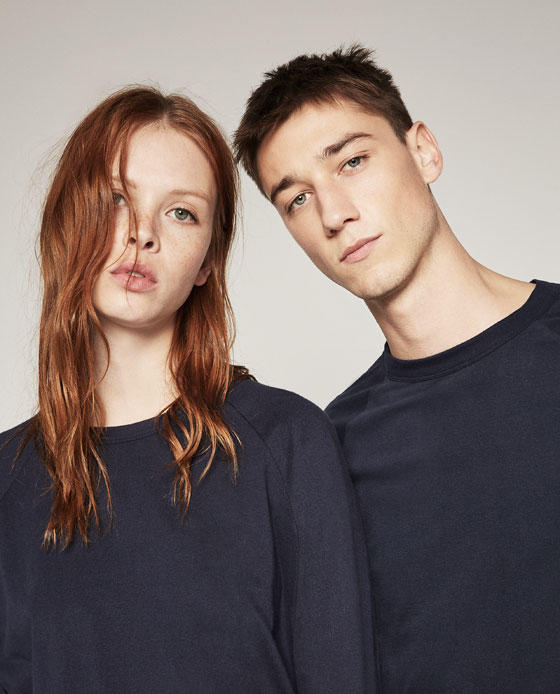
“Zara Drops a New Genderless Clothing Line”

“The retailer is the latest to embrace gender-defying fashion.”

Folks, this doesn’t defy anything.  This clothing line consists of items you could obtain, without patting yourself on the back for genderforwardness, by shopping at Hanes.com.    .

What I’m waiting for is Business Casual Ungendered Work Slacks in which the waist fits and I don’t have to cut a foot of fabric off the bottom.  This will be a huge boon for my particular subgroup: short rectangular women with no perceivable waistline.  I wear men’s Levi’s, but that’s not an option for work slacks.

Sadly, fashion that actually fits short people is a step too far for even the most forward-thinking fashion house.

Also I have to make a word-nerd comment that will conclusively identify me as an old fart, but when did “drop” start meaning “add”?  I read the headline to mean Zara had a genderless clothing line, which they ultimately decided not to carry, and thus dropped it.

Source: Zara Drops a New Genderless Clothing Line | Complex

Musing on the passing of Justice Scalia

Randomly:

These two sayings have been bouncing around in my head:  Thumper’s Mother* —  “If you can’t say something nice, don’t say nothing at all;”  Alice Roosevelt Longworth — “If you can’t say something good about someone, come sit right here by me.”

Many people, possibly casting about for something nice to say, praise Scalia’s “fine legal mind” or words to that effect.  But that seems to me like eulogizing someone for having really good looking toes.  Or excellent hair.  Your brain is just another body part.   The fact that it worked quickly, or generated scathing bons mots, or was especially astute at plumbing the intentions of the long-dead committee who stapled together our Constitution, seems secondary or tertiary or hundred-ary to how you used your brain.  (Or your feet.  Or your . . . hair?)   On that score, it is very hard to find anything good to say.  Scalia’s jurisprudence insulted and excluded LGBT and Black Americans, closed the courthouse doors on non-corporate citizens, and sent hundreds of our fellow human beings to their death at the hands of our own states.  And often that fine mind of his refused to stop with a legal analysis of why our LGBT friends and family should not be able to marry or why universities should not be permitted to open their doors a bit wider for people whose great-grandparents WE HELD IN CHAINS.  So often, especially in dissent, he used that fine mind to craft scathing insults for those who disagreed with him.

He was a bully, and he used his powerful brain the way a bully uses his powerful fists.  We would not eulogize a bully for his awesome fists.

There is no universe in which Antonin Scalia could have been considered a good person.  Honestly, I would have trouble eulogizing a liberal judge who decided every case just the way I would, but insulted and demeaned his sibling judges, the litigants before him, and his fellow human beings.

Am I speaking ill of the dead?  Yes, I suppose I am.  But as one Tumblr philosopher noted, “we don’t speak ill of the dead in America unless they were unarmed and black.”  It’s time to make that practice more inclusive.

Update:  Don’t miss Lao Bao’s second comment below — and be thankful that he’s teaching our next generation!

************

* Oddly, I had remember this as Peter Rabbit’s mother, possibly because my father used Beatrix Potter as the source of a fair amount of conveyed wisdom.


Chief Justice Roberts quietly burns Scalia in the Obamacare decision – The Washington Post

Chief Justice Roberts quietly burns Scalia in the Obamacare decision – The Washington Post.

From the WaPo article:

The main question in the case is about the subsidies used to buy health insurance by people who otherwise can’t afford it. Roberts and Scalia disagree on whether Congress meant for the subsidies to be available through the federally run insurance marketplace set up under the law, as the Obama administration argued, or if Congress wanted to give subsidies only to people who bought insurance through an exchange operated by a state government, as the law’s opponents claimed.

Roberts agreed with the administration. He wrote that it was “implausible” for Congress to set up a system in which people who used the federal marketplace wouldn’t be able to get financial help buying insurance. Scalia disagreed. But, back in 2012, he had written that without subsidies, “the exchanges would not operate as Congress intended.”

And then there was this, from yesterday’s decision affirming the validity of the disparate impact theory of fair housing decision.  The majority opinion by Justice Kennedy explains that the Court had previously held similar language in Title VII and the Age Discrimination in Employment Act (ADEA) to support that theory.  Regarding the ADEA decision, Justice Kennedy wrote:

In a separate opinion, Justice SCALIA found the ADEA’s text ambiguous and thus deferred under Chevron U.S.A. Inc. v. Natural Resources Defense Council, Inc., 467 U.S. 837 (1984), to an Equal Employment Opportunity Commission regulation interpreting the ADEA to impose disparate-impact liability, see 544 U.S., at 243–247 (opinion concurring in part and concurring in judgment).

Texas Dep’t of Hous. & Cmty. Affairs v. Inclusive Communities Project, Inc., No. 13-1371, 2015 WL 2473449, at *8 (U.S. June 25, 2015).  In other words, in 1984, Scalia believed that the language of the ADEA was ambiguous on the question of disparate impact and deferred to the regulations, something he refused to do with respect to the Fair Housing Act yesterday.

And this was just gratuitous, as I’m confident there are approximately 10,000 statutory construction treatises Kennedy could have quoted from:

Against this background understanding in the legal and regulatory system, Congress’ decision in 1988 to amend the FHA while still adhering to the operative language in §§ 804(a) and 805(a) is convincing support for the conclusion that Congress accepted and ratified the unanimous holdings of the Courts of Appeals finding disparate-impact liability. “If a word or phrase has been … given a uniform interpretation by inferior courts …, a later version of that act perpetuating the wording is presumed to carry forward that interpretation.” A. Scalia & B. Garner, Reading Law: The Interpretation of Legal Texts 322 (2012).

Id. at *11.

Such weird unpredictability from someone who believes the meaning of the constitution was fixed in 1787.

[Updated to add the second Inclusive Communities quote.]

Drive Like Your Kids Live Here*

Image: Red lawn sign with white letters that read "Drive Like Your Kids Live Here."  Other lawns in the background have the same sign.These preachy little signs are popping up all over our neighborhood. Every time I see one, two thoughts float through my head:

First thought:  I don’t have kids, you sanctimonious shit, so I’ll drive the way I would if my imaginary kids lived there and my imaginary kids all drive for NASCAR.

Second thought:  let’s apply this standard universally:

  • Provide access like your kids used wheelchairs.
  • Provide interpreters like your kids were Deaf.
  • Locate fracking like your kids lived there.
  • Make cops treat all kids like your kids.
  • Fund public education like you had one imaginary kid in each school in the country.  (Hey, if the Duggars can do it . . .).
  • Generally do unto others like you would do unto your kids.

Wasn’t there some guy a while back who had a whole philosophy, a religion, actually, IIRC, around a concept sort of like this?

Actually, a third thought often sneaks in, which is this:  I HATE this sort of sanctimony . . . FLOOR IT!  I honestly think this reaction would not be unusual, and that they’d have better results with a sign that read something like, “radar speed camera ahead.”

**************

* Shouldn’t it be “like your kids lived here.”  It’s the subjunctive, you sanctimonious UNGRAMMATICAL shits!

“The Case Against Gay Marriage: Top Law Firms Won’t Touch It”

The Case Against Gay Marriage: Top Law Firms Won’t Touch It – NYTimes.com.

Here is what I wrote to the author:

I find it funny that the unwillingness of big law firms to handle cases that might affect their bottom line is getting a lot of attention around the marriage equality issue. We run a small civil rights non-profit that files lawsuits to enforce the Americans with Disabilities Act, and honestly, big firms that will represent tobacco companies and death row inmates won’t touch our cases. Why? Because we are asking their [potential] clients to be accessible to people who use wheelchairs, to deaf and hard of hearing people, to others with other disabilities. It’s not front page news; it’s business as usual for us.

Here is what I wrote on Facebook:

Oh cry me a fucking river. Your position is unpopular. Deal with it. Grow some balls and speak up for what you believe in. It’s not “crushing dissent” when you self-censor for economic gain.

Image Description and Identity

Sometimes I try to take on big questions; today we’re going to keep it light and only tackle the nature of identity and the relationship between author and reader in interpreting an image.

It all started with a question about image descriptions. Image descriptions are a way of making the images in webpages more accessible, primarily for readers with print disabilities. Screen readers will read accessible text, but when they encounter a photo, say (to take an image at random)

Image: Photo of golden retriever.

the screen reader can’t read it or render any useful information from it unless you add an image description. To make sure that print-disabled readers aren’t left out, I would add the description “Image: Photo of golden retriever.” I can put that either in the body of the blog, or in the “alt-text” field of the photo when I upload it. Here, I did both.

When adding image descriptions, I’m always challenged by how much detail to include. The photo above is easy: there’s one major feature and it’s quick and easy to describe. When I describe people, I’ve tended to describe them using a couple of basic characteristics: gender; age(ish); race; and perhaps an additional detail or two (color of clothing; glasses; sitting/standing). When someone is in a wheelchair, I say that; when they’re not, I don’t say anything.

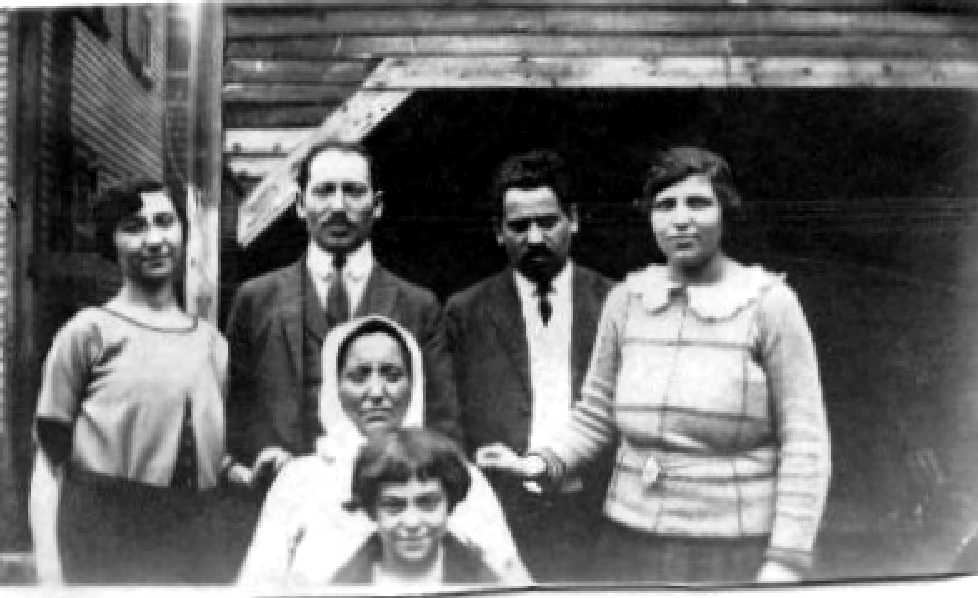
For example, I described this photo

Image: slighly blurry black & white photo of a group of 6 people. In back, a young woman, two middle aged men and a middle aged woman; in front of them, an older woman, and in front of her, a child of about 10.

as

slightly blurry black & white photo of a group of 6 people. In back, a young woman, two middle aged men and a middle aged woman; in front of them, an older woman, and in front of her, a child of about 10.

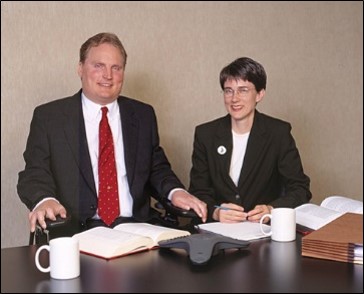
When I started adding image descriptions to the large number of people photos in the presentation we put together to introduce CREEC, I started tripping over the question of how — if at all — to describe race and ethnicity.  Many of the photos depicted people whose races were (1) obvious; and (2) known to me.  For example, this awesomely cliched photo that Tim and I had taken around 2002 as an Official Fox &  Robertson Photo:

Tim and Amy at a conference table ca. 2002.  (Tim is a white man with short blond hair who uses a wheelchair.  He is dressed in a suit.  Amy is a white woman with short brown hair and glasses.  She is sitting in a chair, also wearing a suit.  In the foreground, a table posed with law books, a speaker phone, files and mugs.

I described it:

Tim and Amy at a conference table ca. 2002.  Tim is a white man with short blond hair who uses a wheelchair.  He is dressed in a suit.  Amy is a white woman with short brown hair and glasses.  She is sitting in a chair, also wearing a suit.  In the foreground, a table posed with law books, a speaker phone, files and mugs.

That was easy:  I’m white; Tim’s white; I know our races.  Tim’s disability is visible.  All the props on the table probably aren’t that relevant, but my view is that the description helps convey the posed-ness of the photo.

But what about photos depicting people whose race or ethnicity was either unknown to me or not easily described?  This, in turn, raised the obvious question whether it is relevant at all. I felt torn between trying to achieve accuracy for print-disabled readers and adding unnecessary focus on race and ethnicity. I posed this question on Facebook, and deeply enjoyed the ensuing discussion.

When adding image descriptions to photos, what do you do about perceived vs. known vs. visible ethnicities? For example, if I’m in a photo with an African-American woman, I would say something like, “White woman in white shirt and jeans; African-American woman in dark shirt and skirt.”  Easy.  But what about describing someone whose ethnicity is likely neither white nor African-American but is not known to me? Or someone who “looks” “white,” but I know would be annoyed by being described as “white.” Describing degrees of skin tone seems weird.

A surprising number of people responded with something like, “I don’t describe race.”   From Andrew Montoya:

Generally I do not comment on race/skin tone in alt text unless it’s germane to the picture.

From Carrie Lucas:

I don’t describe skin color.  If race is important to the picture, or skin, hair, etc, then describe it.  Otherwise just say “person” or “people of multiple races.”

My response (edited for coherence):

But that would mean that (respectfully) I’m making the decision for the reader when race/color/ethnicity are relevant. I try to be complete and objective in descriptions, though completeness is never possible and there is always editorial discretion.

If you don’t mention race, do you say “woman in a wheelchair” “older woman” “young girl” or just “person”?   What matters?  Gender? Race? Age? Disability? Hair color? Skin color?  At what point are we short-changing a blind reader who just wants to know what the photo looks like.

Carrie:

  I wouldn’t say race; I would say “dark colored skin, light colored skin, olive colored skin.”

Me:

But if I say that [Chinese-American colleague] has “olive skin” don’t I leave out something important, that is, that he’s Asian?  Or do I have to anatomically describe his eyelids?

Andrew:

But then where do you draw the line? How much detail do you use to describe the individual’s clothes, type of glasses, how the hair swoops over an eye, where the person’s shadow falls against the all white background even? It seems a line must be drawn somewhere lest you lose the content to the details of the description. So unless race is part of the relevance of the picture, I prefer to let people be people.

I will state that a person is in a wheelchair or using other equipment if it’s relevant. I rarely mention age, unless it’s relevant to the description (i.e., saying “cranky man” doesn’t convey the image as well as saying “cranky old man” for the stock picture of the muppet in the theater box guy). I do often state gender, as it seems a natural descriptor, but generally only for pictures where there’s only one gender present. However, stating a race or skin color where it’s not relevant to the picture seems odd and forced to me. As for determining relevance, I think that I’m already editorializing by having used the picture. I intend it to convey a particular thing by using it, so that’s where I focus my alt text description.

Corbett:

Some descriptions I have seen include information that is visible such as describing the skin tone but not assigning racial identity. So the description might say: “a light skinned female appearing person sits in a wheelchair. A dark skinned male appearing person stands nearby wearing a dark suit with a light shirt and plaid tie.”

Good point:  you can’t assume gender either.

Carrie:

It depends on why you are including the picture; whether race is important to the purpose of the picture.

Me:

But I think that’s circular, in the sense that “importance” is created by the interaction of creator and reader.  Should my purpose be the be-all-and-end-all of the decision?  I totally agree you have to make choices or you’d spend 3 paragraphs describing the building in the background of the photo, etc. But the question of when race is relevant seems to me to be one that the reader should make.

Carrie:

Yes, you are the author.

Me:

Don’t you often see things in photos that the photographer or user didn’t see or intend? I think we’re heading into lit crit territory!!!

That is, it was starting to sound very vaguely like the discussions of author, reader, and text that my much smarter classmates were having in 1981.  Which, to me, meant that I was way in over my head, and thus could start making shit up with impunity!

Then my law school roommate, Kristin Robinson, chimed in.  She was a grad student in American Studies (IIRC) when the two of us and a med student shared a house in 1985, and we’ve only recently reconnected on Facebook.

Long descriptions include information that is relevant to understanding the reason (instructional goal) the image has been included. It highlights salient information. So, if race or other aspects of people’s appearance is salient, you would include it. If it isn’t, you wouldn’t.

So perhaps in a strictly educational context, the teacher’s purpose is more important than total transparency.  Kristin also provided a helpful link to guidelines for describing science and technology images in the educational context.  The very first guideline is

Brevity. The most frequent recommendation from respondents was for more brevity in description. Simply put, it takes people with visual impairments more time to read books and articles than people without visual impairments and the process should not be further slowed down by unnecessarily long image descriptions.

For all my pontificating about the need for enough detail to let print-disabled readers interpret the image, I may also be annoying the crap out of them with verbose image descriptions.

Here’s where I end up.  Once you start describing people — that is, going beyond something like “three people in the background” — you owe it to your readers to give a description sufficient to let them decide what features are relevant.  To my mind, that includes at least (perceived) gender, age, race/ethnicity/skin tone, and [visible] disability/lack.

There will always be filtering and interpretation in the descriptions and I realize that my perceptions (and thus descriptions) will not always be accurate.  That I may describe someone in a way that suggests the wrong identity, or that suggests an ethnic, gender or disability identity where the subject would prefer to be just “a person.”  So I’m making a decision that affects not only the reader but the subject.

Ultimately — perhaps by dint of what I do for a living — I don’t think I should be deciding for the reader that race and other identities don’t matter.  I may use a photo for one purpose, while my reader perceives other meanings.  When I see a photo, my eyes and brain (with its inevitable set of life experiences and preconceptions) conspire to give it meaning.  Sometimes that meaning may be different from what the photographer and/or author intended.  My goal in creating an image description should be to try — with acknowledged and inevitable limitations — to provide the opportunity for a print-disabled reader to have that same conspiracy of brain and ear to give their meaning to the image.

Suing to protest your child’s existence should be prima facie evidence of child abuse

Perhaps you’ve seen the articles about a white lesbian couple who are suing because the sperm bank they used to conceive their child gave them the sperm of Donor #330 instead of Donor #380.  Likely would not have been a problem, but Donor #330 turned out to be African-American, and the women are freaking out because they have to raise a mixed-race child.

This reminded me instantly of parents who bring “wrongful life” or “wrongful birth” lawsuits, [.pptx]* alleging that doctors failed to warn them of potential risks of disability that would have caused them to abort their unborn child.  The mixed-race case and the undetected-disability case share this in common:  they require parents to say they would not have had a child who is now born, is now here, is now A PERSON.

It always makes me think:  Don’t these parents realize their unwanted infants will grow up to be teenagers who can use Google?  Don’t they realize that even the youngest of children will understand an environment of unwantedness?

The request for damages is usually for the extreme distress of raising a disabled child (wrongful birth) or BEING a disabled person (wrongful life).  What it should be for is PREPAYMENT OF THE SHRINKS’ BILLS THE KID WILL INCUR BECAUSE HER PARENTS DECIDED TO TELL THE WORLD THEY DIDN’T WANT HER.

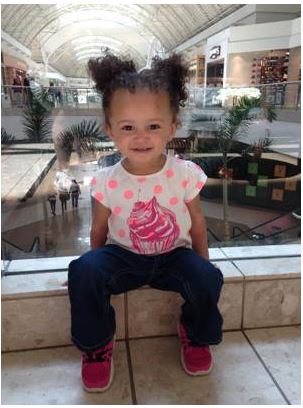
Image:  mixed race toddler girl in pick polka-dot t-shirt and jeans sitting in what appears to be a shopping mall.

Original caption:  “This undated family photo provided by Jennifer Cramblett shows her daughter, Payton.”   So not only is she telling the world that her daughter is a mistake, she’s publishing her name and photograph.  Do they think that their child alone in the world will never Google her own name?  W.T.F.?

This situation is so fucked up that my conservative brother and I — who agree about almost nothing except that his kids are awesome and the rest of our family is a clown car — are in complete agreement.  Take it away, Bruce!

Two white people decide to have a baby and, surprise, it comes out black (or half black). They’re lesbians so you’d think maybe they’d have some sensitivity to being a minority (and pay some lip service to that), but fundamentally they’re pissed that they bargained for a white baby and got a half-black one.

But, don’t people get surprises not of their choosing with babies all the time. I think this has been your mantra for a long time – that all life is equally valuable, etc. Interesting that therapists actually recommended they move out of a white neighborhood into a more “diverse” neighborhood.

Not sure, but this story seems to have about a million things wrong with it, none of which have to do with the mistake made by the sperm bank.

Sadly I learned early in my career in civil rights law that being in one minority does not guarantee you give a rat’s ass about any other minority or civil rights in general.  In an investigation not long after we started Fox & Robertson, we were interviewing people with disabilities whose personal care assistants were managed by a company who we thought might be committing Medicaid fraud.  The primary complaint of one of the first people I spoke with was that, despite her request, the agency would not stop sending Black people to her house.   Sigh.  This recent post by our friend Corbett describes a similarly depressing lack of rat’s-ass-giving by a group of non-disabled feminists.

Working hypothesis:  Humans are selfish, insular, and thoughtless, except the ones who are generous, compassionate, and funny.  It’s hard to say.

But back to parents who sue because their child exists.  As Bruce says:  having a kid is always full of surprises.  My parents — dyed-in-the-wool liberals — could not possibly have predicted they’d have a gen-u-ine Republican son.  But then, my dyed-in-the-wool Republican/WASP grandparents could not possibly have predicted they’d have a Democratic son who married a Jewish liberal, either.  Generations of parents — to the beginning of time — cope with children who aren’t what they expect them to be, yet the law does not recognize a right to compensation for parental disappointment unless the child is disabled or — I guess we’ll soon learn — of a different race.

Meanwhile, I’d like to set up shop as the lawyer representing the grown kids of these hateful lawsuits, bringing suit against their parents for the child abuse of publicly rejecting their very existence.

**********

* Link is to an excellent PowerPoint presentation on the subject by Samantha Crane, Public Policy Director at the Autistic Self Advocacy Network.

This guy is tasked with public safety?

I personally believe in Jesus Christ as my lord savior, but I’m also a killer. I’ve killed a lot. And if I need to, I’ll kill a whole bunch more. … If you don’t want to get killed, don’t show up in front of me, it’s that simple. I have no problem with it. God did not raise me to be a coward.

via Ferguson-Area Police Officer Suspended After ‘Killer’ Rant Surfaces Online.  He apparently rants on along these lines, on the video, for an hour or so, largely missing the point of the whole “Christianity” thing.  And the whole “protect and serve” thing.

This guy is a cop, and a member of the “Oath Keepers, the right-wing law enforcement group that is aligned with the Patriot movement.”   A quick (and slightly toxic) visit to their website reveals that “Oath Keepers” are a collection of police and military types who believe their “oath” to their interpretation of the constitution gives them the right to do things like not do their jobs and shoot random people who do not share their interpretation of the constitution.*

They have a list of orders they will not obey, including executing warrantless  searches (good), disarming Americans (potentially bad, if the armed American is threatening to kill someone), and wildly paranoid:

We will NOT obey orders to invade and subjugate any state that asserts its sovereignty and declares the national government to be in violation of the compact by which that state entered the Union.

We will NOT obey any order to blockade American cities, thus turning them into giant concentration camps.

Whew!  Glad we cleared that up.  And good to know that when Texas finally secedes, no one will try to stop them.  Buh byeeeeee!

I do appreciate that this group is a big fan of Edward Snowden.  So they exist in that special place where the extreme right and extreme left of the political spectrum meet up in shared paranoia and megalomania.

I guess we’ve always known that certain subsets of law enforcement view themselves as creating, interpreting, and executing the law; it’s more than a bit frightening to think those cops have a self-aggrandizing club where they can encourage and reward each other for doing so.

*********

* Based on their logo, this may or may not be caused by the emotional trauma of having very long but very thin penises:

Image: silhouette of man holding long gun, which also looks like he has a very long, thin penis protruding from his midsection.

Why is it OK to be a trans man or trans woman but not . . .

So just the other day, I was lecturing radical feminists never to question anyone’s identity as a woman, even if she was born with guy parts.  In that post, I posed what I thought was a rhetorical question.

Could a white person declare himself black in the same way a person born with female parts can declare himself to be male? Can I decide to be disabled without actually having a physical or mental impairment that substantially limits one or more major life activities?

If I should have learned anything in 53 years, it’s that there are no questions rhetorical enough that someone somewhere won’t answer, “yeah — that’s me.”

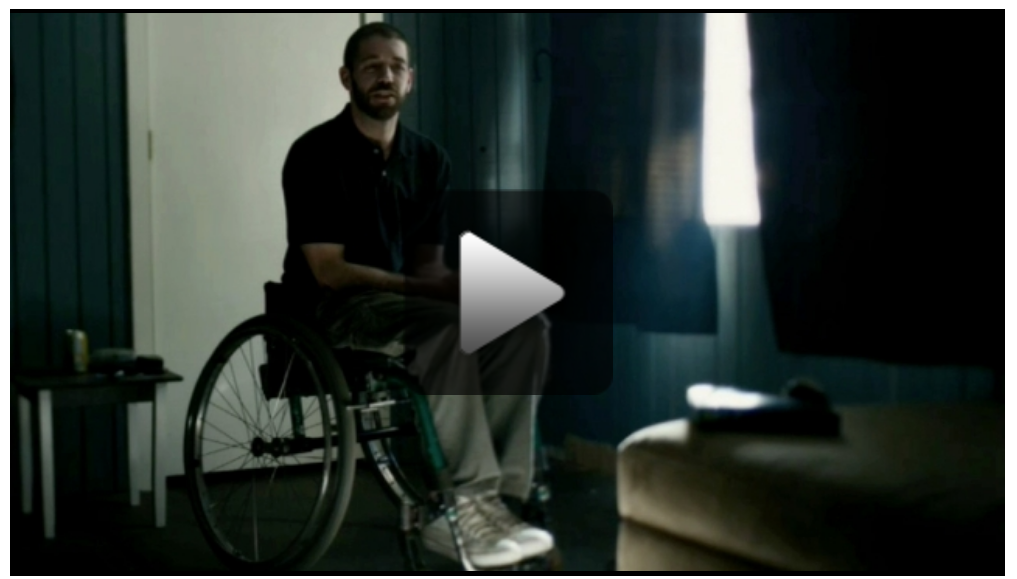
Meet Chris. He is not a person with disabilities, but nonetheless identifies as one and sits in a wheelchair whenever he can without giving his secret away to the people that know him. On last night’s episode of Showtime’s documentary series 7 Deadly Sins (this week’s sin: envy), Chris shared his story.

“I identify as a guy in a wheelchair,” he said. “I feel like I have the wrong body. I feel like I’m supposed to be disabled. What I want my life to be like is what is the detriment of a lot of people’s lives, the worst thing that’s ever happened to them, and I think it would be the best thing that ever happened to me.”

image

I feel fairly strongly that this is wrong, just as a white person declaring himself to be black or have a black identity is wrong. I’m just having a hard time articulating a principled reason why.

I support the rights of trans men and trans women to be the ones to tell us what gender they are, rather than having that be dictated by the body parts they were born with or what society thinks they should be.  And I have no problem if a person of one religion converts to another, and adopts a new identity wholesale.

Then there are those (Obama; me) born into two identities (black/white; Jewish/Protestant) who essentially get to choose — one; the other; or both — which choice is generally respected.

Yet we clearly have a set of negative judgments for people of a privileged status (white; nondisabled) adopting and asserting an identity as a less-privileged status (black; disabled) and a different set of negative judgments for the reverse (a black person deciding to identify as white; a disabled person identifying as nondisabled).  In the first situation, we use words like “wannabes” or “appropriation” or — in an article in New Mobility — “pretenders;” in the latter, “oreos,” “bananas,” or “passing.”

So, uncharacteristically, I don’t have an answer, or even a working hypothesis.  Why is it OK for a person born with male parts to identify as a woman, for a Christian to convert to Judaism, or for a person born in a mixed marriage to choose either identity or both, but not for Chris to identify as a person with a disability?


Peter Singer and the TERFs: We Know You Better Than You Know Yourself

And we want to make pejorative, exclusionary and — in Singer’s case — homicidal* decisions based on our superior knowledge of your inner state.

I had just written my random thoughts on the importance of trans* [**], Autistic and other former others rejecting the default setting, and my view that this made it easier for all of us “to be who we are and find or create our own cubbyhole, or none, or multiple,” when the New Yorker published “What is a Woman?” by Michelle Goldberg, an article describing the anti-trans* faction of “radical feminism” called, variously, Radfems or — more pejoratively but accurately — “trans-exclusionary radical feminists” (“TERFs”).

But what truly reminded me of Peter Singer was the TERFs’ certainty that they know the inner life of trans women and trans men. One Sheila Jeffreys has written a book, “Gender Hurts: A Feminist Analysis of the Politics of Transgenderism,” in which she proclaims her knowledge of and judgment on the inner life of trans men and trans women by seeing them entirely through the political prism of male-dominated society. A man, per Jeffreys, can never appropriate the experience of being a woman. Accordingly, Jeffreys “insists on using male pronouns to refer to trans women and female ones to refer to trans men.” To her, trans men are simply trying to “raise their status in a sexist system” while trans women, well, “when trans women ask to be accepted as women they’re seeking to have an erotic fixation indulged,” or — according to the psychology professor on whose work she relies — trans women have “‘autogynephilia,’ meaning sexual arousal at the thought of oneself as female.”

So Jeffreys and other TERFs — cis women all — have decided that they know the inner life of trans people better than trans people themselves do, and not only pontificate about this in writing, but ultimately reject trans women as women, refuse to use their preferred pronouns, and in some cases exclude them from women-only spaces.

This is rank Singerism. Peter Singer is a Princeton professor who believes that, well, I’ll let Harriet McBryde Johnson describe it:

Applying the basic assumptions of preference utilitarianism, he spins out his bone-chilling argument for letting parents kill disabled babies and replace them with nondisabled babies who have a greater chance at happiness. It is all about allowing as many individuals as possible to fulfill as many of their preferences as possible.

In other words, privileged white male Princeton professor asserts that he knows with such certainty the inner life of people with disabilities that he advocates killing them as infants. To me, Singerism means making policy — usually negative — based on the facially impossible premise that you can know and pass judgment on someone else’s inner life. Singer can never know how happy any particular person is or will be, much less disabled infants he’s never met. Jeffreys and the TERFs have no idea how trans women experience their lives and their identities.

Where the fuck do they get off deciding to kill, insult, and exclude people based on these arrogant and patently impossible judgments?

Jeffreys claims that cases of “regret” — people who have physically transitioned and later regretted the move — “undermine[ ] the idea that there exists a particular kind of person who is genuinely and essentially transgender and can be identified accurately by psychiatrists.” Well, it might undermine that idea for the person experiencing regret but how it undermines the self-knowledge — often hard-won — of everyone who has ever transitioned is hard to see. More Singerism.

The New Yorker article describes one TERF group, Deep Green Resistance, as holding the view that “a person born with male privilege can no more shed it through surgery than a white person can claim an African-American identity simply by darkening his or her skin.” I suppose that may mark the far outer boundaries of my “Free to Be You and Me” approach to identity, that is, that we should credit people with knowing themselves and defer to the identity each asserts. Could a white person declare himself black in the same way a person born with female parts can declare himself to be male? [2024 note: this was a year before Rachel Dolezal caught everyone’s attention.] Can I decide to be disabled without actually having a physical or mental impairment that substantially limits one or more major life activities? When does the assertion of identity become appropriation? I think we avoid Singerism by saying (1) we don’t know; and (2) we have no business killing, insulting, or excluding people based even on identities that push the boundaries of credibility.

It is reassuring that TERFs find themselves marginalized in feminist and academic circles, though frustrating that Singer is not similarly ostracized. It is apparently more acceptable to mainstream academia to advocate killing disabled infants than it is to advocate excluding trans women from all-female music festivals.***

I conclude with this quote from the New Yorker article:

Older feminists . . . can find themselves experiencing ideological whiplash. Sara St. Martin Lynne, a forty-year-old . . .

Hold on! “Older” and “forty-year-old” do not go together!  But assuming that “older feminist” would accurately describe this 54-year-old, I experience no whiplash, but only a deepening appreciation for each way we let people be themselves, and each mind-opening step we take away from the default setting.

Update: Here is an excellent response to the New Yorker article, in Bitch magazine.****  TERF War: The New Yorker’s One-Sided Article Undermines Transgender Identity by Leela Ginelle.  Lots of good points about the the TERF problem, though I disagree that the original article undermined transgender identity.  I thought it was fair, and that the TERFs were portrayed as the narrow-minded troglodytes that they are.

Update 2:  Julia Serano, who is mentioned in Goldberg’s article, has an informative rebuttal in The Advocate.  Here is my comment:

This is an excellent rebuttal to the New Yorker piece, but reading this & the rebuttal in Bitch made me wonder whether we read the same original article. First, though, I agree that Julia Serano has every right to feel personally pissed. But while Goldberg clearly skates over the surface of a complex issue, and probably did sensationalize the feminist catfight angle, I thought the TERFs came off in her article as deeply misguided, insular, and hateful. Specifically the reference to “autogynophilia” seemed to me like a self-evidently hysterical use of scientific-sounding Greek word roots to disguise abject quackery. All that said, Serano’s response adds a great deal of useful detail; would be great if The New Yorker published it.

*******

* I was going to say “life-threatening” but Singer doesn’t just want to threaten the lives of disabled infants, he wants to permit people to kill them. Let’s call it what it is.

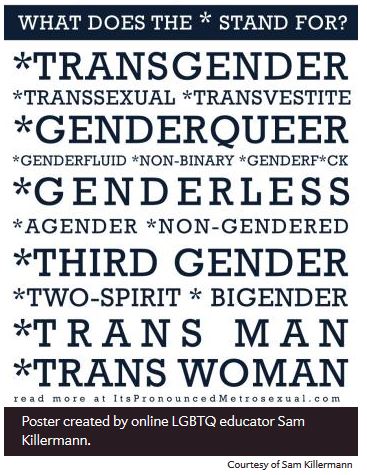
** “Trans*” is a way of indicating a wide variety of trans ways of being. As Slate explains, “the asterisk stems from common computing usage wherein it represents a wildcard—any number of other characters attached to the original prefix.”

Image: Graphic that reads, "Trans*. I recently adopted the term 'trans*' (with the asterisk) in my writing. I think you should, too. If it's new to you, let me help clarify. Trans* is one word for a variety of identities that are incredibly diverse, but share one simple, common denominator: a trans* person is not your traditional cisgender wo/man. Beyond that there is a lot of variation. What does the * stand for? *Transgender, *Transsexual, *Transvestite, *Genderqueer, *Genderfluid, *Non-binary, *Genderf**k, *Genderless, *Agender, *Non-Gendered, *Third gender, *Two-spirit, *Bigender *Transman *Transwoman" Poster created by online LGBTQ educator Sam Killerman.This can get confusing here, in light of the fact that the ThoughtSnax Style Manual calls for asterisks for footnotes.  We’ll muddle through.

*** The article noted that violence and threats have been directed toward TERFs, which is of course deeply offensive and wrong . . . except the graffiti “Real Women have Dicks,” which is just the sort of smartass, mind-opening civil disobedience I love.

**** Of course I read Bitch Magazine — it’s my trade publication!