The FoxRob Christmas/Chanukah/Festivus/New Year Tree

Of course

Image: coffee cup ornament

From our neighbors’ Hawaiian vacation

Image: Hawaiian dancer ornament with text Mele Kalikimaka

From my Dad (of course!):

Image:  Lobster and life jacket ornaments

To celebrate our southwestern holiday season:

Image:  chili pepper ornament

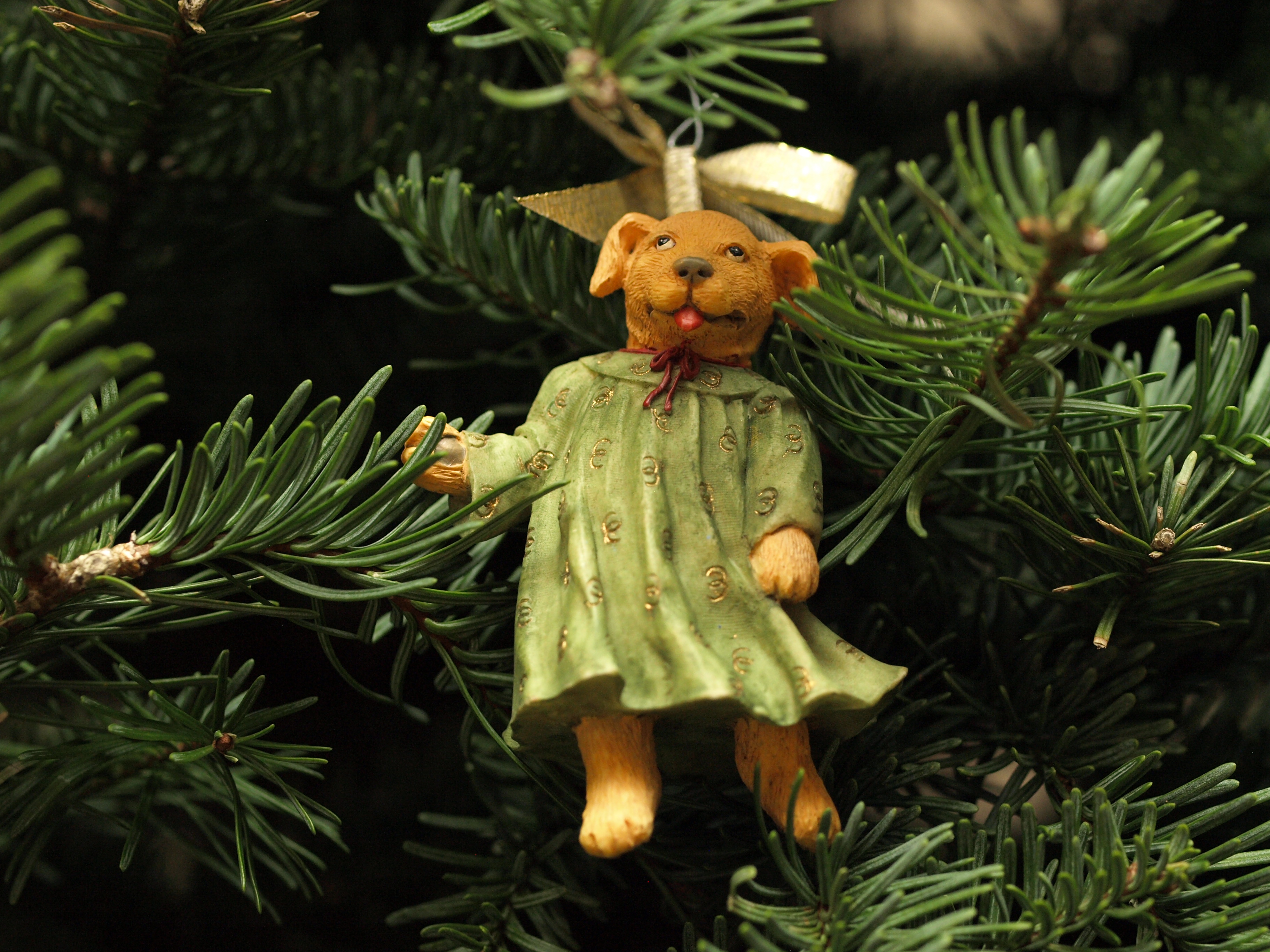
I think this started out as a Golden Retriever Angel, but over time the wings snapped off, so now it’s more like Golden Retriever in PJs.

Image:  ornament consisting of Golden Retreiver in baggy green gown.

And of course of course:

Image:  Denver Broncos jersey ornament

Happy Everything You’re Celebrating Whenever You’re Celebrating It!

I converted to Word.

It finally happened:  I converted from WordPerfect to Word.  Like my father, I was an early-adopter-never-let-goer.   I first worked on a commercial word processing program in Taiwan in 1984, when I was a translator at Lee & Li and learned the proprietary Wang word processing system.  (IIRC, Swarthmore in 1983 had a student-created system available on terminals in the computer center.  It was a huge improvement over my Smith-Corona and Wite-Out strips, and I wrote my thesis on it when I could reserve time.  Still didn’t top my Dad’s late 1970s adoption — and never-let-go-tion — of the Lexitron.)

I came back from Taiwan to go to law school in 1985 and acquired the then top-of-the-line approximately-the-size-of-a-lawnmower IBM PC.  I had heard that a program called MultiMate mimicked the Wang program, so I was determined to buy and install it.  My mother — thanks, Mom! — talked me out of that and into WordPerfect.  Thus began a 29-year relationship that only ended this year with my inevitable assimilation to the Borg:  Microsoft Word.

Top reasons for assimilation:

4.  Annoyed co-counsel (“the formatting in the Word version is all effed up!”)

3.  Awkward emails to opposing counsel (“we draft in WordPerfect, but send us your changes on the pdf version and we’ll incorporate them”).

2.  Track changes!!!!

But my favorite feature is

1.  Comment boxes.

I started using them as they are supposed to be used:  to expound on tracked changes or make a general comment on a section of text.  Now they’ve become sort of like “The Word” in the Colbert Report:

Image: Screen grab from the Colber Report with Stephen Colbert making air quotes while the word "Truthiness" appears off to the side.

a way of letting my id come out while drafting a brief, one that entertains me as I write but that is easy to delete and sanitize before I file.

Image:  a Word comment box reads, "I need a better word.  "Revealed to be bullshit" didn't seem quite right."

or even

Image:  Word comment box that reads "Ha ha!  Fuck you [opposing counsel]!"

I miss WordPerfect’s “reveal codes” feature, and I still maintain that outlining in Word is a random-number-and-indentation-generator, Image: Word comment box reading, "But I still call Julia Campins in confused desperation at least once a week."but I’m generally adapting to the change.


Image Description and Identity

Sometimes I try to take on big questions; today we’re going to keep it light and only tackle the nature of identity and the relationship between author and reader in interpreting an image.

It all started with a question about image descriptions. Image descriptions are a way of making the images in webpages more accessible, primarily for readers with print disabilities. Screen readers will read accessible text, but when they encounter a photo, say (to take an image at random)
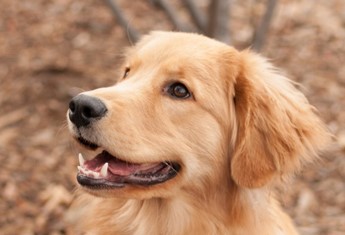
Image: Photo of golden retriever.

the screen reader can’t read it or render any useful information from it unless you add an image description. To make sure that print-disabled readers aren’t left out, I would add the description “Image: Photo of golden retriever.” I can put that either in the body of the blog, or in the “alt-text” field of the photo when I upload it. Here, I did both.

When adding image descriptions, I’m always challenged by how much detail to include. The photo above is easy: there’s one major feature and it’s quick and easy to describe. When I describe people, I’ve tended to describe them using a couple of basic characteristics: gender; age(ish); race; and perhaps an additional detail or two (color of clothing; glasses; sitting/standing). When someone is in a wheelchair, I say that; when they’re not, I don’t say anything.

For example, I described this photo

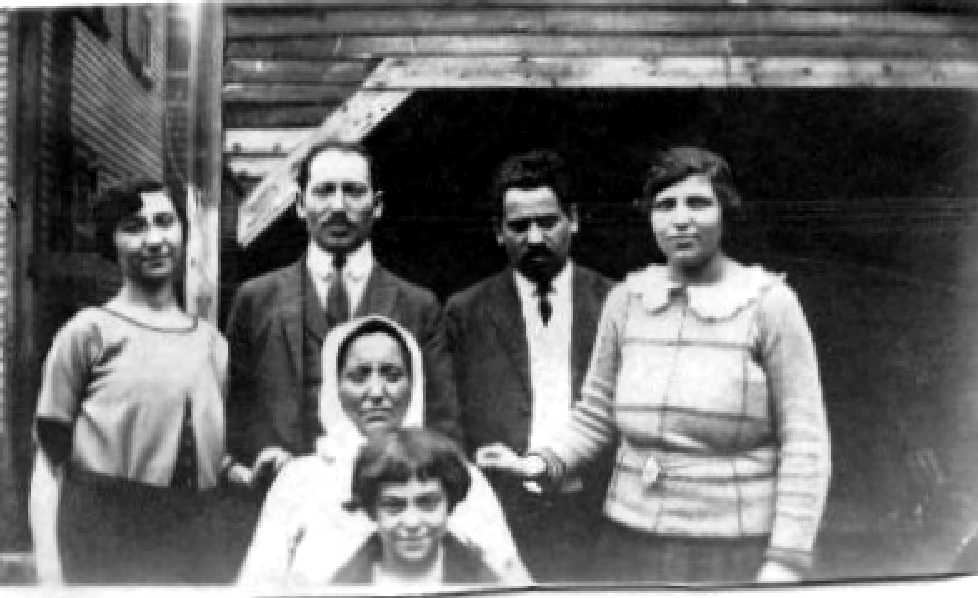
Image: slighly blurry black & white photo of a group of 6 people. In back, a young woman, two middle aged men and a middle aged woman; in front of them, an older woman, and in front of her, a child of about 10.

as

slightly blurry black & white photo of a group of 6 people. In back, a young woman, two middle aged men and a middle aged woman; in front of them, an older woman, and in front of her, a child of about 10.

When I started adding image descriptions to the large number of people photos in the presentation we put together to introduce CREEC, I started tripping over the question of how — if at all — to describe race and ethnicity.  Many of the photos depicted people whose races were (1) obvious; and (2) known to me.  For example, this awesomely cliched photo that Tim and I had taken around 2002 as an Official Fox &  Robertson Photo:

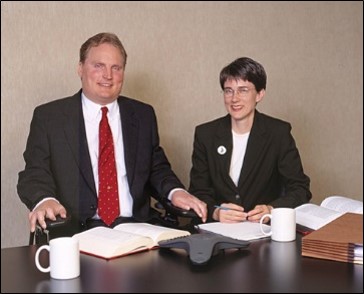
Tim and Amy at a conference table ca. 2002.  (Tim is a white man with short blond hair who uses a wheelchair.  He is dressed in a suit.  Amy is a white woman with short brown hair and glasses.  She is sitting in a chair, also wearing a suit.  In the foreground, a table posed with law books, a speaker phone, files and mugs.

I described it:

Tim and Amy at a conference table ca. 2002.  Tim is a white man with short blond hair who uses a wheelchair.  He is dressed in a suit.  Amy is a white woman with short brown hair and glasses.  She is sitting in a chair, also wearing a suit.  In the foreground, a table posed with law books, a speaker phone, files and mugs.

That was easy:  I’m white; Tim’s white; I know our races.  Tim’s disability is visible.  All the props on the table probably aren’t that relevant, but my view is that the description helps convey the posed-ness of the photo.

But what about photos depicting people whose race or ethnicity was either unknown to me or not easily described?  This, in turn, raised the obvious question whether it is relevant at all. I felt torn between trying to achieve accuracy for print-disabled readers and adding unnecessary focus on race and ethnicity. I posed this question on Facebook, and deeply enjoyed the ensuing discussion.

When adding image descriptions to photos, what do you do about perceived vs. known vs. visible ethnicities? For example, if I’m in a photo with an African-American woman, I would say something like, “White woman in white shirt and jeans; African-American woman in dark shirt and skirt.”  Easy.  But what about describing someone whose ethnicity is likely neither white nor African-American but is not known to me? Or someone who “looks” “white,” but I know would be annoyed by being described as “white.” Describing degrees of skin tone seems weird.

A surprising number of people responded with something like, “I don’t describe race.”   From Andrew Montoya:

Generally I do not comment on race/skin tone in alt text unless it’s germane to the picture.

From Carrie Lucas:

I don’t describe skin color.  If race is important to the picture, or skin, hair, etc, then describe it.  Otherwise just say “person” or “people of multiple races.”

My response (edited for coherence):

But that would mean that (respectfully) I’m making the decision for the reader when race/color/ethnicity are relevant. I try to be complete and objective in descriptions, though completeness is never possible and there is always editorial discretion.

If you don’t mention race, do you say “woman in a wheelchair” “older woman” “young girl” or just “person”?   What matters?  Gender? Race? Age? Disability? Hair color? Skin color?  At what point are we short-changing a blind reader who just wants to know what the photo looks like.

Carrie:

  I wouldn’t say race; I would say “dark colored skin, light colored skin, olive colored skin.”

Me:

But if I say that [Chinese-American colleague] has “olive skin” don’t I leave out something important, that is, that he’s Asian?  Or do I have to anatomically describe his eyelids?

Andrew:

But then where do you draw the line? How much detail do you use to describe the individual’s clothes, type of glasses, how the hair swoops over an eye, where the person’s shadow falls against the all white background even? It seems a line must be drawn somewhere lest you lose the content to the details of the description. So unless race is part of the relevance of the picture, I prefer to let people be people.

I will state that a person is in a wheelchair or using other equipment if it’s relevant. I rarely mention age, unless it’s relevant to the description (i.e., saying “cranky man” doesn’t convey the image as well as saying “cranky old man” for the stock picture of the muppet in the theater box guy). I do often state gender, as it seems a natural descriptor, but generally only for pictures where there’s only one gender present. However, stating a race or skin color where it’s not relevant to the picture seems odd and forced to me. As for determining relevance, I think that I’m already editorializing by having used the picture. I intend it to convey a particular thing by using it, so that’s where I focus my alt text description.

Corbett:

Some descriptions I have seen include information that is visible such as describing the skin tone but not assigning racial identity. So the description might say: “a light skinned female appearing person sits in a wheelchair. A dark skinned male appearing person stands nearby wearing a dark suit with a light shirt and plaid tie.”

Good point:  you can’t assume gender either.

Carrie:

It depends on why you are including the picture; whether race is important to the purpose of the picture.

Me:

But I think that’s circular, in the sense that “importance” is created by the interaction of creator and reader.  Should my purpose be the be-all-and-end-all of the decision?  I totally agree you have to make choices or you’d spend 3 paragraphs describing the building in the background of the photo, etc. But the question of when race is relevant seems to me to be one that the reader should make.

Carrie:

Yes, you are the author.

Me:

Don’t you often see things in photos that the photographer or user didn’t see or intend? I think we’re heading into lit crit territory!!!

That is, it was starting to sound very vaguely like the discussions of author, reader, and text that my much smarter classmates were having in 1981.  Which, to me, meant that I was way in over my head, and thus could start making shit up with impunity!

Then my law school roommate, Kristin Robinson, chimed in.  She was a grad student in American Studies (IIRC) when the two of us and a med student shared a house in 1985, and we’ve only recently reconnected on Facebook.

Long descriptions include information that is relevant to understanding the reason (instructional goal) the image has been included. It highlights salient information. So, if race or other aspects of people’s appearance is salient, you would include it. If it isn’t, you wouldn’t.

So perhaps in a strictly educational context, the teacher’s purpose is more important than total transparency.  Kristin also provided a helpful link to guidelines for describing science and technology images in the educational context.  The very first guideline is

Brevity. The most frequent recommendation from respondents was for more brevity in description. Simply put, it takes people with visual impairments more time to read books and articles than people without visual impairments and the process should not be further slowed down by unnecessarily long image descriptions.

For all my pontificating about the need for enough detail to let print-disabled readers interpret the image, I may also be annoying the crap out of them with verbose image descriptions.

Here’s where I end up.  Once you start describing people — that is, going beyond something like “three people in the background” — you owe it to your readers to give a description sufficient to let them decide what features are relevant.  To my mind, that includes at least (perceived) gender, age, race/ethnicity/skin tone, and [visible] disability/lack.

There will always be filtering and interpretation in the descriptions and I realize that my perceptions (and thus descriptions) will not always be accurate.  That I may describe someone in a way that suggests the wrong identity, or that suggests an ethnic, gender or disability identity where the subject would prefer to be just “a person.”  So I’m making a decision that affects not only the reader but the subject.

Ultimately — perhaps by dint of what I do for a living — I don’t think I should be deciding for the reader that race and other identities don’t matter.  I may use a photo for one purpose, while my reader perceives other meanings.  When I see a photo, my eyes and brain (with its inevitable set of life experiences and preconceptions) conspire to give it meaning.  Sometimes that meaning may be different from what the photographer and/or author intended.  My goal in creating an image description should be to try — with acknowledged and inevitable limitations — to provide the opportunity for a print-disabled reader to have that same conspiracy of brain and ear to give their meaning to the image.

Word of the Day: Desnarkification

De-snark-i-fi-ca-tion:  the process by which your co-counsel gently, diplomatically, wisely revise your legal brief to remove the snark your opposing counsel so richly deserves.  Synonym:  debitchification.

With love for my gentle, diplomatic, wise co-counsel.

One of these is not like the other

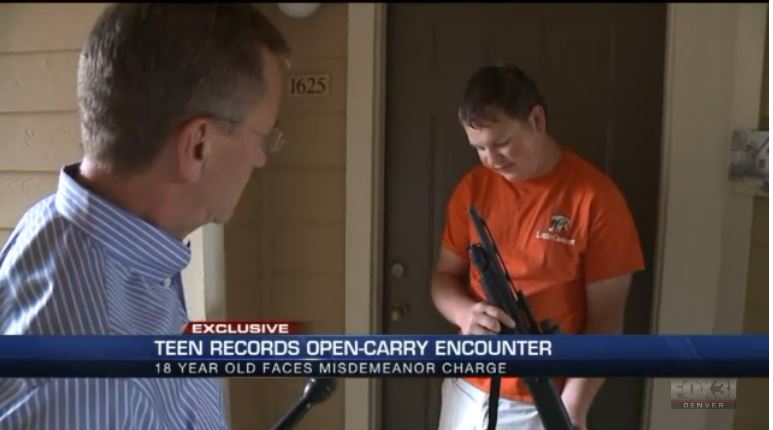
White 18-year-old walks up and down city streets with a loaded shotgun.

Result:  is approached and questioned by police, refuses to show ID to prove that he’s carrying legally, lives to make a total dick of himself on the evening news.

Image: snip from local news showing reporter on the left (white; male; salt & pepper hair) talking to white teenager with shot gun.  Caption reads "Teen Records Open-Carry Encounter.  18 year old faces misdemeanor charge."

Black 12-year-old plays with toy gun in a park.

Result:  shot dead by police 2 seconds after they arrive by car on the scene.

Image:  clip from newscast with photo of black boy with caption "Boy with toy gun shot 2 seconds after police arrived.  Police:  cop told boy 3 times to show hands before the shooting."

Yet another photo dump

That periodic post in which I gather all the photos since the last dump that are entertaining but not really worth an entire post.

Targeted email fail?  Or maybe very accurate, based on the pallets of manure I have to lift in responding to opposing counsel!

Image:  an email from "Forklift Deals," with the re: line "Bid forklifts for sale now."  The body has a photo of a forklift with the text, "Save Big Bucks on Used Forklifts."

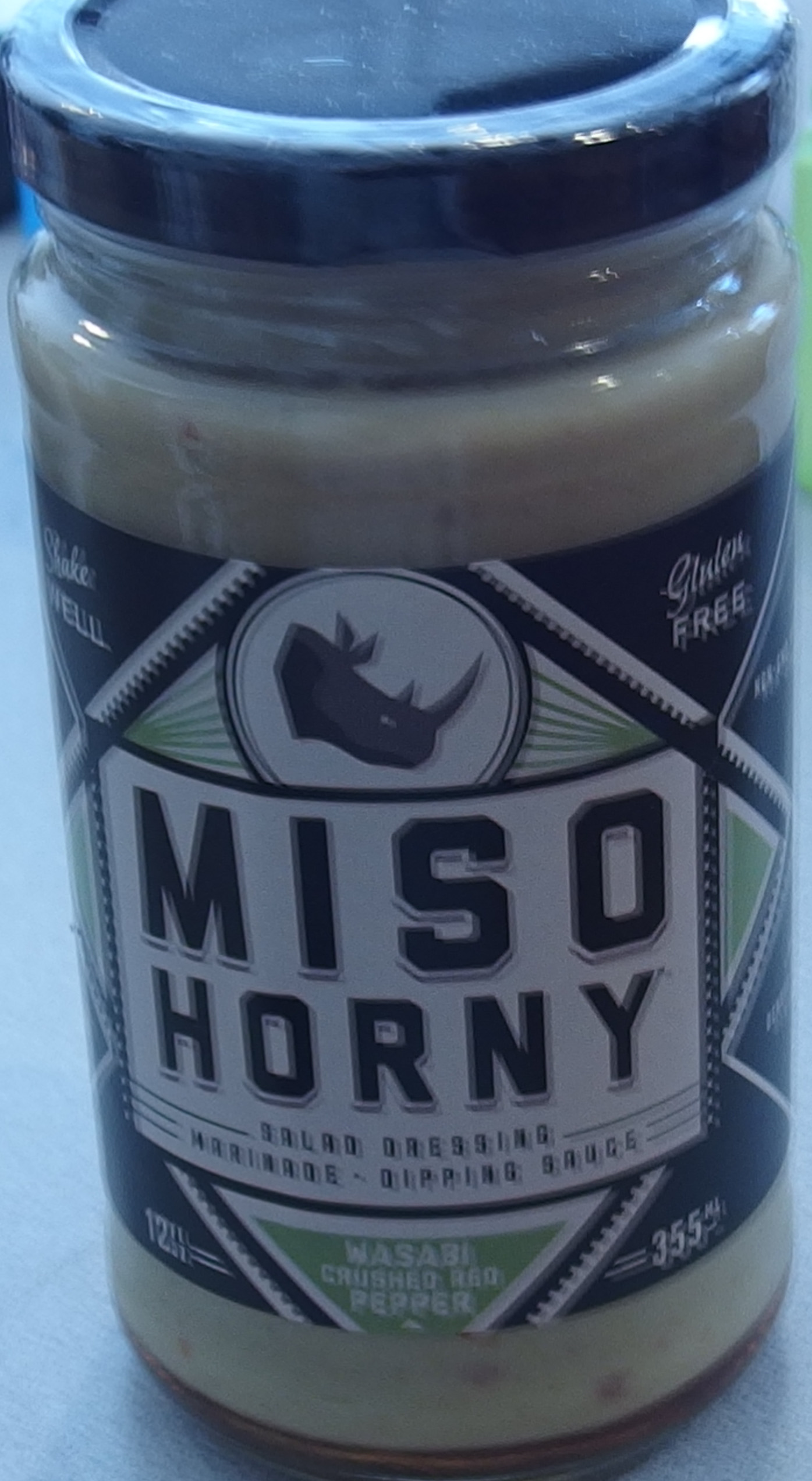
When dudebros hit the farmer’s market.

Image: Jar with label "Miso Horny."

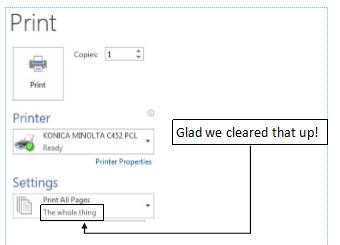
Two from the “glad we cleared that up” department, starting with the helpful MS Word gnomes:

Image:  snip from MS Word's print menu including an icon of a printer, and a box called "Setting" which says "Print all pages" and below that, "The whole thing."  Off to the side, I have inserted a text box with an arrow saying "Glad we cleared that up!"

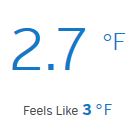
and Weather Underground:

Image:  snip from a weather app, that says 2.7 degrees F; feels like 3 degrees F.

I saw a link in Lifehacker to a logo generator, withoomph.com and thought I’d give it a try for CREEC.  Our full name is too long, so I typed in the abbreviation and the description “civil rights non-profit.”  I wonder what they think we’re up to?   But it is sort of badass!

Image:  the word "CREEC" with a pair of rifles cross above it.

The next two are Signs You Know You’re Not Inside The Beltway Anymore, Toto.  From the National Western Complex where the DeafNation expo took place this year:

Image:  Sign affixed to a cinderblock wall that reads, "WARNING  Under Colorado law, an equine professional is not liable for an injury to or the death of a participant in equine activities resulting from the inherent risks of equine activities pursuant to Section 13-21-119 Colorado Revised Statutes. "

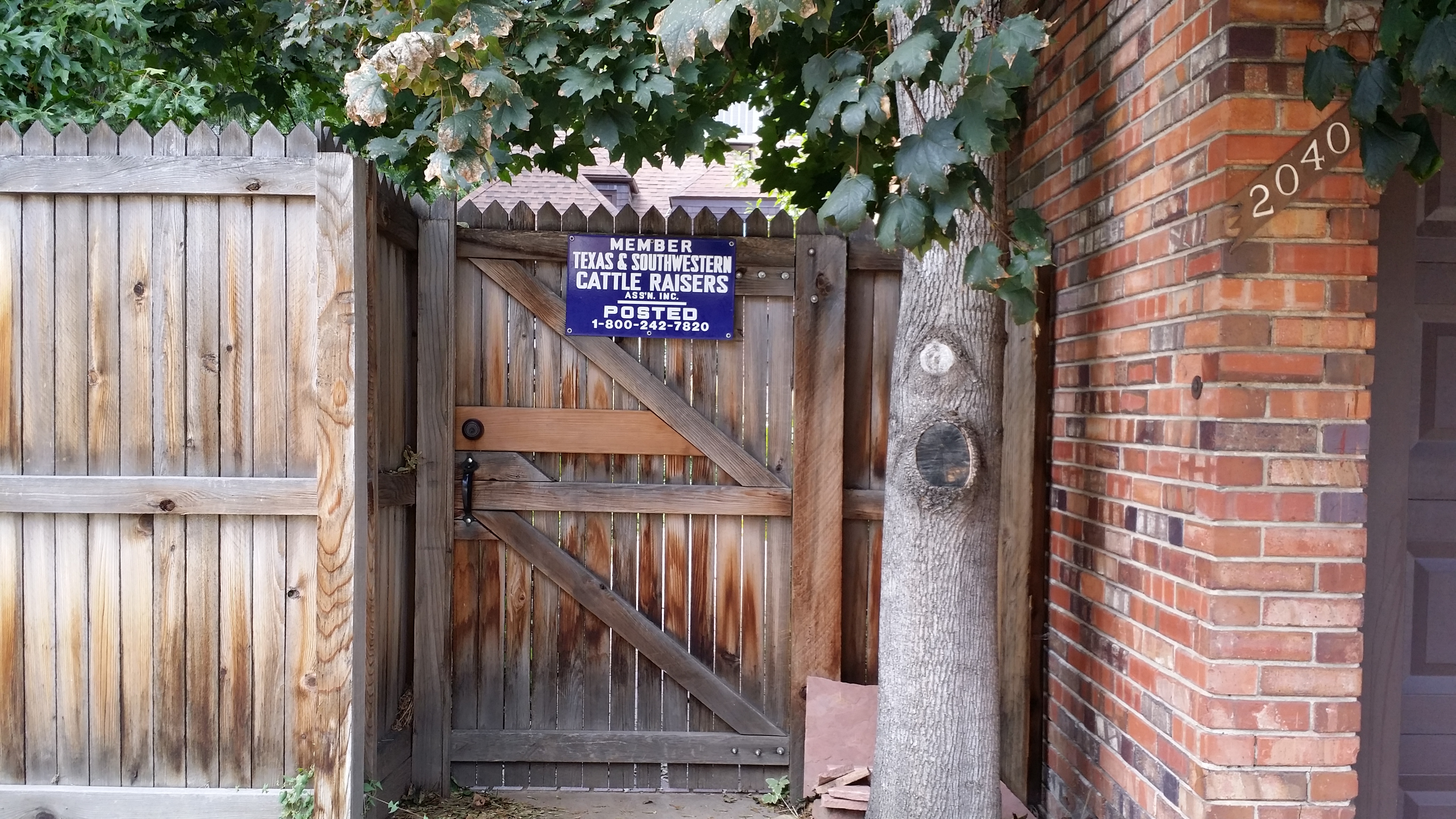
This one is posted along the alley a block south of our house, in residential Denver.  But you just never know when you’ll need a cattle raiser, and now I know where to find one!

Image:  Wooden fence with a sign reading "Member Texas & Southwestern Cattle Raisers Ass'n Inc.  POSTED.

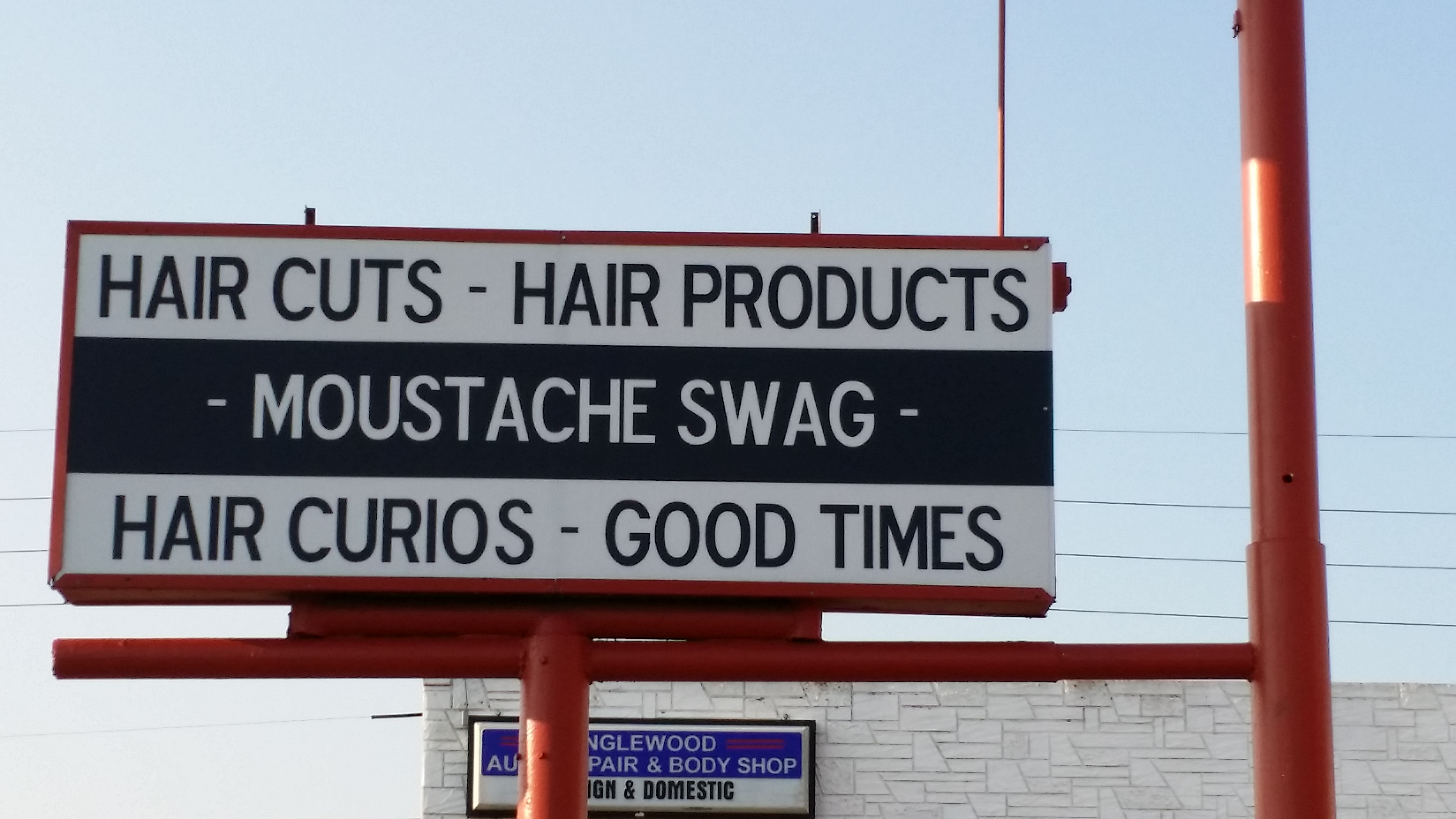
I have no clue what moustache swag is but I have no doubt it can lead to good times!

Image: large commercial sign reading "hair cuts.  hair products.  moustache swag. hair curios. good times."

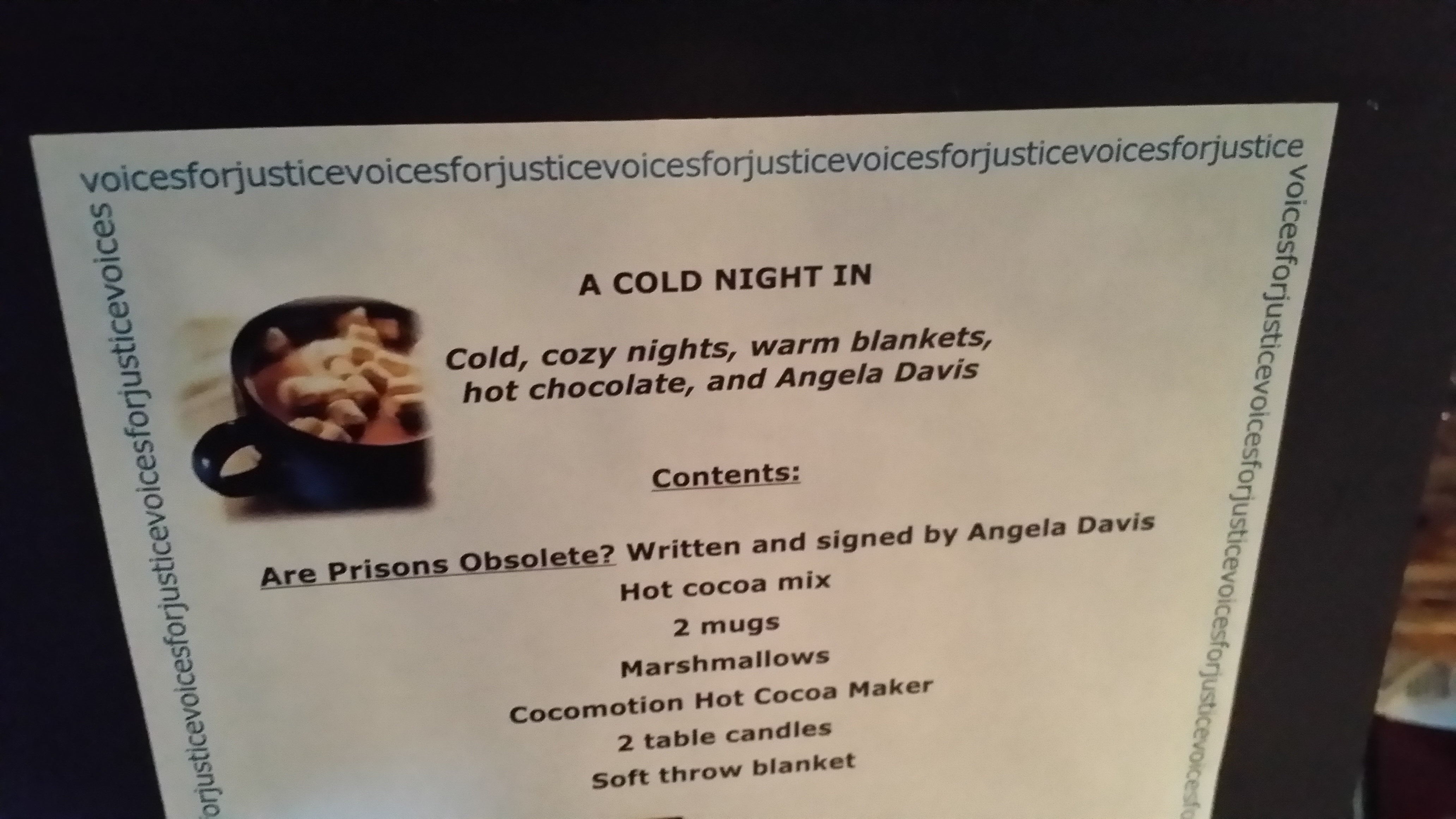
From the silent auction of a local criminal justice reform non-profit. Very cozy!

Image:  photo of a sign reading, "A cold night in:  Cold, cozy nights, warm blankets, hot chocolate, and Angela Davis.  Contents:  "Are Prisons Obsolete?" written and signed by Angela Davis; hot cocoa mix; 2 mugs; marshmallows; cocomotion hot cocoa maker; 2 table candles; soft throw blanket.

Next, a couple of law nerd items.  Who knew there was a reference book for zingers . . .

Image:  Advertisement for a law book with the tag line, "Need a Zinger for Court?"  The book is called  "Uncle Anthony's Unabridged Analogies."

. . . and that standing could be as simple as buying the right clothes:

Image:  A man and a woman in a clothing ad with the legend, Kenneth Cole:  Improve your Standing.  Shop our modern clothing, shoes and accessories.

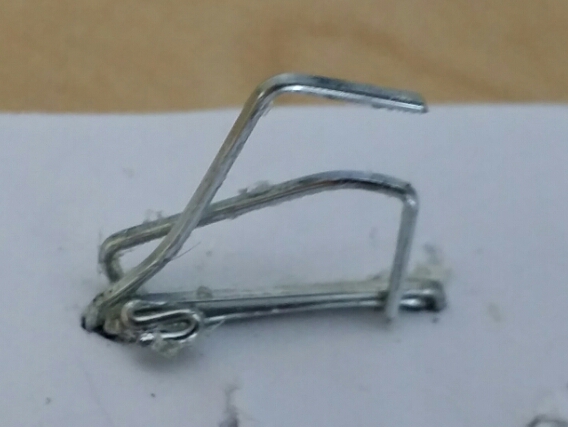
Finally, I have very very bad stapler karma.  Do staplers fail for other people at a rate over 50%?  This was one recent attempt:

Image:  close up photo of 3 or 4 badly mangled staples all attempting to occupy the same staple-space in the corner of a document.

“We were strangers once, too.”

Image:  slighly blurry black & white photo of a group of 6 people.  In back, a young woman, two middle aged men and a middle aged woman; in front of them, an older woman, and in front of her, a child of about 10.

My Jewish grandmother, Edith Spivack, was born in Kiev, Ukraine in 1904 or 1905.  The family immigrated to the U.S. when she was young, and her remaining four siblings were all born in America.  She’s not in this photo, but her father (my great-grandfather), Zacharias, is the second from the right in the back row, and next to him is his sister, Fanny.  The older woman in the middle is Zacharias’s mother, my great-great-grandmother.

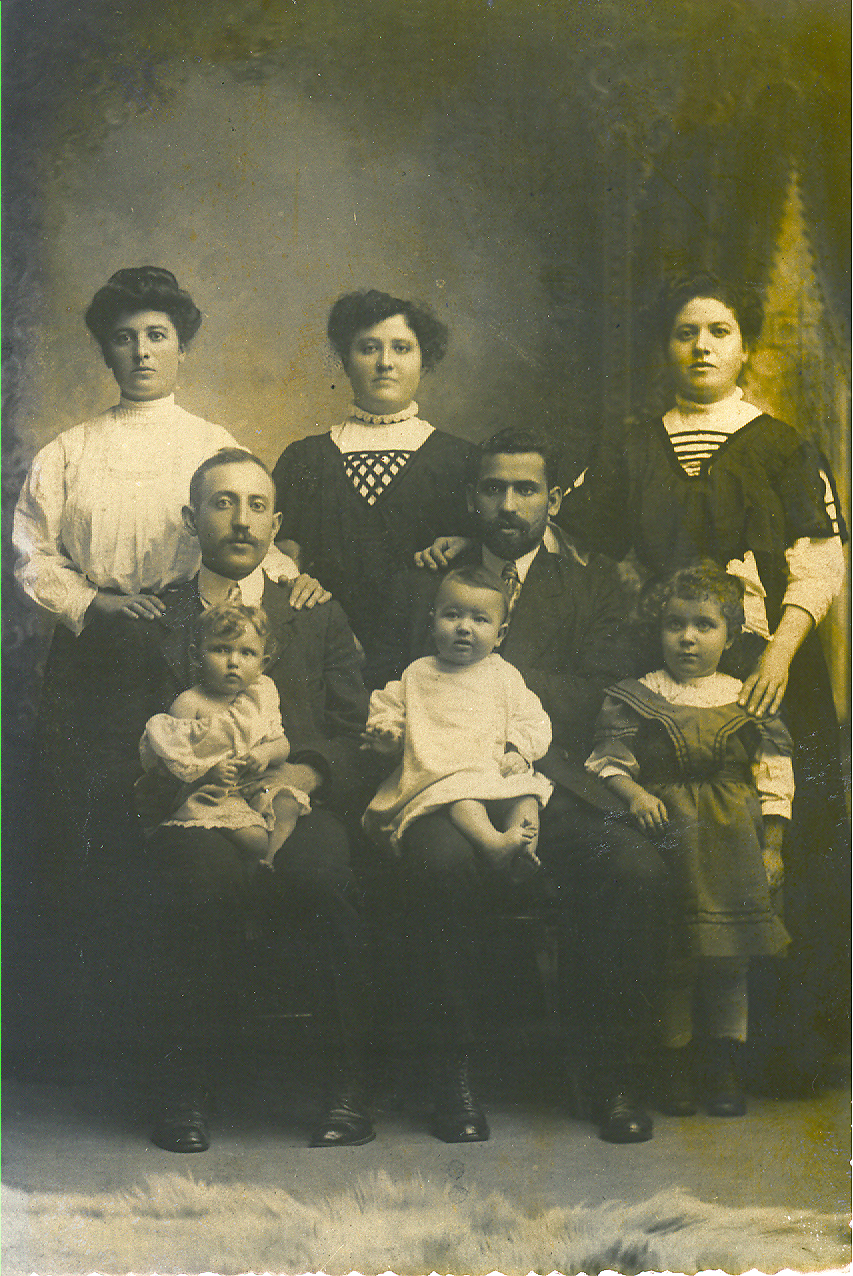
Update:  My mother just sent this excellent old-world photo, though by dint of the cast of characters, taken in the U.S. in about 1907 or 1908.  (Thanks, Mom!)

Image: sepia (brown and white) photo of eight people in formal dress of the early part of the 20th Century.  In the back row, three women (standing) in high-collared blouses, all apparently in their 20's or 30's; in the middle row, two men (sitting) wearing suits; the one on the left has a moustache; the one on the right has a full but neat beard.  In the front row, three children.  Two toddlers sit on the men's knees.  One perhaps 4-year-old stands on the right, with one of the women's hands on her shoulder.

From my mother’s description, with my commentary:  Back row:  Rachel (Toporovskaya) Palkin; Ida Toporvskaya (apparently  not yet married when this photo was taken); Fanny (Toporovskaya) Spivack [my great-grandmother].  Middle row:  ? Palkin (Rachel’s husband); Samuel Spivack [Fanny’s husband; my great-grandfather; Zacharias from the photo above — Samuel was the English name he selected].  Front row:  Palkin child; [my great-uncle] Max Spivack (on Samuel’s lap); [my grandmother] Edith Spivack (later Blau; standing, her mother’s hand is on her shoulder).  Rachel, Ida, and Fanny were sisters.

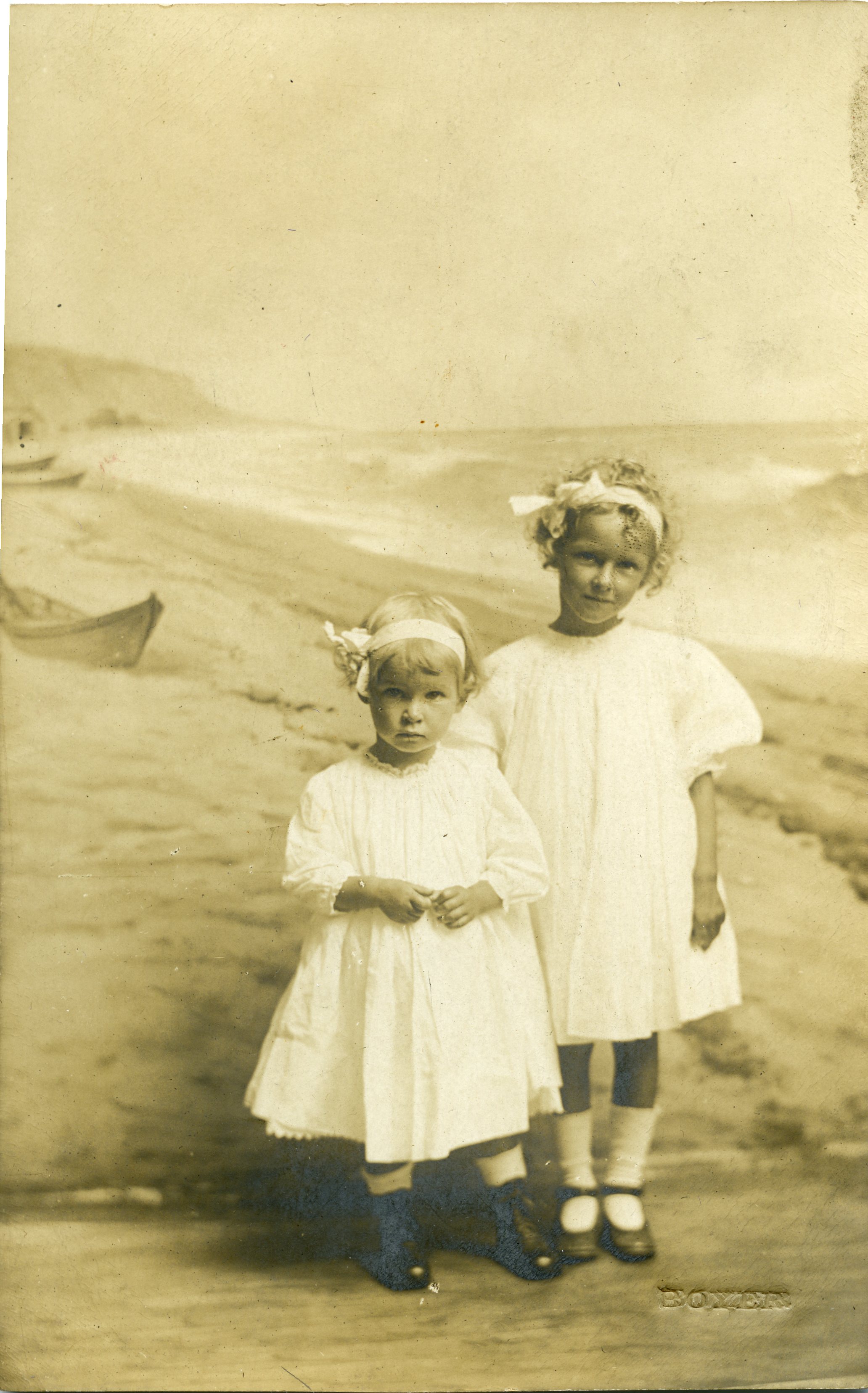
On the Protestant side, you have to go back a couple more generations:  my great-great-great-grandfather was born in Colne, England.  I have fuzzy memories of my father — an enthusiastic if not terribly well-organized genealogist — telling me that that he or another early family member essentially absconded from England with a patent that he did not, technically, own to start a manufacturing business in Massachusetts.

Update:  My Protestant peeps deserve a photo, too, right?

Image:  sepia photo of two young blond girls in white dresses with white ribbons in their hair, standing in front of a painting or backdrop of a beach with a rowboat.

My grandmother Helen Farr Smith [Robertson] [Love] and my great-aunt Elizabeth (Betty) Lees Smith [Carey], in 1911.

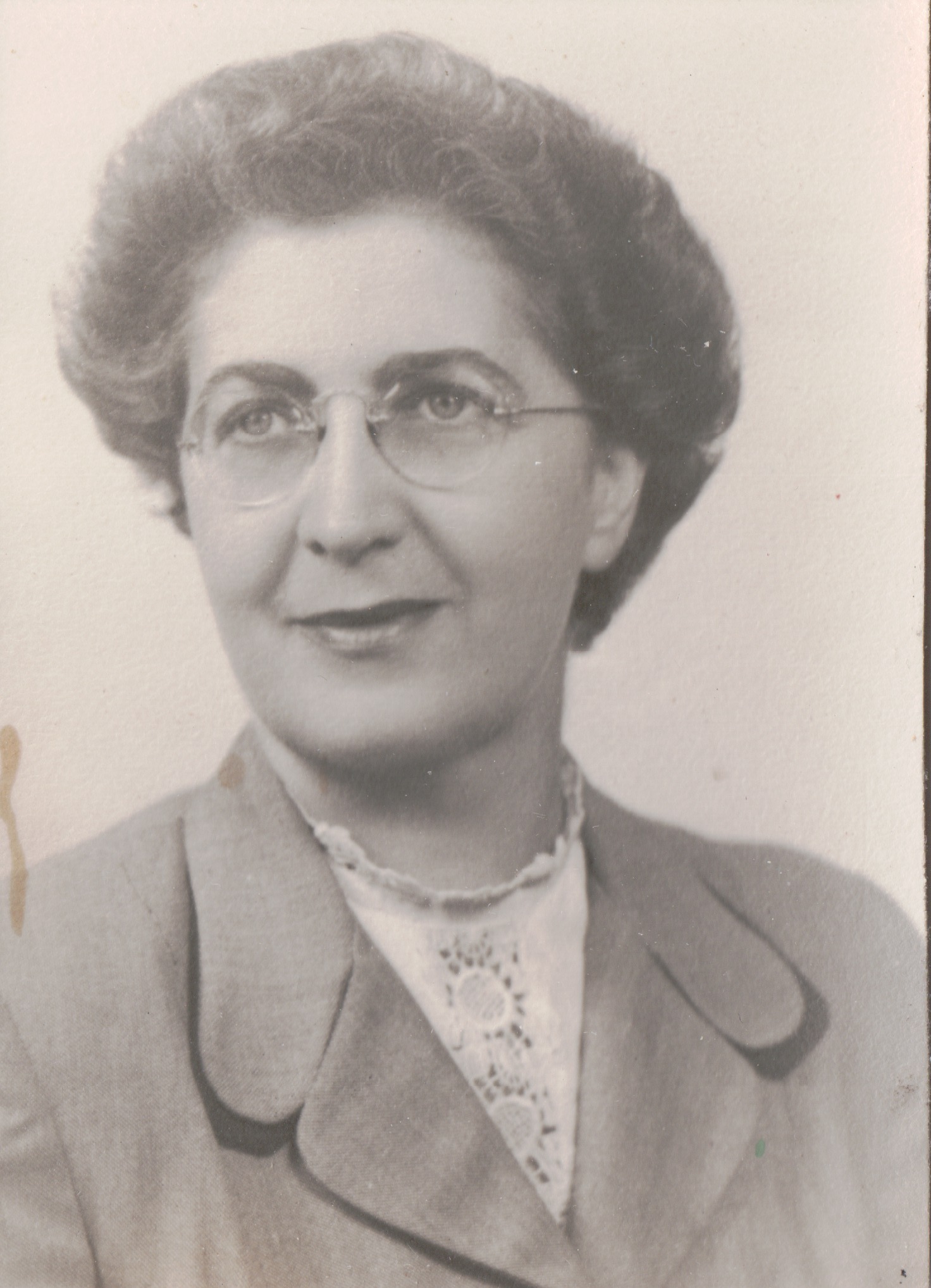
So we were strangers, once, and possibly of that criminal immigrant element you keep hearing about.  And yet here we are, a largely productive and law-abiding bunch.  I am grateful for the country that welcomed these people from such different places.  I’m grateful for the opportunities that allowed my grandmother to go from the shtetl to Radcliffe in the span of a single life.

Image:  black & white photo of a middle-aged woman with short salt & pepper hair and wire-rimmed glasses, wearing a suit jacket and a lace blouse underneath

I’m grateful for the mixing bowl that allowed a Protestant college guy and a Jewish college gal to meet and marry and have the quintessential American mutts that are my brother and me.  I’m grateful that many of us still welcome the strangers from many places, and hopeful that those who don’t will gradually find room in their hearts for their fellow immigrants.*

Scripture tells us that we shall not oppress a stranger, for we know the heart of a stranger – we were strangers once, too.

My fellow Americans, we are and always will be a nation of immigrants. We were strangers once, too. And whether our forebears were strangers who crossed the Atlantic, or the Pacific, or the Rio Grande, we are here only because this country welcomed them in, and taught them that to be an American is about something more than what we look like, or what our last names are, or how we worship. What makes us Americans is our shared commitment to an ideal – that all of us are created equal, and all of us have the chance to make of our lives what we will.

Barack Obama, November 20, 2014.

*************

* Well, most of us.  I realize these heart-warming words need some editing for those whose ancestors crossed the Atlantic in the hold of a slave ship or were already here when our ancestors got here and started waxing eloquent about welcoming each other.  Bottom — un-heart-warming — line:  white people who would close our borders need to stfu.

Come join us for a drink with this lady:


Photo:  [advertising exhibition]  Black & White photo of latina woman in a sleeveless dress, sitting with her elbows on a table, holding a shot glass.  The wall in the background painted with religious art.

We’ve been trying to convince you to come to CREEC’s Inaugural Event with promises of listening to civil rights lawyers talk about civil rights.  That’s how we get our thrills.  But we thought some of you might prefer to hang out with this lady — and many other photos in the current exhibition at Museo de las Americas, the amazing venue for next week’s CREEC event.

From the Museo’s website:

Museo de las Americas in collaboration with The Mexican Cultural Center & Mexican Consulate of Denver announce the Fall exhibit, EL Brindis Remixed. The exhibit features photography from the 19th & 20th century taking a lighthearted . . . look at drinking within the Mexican Culture.

Featured artists include: Manuel Alvarez Bravo, Agustín Víctor Casasola, Gabriela Iturbide, Juan Rulfo, Gabriel Figueroa, Mariana Yampolsky and several other creatives who comprised Frida & Diego’s personal inner circle.

In 2000 the exhibit was on display in Paris for the Millennium Celebration and will be featured for the final time in the United States at Museo this Fall.

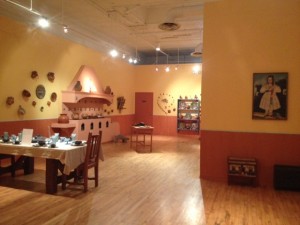
We are very lucky to be able to use this beautiful space — right in the middle of Denver’s Santa Fe Arts District.  Come for the art, stay for the civil rights!   Or vice versa!

Photo of museum space with high ceilings, open rooms and painted warm colors of yellow and orange.  In the foreground, a table.

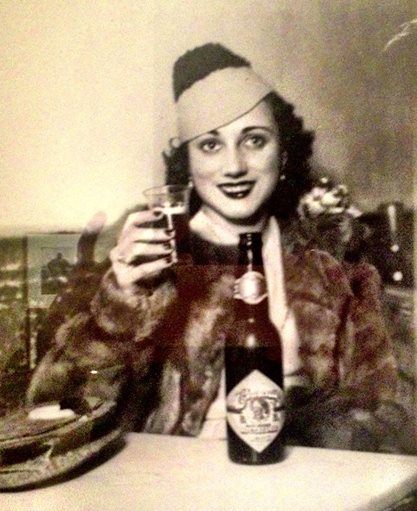
I think she’ll be there, too.

Photo: brown & white photo of well-dressed woman in make-up and a fashionable hat with a bottle in front of her holding up a shot glass.

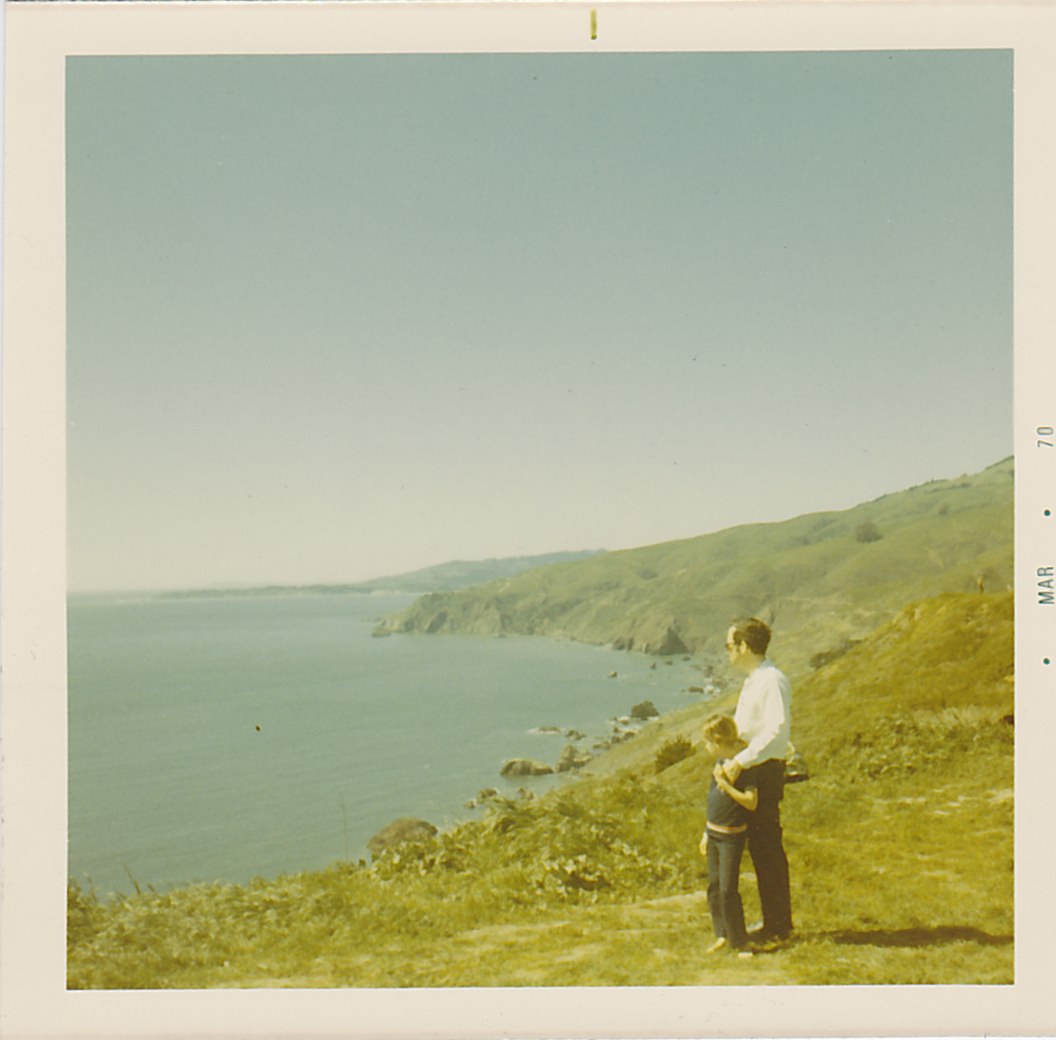
Thinking of my Dad on what would have been his 79th birthday

Photo:  A man and a girl (about 10) stand on the shore facing the water.  The man is in a white shirt and dark pants; the girl is in a blue shirt and pants.  The man has his hand on the girl's shoulder.

Me with my Dad on a family trip to the west coast in 1970ish.