goes virtually unnoticed, however, because white rage doesn’t have to take to the streets and face rubber bullets to be heard. Instead, white rage carries an aura of respectability and has access to the courts, police, legislatures and governors, who cast its efforts as noble, though they are actually driven by the most ignoble motivations.
These are the dying gasps of a worldview that is fading, and will fade faster as more old farts who hold these views die off and younger generations are raised in a multiracial world where they and/or many of their friends and family have two mommies or two daddies. It doesn’t mean we can be anything but vigilant in the face of these last-ditch efforts, but it does give me confidence that
The arc of the moral universe is long, but it bends toward justice.
We attended the funeral of a friend who passed earlier this month. She was a wonderful, righteous, generous, sweet person, teacher, and friend. The funeral was a Catholic mass, probably the third mass I’ve ever attended — including the invite-a-Jewish-friend mass I attended with a friend when I was about 11 — so I was even more unfamiliar with the ritual than I am in a slightly closer-to-home reform synagogue or Episcopalian service. But the lack of familiarity combined with the emotion of the occasion pulled me out of my own head, where I spend way too much time, and hit me with a 2×4 of wisdom.
It came in the form of the Beatitudes, which the priest recited because they were so very fitting for Liz Feldman — long a teacher and activist. They really struck me, especially the final passage:
Blessed are they which are persecuted for righteousness’ sake: for theirs is the kingdom of heaven.
Blessed are ye, when men shall revile you, and persecute you, and shall say all manner of evil against you falsely, for my sake.
Rejoice, and be exceeding glad: for great is your reward in heaven: for so persecuted they the prophets which were before you.
Matthew 5:10-12.
It seems to me that Jesus was telling his followers that they would go forth and preach the word they believed in and would take a great deal of crap for it, but should have the faith to see beyond the crap, and realize that perhaps even because they had to take a lot of crap, they were righteous, and their reward was elsewhere than in the arena in which crap was being dished out.* We take a fair amount of crap as plaintiffs’ lawyers, and I know and work with people who represent clients on the far margins of society, and take great deal more crap for it. But when we are most reviled, and hear all manner of false, evil crap, it is likely just then that we are most true to our righteous course.
We’ll miss you, Liz.
*******
* Possible that religious scholars would not phrase it precisely this way.
I’ve been trying, through hypotheticals, to explain some of my frustration with the Hobby Lobby decision. Luckily today’s WestClip brought a real-life example from D. Colo.
Hobby Lobby meet Jah Frederick Nathaniel Mason, III.
The Hobby Lobby decision is frustrating primarily for magically turning legally-fictitious corporations into people of faith. But it was truly specious for another reason, as well: it was based on religious beliefs that were based, in turn, entirely on scientific fallacy.
Hobby Lobby’s objection to contraception is that some contraception is really abortion which contravened the religious beliefs of their executives.
[T]he company’s mission, as they see it, is to “operate in a professional environment founded upon the highest ethical, moral, and Christian principles.” The company’s “Vision and Values Statements” affirms that [the company] endeavors to “ensur[e] a reasonable profit in [a] manner that reflects [the executives’] Christian heritage.” It is therefore “against [their] moral conviction to be involved in the termination of human life” after conception, which they believe is a “sin against God to which they are held accountable.” The [executives] have accordingly excluded from the group-health-insurance plan they offer to their employees certain contraceptive methods that they consider to be abortifacients.
…
[They object to the ACA because] it requires them to provide health-insurance coverage for four FDA-approved contraceptives that may operate after the fertilization of an egg.These include two forms of emergency contraception commonly called “morning after” pills and two types of intrauterine devices.
Burwell v. Hobby Lobby Stores, Inc., 134 S. Ct. 2751, 2764-65 (2014) (internal citations omitted). The problem with this is — whatever their faith* — they got the science wrong. The measures that the ACA covers — and that the executives fear — are not, in fact, abortifacients. As an L.A. Times article summarizes — quoting the American College of Obstetricians and Gynecologists — neither IUDs nor “morning after pills” cause abortions.
So the “beliefs” of a legal fiction (the corporate entity) based on a scientific fallacy entitled the company to opt out of a law of general application.
OK, then. Let’s see how this works in practice for a real live human being with religious beliefs he is seeking to enforce in court. Take it away, Jah Frederick Nathaniel Mason, III:
Mr. Mason asserts nine claims based on his belief that the use of satanic imagery on the seals of government justifies his driving without a license because the seal on Colorado drivers’ licenses displays satanic images. He also apparently believes that, by following his religious beliefs in not carrying a driver’s license, he should not be charged with traffic offenses as a result.
…
[In addition], [h]e is suing the meter agent for issuing a ticket for a missing front license plate and calling the police, who had his car towed, despite his explanation that he considered himself to be a “religious sovereign and had conscientious objections to the image of mountains on the Colorado plates as they violate God’s commands.”
Mason v. Clear Creek Cnty. Sheriff, 2014 WL 4099326, at *2, *5 (D. Colo. Aug. 20, 2014). Sounds reasonable. Just about as scientific as the Hobby Lobby execs’ beliefs, and what’s the big deal of one guy driving without a license or license plate. Not even close to the burden on society of permitting a corporation to exclude coverage of an entire set of benefits for its entire female workforce.
Predictably, Mr. Mason did not fare as well as Hobby Lobby:
Plaintiff cannot argue there is no legitimate governmental interest in requiring license plates on cars. Mr. Mason’s religious beliefs—whatever they may be—do not excuse him from complying with the State’s requirement that he display license plates attached to his car. See Colo.Rev.Stat. § 42–3–202(1)(a) (license plates to be attached to the front and rear of a vehicle); see also Colo.Rev.Stat. § 42–1–101 (licenses for drivers required). The requirement for attached license plates is valid and neutral—all Colorado drivers are required to have license plates on their cars. . . . Mr. Mason’s claims asserted against the unnamed Denver parking management meter agent will be dismissed as legally frivolous.
Mason, 2014 WL 4099326, at *5. He not only loses a case at least as well-grounded in religion and reality as Hobby Lobby, his case is deemed frivolous.
Given that the Supreme Court had already decided that individuals did not have the right to smoke peyote** or opt out of the social security system*** based on sincerely held religious beliefs, the sad take-away from Hobby Lobby is that legally-fictitious corporations in fact have greater rights of religious freedom that individual believers.
Welcome to the Roberts Court!
*********
* Many have pointed out that, at the same time that Hobby Lobby was touting its Christian business principles in refusing to participate in a broad health insurance program that, based on the private decisions of insureds and their doctors, may result in use of contraception that Hobby Lobby believes to be — but in point of scientific fact is not — abortion, it is engaging in a wide variety of un-Christian business activities, including investing in companies that produce the type of contraceptive devices that it refuses to cover and purchasing massive quantities of cheap crap from China, which not only supports fairly un-Christian labor practices, but actively encourages actual — rather than imagined — abortion. This would be like an inmate insisting on a kosher diet while ordering sliced ham from the commissary.
I personally believe in Jesus Christ as my lord savior, but I’m also a killer. I’ve killed a lot. And if I need to, I’ll kill a whole bunch more. … If you don’t want to get killed, don’t show up in front of me, it’s that simple. I have no problem with it. God did not raise me to be a coward.
This guy is a cop, and a member of the “Oath Keepers, the right-wing law enforcement group that is aligned with the Patriot movement.” A quick (and slightly toxic) visit to their website reveals that “Oath Keepers” are a collection of police and military types who believe their “oath” to their interpretation of the constitution gives them the right to do things like not do their jobs and shoot random people who do not share their interpretation of the constitution.*
They have a list of orders they will not obey, including executing warrantless searches (good), disarming Americans (potentially bad, if the armed American is threatening to kill someone), and wildly paranoid:
We will NOT obey orders to invade and subjugate any state that asserts its sovereignty and declares the national government to be in violation of the compact by which that state entered the Union.
…
We will NOT obey any order to blockade American cities, thus turning them into giant concentration camps.
Whew! Glad we cleared that up. And good to know that when Texas finally secedes, no one will try to stop them. Buh byeeeeee!
I do appreciate that this group is a big fan of Edward Snowden. So they exist in that special place where the extreme right and extreme left of the political spectrum meet up in shared paranoia and megalomania.
I guess we’ve always known that certain subsets of law enforcement view themselves as creating, interpreting, and executing the law; it’s more than a bit frightening to think those cops have a self-aggrandizing club where they can encourage and reward each other for doing so.
*********
* Based on their logo, this may or may not be caused by the emotional trauma of having very long but very thin penises:
There is a lot of overlap between the way cops treat African-Americans and the way they treat people with disabilities. And in Denver, that conversation blurs into one about the Denver Sheriff Department’s violence and incompetence. There are times that call for conversations about overlap and blurring and intersectionality, and there are times we need to FOCUS. Right now, we need a bit of focus on a specific problem: the mortal danger of being an African-American — specifically, a young, male African-American — in any action with the cops.
Often discussions of derailing can sound like shutting down. That’s why I like the way Anita puts it:
So just the other day, I was lecturing radical feminists never to question anyone’s identity as a woman, even if she was born with guy parts. In that post, I posed what I thought was a rhetorical question.
Could a white person declare himself black in the same way a person born with female parts can declare himself to be male? Can I decide to be disabled without actually having a physical or mental impairment that substantially limits one or more major life activities?
If I should have learned anything in 53 years, it’s that there are no questions rhetorical enough that someone somewhere won’t answer, “yeah — that’s me.”
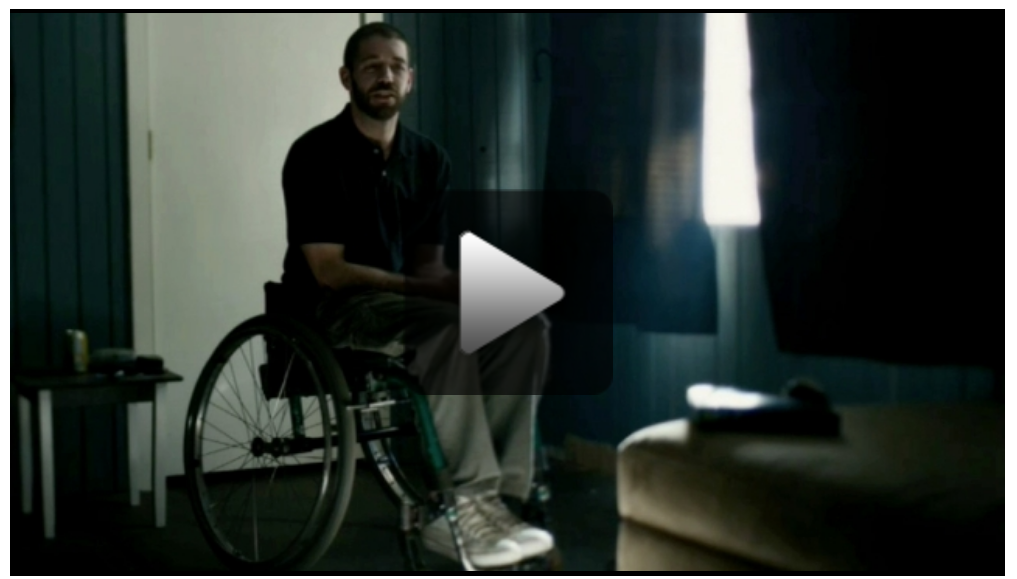
Meet Chris. He is not a person with disabilities, but nonetheless identifies as one and sits in a wheelchair whenever he can without giving his secret away to the people that know him. On last night’s episode of Showtime’s documentary series 7 Deadly Sins (this week’s sin: envy), Chris shared his story.
“I identify as a guy in a wheelchair,” he said. “I feel like I have the wrong body. I feel like I’m supposed to be disabled. What I want my life to be like is what is the detriment of a lot of people’s lives, the worst thing that’s ever happened to them, and I think it would be the best thing that ever happened to me.”
I feel fairly strongly that this is wrong, just as a white person declaring himself to be black or have a black identity is wrong. I’m just having a hard time articulating a principled reason why.
I support the rights of trans men and trans women to be the ones to tell us what gender they are, rather than having that be dictated by the body parts they were born with or what society thinks they should be. And I have no problem if a person of one religion converts to another, and adopts a new identity wholesale.
Then there are those (Obama; me) born into two identities (black/white; Jewish/Protestant) who essentially get to choose — one; the other; or both — which choice is generally respected.
Yet we clearly have a set of negative judgments for people of a privileged status (white; nondisabled) adopting and asserting an identity as a less-privileged status (black; disabled) and a different set of negative judgments for the reverse (a black person deciding to identify as white; a disabled person identifying as nondisabled). In the first situation, we use words like “wannabes” or “appropriation” or — in an article in New Mobility — “pretenders;” in the latter, “oreos,” “bananas,” or “passing.”
So, uncharacteristically, I don’t have an answer, or even a working hypothesis. Why is it OK for a person born with male parts to identify as a woman, for a Christian to convert to Judaism, or for a person born in a mixed marriage to choose either identity or both, but not for Chris to identify as a person with a disability?
When I saw Mighty Girl’s post on Rosie’s Girls summer camp, “a trades exploration day camp for school girls” where girls can learn welding, carpentry, auto repair, etc., I was moved to comment (on Facebook) that I wish this had been an option for me instead of figure skating camp. I thought I’d expound.
Yes, figure skating camp. But first, I got to spend a summer attending the Flint Hill Day Camp, where (IIRC) we spent up to six hours each day making plastic lanyards. I’m confident that there must have been other activities, but that’s the only one I recall. I loved it just as much as you would expect a nerdy introvert to love engaging in six hours a day of non-book-oriented activities with random unfamiliar kids.
By the time I was 12, I was launched on my figure skating career, which was ultimately as successful as you would expect for a klutzy nerdy introvert, but did provide good money-making opportunities in college, teaching private lessons to local kids. But back to skating camp. In 1973, there was no year-round ice rink in the DC area, and the Skating Club of Wilmington ran a summer program for skaters of a wide range of abilities, from Olympic trainees to klutzy kids from locations without year-round rinks. So off I went.
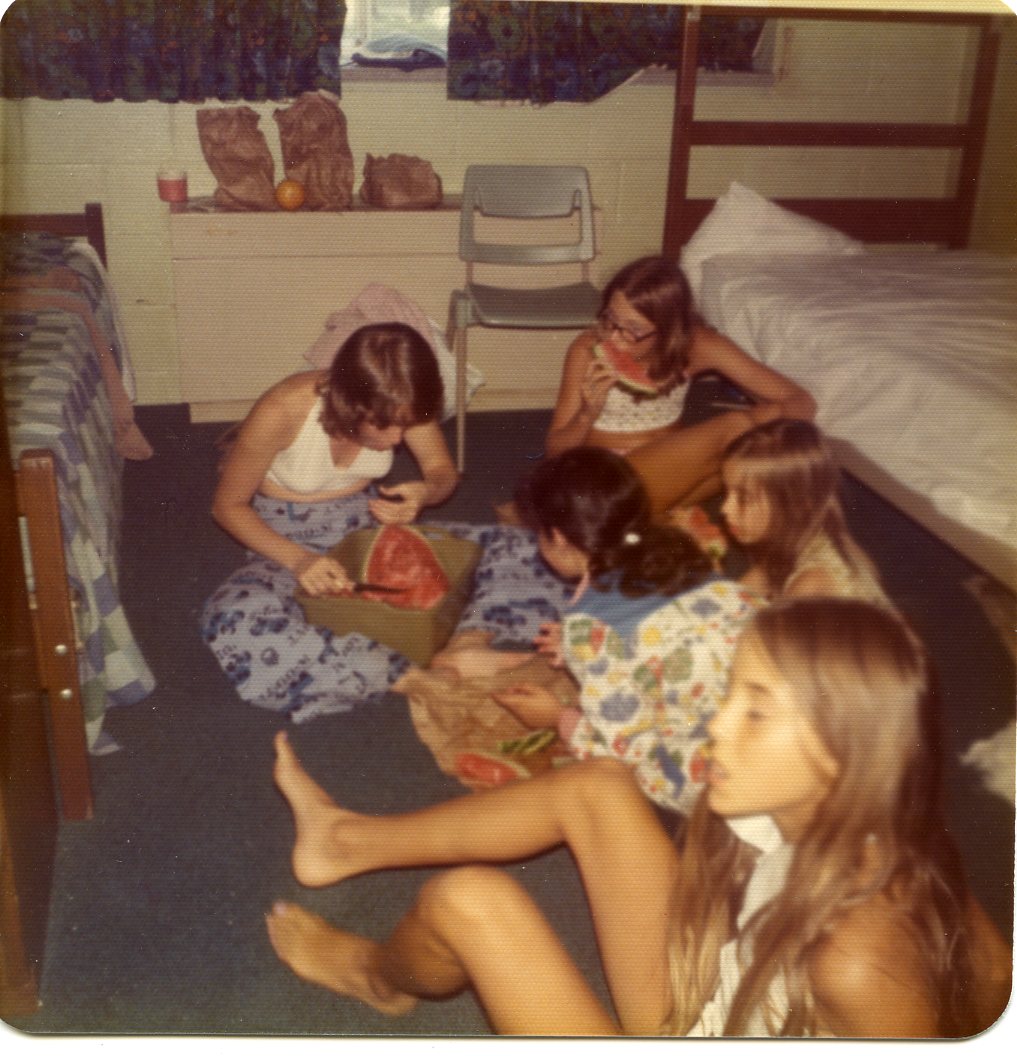
Activities consisted of skating, hanging around the skating rink, and hanging around the dorm. When I think of the sort of enrichment and structure that my friends expect from their kids’ camps these days, I don’t think they envision the sort of enrichment and structure the Wilmington summer skating program dorm provided:
The back of the photo reads, “Laurie and Dr. John.” So, yes, one of my dorm-mates — already much older than me — had a much older, beer-drinking boyfriend who had dubbed himself “Dr. John.”
What’s amazing is that — at 12 — I wasn’t even the youngest kid living parentless in this enriching environment.
More of my hall-mates.
The back of that photo reads, “Laurie, Jill Cosgrove, Carrie Applegate, Amy Keilly, Bruno, Patti Downst.” Through the miracle of Google, I learn that Jill Cosgrove went on to have a successful career as a figure skater and choreographer. Couldn’t find the others.
Since I was the photographer, there are — sadly — no photos of me. Wait, what? No. That’s not me. No way. Seriously?
I also found this one, of me with my coach, Uschi Keszler, whom I totally idolized and who turns out — who knew?* — to be minorly famous herself, complete with Wikipedia page.
Yes, I’m holding a toy lobster. Deal with it.
I tend not to have very fond memories of the whole skating camp experience. It was my choice — my parents were not stage parents, though God knows the skating world had plenty of those — but in retrospect I’ve come to believe that neither the program nor figure skating in general was a very healthy experience. It was a world that encouraged kid vs. kid (generally girl vs. girl) competition, with no sense of teamwork. We heard rumors of kids ruining each other’s skates or program tapes before big competitions. And, at bottom, I just sucked at it. So wish there had been a Photography and Reading for Introverted Klutzes camp. My peeps!
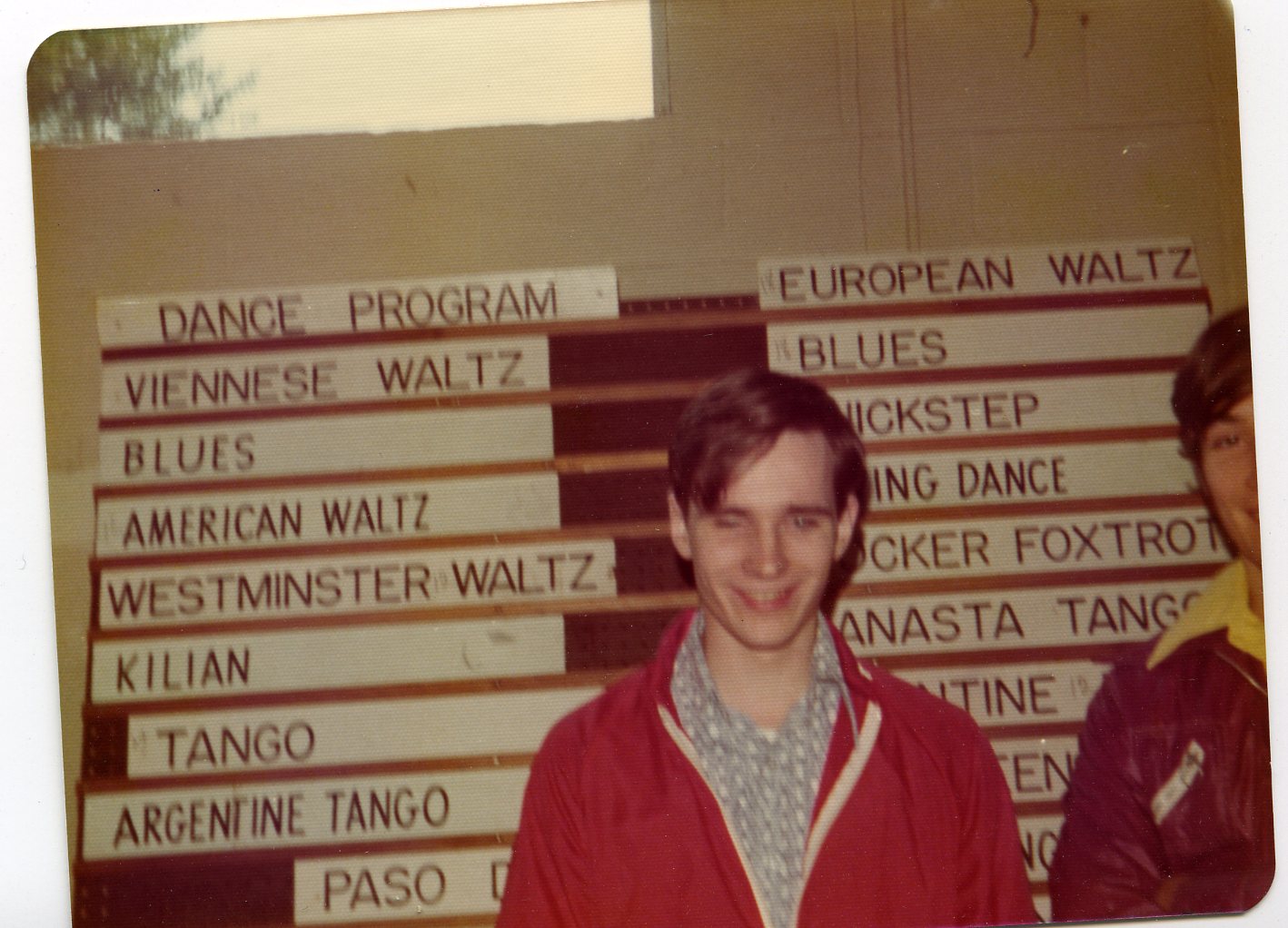
But going back through the photos made me remember a couple of other cool things (besides the early introduction to wardrobe-coordinated beer drinking). Wilmington, in 1973, had a number of blind skaters. One, Stash Serafin, shown here in my 1973 photo,
has (thanks again, Google!) gone on to have a successful skating career.
And finally, in 1973, you could get an entire basket of fries for 35 cents!
********
*Well, I suppose many Germans whom she represented in the Olympics knew, but I was stunningly unaware of who she was. In retrospect, I can only imagine her thinking — watching me skate — “I left my homeland for THIS?”
Since the recent attempt to sell the Rockies on Craigslist* and my attempt to convince my brother to undertake a humanitarian venture capital mission to purchase the team have both apparently failed, I’m forced to put my fandom up for adoption.
My ad:
Born a Washington Senators fan. Orphaned in 1971. Short foster team relationships with the Baltimore Orioles, Richmond Braves, and Minnesota Twins. Genetic fandom of St. Louis Cardinals. Adopted by the Colorado Rockies in 1995. Abandoned in 2014.
Can explain the infield fly rule, but cannot tell one pitch from another. Willing to bring ancient baseball mitt to games. Prefers high-scoring home-run-intense games to pitchers’ duels. Needs playing field with good views and decent beer. Will not do “the wave.” Will check scores on CBS Sports app during dinner when result actually matters. Prefers team with owner who gives a shit, preferably two, and sufficient front-office talent to spell players’ names correctly. Willing to wear team colors, paint toenails to match. Currently in possession of and routinely wears Elway jersey and old-logo Broncos sweatshirt. Not afraid of face paint for playoffs.
In other words, loyal to team that earns it.
Please contact the Fan Adoption Agency to set up a homestudy.


















 Thought Snax