Hiking in Frisco

After a long week preparing for a [successful] hearing, Tim and I took off for a hike in the mountains.  Love all the Vehicles Sharing Path:

Paved hiking path with woods on either side.  Yellow road sign on the right side of the path reads "Vehicles Sharing Path."  On the path, photographed from behind, are a number of cyclists and a man driving a power wheelchair with a Golden Retriever walking to his left.

{Image description:  Paved hiking path with woods on either side.  Yellow road sign on the right side of the path reads “Vehicles Sharing Path.”  On the path, photographed from behind, are a number of cyclists and a man driving a power wheelchair with a Golden Retriever walking to his left.}

Had a beautiful, relaxing hike of at least [redacted number] [redacted unit of distance measurement].  Saguaro got about twice that, jogging alongside Tim’s chair as he and Tim shot ahead and doubled back for their slower, unwheeled, bipedal hiking companion.  By the end, Saguaro was a pooped puppy; I couldn’t tell whether he was chilling in the shade or expressing a preference for a cooler vehicle than the minivan he arrived in.

White pick-up truck with a Golden Retriever lying on the pavement in its shadow, panting.

{Image description:  White pick-up truck with a Golden Retriever lying on the pavement in its shadow, panting.}

The hike was followed by lunch at Empire Burger — with hand-cut fries and a huge menu of dipping sauces — and a milkshake from Cold Stone.

Ahhhhhhhhh.

Random signs

Drove to Fountain, Colorado, today.  I promise both of these signs are real.

Um, no:

{Image description:  Church sign reading “Reason Is The Enemy of Faith.”}

And, um, I’d never really thought about it but yes:

{Image description:  Green street sign against a blue sky, reading “A Dog Will Lick His Butt But Won’t Eat A Pickle Rd.”}

Good thing they’re pro-life in Texas

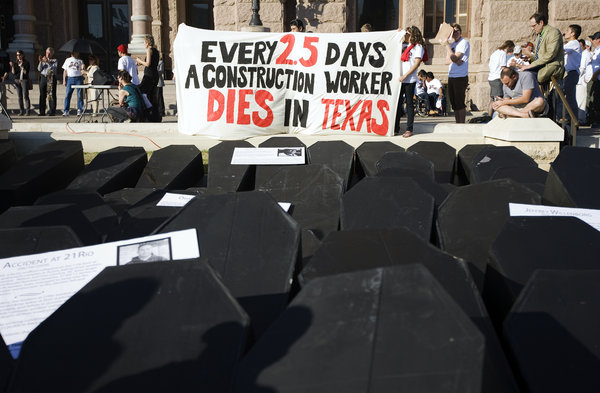
Every 2.5 Days A Construction Worker Dies in Texas

Every 2.5 Days A Construction Worker Dies in Texas

{Image description:  Photo of a large banner displayed in front of a (government?) building.  The banner reads “Every 2.5 Days A Construction Worker Dies in Texas.”  The foreground of the photo is entirely occupied by black coffins.}

Photo from the New York Times, 8/11/13

Go Bureaucrats!

As I’ve previously blogged, I’m not a big fan of the racist name of Washington’s football team.  I’m pleased to report that more and more publications are taking this stand and not using the name, including SlateThe New Republic, The Washington City Paper, and Mother Jones.  I’ve also enjoyed some of the suggestions for new names, including Pigskins, Griffins,

Washington’s pro football team” or, if we get sassy, “the Washington [Redacted].”

My favorite, apparently from Huffington Post reporter Arthur Delaney:

This team should be called the Washington Department of Football.  . . . At least two former Skins players were known as secretaries of defense, including Dexter Manley and David Deacon Jones. So clearly, this is a name that would honor local tradition much better than ‘Redskins’ does.

Go Bureaucrats!*

*****************

* Defined, my Dad always said, as a Democrat who has a job a Republican wants.

The ramps of Route 1

[Cross-posted at CREECblog.]

Every summer or so, we visit my brother and his family at their place in Maine.  To do this, we generally fly into Boston and then drive the four hours from Logan to mid-coast Maine.  The first three hours are on I-95; the last hour or so on Route 1 from Brunswick to Thomaston.  It has long struck me, as we meander up the barely two-lane road — often at 30 mph behind a giant RV or tractor — the amazing number of very small businesses that have ramps.

This past weekend I made the trip with no deadline and no one else in the car, so I had the time* to take some photos of these examples of readily-achievableness. (Ready achievability?)**

Disclaimer, because every now and again some defense-side attorney (hi, guys!) may read this:  I did not evaluate these ramps for compliance with the Standards.  I don’t know their dimensions or slope.  If you try to introduce this as evidence in one of my cases, I will file a Motion for Judicial Notice of Completely Missing the Point.

The first couple were actually near Manchester, NH, where I had taken a detour to visit a college classmate.

Small free-standing store with parking lot.  Store has steps in front and a ramp up the side starting from the back of the store and rising to the middle of the right hand side.
These next two are churches, which aren’t even covered by the ADA (unless they have some sort of commercial business on the side):

Front view of white building with three steps at the front entrance (in the middle of the front of the building) and a ramp extending from the entrance along the front to the left side of the building.  Ramp has a sign that reads, "Christ Died for Our Sins."


Photo of beige church building with the words "Saint Peter" on the front and a ramp curving around to the right side of the building.


Onward to Rte 1:

One story building with front porch accessible by a short ramp in front of the building.

This actually might have been someone’s house.  Along Route 1, the distinction between house and business is often sort of vague.

Gabled grey house with wooden ramp extending from the front door and curling around to the right in the front yard.  The base of the ramp is white lattice work and flowers grow along the front of the base.

Just north of Wiscasset.

Small free-standing red building with a ramp extending from the middle of the front off to the right.

Jean Kigel Studio, Damariscotta.

One-story building viewed from the side where a ramp provides access up onto the porch.

Cheap cigarettes in Waldoboro.

One-store store with a sign in the front reading "Cheap Cigarettes."  The front door is served by a short apparently level ramp with a slighly sloped portion at the end.

Somewhere south of Thomaston.

House or business with approximately five steps to the front door and a ramp to a side door on the left.

The Hair Loft, Warren, Maine.

One-story building with a sign reading "Hair Loft."  The front entrance is on the left side of the photo, served by approximately six steps.  The door is also served by a ramp from the door leading to the right of the photo.

Unidentified business, Warren:

Front of a two-story house or business with a wide metal ramp leading to the front entrance.

The famous Moody’s Diner, Waldoboro:

White building with neon sign reading "Moody's Diner" on the roof.  A ramp is positioned along the left side of the building leading up to the entrance in the middle.

Ralph’s Homes, Waldoboro:

Freestanding white building with a long switch-back ramp serving the front entrance, which is up approximately six steps.

Random business south of Waldoboro:

Red building with approximately 3 steps to a porch serving the front entrance.  A ramp serves the porch as well.

The Nobleboro Antique Exchange:

Blue two-story building with a switch back ramp serving the porch and front entrance.  Sign in front of the building reads "Nobleboro Antique Exchange."

So next time you hear some fancy store or chain claim that it’s not readily achievable to ramp their business, here are some examples to, in legal terminology, call baloney.***

*****************

* My leisurely pace turned out to have been a good plan for another reason:  when I got to my brother’s house, he and his family were out and their house was guarded by their snarling goldendoodle.  Seriously.  This dog

Benign-looking light brown dog, sized somewhere between a poodle and a golden retriever, with a multicolored color, sitting on a lawn looking to the right of the photo.

exiled me to the hammock until my hosts returned to chaperone my canine interaction.

I was not suffering:

Legs and feet of photographer on hammock, sunny Maine seascape in the background.


** Under the ADA, buildings built after January 26, 1993 were required to be accessible.  42 U.S.C. § 12183(a).  Those built before that date and not altered since must remove barriers — by, for example, ramping entrances that are only accessible by steps — where it is “readily achievable” to do so.  42 U.S.C. § 12182(b)(2)(A)(iv).

*** I might have used a different word if not for the cross-posting, but I’m trying to keep it clean on CREECblog.

“The white community needs to ask itself, ‘how are we going to deal with this problem?'”

Chris Hayes

Note the warning at the beginning.  Nevertheless, countdown to FoxNews meltdown in 3, 2, 1….

Great Moments in Standing Law

In 1975, the plaintiffs — four public inebriates and one taxpayer — brought a class action suit against various governmental entities in the City and County of Los Angeles to challenge the prosecution of public inebriates under California’s public intoxication statute.

Sundance v. Municipal Court, 192 Cal.App.3d 268, 270 (1987).

You lawnerds know what I’m talking about:  to have standing to challenge a law punishing public inebriates, you have to identify as a public inebriate.   QED.

We’re number 6,811,405! We’re number 6,811,405!

Rank

Keep clicking, people!  We can make it to 6,811,404!

(h/t Gail.)

No, I’m not “with the wheelchair.”

I’m “with the passenger in a wheelchair” or perhaps “with the passenger who uses a wheelchair,” or most accurately, “with the hot guy using a wheelchair.”

But I guess this makes the distinction clear:

IMG_1004


If you are a “wheel chair” or a stroller, you are not a “passenger.”  You are your equipment.

And airline people, you don’t have “two wheelchairs on the plane.”  As a matter of empirical fact, you have zero wheelchairs on the plane.  You have two people who use wheelchairs who are waiting patiently on your plane for the doofuses (doofi?) in your ramp crew to figure out how to get their wheelchairs to the jetway.

I realize there are other circumstances in which an object associated with a person comes to stand for the person.  “Suits” comes to mind, to mean the dweebs in the organization who are imposing rules on the real people who want to create/get things done/think outside the box.  It’s not a compliment.  “Brass” for officers, perhaps.  “Uniforms” to distinguish beat cops from higher ranking detectives.  I would put “wheelchair” as a substitute for the person in a very different category, though, largely because I only hear it from people in a position to treat the people themselves as objects.

I don’t take a position on the people-first language discussion, that is, whether it is better to say “disabled person” or “person with a disability.”  Both seem better than “the disabled,” but as my disabled friend/friend with a disability Laura Hershey would say, English puts its adjectives before its nouns, so “disabled person” puts the focus on the person, it just does so grammatically.

But once you’ve taken the person out of the equation completely and substituted the thing, you’ve left the realm of grammar and made a decision to depersonalize.

The funny thing is, I always respond — when I hear this — “no I’m not with the wheelchair, I’m with the guy in the wheelchair”  or to the airline peeps, “actually, you don’t have two wheelchairs on board, you have two people who use wheelchairs.”  But no one even gets the difference.

Sigh.

Prior litigation: admissible; evidence of life with a disability: inadmissible.

[Cross posted at FoxRobBlog, which is involved in some sort of DNS attack.  Whatever that is.]

In Yates v. Sweet Potato Enterprises, Inc., 2013 WL 3662645 (N.D. Cal. July 12, 2013), the plaintiff — a guy who uses a wheelchair — alleges that he encountered barriers at a Popeyes restaurant.  In the order, the judge addresses questions from both the plaintiff and the defendant about what evidence can be used at trial.  In so doing, she does two things that are stunning individually, but that — taken together — turn the plaintiff into the defendant, defending his right to equal access to the businesses that non-disabled people patronize everyday without a second thought.

First, the court grants the defendant’s motion to exclude “sympathy-inducing evidence regarding Plaintiff’s disability” that is not directly relevant to his experience at Popeyes, including “testimony regarding his day-to-day hardships.” The court just doesn’t see how that’s relevant.

Second, the court denies the plaintiff’s motion to exclude evidence that he has filed a large number of other access lawsuits.

Pause.

If people who use wheelchairs filed a lawsuit challenging every illegal barrier they encountered each day, most would file — I’m guessing — five to ten lawsuits each day.  Instead, most people go about their days, swearing at the illegal and thoughtless barriers, but without the time or resources to file those tens and eventually hundreds of lawsuits.  A brave and energetic few take the time to bring the lawsuits that remain necessary — twenty years after the effective date of the ADA’s architectural provisions and thirty years after California’s — to achieve a modicum of compliance.  For their trouble, these people are dubbed — in the press and in court — “serial litigators.”

The Ninth Circuit — the court with appellate authority over the Yates court — has recognized the role of these brave and energetic people in enforcing the law:

Courts must tread carefully before construing a Disability Act plaintiff’s history of litigation against him. As we have noted more than once, “[f]or the [Disabilities Act] to yield its promise of equal access for the disabled, it may indeed be necessary and desirable for committed individuals to bring serial litigation advancing the time when public accommodations will be compliant with the [Disabilities Act].” We must therefore be “particularly cautious” regarding “credibility determinations that rely on a plaintiff’s past [Disabilities Act] litigation.”

Antoninetti v. Chipotle Mexican Grill, Inc., 643 F.3d 1165, 1175 (9th Cir. 2010) (internal cites omitted; emphasis — though not nearly enough — added).   One of the cites I pulled out to make that quote more readable was Sam Bagenstos’s excellent article The Perversity of Limited Civil Rights Remedies: The Case of “Abusive” ADA Litigation, 54 UCLA L.Rev. 1 (2006).

So despite the fact that the Ninth Circuit has instructed courts to be particularly cautious about credibility determinations relying on past litigation, the Yates judge — without citing Antoninetti — holds that

Plaintiff’s  filing  of  well  over  a  hundred  disability  lawsuits  in  which  he  alleges  identical injuries bears directly upon his credibility.  . . . Plaintiff’s  alleged  scheme  to  generate  income  through  the  serial  filing  of  lawsuits  in  an  effort  to  extract  settlements  from businesses, may, in fact, be probative of his credibility.

More than simply disregarding controlling precedent, this decision has the very immediate and apparently intended effect of converting Mr. Yates from a real, live person who navigates his day to day world  in a wheelchair to a greedy serial litigant, judged on the fact that he has filed other complaints, the legitimacy of which he will likely not be able to prove before the jury.  (This question is not addressed in the decision, but my strong guess is that the defendant will be allowed to show the fact of hundreds of lawsuits, while the plaintiff will not be permitted to show that, in each one, the facility in question was indeed out of compliance.  That would, in essence, require hundreds of mini-trials within this single trial.)

On another level — about which I’ll write more later, as I have to get back to the other outrages on my desk — this is part of the broader scheme on the part of the business world to spin the fact that — 20-30 years after the federal and state standards took effect — there is still massive noncompliance.  When you’re really really wrong, accuse the other guy of “serial litigation” to correct your many many failures.