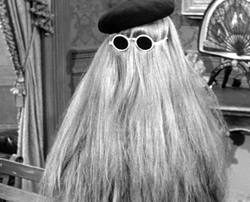
Cousin Itt and Airplane Security

Although it is with some trepidation that I wade back into the airplane security discussion, I have to relate this short but bizarre tale, one that would indeed be have been ameliorated by profiling.

When we fly, which we do often, Tim likes to devote the flight time to catching up on the sleep he loses each night composing new and more complex databases in his head.  To create conditions conducive to sleep, he drapes a blanket over his head.  He has passed dozens of flights over the past few years next to me, doing his imitation of Cousin Itt.

On our flight out to San Francisco, however, he was informed that this was not permitted.  Post-9/11 security precautions prohibit covering your head while on an airplane.

Why?  We asked.

“Well, since the Detroit flight when a would-be terrorist covered himself with a blanket and assembled a bomb, it has been illegal to cover your head on a flight.”

That would seem to suggest that covering his HANDS would be prohibited.  Could he perhaps cover his head but leave his hands exposed?

“No — it’s just your head you can’t cover.”

So, under this rule, he could in fact cover his hands and assemble a bomb so long as his head was uncovered?

“Um, right”

But this makes no sense!  He can’t even *use* his hands.  He couldn’t assemble a bomb if he wanted to.

“I could have the police and airline security waiting for you when the plane lands.”

Seriously.  This was the flight attendant who had seen us board the plane and seen the power wheelchair be wheeled out the galley door onto the belt loader.  (Don’t ask!)  And she was telling Tim he couldn’t sleep in his preferred cocoon because he might assemble a bomb.

Hey, Bruce, this situation calls for profiling:  of people WHO CAN USE THEIR HANDS.

Turns out that won’t be necessary.  When we landed at SFO, I quietly asked a different flight attendant whether he could tell us where we could find that rule so we could look it up and read it.  He quietly told us that there was no such rule, and that he had quietly told the first flight attendant that, and gently suggested that she apologize.

That’s right, she had woken Tim up, argued with us about quadriplegic bomb assembly, and threatened to have us arrested, all based on a rule that she invented out of whole cloth on the spot.

Adventures in Trial Technology

We recently went to trial against a big-ass nationwide law firm.  To prepare for this trial, in addition to mastering the law and facts, we decided to take the additional step of freaking out about trial technology.  I’m hoping you can learn from our experience.

What I hope you’ll learn is:  most trial technology is expensive bullshit.  All you really need is a projector and Adobe Acrobat Standard.

We started our legal technology project as we start most projects:  by procrastinating.  After an appropriate period of procrastination, our project began with an email to opposing counsel at the big-ass firm, asking if he’d be willing to work together to share in-court technology.  He did what he usually does with our attempts to cooperate:  ignored it.  So we set off to acquire an arsenal of legal tech that could outshine anything a big-ass firm could put together.

The first thing we did was to update our document management software.  As I’ve previously blogged, this immediately hung up on the fact that the software vendor wanted us to pay several years in arrears before they were willing to update us.  More from stubbornness than cheapness — though let’s be honest, from a great deal of cheapness, too — we refused.  But we’re so clever we figured out a work-around.  The old version of the software would run on an old laptop with a giant external hard drive attached.  If this were a horror movie, the camera would now focus in on the old laptop, and ominous music would play ominously in the background.

We next decided that we needed trial software, and invested in three licenses for Trial Director, which promises that you’ll be able to do ALL KINDS OF INCREDIBLY COOL AND POWERFUL STUFF IN TRIAL like, you know, pop-outs.  And, um, …. well, pop-outs.  Which as near as I can tell are when you use your mouse to select some piece of text on the screen and it … you guessed it… pops out.  It was also supposed to have all sorts of amazing organizational features.  Notice the use of the past-disappointed tense.  After investing a couple thousand dollars in Trial Director, we spent the next week or so (and we didn’t, at that point, have a lot of weeks before trial) trying to get it to load, and then another week or so getting error messages.  Never!  Mind!  Our talented and persuasive paralegal called, returned our licenses, and got our money back.

But we did invest in a projector and screen.  You know, the sort of sophisticated equipment you’d expect from people who live less than a mile from a Best Buy and who are too cheap to upgrade their software.  More ominous music.

So that left us, on the eve of trial, with an ancient laptop, two new laptops (I forgot to mention how I was trying to master Windows 7 two weeks before trial — brilliant!), a projector, a screen, and Adobe Acrobat Standard 8.  And me, a lawyer with aspirations to graphic design, playing with PowerPoint and Publisher much like Stuart Little played with his little car.  (“Hey, what does this button do?  Aaaaaaaaaaaaaaaahhhhhhhhhhhhh shit.”)

We figured we’d just take the documents we wanted to display during trial, compile them into a pdf and then flip from page to page, occasionally using Acrobat’s editing features (highlighting, box-drawing) to draw attention to some significant piece of text.  And — spoiler alert — this is what we did and it worked fabulously.  If you’re here for the trial tech lesson, you can stop reading:  so long as you don’t need to show video, which we didn’t, Acrobat — plus the occasional pdf’d PowerPoint slide or Publisher graphic — is all you need.

But the road to our pdf nirvana was still a bit bumpy.  For example, confident as we were in our minimalist approach, it was still a shock to the system when Tim, our paralegal Caitlin, and our co-counsel Mari showed up at the courtroom the Friday before trial to set up.  We had our Best Buy projector — which we had purchased and tried out in our conference room in Denver — and a screen that we had ordered online and had delivered to Mari, which she had learned to assemble in her home office in Berkeley.  Crucially, prior to that Friday, the projector and screen had never before interacted with one another.

The big-ass law firm had:

  • a real projector;
  • a real screen;
  • an Elmo*;
  • extra monitors for the witness and the judge;
  • an extra table for their technology hub, staffed by a specially-trained technology dude; and
  • extra tables for all this fancy technology; with
  • table skirts.

I think that could be a new item in my growing Jeff Foxworthy imitation:  If the skirts on the tables supporting the courtroom technology of your opposing counsel are nicer than the skirt you’re wearing, you could be a plaintiffs’ lawyer!

I really should let Tim tell this part of the story, because I wasn’t there.  I was just receiving frantic updates on my cell phone.  Apparently the mail-order screen and the Best Buy projector were a match made in hell, the upshot of which was the courtroom was not big enough to give the projector enough distance to project an image of the proper size onto the screen.  Even more exciting, in attempting to find the proper distance and angle, Tim and Mari apparently projected into the security cameras, causing the court security officers to charge worriedly into the courtroom.

Meanwhile the big-ass law firm’s team of technology professionals (the firm, of course, just sent its technology team; no lawyers were present) were busy assembling equipment and putting skirts on tables when the judge’s deputy came in an announced that only one screen would be permitted — we’d have to share.  This was fine with our team and with their technology team — who were sweet and helpful — but we wondered how the news would go over with the big-ass law firm lawyers.  With a word on the side to the clerk to please back us up on Monday when we requested a link to their projector to project our pdfs onto their screen, Tim and Mari packed up our equipment and tucked it away in the back of the courtroom.  For those of you keeping score at home, the amount of fancy new hardware and software we brought to trial was precisely:  zero.

The weekend brought even more technology adventures and heroic last-minute repairs, which I have to tell in bullet point format lest this post last longer than the trial:

  • A motor in Tim’s wheelchair failed.
  • We found a wheelchair tech who made a house call  (hotel call?).  (Thanks, John!)
  • The old laptop screen failed — remember the ominous music?
  • We found a computer tech who made a house call . . . on Sunday.  (Thanks, Dean!)
  • Just in case, we borrowed our co-counsel’s daughter’s monitor.  (Thanks, Miya!)
  • The old laptop screen started working again.
  • Tim’s new laptop screen failed.  He spent the rest of the trial tethered to the borrowed monitor.

By this time, the case was starting to bear more than a passing resemblance to My Cousin Vinny:

My suits were only slightly less heinous than Joe Pesci’s:

My partner was much better versed in the rules of evidence than I was.

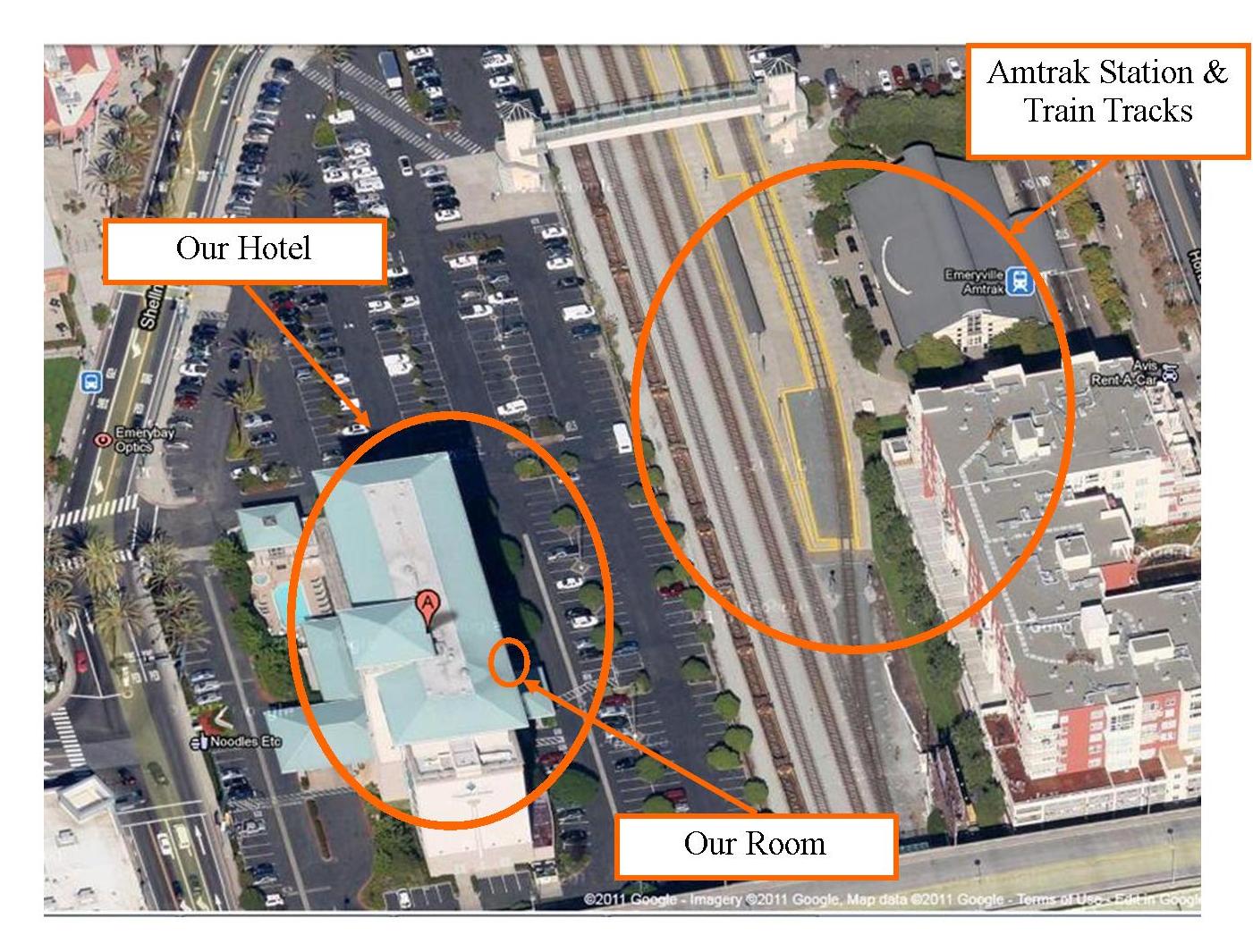
And we had train tracks right outside our hotel window.**  So not kidding:
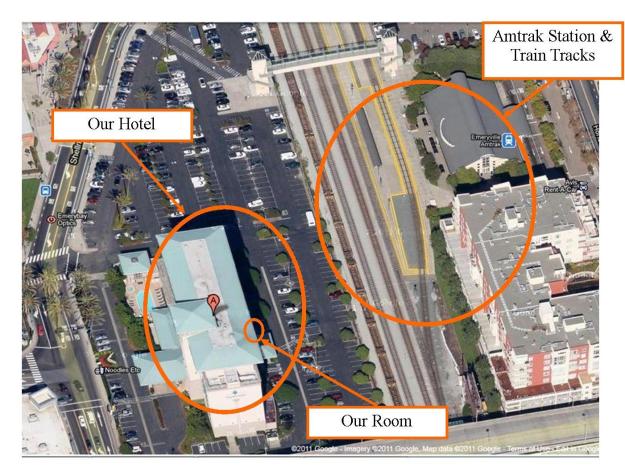
But this is all building to the inevitable moment when the big-ass law firm lawyer learned he’d have to share his technology.  And let me assure you, [DESCRIPTION DELETED BY TIM’S BETTER JUDGMENT, AND MY BETTER JUDGMENT TO ASK HIM ABOUT HIS BETTER JUDGMENT].  The Court told the parties to work it out, and we figured it was worth it to pay half of his technology bill to be able to project our pdfs on a big screen and on monitors in front of the judge and witness.  I do think that our trial team owns one-half of a bunch of monitors and table skirts sitting in a storage room in a big-ass law firm somewhere.

************************
* Not the doll.  It’s like a modern-day overhead projector, taking the document or object you place on the illuminated surface and projecting it onto a screen.  I.e., ways in which we have not progressed much beyond my 8th grade geometry class.

**I have to add that we love the Hyatt Summerville Suites in Emeryville.  It’s perfect for our needs.  The staff knows us and is outstanding and friendly.  And we’re walking distance to both the Bay — for a relaxing stroll after a day in court — and a Trader Joe’s, which still doesn’t exist in Denver.  Most of our trips west are like some sort of ancient trading caravan:  we arrive laden with binders of legal documents and depart laden with Trader Joe’s condiments.

Tribute to the 88 Honda

I had an idea for a comedy routine that would include this derivative one-liner:  if your car is older than your paralegal . . . YOU COULD BE A PLAINTIFFS’ LAWYER!  I never came up with other humorous  Foxworthian indicia of plaintiffs’ lawyer status, so that was as far as I got.  But I would like to pay tribute to the car that inspired that hilarious line:  My 1988 Honda Accord.

January 1988:  Purchased.  At the ripe old age of 27, I had never actually owned my own car.   I had previously driven the family Fiat (in high school) and a hand-me-down Malibu — the quirks of which I have previously described — in law school.  In between, I lived on a self-contained college campus (where the Fiat was an occasional visitor) and then in Taipei, which had such an outstanding bus system that I spent three years not driving and not missing it.

Early Summer 1988:  Drove the Accord cross country to a summer associate position in Los Angeles.  For part of the journey, I was joined by the guy I was misguidedly dating at the time.  Advice for any young ladies reading this:  Young Ladies, do not attempt to teach your boyfriends* to drive stick shift cars.  If your guy does not know how to drive a stick shift car, my advice is just to dump him now, as it suggests that he is too coddled to make good boyfriend material.

Late Summer 1988:  Drove the Accord back across country to start my clerkship in VA.  Picked up step-brother in Santa Fe.  Based on fear of step-brother’s driving record (love you, Jeff!), undertook to keep the wheel to myself during a three-day dash from Santa Fe to Arlington, VA.  Another lesson learned:  you cannot get off the highway in Oklahoma and expect to get a good steak at a random steakhouse.  Yelp.com didn’t exist in those days.

1988-89:  Lived in Richmond for my clerkship.  The Honda acquired the trunk gash it still bears today from some klutz’s attempt to attach a bike rack and (what the hell) a bike to the back of the car.

September 1989:  Drove to Minneapolis based on misguided relationship.  See supra.

February 1991:  Escape vehicle from misguided relationship.  Driven at great speed from MN to VA.  Stopped in IL to visit law school roommate, whose two-year old painted me a picture, which I put on top of the worldly possessions stuffed into the car.  To this day, I think of that 2-year-old (who, I believe, just graduated from college) every time I look in the rear view mirror and see the glop of yellow paint that remains from the inevitable moment when the picture flew up from the worldly possessions and adhered to the back window.

January 1992: Spun out in the snow driving to first date with Tim.  I remain very grateful that the Honda righted itself and I made it to the date on time.  Tim received early warning of my driving skills.

Later in 1992:  Acquired a “Clinton for President” bumper sticker, which would, even later, be covered with an X of duct tape when . . .

1993:  I loaned the Honda to my conservative brother.  It spent several months as the vehicle of choice for my sister-in-law to transport my newborn nephew — who is now 17 — as it had four doors to her CRV’s two.  That meant I got to drive around in a sporty red CRV for a few months.

1995:  Traveled to Denver in the back of a moving van.  I think it is still pissed at me for that.

Since 1995, the Accord has seen a lot less driving time, as Tim and I commute in the van.  It is now missing its hubcaps and the trim on the passenger side, which largely means that no one — no one — ever challenges me when I want to change lanes.  A few years ago, when I parked it on the street in front of our house for one night — it usually lives in the garage — someone broke the driver’s side window and crowbarred the original equipment radio and cassette (cassette!) deck out of the dashboard.  This had to have been the single most pointless and annoying crime in the history of crime, as the criminal ended up with a P.O.S. sound system, and I discovered that the cost of replacing that part of the dashboard — even without a new radio — exceeded the book value of the car. Luckily the thief left the lighter socket, so sound now comes from a jerry-rigged system involving a DC to AC outlet adapter and my smart phone.

From time to time, we talk about replacing the 88 Accord, but it never gives us a good reason to do that , and honestly I’m not sure how I’ll part with it.  Although automotive technology has advanced considerably in the past 23 years, I think the only thing I really miss is:  a cupholder.

***************
* Upon rereading, I recognized the heterocentrist assumptions underlying this sentence.  So to clarify:  advice for any young ladies dating young men.  I do not have any data on the advisability of young ladies trying to teach their girlfriends to drive manual shift cars.

Important life options . . .

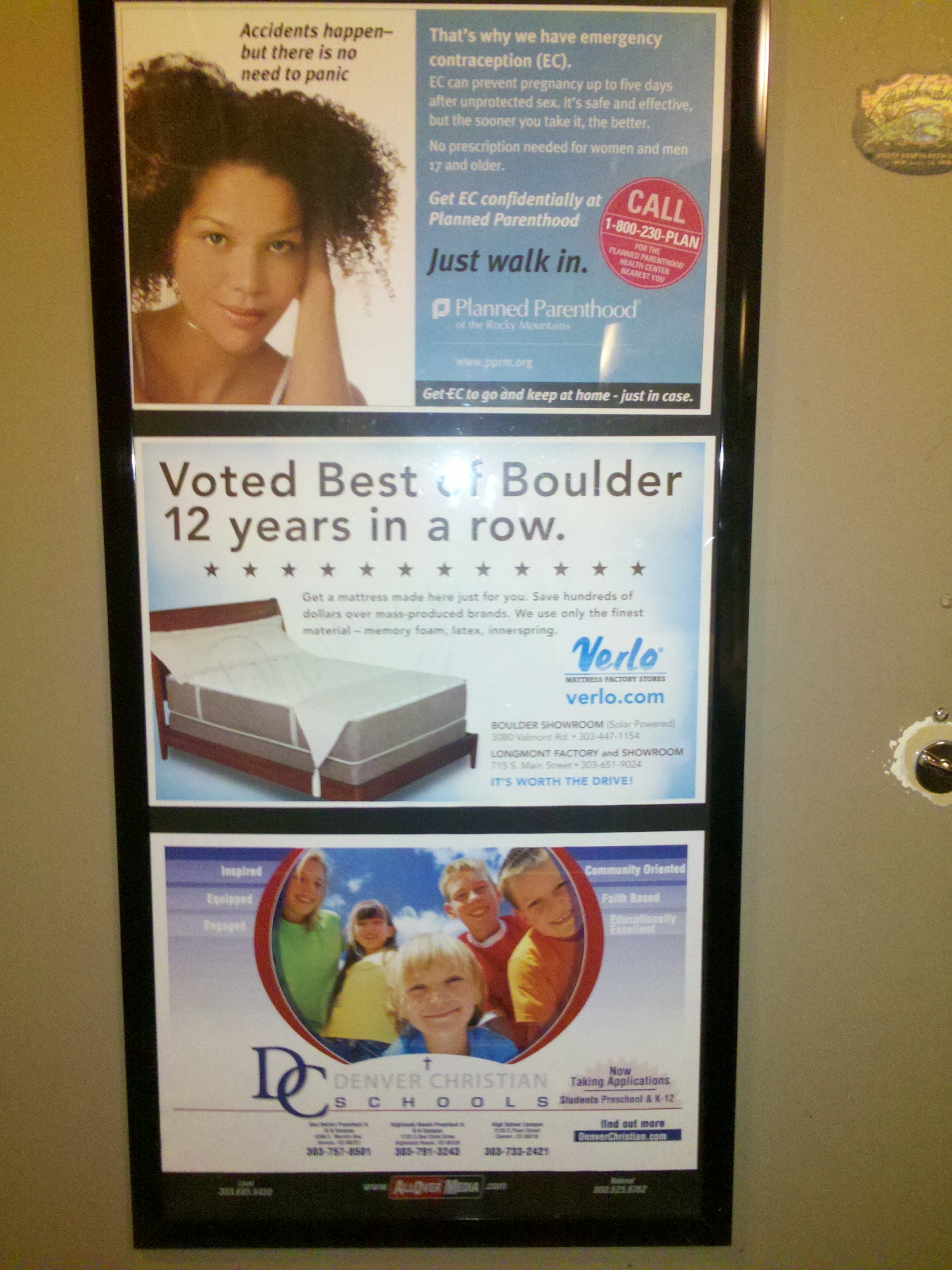
… presented through the medium of bathroom-stall advertising.

A bed (“Best in Boulder”), emergency contraception (“Accidents happen – but there is no need to panic”) or Denver Christian Schools (“the perfect place for your five tow-headed children”).  OK, I invented the last tag line, but you gotta love the juxtaposition of the bed, Plan B, and, um, Plan C.

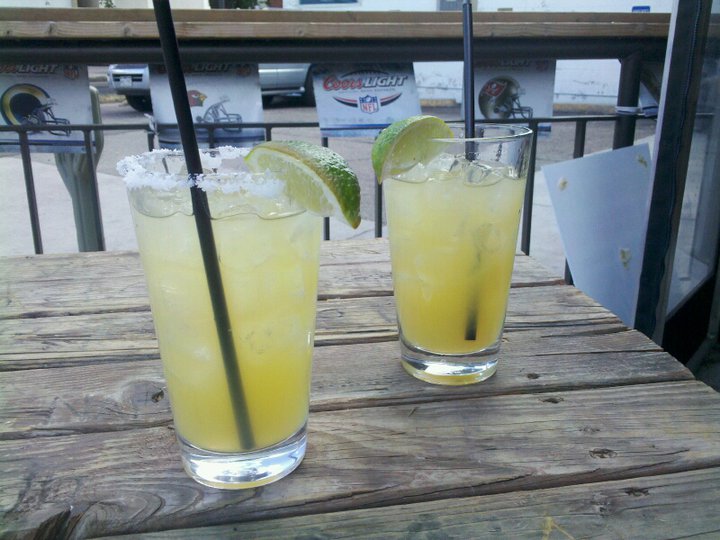
This is an actual bathroom advertisement at The Pioneer Bar.   OK, it’s a total college bar, but if you avoid times that it’s full of college students, and go when it’s sunny so you won’t be exposed to the cheesy decor and can enjoy a pleasant patio, a good margarita, and freaking excellent quesadillas.  Also highly recommend the steak fajitas.  In other words, a great place to goof off.


Amycare: replace doctors with veterinarians

Anyone who has ever taken a pet to the veterinarian has probably thought:  geez, why can’t humans get health care like that?  I mean, at the most basic level, vets are just cooler than MDs.  Think of all the vets you’ve known in your life and then all the doctors:  who would you rather hang with? Case closed.

But it’s more than that.  Our older dog is now seeing a specialist, so we are having a good deal of exposure to the veterinary profession.  This has placed the differences in stark contrast.

Both our regular vet and the specialist call us a day or two after each appointment just to see how our dog is doing.  I’m not sure my PCP would know me if she ran into me at the Target the day after my annual physical.  And I really do like my PCP; it’s just not part of the human medical culture to follow up.

The vet specialist also faxes a report to the regular vet after each appointment, and calls *him* to follow up.  When I needed one doctor to send my file to another doctor a few years back — just send the damn file; no communication; no follow up — I had to make multiple phone calls and fill out multiple forms, and I still showed up at the second doctor’s office to find that no communication in any medium had occurred between the two doctors, their staff, or their file rooms.

And our vet appears to use computer technology from the post-1995 period.  At a recent human medical appointment, the receptionist handed me a form when I checked in.  I pointed out that none of the items on the form had changed since the last appointment.  No good:  “It’s a policy, we have to update our information.”  But there’s nothing to update.  “Sorry, it’s a policy.  We require this form.”  A form made of paper, from dead trees, which they expected me to interact with using primitive ballpoint technology.  I pointed out that they had also every single piece of information requested on the form having photocopied my driver’s license and insurance card only moments ago, but I was instructed to please sit down and just fill out the form.  After I filled out the top half, I handed it back and pointed out that since I was the insured, the information requested on the bottom half of the paper was already filled in on the top.  Nope.  Still not good enough.  “The two halves of the form go to different places,” I was told, “You have to fill out both.”  At about that moment, I looked at the receptionist’s computer and noticed:  DOS.  That’s right, green type on a black screen.  In 2011.  I can go up to a computer terminal at the Bed, Bath and Beyond and find out what wedding gifts my friends and family in distant cities have registered for, but MY DOCTOR is using DOS, and asking me to fill out identical information on the top and bottom halves of a piece of paper in much the way I filled out a field trip permission slip in 1971.

You can’t really do a head-to-head comparison of the financial aspect of human and dog care, because the veterinary industry lacks many of the important cutting edge features of the American human medical system:  astronomical insurance company executive salaries; palatial insurance company corporate campuses; and cubical farms staffed with adjusters trained to deny your claims.  So it’s not really fair to point out that the financial aspect of dog care is much simpler:  after each appointment, we hand them our credit card and we’re done.  But that is at least part of the point:  the vet industry doesn’t have to support legions of insurance executives, so the amount we’re paying is a very small fraction of what our insurance company pays our doctors.  And honestly, how different *is* a human body from a dog’s?  We seem to have many of the same internal organs.  Can human treatment really be that much more expensive?  (This is where my brother will blame the lawyers.  Love you, Bruce!)

Finally, of course, no matter how intrusive the medical procedure, I have *never* been offered a treat.  Not once.

Lessons learned in trial — days 1 & 2

Lesson from trial day 1: The haircut you got for trial in a salon at 5,280 feet and zero humidity will not look at all the same at sea level and 100% humidity.

Lesson from trial day 2: Do not attempt new and untested methods of blow drying your hair on trial day 2.

Lesson from the evening of trial day 2: We are not in Kansas Colorado anymore.  Came out of the Safeway just in time to see the Oakland police surrounding someone at gunpoint in the parking lot.  Oddly, my first instinct — from years of Law & Order and Cops — was to walk toward the scene to check it out.  It took a sec to realize that “away” might be a better direction.

Why I love videoconference depositions

Because I only have to dress up from the waist up and can wear

badass socks out of camera range.

What would you do for serrano-wrapped dates?

UPDATE (August 19, 2012):

Tim and I went  back to the 9th Door today and had a great time.   The seating had been improved significantly.  All of the low benches and sofas were gone, replaced by very accessible four-tops.  Spanish music had replaced the techno.  Everyone’s attitude was fabulous.  And of course the food remains spectacular.

ORIGINAL POST (May 22, 2011):

Turns out, Tim and I would put up with a fairly annoying level of discrimination and techno music for this tasty treat.  We went to our favorite tapas joint last night — Denver’s 9th Door.  We’ve always known that an evening at 9th Door is a trade-off between amazing food and a deeply annoying hipster-and-techno-music ambiance.  But we’ve been there many times and always been seated politely.  Last night, the manager decided we were a fire hazard.

You know how there are phrases that just signal discrimination, that members of minority groups hear often — each time from someone thinking he is original — demonstrating conclusively that you are different, outside, etc.  For example, saying an African-American is “articulate,” or an Asian is a “model minority,” or a Jewish name is “delightful.”*  Well, nothing says “other” better than calling you a fire hazard.

We got there at our usual old-fogie, early-bird-special hour and the manager showed us to a two-top — one we had occupied on a number of previous occasions — and then started vocally fretting about how she could arrange us so that neither Tim nor I would be a fire hazard.  In one arrangement, I would have been sitting in the aisle.  She rejected this, causing Tim to tell the rather chubby manager, “she’s only 105** pounds, she won’t take up the whole aisle.”  Oh snap!  Following much dramatic table-dragging and eye-rolling, we were seated, after which, of course, the entire length of the aisle she was worried about immediately filled up with annoying hipsters, posing a far more serious, non-wheelchair-related, fire hazard.

A word about techno music.  Does. Anyone. Like. That. Shit?  OK, 5 words.  It seems to me to have been composed by lab rats seeking revenge for whatever we’ve done to them in the name of science.  Hey, Rats – here’s your data:  techno music makes me want to rip my own ears off.  Now make it stop.

But I swear to God it was all worth it.

Dátiles: Crispy Serrano ham-wrapped dates stuffed with almonds and drunken goat cheese

Pimientos del Piquillo Rellenos: Fire-roasted piquillo peppers stuffed with fresh goat cheese and rosemary

Aged Manchego cheese with membrillo Cabrales blue cheese with almonds and honey Cabra cheese with dried fig chutney

Alcachofas a la Plancha: Crispy pan-fried artichoke hearts with lemon-thyme aioli

Croquetas de Hongos: Mushroom and rice croquette with sherry wine and mushroom sauce

Albóndigas: Traditional lamb meatballs served in a delicate Moorish mint almond sauce

Extra-bonus sexism.  See if you can spot it in their menu blather:

On Spain’s Costa del Sol, located between Malaga and Marbella, sits a quiet little mountain village called Mijas.

During the summer of 1969, after having been made famous by James Michener’s novel The Drifters, Mijas had become an expatriate community of writers and poets. On lazy afternoons, these expats would gather at their favorite bar – one without a name, recognizable only by the number nine that was carved into the door.

Behind the 9th door, they would imbibe on the local wine and brandy and share the tapas of the house, trading stories and reciting poetry to the local women until the early hours of the morning.

Raise your hands if the first time you read the words “expatriate community of writers and poets” you pictured a mixed group of men and women.  Ha!  Fooled you!  Or maybe I’m just being heteronormative:  male and female expat writers and poets could all have been seducing the local women.  Of this I’m confident:  no techno music was involved.

***************

* OK, this one might not make sense out of context.  Here’s the context:  I’m half Jewish, half, well, WASP.  When discussing a friend of mine with one of my older WASPy cousins, he responded to hearing the guy’s name by laughing out loud, repeating it over and over, saying “how delightful!”  Not an anti-Semetic bone in his body, but almost nothing could have made me feel more “other” at that moment.

** This reflects the historically accurate weight stated on my driver’s license.  Let’s just say:  it’s up for renewal this year.

Law Nerd Heaven

If you’re not watching The Killing, you should be.  It’s an incredible series, right up there behind The Wire as far as I’m concerned for Best TV Show Ever.  But it endeared itself to this Law Nerd when the last episode discussed one of my favorite, slightly obscure, legal topics:  organizational standing — citing, by name, to the leading case, Hunt v. Washington State Apple Advertising Commission.

I realize this will be meaningful to only a small fraction of my readership (which might at this point be measure in fractions of actual human bodies).  But it made my night!