Category Archives: Stupid Lawyer Tricks

Memo to OC: remember the ratio!

We just got a 12-page brief from our opposing counsel.  Here is the score:

Italics:  9

Italics + underline:  11

Italics + underline + bold:  1

I’m not talking about case names or other citations.  I’m talking about entire sentences, frantically italicized and underlined.  Important things like “two entire business days passed without any follow up response trom plaintiffs’ counsel as to the six (or seven) deponents’ availability to proceed with their depositions on any date.”

What I love about law:  nerding out with Westlaw and a good, chewy legal question.

What I hate:  being yelled at through font changes about deposition scheduling.

Adventures in Trial Technology

We recently went to trial against a big-ass nationwide law firm.  To prepare for this trial, in addition to mastering the law and facts, we decided to take the additional step of freaking out about trial technology.  I’m hoping you can learn from our experience.

What I hope you’ll learn is:  most trial technology is expensive bullshit.  All you really need is a projector and Adobe Acrobat Standard.

We started our legal technology project as we start most projects:  by procrastinating.  After an appropriate period of procrastination, our project began with an email to opposing counsel at the big-ass firm, asking if he’d be willing to work together to share in-court technology.  He did what he usually does with our attempts to cooperate:  ignored it.  So we set off to acquire an arsenal of legal tech that could outshine anything a big-ass firm could put together.

The first thing we did was to update our document management software.  As I’ve previously blogged, this immediately hung up on the fact that the software vendor wanted us to pay several years in arrears before they were willing to update us.  More from stubbornness than cheapness — though let’s be honest, from a great deal of cheapness, too — we refused.  But we’re so clever we figured out a work-around.  The old version of the software would run on an old laptop with a giant external hard drive attached.  If this were a horror movie, the camera would now focus in on the old laptop, and ominous music would play ominously in the background.

We next decided that we needed trial software, and invested in three licenses for Trial Director, which promises that you’ll be able to do ALL KINDS OF INCREDIBLY COOL AND POWERFUL STUFF IN TRIAL like, you know, pop-outs.  And, um, …. well, pop-outs.  Which as near as I can tell are when you use your mouse to select some piece of text on the screen and it … you guessed it… pops out.  It was also supposed to have all sorts of amazing organizational features.  Notice the use of the past-disappointed tense.  After investing a couple thousand dollars in Trial Director, we spent the next week or so (and we didn’t, at that point, have a lot of weeks before trial) trying to get it to load, and then another week or so getting error messages.  Never!  Mind!  Our talented and persuasive paralegal called, returned our licenses, and got our money back.

But we did invest in a projector and screen.  You know, the sort of sophisticated equipment you’d expect from people who live less than a mile from a Best Buy and who are too cheap to upgrade their software.  More ominous music.

So that left us, on the eve of trial, with an ancient laptop, two new laptops (I forgot to mention how I was trying to master Windows 7 two weeks before trial — brilliant!), a projector, a screen, and Adobe Acrobat Standard 8.  And me, a lawyer with aspirations to graphic design, playing with PowerPoint and Publisher much like Stuart Little played with his little car.  (“Hey, what does this button do?  Aaaaaaaaaaaaaaaahhhhhhhhhhhhh shit.”)

We figured we’d just take the documents we wanted to display during trial, compile them into a pdf and then flip from page to page, occasionally using Acrobat’s editing features (highlighting, box-drawing) to draw attention to some significant piece of text.  And — spoiler alert — this is what we did and it worked fabulously.  If you’re here for the trial tech lesson, you can stop reading:  so long as you don’t need to show video, which we didn’t, Acrobat — plus the occasional pdf’d PowerPoint slide or Publisher graphic — is all you need.

But the road to our pdf nirvana was still a bit bumpy.  For example, confident as we were in our minimalist approach, it was still a shock to the system when Tim, our paralegal Caitlin, and our co-counsel Mari showed up at the courtroom the Friday before trial to set up.  We had our Best Buy projector — which we had purchased and tried out in our conference room in Denver — and a screen that we had ordered online and had delivered to Mari, which she had learned to assemble in her home office in Berkeley.  Crucially, prior to that Friday, the projector and screen had never before interacted with one another.

The big-ass law firm had:

  • a real projector;
  • a real screen;
  • an Elmo*;
  • extra monitors for the witness and the judge;
  • an extra table for their technology hub, staffed by a specially-trained technology dude; and
  • extra tables for all this fancy technology; with
  • table skirts.

I think that could be a new item in my growing Jeff Foxworthy imitation:  If the skirts on the tables supporting the courtroom technology of your opposing counsel are nicer than the skirt you’re wearing, you could be a plaintiffs’ lawyer!

I really should let Tim tell this part of the story, because I wasn’t there.  I was just receiving frantic updates on my cell phone.  Apparently the mail-order screen and the Best Buy projector were a match made in hell, the upshot of which was the courtroom was not big enough to give the projector enough distance to project an image of the proper size onto the screen.  Even more exciting, in attempting to find the proper distance and angle, Tim and Mari apparently projected into the security cameras, causing the court security officers to charge worriedly into the courtroom.

Meanwhile the big-ass law firm’s team of technology professionals (the firm, of course, just sent its technology team; no lawyers were present) were busy assembling equipment and putting skirts on tables when the judge’s deputy came in an announced that only one screen would be permitted — we’d have to share.  This was fine with our team and with their technology team — who were sweet and helpful — but we wondered how the news would go over with the big-ass law firm lawyers.  With a word on the side to the clerk to please back us up on Monday when we requested a link to their projector to project our pdfs onto their screen, Tim and Mari packed up our equipment and tucked it away in the back of the courtroom.  For those of you keeping score at home, the amount of fancy new hardware and software we brought to trial was precisely:  zero.

The weekend brought even more technology adventures and heroic last-minute repairs, which I have to tell in bullet point format lest this post last longer than the trial:

  • A motor in Tim’s wheelchair failed.
  • We found a wheelchair tech who made a house call  (hotel call?).  (Thanks, John!)
  • The old laptop screen failed — remember the ominous music?
  • We found a computer tech who made a house call . . . on Sunday.  (Thanks, Dean!)
  • Just in case, we borrowed our co-counsel’s daughter’s monitor.  (Thanks, Miya!)
  • The old laptop screen started working again.
  • Tim’s new laptop screen failed.  He spent the rest of the trial tethered to the borrowed monitor.

By this time, the case was starting to bear more than a passing resemblance to My Cousin Vinny:

My suits were only slightly less heinous than Joe Pesci’s:

My partner was much better versed in the rules of evidence than I was.

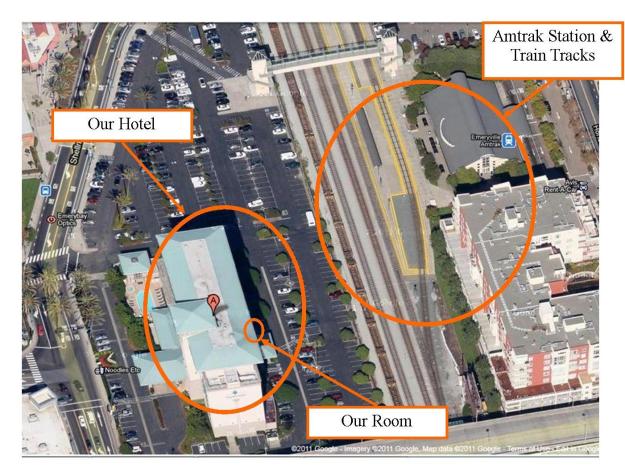
And we had train tracks right outside our hotel window.**  So not kidding:
But this is all building to the inevitable moment when the big-ass law firm lawyer learned he’d have to share his technology.  And let me assure you, [DESCRIPTION DELETED BY TIM’S BETTER JUDGMENT, AND MY BETTER JUDGMENT TO ASK HIM ABOUT HIS BETTER JUDGMENT].  The Court told the parties to work it out, and we figured it was worth it to pay half of his technology bill to be able to project our pdfs on a big screen and on monitors in front of the judge and witness.  I do think that our trial team owns one-half of a bunch of monitors and table skirts sitting in a storage room in a big-ass law firm somewhere.

************************
* Not the doll.  It’s like a modern-day overhead projector, taking the document or object you place on the illuminated surface and projecting it onto a screen.  I.e., ways in which we have not progressed much beyond my 8th grade geometry class.

**I have to add that we love the Hyatt Summerville Suites in Emeryville.  It’s perfect for our needs.  The staff knows us and is outstanding and friendly.  And we’re walking distance to both the Bay — for a relaxing stroll after a day in court — and a Trader Joe’s, which still doesn’t exist in Denver.  Most of our trips west are like some sort of ancient trading caravan:  we arrive laden with binders of legal documents and depart laden with Trader Joe’s condiments.

One Simple Graph Explains Lawyer Stress

I’m a law nerd.  Out and proud.  Give me an interesting legal question, access to my Westlaw account, and a steady supply of seltzer and pasta, and I’ll be happy for days.  I’m also privileged to have the world’s best law partner (my husband) and the world’s coolest co-counsel, with essential qualities like a sense of humor, appreciation for good beer, and knowledge of excellent restaurants.  Oh, yeah, and they’re really freaking smart lawyers, too.

Why, then, would I ever experience stress?*  I submitted this question to the world’s most powerful computer, which analyzed years of data in the form of briefs, letters, and emails in my cases, applied a complex algorithm** decades in development, and came up with the following answer:  The Merits:Bullshit Ratio.  It is best understood as a graph:

This means, for example, that in the brief we will receive next week, the bullshit level will be at the far right-hand side of the chart.  The question at issue is very simple, and we’re right.***  So why should I stress?  Because the extremely low level of merit in the defendant’s position means — I promise you, this is a scientific fact — there will be an extremely high level of bullshit.


You lawyers know I’m right on this.  When you’re briefing a complex, interesting, multi-faceted question with some merit on both sides, the briefs tend to be substantive and relatively mature.  When you’re simply flat-out correct, and your opponent has no real argument, his briefs are filled with arguments that are the legal equivalent of “I’m rubber, you’re glue,” “takes one to know one,” and “you’re a poopyhead.”  In addition, of course, the level of italicized text goes up.  Further computer analysis generated this chart:


Having achieved the first part of our research goal (the charts above), I have asked the computer to generate a solution to the stress that results from reading too much bullshit.  Preliminary results indicate that the solution involves beer.  Stay tuned.

****************

* There are two other well-known reasons for lawyer stress.  One is the stress people feel when they really don’t want to be lawyers.  This is not my problem:  I really really love being a lawyer; I just hate the bullshit.  The other reason is trying to balance your lawyer-life with your family-life.  I have solved this problem by completely merging the two.  It’s not for everyone, but it works for us!

** I love that word.  Does it really mean anything other than “equation”?  I don’t think so but it makes you sound really cool!

*** We’re always right.  That’s why we take the cases we take.  Only civil defense counsel get paid to represent wrong positions.  If our client has a wrong position, we don’t eat or pay the rent.

Amy’s Rules of Professional Conduct

We lawyers have to sit through hours of sanctimonious crap about professionalism.  Crap not because professionalism is crap.  Crap because what we’re sitting through is generally a lot of theoretical hand-wringing and brow-furrowing by Leading Lights of the Bar — for whom professionalism means kissing the right behinds over G&T’s at The Palm — and judges and magistrates who would prefer it if we all played better together but are so afraid of appearing partisan that they won’t admonish obviously unprofessional behavior.

Memo to judges and magistrates:  There would be a lot more civil behavior in the legal profession if you increased even slightly your level of knuckle-rapping.  When one party argues the law and the other presents briefs full of underlined, italicized, bolded, legally-irrelevant ad hominem arguments, say something.  You can even rule in favor of the font-abusing jerks — if, counterfactually, they were ever right — but damn, lawyers are not going to get any more civil unless you are willing to call them on their incivility.  In real time, too, not theoretically at later hand-wringing professionalism lectures.

Of course, judges and magistrates are not generally party to lawyers’ emails, so we’re  sort of on our own there.  In that medium, to steal a phrase from my step-brother Duncan, we* are often like a classroom full of five-year-olds with guns and liquor.  We recently endured over a month of bold/italicized emails from opposing counsel to schedule a single deposition, the highlight of which was the accusation that we were “playing games” by not disclosing our witnesses a week before the deadline.

In every state, there are rules governing lawyer behavior, for example, in Colorado we have the Colorado Rules of Professional Conduct.  These rules tell you helpful things like don’t steal money from your clients or disclose their secrets.  Things that we’d never figure out if they were not written down for us.**  The CRPC don’t teach you the important stuff, though.  So herewith the ARPC:  Amy’s Rules of Professional Conduct.

1.    Don’t be a jerk.***

2.    Respect, or at least act respectfully toward, other lawyers.  Older lawyers in fact know more than you do.  Younger lawyers are learning how to behave; if you act like a jerk to them, you contribute to the replication of jerk lawyer culture.****  And most important, (she says hopefully) acting like a jerk to opposing counsel in court just makes you look like a jerk.  And desperate.  And wrong.

3.    Don’t be sarcastic, at least not outside your own litigation team.  That means, when your OC claims he couldn’t find ten names in a searchable 300-page document over the course of almost two years, do not send an email that reads:

I have one question:  does anyone in your 1,200-laywer firm know how to use the “Control-F” function in a pdf document?   Because if you had such advanced technical capabilities, you would have discovered those ten people using that complex combination of two of the keys found on all modern computer keyboards sometime in the 18 months since you received our disclosures.   Just sayin’.

It was fun to write, but — on sober reflection — I should not have sent it.  At least not to OC —  that’s what the blog is for.  This is clearly the ARPC rule that I violate most frequently.  For example, I also once sent an email to an OC the entire content of which was, “Oh, snap!”  Luckily, that OC has a sense of humor, so the offense was not as grave.  It was a violation, nonetheless.

4.    Italics are for case names.  Bold text is for celebrity names in gossip columns.  Neither font is appropriate as a written representation of raising your voice in briefs and correspondence.  Bolding and italicizing the same chunk of text makes you look desperate.  And wrong.

5.    There is such a thing as deadline karma.  Say “yes” to at least the first few requests for extensions if they do not actually imperil your client’s interests.  Someday, you’ll need an extension, maybe even in an unrelated case.  If you gratuitously refuse a reasonable extension, deadline karma will kick your ass.

6.    Learn synonyms for the world “lie.”  The judge doesn’t want to hear that your OC is lying, even when he is.  In one of our cases, OC asserted to the judge that his client was unfamiliar with the way an expert took measurements.  We produced a photo of OC’s client watching the expert take measurements.  The judge was completely uninterested in photographic evidence of OC’s lie.   Instead of “lie,” I have learned to say, “that argument is incorrect,” or “that assertion is inaccurate.”  Same idea; less emotion.

7.     Do not attempt to bond with a party or lawyer who is different from you by telling stories about relatives you imagine they have something in common with.  If your client violated the ADA, I don’t want to hear about your aunt who uses a wheelchair.*****  If you’re a sexist windbag, I don’t care that your daughter just graduated from law school.  In a fair housing case, please don’t tell me your son dated an African-American woman.  All of these examples are true, several of them repeatedly.

8.    Do not send aggressive or offensive correspondence on Friday evening.  I know you’ll want to do this to get your desk clear for the weekend.  Right?  That’s why you want to do it, right?  Not that you’d ever think about doing that intentionally to ruin your opposing counsel’s weekend?  We have found that our most annoying OCs also have this habit and that, if you’re not careful to shut down your email program on Friday afternoon (or, back in the day, avoid the fax machine), you end up with a sour stomach the whole weekend.  Don’t be that guy.

9.    Have a sense of humor.  The pompous ass quotient is law is, statistically speaking, the highest of any profession except right-wing talk show host.******   Do your part to reduce pomposity by regularly laughing at yourself, your arguments, (privately) your opposing counsel and (privately if you’re wise; publicly if you have a blog) our entire self-important profession.

10.    Oh yeah, and don’t steal from your clients or divulge their secrets, you doorknob.

***************
*  By “we” I mean, of course, the other guys.

** That’s a joke.  Be polite and just pretend you knew that was a joke.

*** Careful readers will observe that this is closely related to Rule 1.5 of the Revised Federal Rules of Civil Procedure.

**** I’m operating under the assumption that we all share the goal of eradicating jerk lawyer culture.  This assumption, alas, does not have a lot of empirical support.

***** My favorite example of this was an OC whose brother was quadriplegic, telling my husband (a quad) and co-counsel (also a quad) that fact and adding something like, “yeah, we visit him in the nursing home.”

****** And Keith Olbermann.  I never got the attraction of hearing what was more or less the political truth from an ass almost as pompous as the conservative asses he was refuting.

Stupid Lawyer Tricks: ADA Defense Stupidity

An animated response to all the invective-filled, garment-rending articles about lawsuits against businesses that violate the ADA.  As with my earlier attempt, I think I succeeded only in cracking myself up.   Call it Animation Therapy.   Try it:  http://www.xtranormal.com

Couple of notes.  I love how the animated gestures are almost as awkward as the gestures I generate naturally.  On the other hand, I’m very disappointed that I could not make the automated voice render the word “law-nerd.”  This is a significant gap in the Xtranormal program.  And because I can overthink anything, I feel a tiny bit odd that my alter ego is African-American.  (Of COURSE she’s my alter-ego.  What did you think?)  Felt odd as in “in a post about civil rights what right do I have to speak from an African-American perspective?”  Truth is, of the characters available from Xtranormal in this set, I identified strongly with the obviously coffee-related superpower and did not think a minor difference in skin color should stop me.  In addition, my Caucasian choices were rather limited.  This one was not alter enough of an alter-ego:

This one perhaps TOO alter:

We’ve previously established that I’m no superhero in the kitchen.

And I basically didn’t know wtf this was:

So Super Coffee Woman it is!   Superpowers include:  high caffeine tolerance; overthinking; snark; wasting time she should be working playing with online animation programs.

Rewriting the rules of civil procedure: a start.

Rule 1:  These rules govern the procedure in all civil actions and proceedings in the United States district courts, except as stated in Rule 81. They should be construed and administered to secure the just, speedy, and inexpensive determination of every action and proceeding.

Rule 1.5:  Don’t be a dick.

Stupid Lawyer Tricks: Can I vent?

One of the themes of Stupid Lawyer Tricks is that, in civil litigation, there is one set of rules for plaintiffs and another for defendants. Instead of the FRCP – Federal Rules of Civil Procedure — which are supposed to govern what all parties do in federal court, there are really a PRCP and DRCP.

One of my earliest experiences with this was when a federal magistrate gave a defendant a complete Expert Witness Do-Over*.  My opponent designated an expert witness to testify to the astonishing** proposition that it was not racial harassment when my client — an African-American welder — found a naked black Ken doll at his work station with a noose around its neck.  It turned out that the only expert the defendant could find to support its position was — oops! — under indictment for fraud.  Ordinarily once the deadline to designate experts has passed, you gotta dance with the expert who brung you.  FRCP 26(a)(2).  In this case, however, the defendant filed a motion asking for a do-over and got it.  The defendant was permitted to find and designate a new — non-fraudulent — expert, long after the deadline.  DRCP 26(a)(2)(wtf).

My most recent experience is with a defendant who is represented by a 1,200-lawyer nationwide law firm.  We’ve been litigating this class action for 8 years, 6 of them against this firm.  I’m convinced that — big and fancy and expensive as it is — this firm’s technology is limited to Compaqs running DOS or perhaps trained horses scratching out numbers in their stalls.

Almost two years ago, we provided a list of 900-some-odd class members who had contacted us along with some information about each one.  We provided this list in a searchable pdf document of around 300 pages.  The deadline to take depositions in the case was last Friday. Last Tuesday the defendant demanded ten class member depositions.  Now generally, depositions require more notice than three days, especially when you want ten of them.  FRCP 30(b)(1). But these guys argued to the Court that they had had no way to find out who these folks were over the past two years, and the court agreed, on the grounds they were “concealed” in “voluminous discovery.”  DRCP 30(b)(ygtbfkm)

Let’s take a quick look at how concealed these folks really were.  If you had wanted to find the name of a specific witness or some other piece of information in the document we gave them, this is what you would have needed to do:  hit Control-F, then type the search term into Acrobat’s handy search term box, then hit return.  This would have taken you to the first occurrence of that term in the document. Now here’s where it gets a bit more complicated:  if you had wanted to see the next occurrence of the term, you would have had to hit either the return key or the little right-pointing arrow next to the search term box.  Rinse.  Repeat.

But honestly, you do not have to have an IT staff versed in advanced pdf-searching technology to find ten people in a 300-page document over the course of 20 months.  Any of the following would also have worked:

  • Have a paralegal read the document.  At the rate of half a page per day, you’d still have time left over.
  • Enter all of the data into an Access database and run a query.  This is what we did when the defendants included a 921*** page Word document with their motion for summary judgment.  Our opposition was due three weeks later, so our crack team of paralegals (possibly, in this case, meaning paralegals on crack) entered 921 pages of data into our database in the course of about one week.
  • Train a dog to bark at the name or information you are seeking, then show the dog each page and note the pages at which he barks.****

And all this complaining about how — help! help! — difficult it is to search a 300-page pdf comes from a defendant who produced many electronic documents so incompetently that the logos and other graphics embedded in the documents floated free and appeared as separate documents.  So they have produced hundreds of thousands***** of pages of documents, many quite helpful but many that look like this:

So it’s been a frustrating past few days, but ultimately there are several silver linings.  We’ll be headed to San Francisco as the Giants start the Series.  And, well, the case is already very positive for us; ten more witnesses supporting our position can only strengthen that.

**********
* The defendant didn’t call it that, but in my opposition brief, I sure as hell did.

** On the other hand, the judge did call the defendant’s argument “astonishing:”  “[The defendant] contends that  . . . there is no evidence that the incident was racially motivated.  [The defendant] may make that astonishing argument to a jury.  In light of the undisputed fact that a nude Black doll-as opposed to a doll of some other race-was found hanging from a noose in the locker of an African-American man, it would not require a jury to make a herculean leap of logic to conclude that the noose and doll incident was racially motivated.”  Gooden v. Timpte Inc., 2000 WL 34507333, at *11 (D. Colo. 2000).

*** I usually just invent the numbers on this blog, but this one is, coincidentally, accurate.

**** This would not work with Chinook or Saguaro, who would tell you to just use a fucking database so they could get back to obsessing about tennis balls (Saguaro) or napping (Chinook).

*****  Again, surprisingly, not an invention.  687,846 pages to be exact.

Litigation animation, or, I crack myself up!

I don’t know if any of you caught the hilarious animation ridiculing the iphone, but the tag line at the end was “Xtranormal.  If you can type, you can make movies.”  Well, I’ve always thought that I’d be a great animator, but for my total and complete inability to draw, so Xtranormal seemed like a great service:  my deathless prose; their artistic renderings.

Here is my first attempt.   Possibly not funny outside our case team, but importantly, I totally cracked myself up.

I pondered whether it was a good idea to post this and concluded that it was OK:  I don’t name the defendant, and every last bit of it is in the public record.  True,  as a technical matter, no giant saw blade was involved, and I don’t generally wear my Coffee Woman superhero outfit to court.  But it is otherwise completely accurate.

Ratio

(Time spent finding running clothes, putting on running clothes, finding running shoes, putting on running shoes,* putting up hair, finding leashes, leashing dogs, finding, folding & pocketing baggies, standing around waiting for dogs to pee, standing around waiting for dogs to poop,** scooping poop, & disposing of poop baggie) : (time spent running) = 2:1.

************
* Despite the fact that my shoes tie like this:

I’m only sorry they didn’t have shoes like this when I was a kid as it took me an unnaturally long time to learn to tie my shoes.  Perhaps my mother can supply the photographic evidence of my entire nursery school lined up to say the pledge of allegiance, with me in my stocking feet.

** This occupies at least as much time as running does, because Saguaro insists on conducting a full olfactographic*** survey of a wide radius of space, and practice-crouching up to ten times before locating the precise right spot.  There is nothing that can be done to speed this up, and in fact I have to restrain Chinook from interrupting the maestro at work, or it will take even longer.

*** That is TOO a word.  I googled it.  Most of the results involved male sea lampreys.  Yes, Saguaro is just that weird.

Congratulations, [your name here], you passed the bar!

We just learned the great news that our law clerk, Darryl Collins, and CCDC’s law clerk, Andrew Montoya, passed the Colorado bar.  Congrats, Darryl and Andrew!!  When I learned that Darryl would not make it to the official swearing-in ceremony, I decided we needed to recreate the experience at Dougherty’s — at least the experience of enduring the inevitable keynote address by some Leading Light of the local bar association.  As a public service, I thought I’d reprint it so that anyone facing the prospect of attending one of these events could save themselves the time and brain damage.

Ahem.

Effusive individualized welcome to various people here whose ass I need to kiss.

Generic welcome to the folks who just passed the bar and their friends and families.

Corny shout-out to family members who put up with loved ones in law school.

Endearing story about my own early years as a lawyer, one that is simultaneously self-deprecating and self-aggrandizing.

But seriously.

Self-evident statement about the importance of the occasion.

Long interlude of meaningless babble about the practice of law.

Several over-thought metaphors.

Frowny-face statement about how “increasingly” uncivil the practice is, despite the fact that the old farts at my law firm delight in crushing the spirits of idealistic young lawyers for sport.

A sentence or two designed to present the momentary illusion that I and my colleagues in big law firms give a rat’s ass about people who can’t afford to pay our fees by the hour.

Concluding anecdote.

Congratulations!