1975: Pot. Effect: that giddy feeling of being stoned.
1985: Coffee. Effect: that giddy feeling of getting shit done.
2015: Cortisone: Effect: that giddy feeling of no lower back pain.

1975: Pot. Effect: that giddy feeling of being stoned.
1985: Coffee. Effect: that giddy feeling of getting shit done.
2015: Cortisone: Effect: that giddy feeling of no lower back pain.
Fantastic post. Can’t wait to read her book!
It’s a strange thing – an almost unnatural thing – to construct careful, analytically rigorous arguments for the value of your own life, or for the bare intelligibility of the claims made by an entire civil rights movement.
Item 1: Advances in Medical Modesty. During yesterday’s installment of the Further Adventures of Amy’s Scoliosis, I was offered not only the traditional hospital gown, but these attractive . . . disposable basketball shorts? Designed to be one-size-fits-all, they were really more like capris on me, but I did appreciate the coverage.

Item 2: I have identified the Worst Pants Ever, possibly the Worst Clothing Item Ever: Goat Suede Track Pants. You might think this comes from a Seinfeldian parody of the J. Peterman Catalog, but it is actually on offer from the good folks at Orvis for the entirely reasonable price of $395.

I’ll just stick with my LL Bean mom jeans, thanks.
I wrote this op-ed for the Denver Post* after we got a flyer under the door of our law office. It was published on January 18, 1998. Given that we have just recently been treated to the clownshow of a white Supreme Court justice announcing that African-American students would be better off in “less-advanced” or “slower track” schools, rather than the University of Texas, I thought it would be fun to re-run this. The Post called it “Clear the bench (and bar) of privilege.” I thought of titling it “Gimme a Fucking Break,” but went for the more descriptive “White Affirmative Action.”
We recently received — under the front door of our law firm’s office, sans postage — an interesting missive announcing the organization of a group called VICTIMS OF AFFIRMATIVE ACTION (all caps in the original). This group (we’ll call them VAA) opposes affirmative action — from context, the race-based variety — and proposes to shed light on “the appointment of lawyers holding unmerited law degrees to the federal court bench” (underline in the original) and to “deny . . . admission of scholasically unfit ‘minorities’ to law schools.” The letter concludes by asking for our “assistance, financial or otherwise.” I choose “otherwise” and offer my invaluable assistance through the formation of what VAA will surely recognize as an important allied organization: VICTIMS OF PRIVILEGE AND NEPOTISM.
VAA argues that their group is necessary because they have found at least two black judges they claim are unqualified for the federal bench: one because the judge invented a story about his youth in Mississippi; the other because the judge — at the trial court level — had no previous judicial experience. (The letter does not mention the law board scores, law school grades, scholastic honors, professional experience or judicial competence of either man.) This got me thinking: In my ten years of legal practice, I have encountered not only a few incompetent white judges but scores of incompetent white attorneys and I have begun to suspect that these lawyers, too, are the recipients of unmerited law degrees.
To remedy this situation, VAA will have to agree, will require our new group to deny law school admission to scholastically unfit white applicants who rely on such illegitimate factors as where their parents went to law school, who their parents know in the admissions department, or how much money their families have contributed to the school over the years. Also in our cross-hairs will be such system-abusers as white kids with lower-than-acceptable scores who try to get admitted based on international travel, internships with friends of the family, political work with same, and other life-enhancing experiences open only to those of wealth and connection. Practicing lawyers who were admitted to law school based on any of these factors must be deemed to hold “unmerited law degrees,” right VAA?
And it doesn’t stop with law school. We’ll also have to get rid of any white lawyer who got his job because he or his parents knew someone at the firm, because his family attended a church or country club with one of the partners, or because the supervisor from a previous — nepotistically-acquired — job made a recommendation. Any white judge appointed based on political connections developed through contact with other privileged white lawyers or contributions to the campaigns of privileged white senators cannot be considered qualified to serve. Finally, of course, any white lawyer who has received the benefit of the doubt based simply on having white skin, good clothes or a standard accent or because a boss or judge of the same ethnic background felt “comfortable” around him — where an equally talented minority lawyer would have been passed over — must step aside.
Well, I’m outta here. And so are most of the white lawyers and judges I’ve worked with over the years — the good, the bad and the ugly. Truth is, it is we who benefit from affirmative action and always has been. Sure merit matters — that’s why we have a bar exam. But if we think merit was ever all that mattered or that affirmative action was invented in the 1970s to assist minorities and women, we are living in a fantasy world.
We white people have been enjoying the fruits of affirmative action ever since a white skin was all you needed to not be enslaved. Even after discrimination was declared officially illegal, our prospects in the school-admissions and job markets still benefit overwhelmingly from affirmative action through nepotism, connection, economic privilege and — above all — the largely subconscious sense of most white bosses and faculty that we are like them, that we fit in, that they are comfortable around us, or that we remind them of their kids. Affirmative action that favors minorities — both the type that requires outreach to non-white populations and, on a larger scale, the type that keeps an eye on the numbers — is necessary and will be until our economy and workforce are sufficiently diverse that the affirmative action working against minorities has faded away.
So whaddya say, VAA? Are you ready to address the plight of all VICTIMS OF NON-MERIT-BASED SELECTION PROCEDURES? We’d like your assistance . . . but skip the “otherwise,” I’ll take financial assistance.
The Post asked me to add a one-sentence biographical description. I chose confession and tribute:
Amy Farr Robertson is a Denver lawyer who graduated from Yale Law School 28 years after her father, who taught her to appreciate all the ways she has benefited from affirmative action.
*****************
*The link will make you pay $2.95 to read the above.
After a recent round of back xrays, I signed up for access to Centura’s online patient portal. Xrays, these days, are just datafiles. The last time I got a set to take from one doctor to another, I picked it up on a CD. As I jumped through the online hoops to set up my Centura account, I thought “cool! that thing where you fill out a release and physically pick up your records is a thing of the past!”
Instead, I clicked on “Medical Records” and got this:

It reads,
Medical Records: If you’ve been a patient in one of our hospitals, you may download a copy of the medical records release form, complete it and fax it to the entity where you were admitted to request your medical record.
Why not just have the xrays copied by monks onto stone tablets and delivered by the pony express!*
************
*Yes, lots of anachronism there, but NONE SO MUCH AS THE REQUEST TO FAX THEM THE FORM.
I need a therapeutic disclaimer in emails and other media that goes like this:
. . . [blah blah blah] they* [blah blah blah] them* [blah blah blah] their* . . .
*Non-binary-aware, not ungrammatical.
I need this because I was raised on grammatical correction. It was how we expressed love in our family, just as many families express love by overfeeding one another, or teaching their young’uns to hunt or catch a spiral pass.
At a point slightly before I was able to consume solid food, my mother taught me — and corrected me — on the difference between “which” and “that.” If you said something was “more unique” in our household, you got a quick lecture on how the thing could be unique or not, but could not be comparatively unique because that suggested there was more than one of whatever it was. I believe my mother stopped drinking Pepsi for a while (actually, I don’t recall her ever drinking Pepsi; Fresca was her soft drink of choice) when they advertised it as “The Refreshingest!” One year, she corrected a typo in my home-made holiday card. That year was 2007.
Perhaps my favorite story, demonstrating the inter-generational quality to this bonding-through-grammar, was when — at the know-it-all age of approximately 12 — I wrote a letter to the editor of the Washington Post suggesting that some article or another was “male chauvinist.” My grandfather read it and provided this encouraging comment for my early efforts at politico-journalistic participation: “I believe the adjectival form is ‘chauvinistic.'” Seriously. I am not making that up.
I have to add, of course, that I love my mother and grandfather, and that they prepared me well for a world in which you are in fact judged on your grammar. No one taught me how to dress fashionably or wear make-up — we just weren’t a fashion-forward family

— but dammit I know how to sound edumacated.
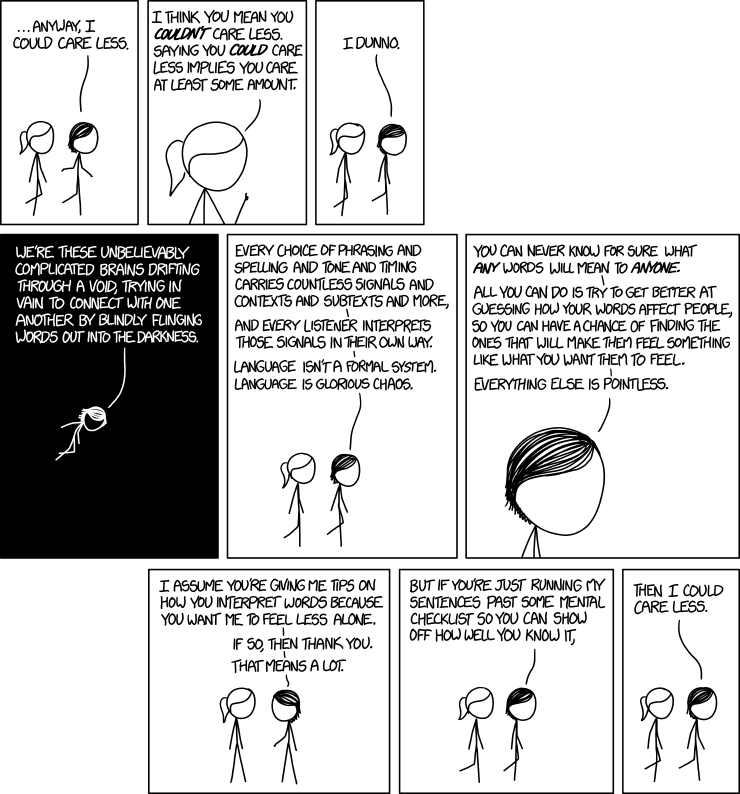
As an act of rebellion, I became a linguistics major and basked in the glow of descriptive grammar. As an adult, I relish hearing and constructing neologisms, making prefixes and suffixes go where they have never gone before, and generally observing the way our brains interact with language when left on their own. For all of this linguistic liberation, however, I still have a very severe case of GIS: Grammatical Insecurity Syndrome.
One of the things I was taught alongside “which,” “that,” and never, ever “most unique,” is that singular verbs take singular pronouns, and that “they, them, and their” are plural pronouns. I learned to police my language for this possible mismatch, and either change the number — that is, rearrange the entire sentence to be plural rather than singular — or change the pronoun. And of course since I was a good feminist, I balked at the generic “he” and used the hell out of “he or she,” “his/hers,” etc. The random use of the generic “she” — which become popular when I was in law school in the 1980s — always seemed sort of strained to me, especially when used by male professors whose approach was otherwise pretty chauvinist . . . I mean, of course, chauvinistic.
It’s time to leave all that binary shit behind. It’s time to embrace they/them/their as singular, non-binary, pronouns. And most of all, it’s time not to care if many people think I’m just ungrammatical. As always, XKCD says it best:
I incorporate by reference all of the other, more eloquent, thanks given by and for family, friends, dogs, food, shelter, and the important peace and safety officers who are working on this holiday. I want to give more specific thanks to the people who made today possible.
For example, I am grateful for whoever invented the Traeger pellet smoker:

to our contractor, Mike, who recommended we buy one, and to the large online community of pelletheads (yes, that’s what they call themselves) who supply and comment on Traeger recipes like this one. Also thankful for the geniuses at the Pillsbury, StoveTop, and McCormick companies who ensured that my guests were not exposed to my actual [lack of] cooking skills. For the people working today at Village Inn (where my in-laws picked up the pies) and Safeway (where I got my last minute ingredients at 7 a.m.). And for the specific family member (hi, Mom!) who taught me how to substitute wine for water in the powdered gravy mix.
Now thankful for my sofa and enriching televised entertainment like how to make a deep-fried Nutella pizza. So not kidding.
Happy Thanksgiving!
The days since the attacks in Paris and Beirut have followed a predictable Scold Cycle:
Rinse repeat. Although I guess this blog may be the next round in the cycle: the criticism-of-hypocrisy-pointing-out. But ever since Republicans decided to launch a media campaign denouncing the way grieving liberals spoke at Paul Wellstone’s funeral — one of the most craven political acts in a sea of cravenness — I’ve decided that people get to say pretty much whatever they want when they are grieving. Perhaps all the Tricolour profile photos belong to people who have traveled to France, or have loved ones there. Or maybe it is because they identify with white Europeans more than brown Lebanese. I don’t know. Let them process their shock and grief for a bit before telling them that it’s racist or colonialist.
Corollary: this is not the time to point out that France has done all sorts of First World colonial bad shit. Yes. True. This is not the time. Like that time you attended the funeral of a guy who had done both good stuff and bad stuff in his life. The funeral, right then, was not the time to point out the bad stuff.
Obviously, the media are in a different situation. They need to be more evenhanded in the way they cover violence. Yet the American media still cover the rest of the world according to Spy Magazine’s “Death News Equation:” a calculation that involves the number killed or injured, the “sensitivity . . . of Times editors to the episode,” and the proximity of the incident to Times Square. And by “sensitivity,” I think they meant “resemblance of the victims to actual Times editors.” That equation still holds up, though I’ve always thought — based on my experience living in Taiwan — that it was a fairly universal phenomenon. The day Benigno Aquino was assassinated, the banner headline in the main Taiwanese newspaper read, “China Airlines service to Philippines suspended” with a smaller headline and article below explaining that Mr. Aquino had been shot on the tarmac after disembarking from a China Airlines plane. We’re all about ourselves, wherever we are.
Judith Miller
https://twitter.com/JMfreespeech/status/665314281219629057http://
So when one bad thing happens in one place, we should forget other things in other places that require our attention? This is not the product of a mature or intelligent mind.
If I become president, we’re all going to be saying Merry Christmas again, that I can tell you.
The free speech clause and the establishment clause: both a mystery to Trump. Or maybe he’s just planning a bullyocracy.
 Thought Snax