Tag Archives: disability rights

Adventures in Discrimination and Intimidation at the Marriott Courtyard Santa Fe

Below is the guts of the letter we sent to Marriott and Fine Hospitality Group, the management company at the Marriott Courtyard Santa Fe. We had reserved a room at the Santa Fe Courtyard Marriott for March 15 and 22, on our way to and from a vacation in Phoenix.  On the 15th, our request for an accommodation under the Americans with Disabilities Act resulted in a police response.

I want to preface this by recognizing that we have a weird sort of privilege — the “sitting in a hotel room waiting for the police to arrive without fearing for your life” privilege — that made this incident stressful and illegal but not, ultimately, fatal. This does not reduce the extreme danger hotel personnel were willing subject their guests to in pursuit of an ADA violation.

Update: The Fine Hospitality Group (not Marriott) reached out and the upshot was that they comped us that night and (in theory) a future night, and promised discipline for the manager and training for staff.

Here’s what happened:

After we checked in and got to the room, it became clear that the bed was too low for Tim to be able to easily transfer in or out from his wheelchair. This is a fairly common problem that can be solved by either putting blocks under the legs of the bed or adding a second mattress on top. We called the front desk, requested this modification and were told “no.” The staff member explained that the way the bed was set up did not permit adding anything to raise the legs of the bed. We suggested that a second mattress could be placed on top of the first; this suggestion was rejected out of hand (“no”). We asked if there were any extra mattresses in the hotel. “No.” (This seems unlikely but who knows.) We asked if there were any empty rooms from which a mattress could be moved. “No.” The staff person then asked if we wanted to talk with the General Manager. Yes, we said, we would.

The General Manager got on the phone and we went through a similar litany of requests and refusals, but the GM added that the room was set up precisely as required by the ADA and therefore could not be altered. As an initial matter, this is not true: ADA regulations and standards do not prescribe a minimum or maximum bed height. But it also doesn’t matter. In addition to requiring certain basic physical and architectural configurations, the ADA also requires that businesses provide reasonable modifications to policies, practices, and procedures. I explained this to the GM, who continued to insist that the room was as legally required and no changes could or would be made. We explained that we were lawyers who were familiar with applicable law, and that this simply was not true. He stood firm on his refusal to make the required modification. Sensing that this conversation would not result in the modification we needed, we said that we’d deal with the room as it was set up but would take up the matter with Marriott’s legal department. We all rang off.

The staff person, the GM, and both Tim and I were entirely calm throughout the call. We were all firm in our respective positions, but no voices were raised, no inappropriate language used, and no threats made.

Less than a minute after the call ended, the GM knocked at our door and told us we would have to leave the hotel. We said no, we did not intend to do that. He said he would call the police.

Approximately 20 minutes later, four fully-armed officers from the Santa Fe Police Department knocked at our door.  We invited them in and Tim explained the above interactions and expressed our desire – it was by that time around 9:10 p.m. – to stay in the hotel so we would not have to pack up and try to find an accessible hotel at that time of night. One of the officers asked what threats we had made. Tim explained that there had been no threats. The officer informed us that the GM had told the police that we had threatened to go door-to-door through the hotel, knocking on doors and harassing guests. There is no other way to characterize this than as a lie, and a dangerous one in that it was used to invoke police intervention in an otherwise calm albeit disappointing interaction. Tim explained to the police that we had not done this, and that it would make no sense for us to anger other hotel guests, who had nothing to do with the situation.

It was my impression that the police were somewhere between puzzled and bemused that they had been called out to discuss wheelchair accommodations. They were professional and friendly throughout.

After the officers had heard us out, one of the officers went to negotiate with the GM on our behalf. The officer returned to say that the GM would “allow” us to stay provided there were no further “issues or threats.” Although, given the exchanges that had brought us to this point, this was a pretty humiliating request, we agreed, the officers left, and we stayed the night.

This entire interaction violated both the requirement to make reasonable modifications to policies, practices, and procedures, 42 U.S.C. § 12182(b)(2)(A)(ii), and the prohibitions on retaliation for opposing discrimination and interference with and intimidation of people exercising or attempting to enjoy their rights under the statute, id. § 12203(a), (b). Indeed, calling the police is at the extreme end of interference and intimidation.

In our letter to Marriott and the management company, we proposed several measures to address this discrimination:

  1. Training for all staff of the Santa Fe Courtyard on the requirements of the ADA, and specifically the requirements for reasonable modifications;
  2. Communication to all U.S.-based Marriott and franchisee/licensee staff that, under no circumstances, are they to involve law enforcement in the discussion of the accommodations and modifications needed by guests with disabilities;
  3. Reprimand to go into the personnel file of the General Manager (whose name we never got); and
  4. Refund of our payment for the room on March 15 (we have, of course, cancelled our reservation for the return trip and will not be staying at that hotel in future trips to Santa Fe).

Stay tuned! I’ll update the post if we receive a substantive response from Marriott or Fine Hospitality Group.
Acheson Hotels v. Laufer: Revenge of the Data Nerds

[Cross-posted at the FoxRob Blog.]

Fox & Robertson along with a dream team of drafting partners filed an amicus brief today in the case of Acheson Hotels v. Laufer, currently pending in the Supreme Court. The case addresses the issue of “tester standing,” that is, whether people protected by civil rights laws have standing to sue when they intentionally investigate compliance and encounter discrimination.

Because tester litigation has been responsible for calling out and challenging widespread disability discrimination, businesses hate it. The amicus briefs they filed were full of hair-on-fire numbers — of pending ADA lawsuits — that they characterize as a “staggering,” “unrelenting tide” that is “clog[ging] federal court dockets.” Chamber of Commerce Br. 7, 11; Retail Litig. Ctr. Br. 4, 11, 20, 22. One business brief asserted that tester standing “threat[ened] . . . the cohesiveness of our union.” Ctr. for Constitutional Responsibility Br. 1. Drama much?

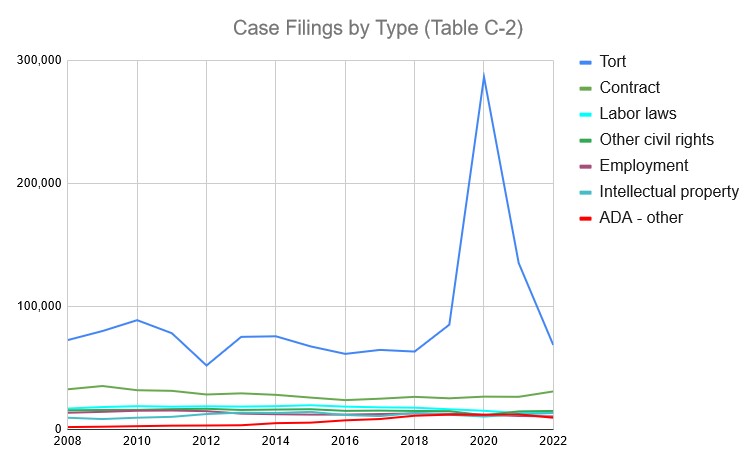
Of course numbers are catnip to the data nerds here at Fox & Robertson World Headquarters, so we decided to take a look at the actual numbers of ADA cases filed in federal court — based on data gathered by the United States Courts on its uscourts.gov website — and see how they looked in context. Here’s a chart comparing the “ADA-Other” category — roughly speaking, non-employment ADA cases, including the Title III cases that cause flaming hair on the business side — with six other common types of cases. Note the bright red ADA-Other line at the bottom.

Image:  a line graph titled “Case Filings by Type (Table C-2),” with the years 2008 to 2022 on the x axis and numbers 0 to 300,000 on the y axis. Seven colored lines cross the graph horizontally, each representing a type of case. The top line is a jagged line representing tort cases (varying between approximately 50,000 and 135,000). The line representing the category "ADA - Other" is in red.  It starts and ends at the bottom of the seven lines, intermingling with them in 2020.  ADA-Other cases vary from approximately 1,700 to approximately 12,000.  Other types of cases are as follows:  Contract cases, in green, vary from approximately 23,000 to 35,000. Labor law cases, in light blue, vary from approximately 13,000 to 19,000. Other civil rights laws, in dark green, vary from approximately 11,000 to 16,000.  Employment cases, in purple, vary from approximately 11,000 to 15,000.  Intellectual property, in blue, vary from approximately 8,000 to 14,000.

See? Not so bad after all! If business put half the effort into compliance that they put into whining, the world would be pretty damn accessible by now.

Be sure to check out our amicus brief with other fun facts and incisive arguments from the dream team: free agent disability rights rockstar Karla Gilbride, Michelle Uzeta at Disability Rights Education and Defense Fund, Tom Zito at Disability Rights Advocates, Justin Ormand at Allen & Overy and yours truly here at the World HQ.

The straw ban is the white liberalest thing ever.

Image: two drinks sitting on a wooden picnic table: a beer without a straw and a margarita with a straw.The effort to ban plastic straws is everything that’s wrong with ableist white liberalism in a nutshell:

  • It’s a policy built on emotion
  • about animals
  • that solves a tiny part of an enormous problem
  • by imposing on a marginalized part of society
  • without listening to the lived experience of those folks
  • letting big corporations make bold declarations of solidarity
  • without holding accountable those and other corporations that cause the real problems.

The disability rights movement needs names for ableist dorks equivalent to “Becky” and “Chad.”  Suggestions?

Update:  I love the suggestion of “Wally” the White Ableist Liberal.  Thanks, MontanaBradley!

Nevertheless she persisted, disability rights division (a start) (updated)

As most of the world knows by now, the white Republican men of the Senate voted to silence Sen. Elizabeth Warren when she attempted to read a letter from Coretta Scott King.  Majority Leader Mitch McConnell stated, “She was warned. She was given an explanation. Nevertheless, she persisted.”

Nevertheless, she persisted.

It’s now a badge of honor, not to mention accurate description of the persistence of the women who have broken barriers in a wide variety of fields.  Herewith, my small contribution:   Nevertheless, she persisted, disability rights division, with an emphasis on ass-kicking disability rights sheroes I know and love, and a few I love but don’t know, but wish I did.

Update: more #persistent women added below; will try to keep adding, but there are so many of you!!!

Carrie Ann Lucas.  [Image:  Carrie, a large white appearing woman in a colorful dress, in a power wheelchair using a vent; her daughter Heather, a smaller white appearing woman in a plaid shirt and jeans, in a wheelchair; behind Heather, Carrie’s daughter Aszia, a tall dark skinned woman in a t-shirt and jeans; Carrie’s son Antonio, a white appearing teenage boy in a brown shirt; Carrie’s daughter Cinthia, a light skinned teenage girl in a pink tank top in wheelchair; and Carrie’s daughter Adrie, a dark skinned teenage girl with a blue shirt and blue hair tie, in a power wheelchair.]

img_8392-1-1024x683

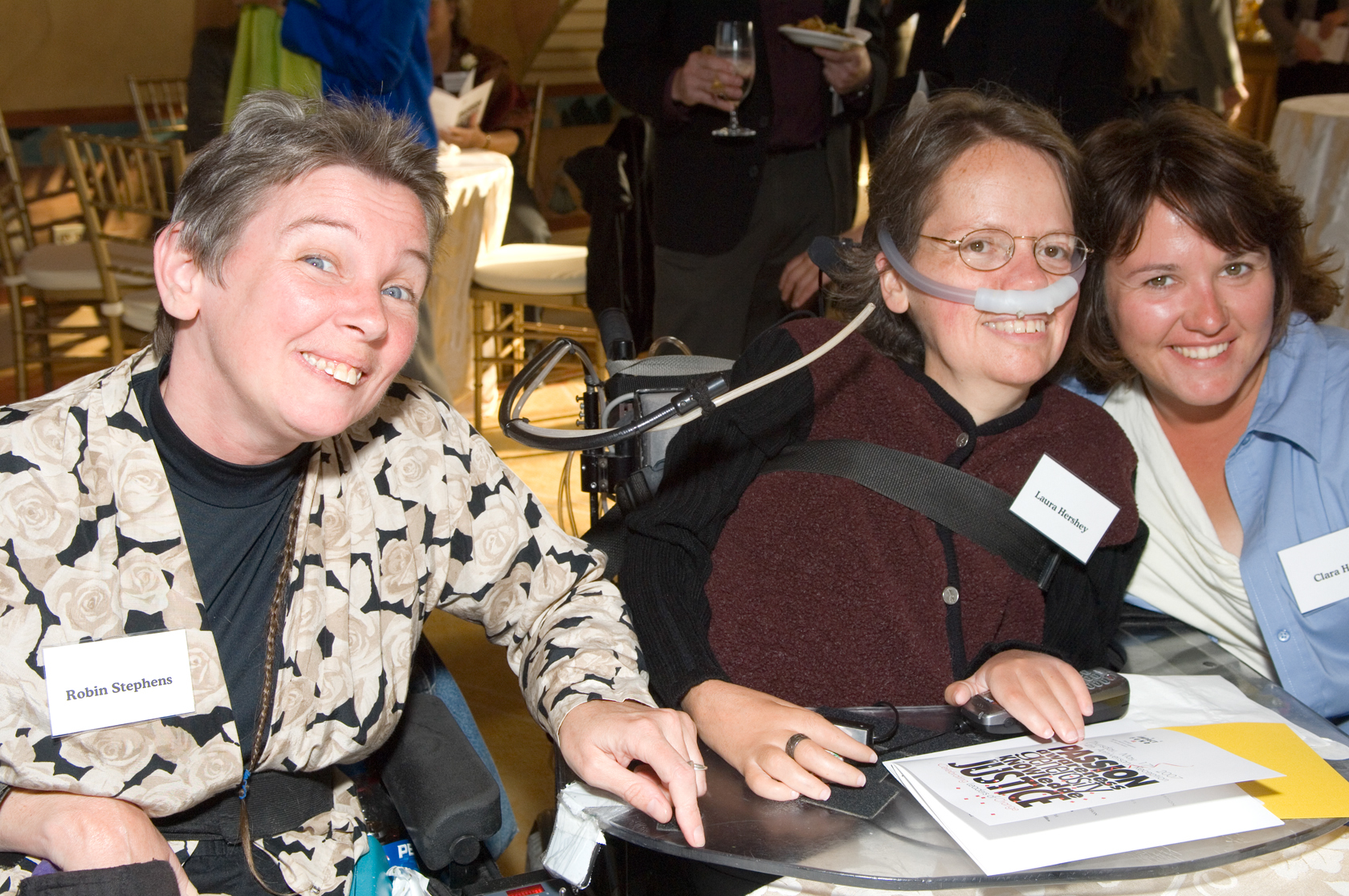
Robin Stephens and Laura Hershey.  [Image: two light skinned women who use wheelchairs.  Robin in a flowered jacket and black shirt with short salt & pepper hair; Laura in a maroon jacket with brown hair using a vent.  With them, is a light skinned woman in a blue shirt.]

if14th-050

Julie Reiskin.  [Image: light skinned woman with glasses perched on top of her head, in wheelchair, hugging a golden retriever dog.]  I suppose I should have chosen a more professional photo of Julie, but Julie and Chinook were besties.

img00010-20100625-1324-arobertsoncreeclaw-org

Haben Girma.  [Image:  dark-skinned woman with long hair, holding a keyboard and reaching out to a German Shepherd dog with a harness.]

haben-girma-feat

Corbett O’Toole.  [Image:  light skinned woman with salt & pepper hair, in wheelchair, speaking into a microphone.]

corbett-speech

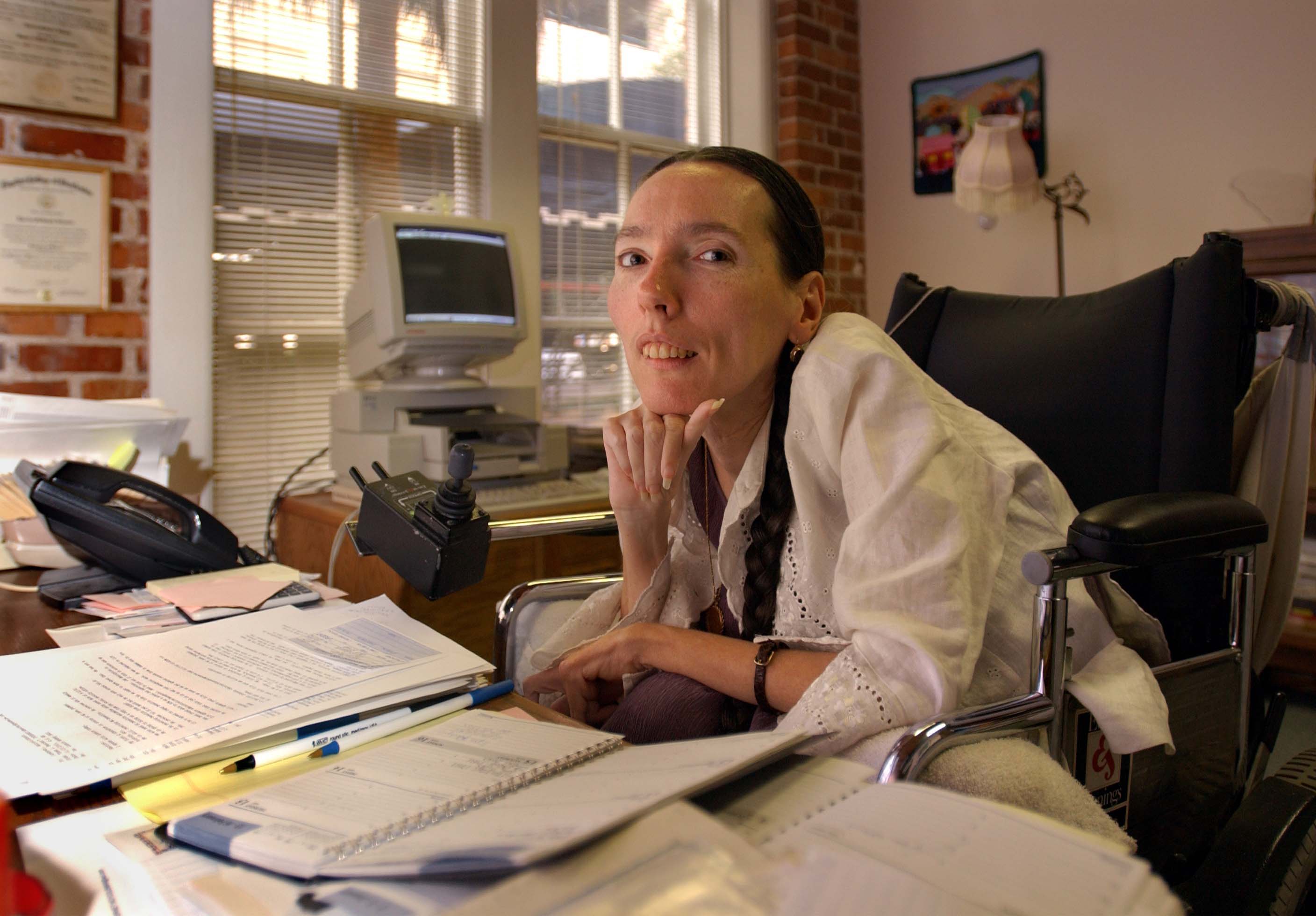
Harriet McBryde Johnson.  [Image:  light skinned woman with two long dark braids, leaning forward in her wheelchair over a desk crowded with papers and books.]

hjohnson

Marilyn Golden.  [Image:  light skinned woman with curly brown hair and glasses.]

marilyn-golden

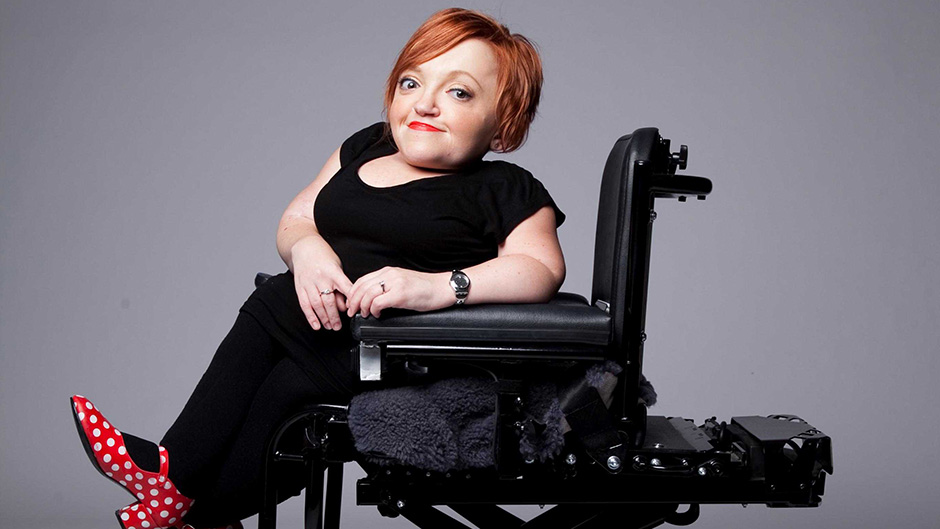
Stella Young.  [Image: small red-haired woman with a black dress and red polka-dot shoes, sits sideways in her wheelchair to smile a the camera.]

stella-young-quote-image-4-data

Tatyana McFadden.  [Image:  light skinned woman in striped tank top, sits in manual wheelchair in front of a set of steps that are painted with her image and the quote, “Anything that a person with disabilities wants to do, they have the right to do, and that can change the world.”]

photo_ada

Ingrid Tischer and Alice Wong.  [Image: Asian woman with glasses wearing a red shirt with white appearing woman with brown hair in blue flowered shirt.]

ingrid-alice

Vilissa Thompson.  [Image: dark skinned woman wearing black shirt in a wheelchair next to President Obama.]

me-with-sen-obama-2008

Lydia X. Y. Brown.  [Image: Asian person in checked shirt with short black hair and glasses speaking into a microphone.]

lydia

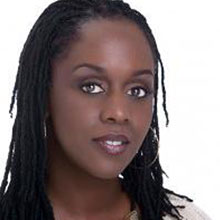
Stephanie Thomas.  [Image: close head shot of dark skinned woman with braids.]

stephanie-thomas1

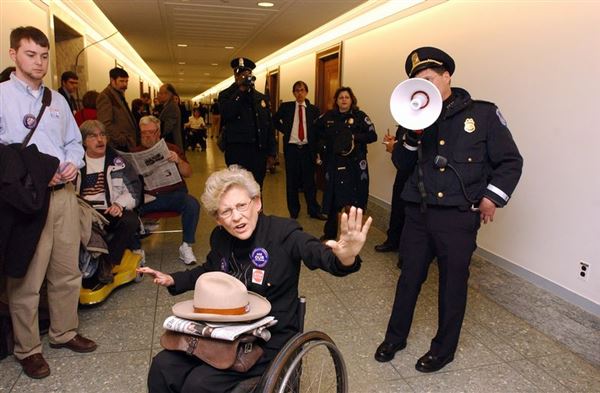
Becky Ogle.  [Image:  white appearing woman with short light hair, in a wheelchair, carrying what appears to be Justin Dart’s hat, surrounded by other people standing and using wheelchairs, and on the right, a uniformed officer speaking into a megaphone.]

ogle


With deepest appreciation for these and many other #persistent women with disabilities.


This . . . for every unpleasant restaurant/access encounter we’ve ever had.

The whole thing is about 1:50, but the fun part starts at 1:21, if you’re really impatient.

From the USA Network series “Complications,” Ep. 6.   Here is a captioned version — in a link, not the original, because I’m not very good at screengrabs and the audio is messed up.

“Valid point, but different conversation, folks.”

There is a lot of overlap between the way cops treat African-Americans and the way they treat people with disabilities.  And in Denver, that conversation blurs into  one about the Denver Sheriff Department’s violence and incompetence.  There are times that call for conversations about overlap and blurring and intersectionality, and there are times we need to FOCUS.  Right now, we need a bit of focus on a specific problem:  the mortal danger of being an African-American — specifically, a young, male African-American — in any action with the cops.

Often discussions of derailing can sound like shutting down.  That’s why I like the way Anita puts it:

Valid point, but different conversation, folks.

Stop Derailing This Conversation! – Musings Of An Angry Black Womyn.

WWJF

Who Would Jesus Fear?

The residents of Indian Village are fighting mad about the potential location of a group home for mentally ill youth in southwest Louisiana’s Allen parish.

“We don’t have a problem helping people,” said 57-year-old resident Beth Courville. “We are a Christian community, a hard-working community.”

“Our fear is fear itself. We don’t know what’s going to be in our backyard,” said Courville. “We would like to stop this nightmare from happening to another community.”

You keep using that word. I do not think it means what you think it means.

My peeps!

My phone only shows the last line in a series of instant messages on the notification screen.  As I was driving yesterday, I saw a message from my friend Carrie:

So I need a couple of judges.  You in?

Carrie is a kickass lawyer and ED of the Center for the Rights of Parents with Disabilities.  She is also very involved in her kids’ schools.  So of course I thought, cool! a moot court!  about disability rights!  maybe with students!

When I next stopped, I was able to read the previous message and discover the august forum in which I was being asked to ascend to the bench:

I have decided we need a disability peeps diorama contest.

Yellow robes, perhaps?  But because it’s Carrie, the Disability Peeps Diorama Contest went from passing thought to reality overnight:

Disability peeps contest

Don’t delay!  You only have a month to create your disability peeps diorama!


Why I love Autistic* women (and you should too). (Guest post!)

[I have been blessed with a guest post by Corbett O’Toole, longtime activist and kickass good writer. ]

My life and disability activism entwined since my early childhood with polio.  I got the good, bad and ugly of the 1950s Poster Child years.**  I got to be the “problem” at my public school (they threw me out after kindergarten because they said my climbing the school stairs would be a ‘liability’), and then an “inspiration” at my Catholic school as the only person with a visible disability (where I climbed 2 flights of stairs everyday).

After I graduated from college, I moved to Berkeley, California with a friend and fell into the Disability Rights Movement.***  We made history (well I just followed along and did what I was told (mostly)).  We got curb cuts on city sidewalks, stopped inaccessible public buses with ADAPT, even shut down HEW director offices in the 1977 Section 504 sit-in.  I saw lots of folks come to Berkeley and then start their own dreams.  It was a time of action (and a whole lot of sex, drugs and rock and roll but that’s another blog).

But by the mid-1980s a lot of disability activism disappeared.  We went mainstream and many folks saw our organizations as service providers not activist centers.  And we started to narrow who was included in “disabled”.  When the first generation of AIDS folks came to our centers, we gave them minimum services (and some places just turned them away).  When the hemophiliac folks started dying from tainted blood, we acted like they were not us and turned away.  Little by little our public face became more about getting public acceptance for specific groups of disabled people (i.e. “us”) and less about disability justice.****

I continued to participate in disability rights work but increasingly I was on the margins – working on queer disabled issues, building bridges with other marginalized crip folks like disabled people of color.  We were not being invited to the official disability tables (not even as token speakers).  Often it felt like the days of serious activism – in your face, on the streets – had passed.

Then I met the Autistic women.  They blew my mind with their honesty, compassion and stunning intellect.  Have you read some of their blogs? I did.  They name injustice.  They call for action.  They help each other out.  They prize kindness. And they are over-the-top smart.

And for their efforts, they are routinely derided, receive hate mail, and are largely ignored (and often shunned) by people in other disability communities.

Here are some of the things I learned from Autistic women (and a few men).  Remember these are folks who are usually excluded from disabled and nondisabled communities; their disability-related needs are ignored; they have no money (or jobs) – yet – they, in my opinion, are leading the way towards disability justice.

SPEAK OUT

Every week there is a news report of an autistic child or adult who was murdered (or nearly murdered) by someone close to them.  In response to the latest one, Alyssa called for a new blog to respond.  Within an hour, a group of Autistics created “Voices for Justice” – a place to fight the public complacency about these murders.

Nearly all the press coverage is ‘explaining’ why the murderer ‘needed’ to kill the disabled person who was a ‘burden’.  There’s been hardly a ripple from the other disability communities – except for the National Council on Disability  – even though this happens with lots of non-autistic disabled folks too.  Here is a great response from Beth Ryan, a parent of an autistic kid.

TAKE CARE OF EACH OTHER

The Autistics I know and follow online acknowledge that there is a lot of diversity among folks so they encourage people to ask for help as they need. They support each other and teach each other successful life survival skills. They also reach out to parents of autistic children.  Elizabeth (Ibby) Grace has a blog just to answer questions from parents.

They created systems to communicate nonverbally.  My favorite is for public spaces like conferences where people use “Interaction badges.” Kassianne explains it best.  Using red, yellow, and green pieces of colored paper we indicate our social availability.  When I am open to social interaction I display my green paper.  If I am feeling less social then I show yellow.  If I am out of juice and need to recharge, I show red.

TELL THE TRUTH

Most of the non-Autistic disabled folks that I know pretend that their disability doesn’t really impact them all that much.  Oh yeah, we complain about our stuff when it’s breaks our patterns – like when a wheelchair breaks – but we rarely talk about what works and doesn’t work everyday for our bodies/minds.

But the Autistic women do talk about this in a much more public way.  Someone might blog about how they can either get work done or clean because they don’t have enough energy for both (I can totally relate to this).  They even created a blog for all the stuff even they don’t like to discuss publicly to help parents of autistic children get some insight, support and strategies.

FIGHTING BACK

They are fighting back against ignorance (“autism = inability to feel empathy”), abuse (electroshocking of young children for “education”) and active annihilation (the murders mentioned above and public “education” campaigns that urge people to “prevent autism before it steals another child”). They challenge the methods and messages of organizations that want to “eliminate autism” (as if it was an scratchy coat) and spread misinformation.

WHY YOU SHOULD TOO

It took me a while to find a bridge into the Autistic world.  Autistic lawyer Shain Neumeier got me started and university professor and Autistic Elizabeth (Ibby) Grace brought me in.  I’m writing this post (THANK YOU AMY) because the kick-ass, fight-back, David-and-Goliath-work these Autistic folks are doing is amazing and needs your support.  They are an incredibly literate bunch and an easy way to find them is through their writings.  It will be well worth your time.  Here’s a taste:

Alyssa Z is a triple major college student (math, engineering and Chinese) who writes Yes, That Too.

Elizabeth (Ibby) Grace is a queer Autistic married mother of two who writes two blogs: Tiny Grace Notes AKA Ask an Autistic and NeuroQueer.

Autism Women’s Network has lots of fabulous writers.

And some great parent blogs:

Brenda Rothman writes Mama Be Good.

Ariane Zurcher writes Emma’s Hope Book.

****************

* I figure that since this is Amy’s blog, I need to follow her protocol and put in as many *footnotes as possible.   I think her record is 5 – I’m hoping to break it.  Back on topic: “Autistic” is the preferred term by many autistic activists.

**  In the 1950s, and for a long time after, children with disabilities were traipsed out like dogs at a Kennel Club show to raise money for organizations run by (and often for) nondisabled people who said they were “helping the handicapped”.  Neither we, nor our families, received any compensation for our ‘performance’.

*** You can read about this history at the Disability Rights and Independent Living Movement Oral Histories.

**** Before you start yelling at me (well, really at Amy since this is her space), I acknowledge that lots of good legislative changes happened because of our ability to be more effective and mainstream.  Lots of college kids got support.  But this blog is about activism and not mainstream stuff.

This is why I never read comments on news stories

On Friday, the judge in our case against Hollister stores and their inaccessible front entrances ordered that the violations be remedied within three years.

Red Alert Politics — “an online publication written by and for young conservatives” — gave the case a straightforward, factual write-up.  There are two comments.  The first is I guess a typical conservative response:  it’s their store; they can do what they want.  Not respectful; not even legal; but plain vanilla conservative.

The second comment was this, by someone designated with a little star as a “Top Commenter”:

yeah well obama is all about controlling and lying…he’ll cost anyone money he can, direct the DOJ to infringe on multiple constitutional rights and keep doing it…

think about this, any speech charge, using what you say in court against you – is against the first amendment, that is saying that you’re freedom is speech can be used against you – that’s a law to the contrary, or the second ammendment – you have the right to keep and bear arms….

article 6 is the supremacy clause and the oath that judicial branches, judges, senators, congressmen, even the president takes….

any charge for a speech or a gun is unconstitutional — ever wonder why when they charge people with murder charges, the gun NEVER EVER comes up? lawyers of that caliber would shit on it….just like america needs to shit on obama, and carry guns, and exercise their god given rights, that their ancestors fought to ensure were protected.

So in response to the fact that Hollister stores will be required to fix their raised front entrances to make them accessible to customers in wheelchairs, we are supposed to “shit on obama and carry guns.”  Ladies and Gentlemen, I present:  Conservative Logic and Spelling 101.