Author Archives: Amy Farr Robertson

Unknown's avatar

About Amy Farr Robertson

Civil Rights Lawyer. Dog Lover. Smartass.

This guy is tasked with public safety?

I personally believe in Jesus Christ as my lord savior, but I’m also a killer. I’ve killed a lot. And if I need to, I’ll kill a whole bunch more. … If you don’t want to get killed, don’t show up in front of me, it’s that simple. I have no problem with it. God did not raise me to be a coward.

via Ferguson-Area Police Officer Suspended After ‘Killer’ Rant Surfaces Online.  He apparently rants on along these lines, on the video, for an hour or so, largely missing the point of the whole “Christianity” thing.  And the whole “protect and serve” thing.

This guy is a cop, and a member of the “Oath Keepers, the right-wing law enforcement group that is aligned with the Patriot movement.”   A quick (and slightly toxic) visit to their website reveals that “Oath Keepers” are a collection of police and military types who believe their “oath” to their interpretation of the constitution gives them the right to do things like not do their jobs and shoot random people who do not share their interpretation of the constitution.*

They have a list of orders they will not obey, including executing warrantless  searches (good), disarming Americans (potentially bad, if the armed American is threatening to kill someone), and wildly paranoid:

We will NOT obey orders to invade and subjugate any state that asserts its sovereignty and declares the national government to be in violation of the compact by which that state entered the Union.

We will NOT obey any order to blockade American cities, thus turning them into giant concentration camps.

Whew!  Glad we cleared that up.  And good to know that when Texas finally secedes, no one will try to stop them.  Buh byeeeeee!

I do appreciate that this group is a big fan of Edward Snowden.  So they exist in that special place where the extreme right and extreme left of the political spectrum meet up in shared paranoia and megalomania.

I guess we’ve always known that certain subsets of law enforcement view themselves as creating, interpreting, and executing the law; it’s more than a bit frightening to think those cops have a self-aggrandizing club where they can encourage and reward each other for doing so.

*********

* Based on their logo, this may or may not be caused by the emotional trauma of having very long but very thin penises:

Image: silhouette of man holding long gun, which also looks like he has a very long, thin penis protruding from his midsection.

Holly’s First Trip to the Dog Park

Image:  photo of golden retriever sitting in the sun panting.

With her friends Quince

Image: photo of coon hound mix, sitting in the sun.


and Mocho

Image:  photo of muddy havanese dog with tennis ball in his mouth.


And my attempts to coax her to swim.  (Thanks for the photos, Cara!)

“Come, Holly! Come on! Here! Give it a try.”


Image:  photo of woman in yellow fleece and khaki shorts standing in a pond trying to coax a golden retriever into the water.


“Aw, geez. You’re a retriever for Pete’s sake.”


Image:  photo of woman in yellow fleece and khaki shorts standing in water with her arms outstretched.


“See:  all these other dogs like the water! [And the treats I was trying to bribe you with.]”


Image:  photo of woman in yellow fleece and khaki shorts standing in water, surrounded by a large grey great dane, a smaller golden-doodle, and the coon hound; the golden retriever watches from the shore.


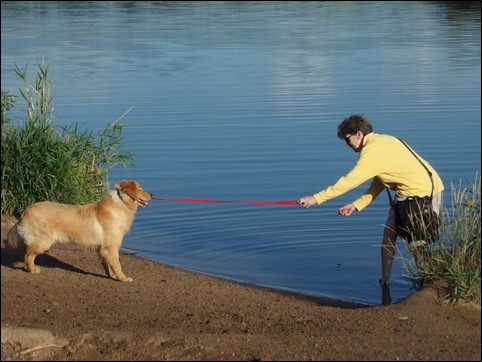
“Let’s try this pond . . . and a leash.”


Image:  photo of woman in yellow fleece and khaki shorts standing in water holding the leash of a golden retreiver, attempting to urge the dog to come in the water.


“Good dog!”


Image:  photo of woman in yellow fleece and khaki shorts standing in water now up to her knees, coaxing the golden retriever to come in up to her haunches.  The havanese happily swims in the lower part of the photo.


Image:  close up of the golden retriever, on her leash, standing in the water up to her haunches.


Image: photo of golden retriever running toward the camera with her tongue out.


THE END

Image:  photo of the backside of a coon hound.

“Valid point, but different conversation, folks.”

There is a lot of overlap between the way cops treat African-Americans and the way they treat people with disabilities.  And in Denver, that conversation blurs into  one about the Denver Sheriff Department’s violence and incompetence.  There are times that call for conversations about overlap and blurring and intersectionality, and there are times we need to FOCUS.  Right now, we need a bit of focus on a specific problem:  the mortal danger of being an African-American — specifically, a young, male African-American — in any action with the cops.

Often discussions of derailing can sound like shutting down.  That’s why I like the way Anita puts it:

Valid point, but different conversation, folks.

Stop Derailing This Conversation! – Musings Of An Angry Black Womyn.

Thinking Holly should try out for the position of Cornerback.

I hear the Broncos could use some help with their pass defense. 


Paging John Fox!  John Elway!

This next play results in an incomplete pass — possibly the quarterback’s fault — but lots of cute puppy interaction!

Why is it OK to be a trans man or trans woman but not . . .

So just the other day, I was lecturing radical feminists never to question anyone’s identity as a woman, even if she was born with guy parts.  In that post, I posed what I thought was a rhetorical question.

Could a white person declare himself black in the same way a person born with female parts can declare himself to be male? Can I decide to be disabled without actually having a physical or mental impairment that substantially limits one or more major life activities?

If I should have learned anything in 53 years, it’s that there are no questions rhetorical enough that someone somewhere won’t answer, “yeah — that’s me.”

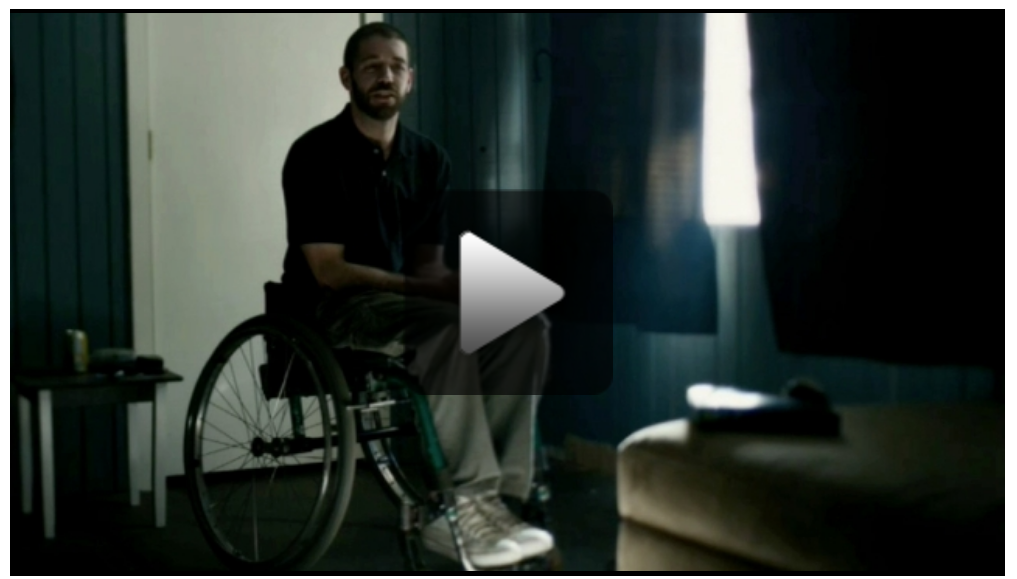
Meet Chris. He is not a person with disabilities, but nonetheless identifies as one and sits in a wheelchair whenever he can without giving his secret away to the people that know him. On last night’s episode of Showtime’s documentary series 7 Deadly Sins (this week’s sin: envy), Chris shared his story.

“I identify as a guy in a wheelchair,” he said. “I feel like I have the wrong body. I feel like I’m supposed to be disabled. What I want my life to be like is what is the detriment of a lot of people’s lives, the worst thing that’s ever happened to them, and I think it would be the best thing that ever happened to me.”

image

I feel fairly strongly that this is wrong, just as a white person declaring himself to be black or have a black identity is wrong. I’m just having a hard time articulating a principled reason why.

I support the rights of trans men and trans women to be the ones to tell us what gender they are, rather than having that be dictated by the body parts they were born with or what society thinks they should be.  And I have no problem if a person of one religion converts to another, and adopts a new identity wholesale.

Then there are those (Obama; me) born into two identities (black/white; Jewish/Protestant) who essentially get to choose — one; the other; or both — which choice is generally respected.

Yet we clearly have a set of negative judgments for people of a privileged status (white; nondisabled) adopting and asserting an identity as a less-privileged status (black; disabled) and a different set of negative judgments for the reverse (a black person deciding to identify as white; a disabled person identifying as nondisabled).  In the first situation, we use words like “wannabes” or “appropriation” or — in an article in New Mobility — “pretenders;” in the latter, “oreos,” “bananas,” or “passing.”

So, uncharacteristically, I don’t have an answer, or even a working hypothesis.  Why is it OK for a person born with male parts to identify as a woman, for a Christian to convert to Judaism, or for a person born in a mixed marriage to choose either identity or both, but not for Chris to identify as a person with a disability?


Summer Camp 1973

When I saw Mighty Girl’s post on Rosie’s Girls summer camp, “a trades exploration day camp for school girls” where girls can learn welding, carpentry, auto repair, etc., I was moved to comment (on Facebook) that I wish this had been an option for me instead of figure skating camp. I thought I’d expound.

Yes, figure skating camp. But first, I got to spend a summer attending the Flint Hill Day Camp, where (IIRC) we spent up to six hours each day making plastic lanyards. I’m confident that there must have been other activities, but that’s the only one I recall. I loved it just as much as you would expect a nerdy introvert to love engaging in six hours a day of non-book-oriented activities with random unfamiliar kids.

By the time I was 12, I was launched on my figure skating career, which was ultimately as successful as you would expect for a klutzy nerdy introvert, but did provide good money-making opportunities in college, teaching private lessons to local kids. But back to skating camp. In 1973, there was no year-round ice rink in the DC area, and the Skating Club of Wilmington ran a summer program for skaters of a wide range of abilities, from Olympic trainees to klutzy kids from locations without year-round rinks.  So off I went.

Image:  The side of a building, painted white, with large letters spelling out "Skating Club of Wilmington."

Activities consisted of skating, hanging around the skating rink, and hanging around the dorm. When I think of the sort of enrichment and structure that my friends expect from their kids’ camps these days, I don’t think they envision the sort of enrichment and structure the Wilmington summer skating program dorm provided:

Image:  young white woman in a white halter top shirt is sitting on the top bunk of a bunk bed with a white man, 20-30 years old, wearing a Budweiser t-shirt and jeans, and drinking from a can of Budweiser beer.Image:  white man, 20-30 years old, wearing a Budweiser t-shirt and jeans, and holding a can of Budweiser beer shares a chair with a young white woman in a white halter top shirt.

The back of the photo reads, “Laurie and Dr. John.”  So, yes, one of my dorm-mates — already much older than me — had a much older, beer-drinking boyfriend who had dubbed himself “Dr. John.”

What’s amazing is that — at 12 — I wasn’t even the youngest kid living parentless in this enriching environment.

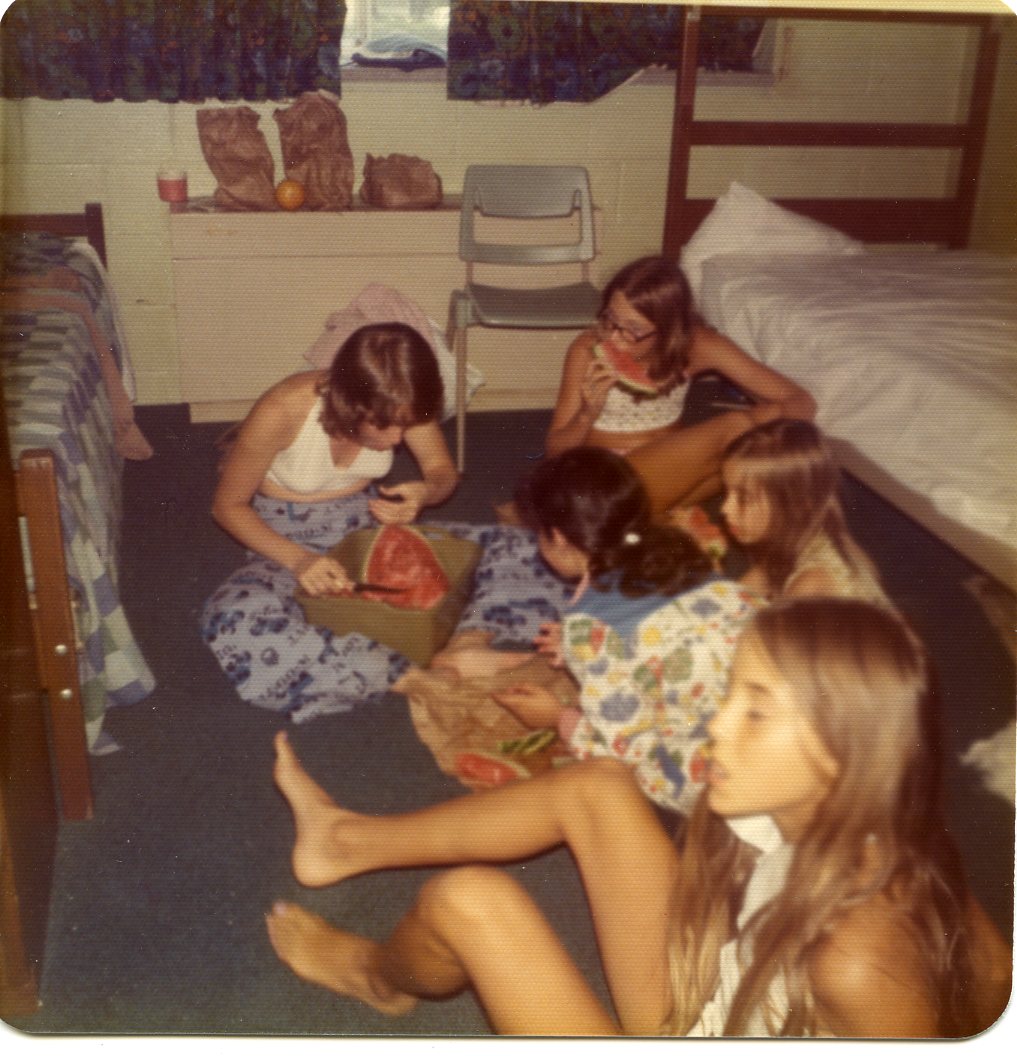
Image:  white woman in white halter top sitting on the floor of a dorm room eating watermelon and sharing it with four young white girls, apparently ranging in age from around 7 to perhaps 12.

More of my hall-mates.

Image:  group photo in a dorm hallway, including 7 white girls ranging in age from 12 to 20, a 20-30 year old man (Dr. John), and a black teen-ager.

The back of that photo reads, “Laurie, Jill Cosgrove, Carrie Applegate, Amy Keilly, Bruno, Patti Downst.”  Through the miracle of Google, I learn that Jill Cosgrove went on to have a successful career as a figure skater and choreographer.   Couldn’t find the others.

Since I was the photographer, there are — sadly — no photos of me.  Wait, what?  No.  That’s not me.  No way.  Seriously?

Image:  two approximtely 12-year-old white girls in pyjamas in a dorm room, one sitting on a bed, the other standing by a desk with a toothbrush.

I also found this one, of me with my coach, Uschi Keszler, whom I totally idolized and who turns out — who knew?* — to be minorly famous herself, complete with Wikipedia page.

Image:  white woman with short, frosted white-blond hair, perhaps 30 years old, wearing a tourquoise polyester suit jacket with a young white girl with brown hair holding a stuffed lobster plush toy.

Yes, I’m holding a toy lobster.  Deal with it.

I tend not to have very fond memories of the whole skating camp experience.  It was my choice — my parents were not stage parents, though God knows the skating world had plenty of those — but in retrospect I’ve come to believe that neither the program nor figure skating in general was a very healthy experience.   It was a world that encouraged kid vs. kid (generally girl vs. girl) competition, with no sense of teamwork.  We heard rumors of kids ruining each other’s skates or program tapes before big competitions.  And, at bottom, I just sucked at it.  So wish there had been a Photography and Reading for Introverted Klutzes camp.  My peeps!

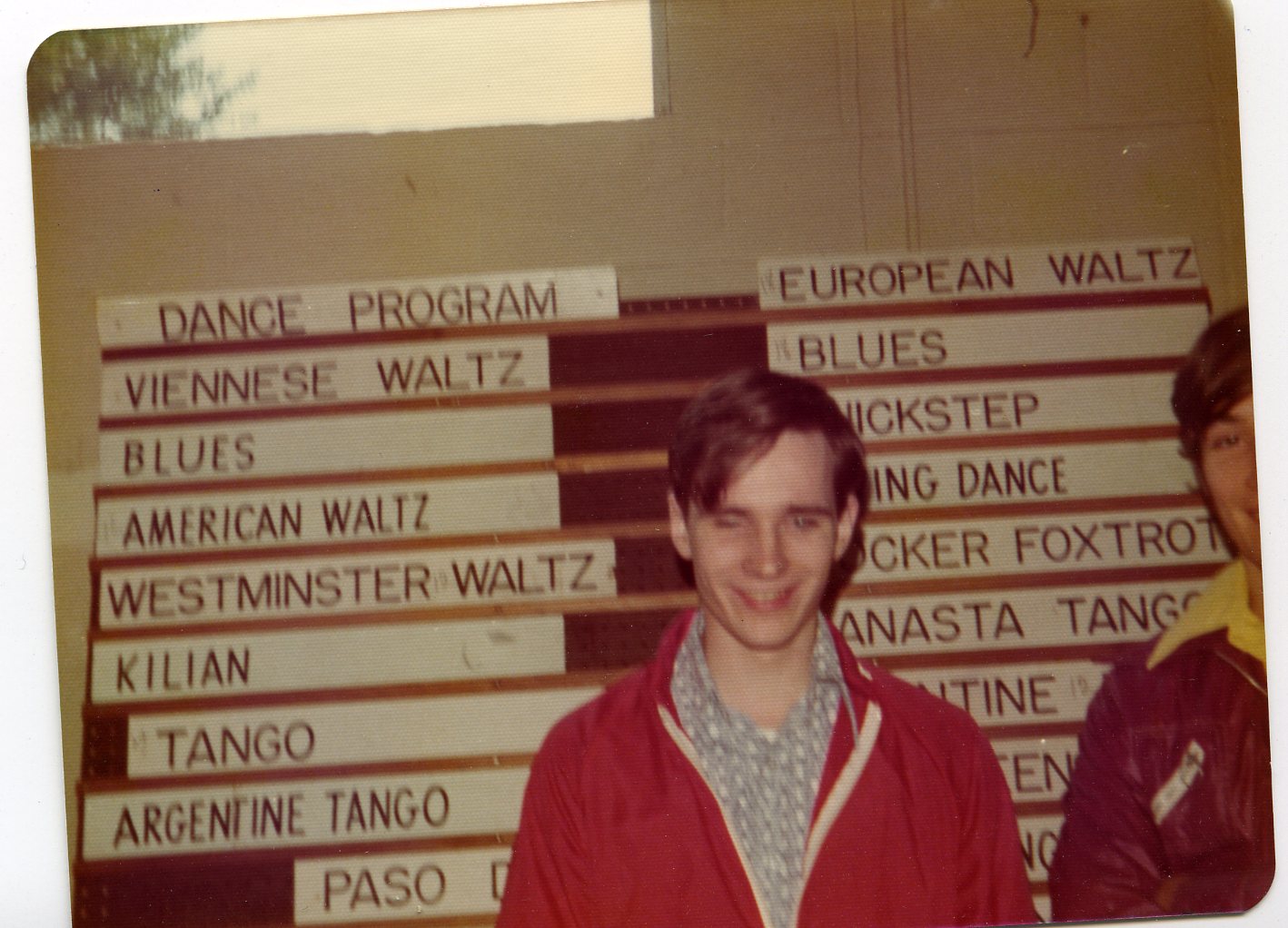
But going back through the photos made me remember a couple of other cool things (besides the early introduction to wardrobe-coordinated beer drinking).  Wilmington, in 1973, had a number of blind skaters.  One, Stash Serafin, shown here in my 1973 photo,

Image:  Young white man in patterned shirt and red warm-up jacket poses in front of a sign-board listing dances by name ("waltz, tango, blues").


has (thanks again, Google!) gone on to have a successful skating career.


And finally, in 1973, you could get an entire basket of fries for 35 cents!

Image:  snack bar with white woman in apron behind the counter.  Sign reads French Fries 35 cents.


********

*Well, I suppose many Germans whom she represented in the Olympics knew, but I was stunningly unaware of who she was.  In retrospect, I can only imagine her thinking — watching me skate — “I left my homeland for THIS?”


Available for Adoption: One reasonably devoted baseball fan.

Since the recent attempt to sell the Rockies on Craigslist* and my attempt to convince my brother to undertake a humanitarian venture capital mission to purchase the team have both apparently failed, I’m forced to put my fandom up for adoption.

My ad:

Born a Washington Senators fan.  Orphaned in 1971.  Short foster team relationships with the Baltimore Orioles, Richmond Braves, and Minnesota Twins.  Genetic fandom of St. Louis Cardinals.  Adopted by the Colorado Rockies in 1995.  Abandoned in 2014.

Can explain the infield fly rule, but cannot tell one pitch from another.  Willing to bring ancient baseball mitt to games.  Prefers high-scoring home-run-intense games to pitchers’ duels.  Needs playing field with good views and decent beer.  Will not do “the wave.”  Will check scores on CBS Sports app during dinner when result actually matters.  Prefers team with owner who gives a shit, preferably two, and sufficient front-office talent to spell players’ names correctly.  Willing to wear team colors, paint toenails to match.  Currently in possession of and routinely wears Elway jersey and old-logo Broncos sweatshirt.  Not afraid of face paint for playoffs.

Image:  Photo of white woman's face, smiling, with short brown hair and the logo of the Colorado Avalance (a maroon A with a swoop of white snow) painted on her face.

In other words, loyal to team that earns it.

Please contact the Fan Adoption Agency to set up a homestudy.

*******

*  Craigslist took down the ad, but Westword got the screenshots.

Image: Screenshot from Craigslist ad: "Barely use Major League Baseball team, taxpayer financed stadium - $575 (20th & Blake)" with a photo of a baseball stadium and a map showing 20th and Blake Streets in Denver.

Peter Singer and the TERFs: We Know You Better Than You Know Yourself

And we want to make pejorative, exclusionary and — in Singer’s case — homicidal* decisions based on our superior knowledge of your inner state.

I had just written my random thoughts on the importance of trans* [**], Autistic and other former others rejecting the default setting, and my view that this made it easier for all of us “to be who we are and find or create our own cubbyhole, or none, or multiple,” when the New Yorker published “What is a Woman?” by Michelle Goldberg, an article describing the anti-trans* faction of “radical feminism” called, variously, Radfems or — more pejoratively but accurately — “trans-exclusionary radical feminists” (“TERFs”).

But what truly reminded me of Peter Singer was the TERFs’ certainty that they know the inner life of trans women and trans men. One Sheila Jeffreys has written a book, “Gender Hurts: A Feminist Analysis of the Politics of Transgenderism,” in which she proclaims her knowledge of and judgment on the inner life of trans men and trans women by seeing them entirely through the political prism of male-dominated society. A man, per Jeffreys, can never appropriate the experience of being a woman. Accordingly, Jeffreys “insists on using male pronouns to refer to trans women and female ones to refer to trans men.” To her, trans men are simply trying to “raise their status in a sexist system” while trans women, well, “when trans women ask to be accepted as women they’re seeking to have an erotic fixation indulged,” or — according to the psychology professor on whose work she relies — trans women have “‘autogynephilia,’ meaning sexual arousal at the thought of oneself as female.”

So Jeffreys and other TERFs — cis women all — have decided that they know the inner life of trans people better than trans people themselves do, and not only pontificate about this in writing, but ultimately reject trans women as women, refuse to use their preferred pronouns, and in some cases exclude them from women-only spaces.

This is rank Singerism. Peter Singer is a Princeton professor who believes that, well, I’ll let Harriet McBryde Johnson describe it:

Applying the basic assumptions of preference utilitarianism, he spins out his bone-chilling argument for letting parents kill disabled babies and replace them with nondisabled babies who have a greater chance at happiness. It is all about allowing as many individuals as possible to fulfill as many of their preferences as possible.

In other words, privileged white male Princeton professor asserts that he knows with such certainty the inner life of people with disabilities that he advocates killing them as infants. To me, Singerism means making policy — usually negative — based on the facially impossible premise that you can know and pass judgment on someone else’s inner life. Singer can never know how happy any particular person is or will be, much less disabled infants he’s never met. Jeffreys and the TERFs have no idea how trans women experience their lives and their identities.

Where the fuck do they get off deciding to kill, insult, and exclude people based on these arrogant and patently impossible judgments?

Jeffreys claims that cases of “regret” — people who have physically transitioned and later regretted the move — “undermine[ ] the idea that there exists a particular kind of person who is genuinely and essentially transgender and can be identified accurately by psychiatrists.” Well, it might undermine that idea for the person experiencing regret but how it undermines the self-knowledge — often hard-won — of everyone who has ever transitioned is hard to see. More Singerism.

The New Yorker article describes one TERF group, Deep Green Resistance, as holding the view that “a person born with male privilege can no more shed it through surgery than a white person can claim an African-American identity simply by darkening his or her skin.” I suppose that may mark the far outer boundaries of my “Free to Be You and Me” approach to identity, that is, that we should credit people with knowing themselves and defer to the identity each asserts. Could a white person declare himself black in the same way a person born with female parts can declare himself to be male? [2024 note: this was a year before Rachel Dolezal caught everyone’s attention.] Can I decide to be disabled without actually having a physical or mental impairment that substantially limits one or more major life activities? When does the assertion of identity become appropriation? I think we avoid Singerism by saying (1) we don’t know; and (2) we have no business killing, insulting, or excluding people based even on identities that push the boundaries of credibility.

It is reassuring that TERFs find themselves marginalized in feminist and academic circles, though frustrating that Singer is not similarly ostracized. It is apparently more acceptable to mainstream academia to advocate killing disabled infants than it is to advocate excluding trans women from all-female music festivals.***

I conclude with this quote from the New Yorker article:

Older feminists . . . can find themselves experiencing ideological whiplash. Sara St. Martin Lynne, a forty-year-old . . .

Hold on! “Older” and “forty-year-old” do not go together!  But assuming that “older feminist” would accurately describe this 54-year-old, I experience no whiplash, but only a deepening appreciation for each way we let people be themselves, and each mind-opening step we take away from the default setting.

Update: Here is an excellent response to the New Yorker article, in Bitch magazine.****  TERF War: The New Yorker’s One-Sided Article Undermines Transgender Identity by Leela Ginelle.  Lots of good points about the the TERF problem, though I disagree that the original article undermined transgender identity.  I thought it was fair, and that the TERFs were portrayed as the narrow-minded troglodytes that they are.

Update 2:  Julia Serano, who is mentioned in Goldberg’s article, has an informative rebuttal in The Advocate.  Here is my comment:

This is an excellent rebuttal to the New Yorker piece, but reading this & the rebuttal in Bitch made me wonder whether we read the same original article. First, though, I agree that Julia Serano has every right to feel personally pissed. But while Goldberg clearly skates over the surface of a complex issue, and probably did sensationalize the feminist catfight angle, I thought the TERFs came off in her article as deeply misguided, insular, and hateful. Specifically the reference to “autogynophilia” seemed to me like a self-evidently hysterical use of scientific-sounding Greek word roots to disguise abject quackery. All that said, Serano’s response adds a great deal of useful detail; would be great if The New Yorker published it.

*******

* I was going to say “life-threatening” but Singer doesn’t just want to threaten the lives of disabled infants, he wants to permit people to kill them. Let’s call it what it is.

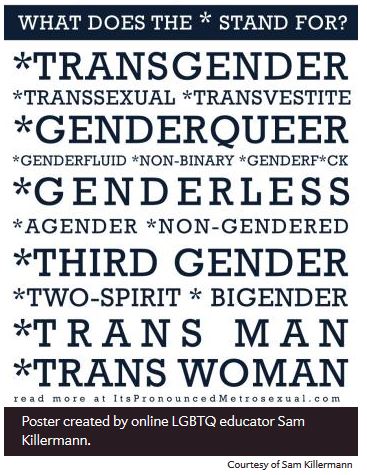
** “Trans*” is a way of indicating a wide variety of trans ways of being. As Slate explains, “the asterisk stems from common computing usage wherein it represents a wildcard—any number of other characters attached to the original prefix.”

Image: Graphic that reads, "Trans*. I recently adopted the term 'trans*' (with the asterisk) in my writing. I think you should, too. If it's new to you, let me help clarify. Trans* is one word for a variety of identities that are incredibly diverse, but share one simple, common denominator: a trans* person is not your traditional cisgender wo/man. Beyond that there is a lot of variation. What does the * stand for? *Transgender, *Transsexual, *Transvestite, *Genderqueer, *Genderfluid, *Non-binary, *Genderf**k, *Genderless, *Agender, *Non-Gendered, *Third gender, *Two-spirit, *Bigender *Transman *Transwoman" Poster created by online LGBTQ educator Sam Killerman.This can get confusing here, in light of the fact that the ThoughtSnax Style Manual calls for asterisks for footnotes.  We’ll muddle through.

*** The article noted that violence and threats have been directed toward TERFs, which is of course deeply offensive and wrong . . . except the graffiti “Real Women have Dicks,” which is just the sort of smartass, mind-opening civil disobedience I love.

**** Of course I read Bitch Magazine — it’s my trade publication!

Two more reasons I love this country.

Two articles from Talking Points Memo:   “Topless Texans Spar with Open Carry Activists: ‘Boobs for Peace!‘”


Image:  Photo of topless woman showing her head (wearing straw hat with feathers) to the tops of her breasts.  Headline reads "Topless Texans Spar with Open Carry Activists: 'Boobs for Peace!'"


And “Satanists Cite Hobby Lobby for Exemption from Anti-Abortion Laws.”

Image:  Satanic symbol with the headline "Satanists Cite Hobby Lobby For Exemption from Anti-Abortion Laws."

Veterinary euphemism.

Last week, our sweet little puppy, Holly,

Image: photo of golden retriever puppy's face, close up.

hunted down, killed, and partially consumed a bird.  So while that photo may look cute, it’s really a MUG SHOT.  This has predictably caused stomach problems of the kind that has me running after her with a roll of paper towels and a bottle of Nature’s Miracle.*  The problems became serious enough by yesterday (I’ll spare you why) that we took her to the vet, who asked, “how long has it been since her dietary indiscretion?

Which means, apparently, “how long since she ate weird shit.”

But I love the new terminology!  Here, I’ll use it in a sentence:  “No, I didn’t eat the entire bag of potato chips.  I merely committed a dietary indiscretion.

The term could be especially useful for Tim, who regularly commits dietary indiscretions by pouring A1 sauce — often followed by hot sauce and salad dressing — on random food:  pasta; salad; cereal.  (Love you!)

So while few of us are indiscreet enough to prey on innocent but apparently disease-ridden birds, I thought the term was useful enough to escape its veterinary origins for wider application.

Holly  is now on the mend on antibiotics and a “bland diet” which is vet-speak for “foul-smelling glop in a can.”**

********

* While this may sound like something that cures cancer or allows humans to fly, it is in fact just a cleaning fluid that removes dog poop stains and odors, which is, indeed, sort of miraculous when you have a puppy.

** Originally typo-ed “fowl,” which would send Holly all the wrong messages in this situation!