 ‘
‘
Note the warning at the beginning. Nevertheless, countdown to FoxNews meltdown in 3, 2, 1….


‘
Note the warning at the beginning. Nevertheless, countdown to FoxNews meltdown in 3, 2, 1….
In 1975, the plaintiffs — four public inebriates and one taxpayer — brought a class action suit against various governmental entities in the City and County of Los Angeles to challenge the prosecution of public inebriates under California’s public intoxication statute.
Sundance v. Municipal Court, 192 Cal.App.3d 268, 270 (1987).
You lawnerds know what I’m talking about: to have standing to challenge a law punishing public inebriates, you have to identify as a public inebriate. QED.

Keep clicking, people! We can make it to 6,811,404!
(h/t Gail.)
I’m “with the passenger in a wheelchair” or perhaps “with the passenger who uses a wheelchair,” or most accurately, “with the hot guy using a wheelchair.”
But I guess this makes the distinction clear:

If you are a “wheel chair” or a stroller, you are not a “passenger.” You are your equipment.
And airline people, you don’t have “two wheelchairs on the plane.” As a matter of empirical fact, you have zero wheelchairs on the plane. You have two people who use wheelchairs who are waiting patiently on your plane for the doofuses (doofi?) in your ramp crew to figure out how to get their wheelchairs to the jetway.
I realize there are other circumstances in which an object associated with a person comes to stand for the person. “Suits” comes to mind, to mean the dweebs in the organization who are imposing rules on the real people who want to create/get things done/think outside the box. It’s not a compliment. “Brass” for officers, perhaps. “Uniforms” to distinguish beat cops from higher ranking detectives. I would put “wheelchair” as a substitute for the person in a very different category, though, largely because I only hear it from people in a position to treat the people themselves as objects.
I don’t take a position on the people-first language discussion, that is, whether it is better to say “disabled person” or “person with a disability.” Both seem better than “the disabled,” but as my disabled friend/friend with a disability Laura Hershey would say, English puts its adjectives before its nouns, so “disabled person” puts the focus on the person, it just does so grammatically.
But once you’ve taken the person out of the equation completely and substituted the thing, you’ve left the realm of grammar and made a decision to depersonalize.
The funny thing is, I always respond — when I hear this — “no I’m not with the wheelchair, I’m with the guy in the wheelchair” or to the airline peeps, “actually, you don’t have two wheelchairs on board, you have two people who use wheelchairs.” But no one even gets the difference.
Sigh.
[Cross posted at FoxRobBlog, which is involved in some sort of DNS attack. Whatever that is.]
In Yates v. Sweet Potato Enterprises, Inc., 2013 WL 3662645 (N.D. Cal. July 12, 2013), the plaintiff — a guy who uses a wheelchair — alleges that he encountered barriers at a Popeyes restaurant. In the order, the judge addresses questions from both the plaintiff and the defendant about what evidence can be used at trial. In so doing, she does two things that are stunning individually, but that — taken together — turn the plaintiff into the defendant, defending his right to equal access to the businesses that non-disabled people patronize everyday without a second thought.
First, the court grants the defendant’s motion to exclude “sympathy-inducing evidence regarding Plaintiff’s disability” that is not directly relevant to his experience at Popeyes, including “testimony regarding his day-to-day hardships.” The court just doesn’t see how that’s relevant.
Second, the court denies the plaintiff’s motion to exclude evidence that he has filed a large number of other access lawsuits.
Pause.
If people who use wheelchairs filed a lawsuit challenging every illegal barrier they encountered each day, most would file — I’m guessing — five to ten lawsuits each day. Instead, most people go about their days, swearing at the illegal and thoughtless barriers, but without the time or resources to file those tens and eventually hundreds of lawsuits. A brave and energetic few take the time to bring the lawsuits that remain necessary — twenty years after the effective date of the ADA’s architectural provisions and thirty years after California’s — to achieve a modicum of compliance. For their trouble, these people are dubbed — in the press and in court — “serial litigators.”
The Ninth Circuit — the court with appellate authority over the Yates court — has recognized the role of these brave and energetic people in enforcing the law:
Courts must tread carefully before construing a Disability Act plaintiff’s history of litigation against him. As we have noted more than once, “[f]or the [Disabilities Act] to yield its promise of equal access for the disabled, it may indeed be necessary and desirable for committed individuals to bring serial litigation advancing the time when public accommodations will be compliant with the [Disabilities Act].” We must therefore be “particularly cautious” regarding “credibility determinations that rely on a plaintiff’s past [Disabilities Act] litigation.”
Antoninetti v. Chipotle Mexican Grill, Inc., 643 F.3d 1165, 1175 (9th Cir. 2010) (internal cites omitted; emphasis — though not nearly enough — added). One of the cites I pulled out to make that quote more readable was Sam Bagenstos’s excellent article The Perversity of Limited Civil Rights Remedies: The Case of “Abusive” ADA Litigation, 54 UCLA L.Rev. 1 (2006).
So despite the fact that the Ninth Circuit has instructed courts to be particularly cautious about credibility determinations relying on past litigation, the Yates judge — without citing Antoninetti — holds that
Plaintiff’s filing of well over a hundred disability lawsuits in which he alleges identical injuries bears directly upon his credibility. . . . Plaintiff’s alleged scheme to generate income through the serial filing of lawsuits in an effort to extract settlements from businesses, may, in fact, be probative of his credibility.
More than simply disregarding controlling precedent, this decision has the very immediate and apparently intended effect of converting Mr. Yates from a real, live person who navigates his day to day world in a wheelchair to a greedy serial litigant, judged on the fact that he has filed other complaints, the legitimacy of which he will likely not be able to prove before the jury. (This question is not addressed in the decision, but my strong guess is that the defendant will be allowed to show the fact of hundreds of lawsuits, while the plaintiff will not be permitted to show that, in each one, the facility in question was indeed out of compliance. That would, in essence, require hundreds of mini-trials within this single trial.)
On another level — about which I’ll write more later, as I have to get back to the other outrages on my desk — this is part of the broader scheme on the part of the business world to spin the fact that — 20-30 years after the federal and state standards took effect — there is still massive noncompliance. When you’re really really wrong, accuse the other guy of “serial litigation” to correct your many many failures.
I drove from Boston to Portland (almost) without directions, got lost, swore, got back on Rte 1A, and applied suntan lotion by pouring it on the dashboard and then daubing it on my face.
Also so glad I get to spend the weekend with his brother (my uncle) and his family — for my awesome cousin’s wedding shower. He’d be so proud, Carey!!

Miss you, Dad!
First, a confession: I am the farthest thing from a cyclist.* I own a clunky purple bicycle with upright handle bars and two scruffy panniers. I ride not in spandex but in dorky jeans with one cuff rolled up or — even more fashionistically — rubber-banded. My cycling is limited to a one mile radius of my house, and consists 90% of biking to meet with my co-counsel at the University of Denver law school (.5 miles) in good weather.**
I’m providing this long-winded disclaimer because I’m about to go ballistic in defense of cycling.
WTF is it about cycling that makes conservatives so irrational? I mean, more irrational than usual.*** I blogged earlier about one Dorothy Rabinowitz who believed that a privately-sponsored bike-share program was a totalitarian plot to “begrime” the city of New York.
After Ms. Rabinowitz was widely ridiculed — including a Daily Show segment — she responded. As I’m sure you’ll be shocked to learn, the rationality quotient was not noticeably higher than in her earlier rant. Ask the police, she said, “[t]hey know the . . . helpless screams.” Helpless screams? Of bicycle victims? As my cousin Sproule pointed out — in my first guest post!**** —
of the 136 pedestrians killed in NYC in 2012, NONE were reportedly killed by cyclists, but all of the 155 pedestrians and cyclists killed in NYC traffic in the same year (15,465 were injured) were killed by motorists
But Sproule is probably just one of those cyclists “careening down the sidewalk in all of his splendid self-affirming environmental helpist mood . . .” “Helpist?” “Helpist???” You know when a conservative puts an “ist” on the end of a word, that means it’s a bad thing, so we’ve reached the apotheosis of Randian libertarianism, I guess, when helping is a bad thing.
“Hi. Can I give you a hand with that?”
“Back off, helpist scum! Stop trying to spread your insidious helpism. It’s a slippery slope to thoughtfulism and considerationism.”
But The Divine Ms. R isn’t alone in her irrational anti-bike freak out. Apparently L.A. is thinking of creating bike lanes. Cue right wing talk radio:
Look at these bicyclists, as if they belong to a bizarre cult that worships two-wheel transportation, not a traditional God, not Jesus or Allah, or Jehova, not the Father, Son, and Holy Spirit, they’re like a pagan group, but they don’t even worship trees. Or nature. But they worship two-wheel transportation. And they have their vestments that they wear, their skintight brightly colored clothing, that you don’t see anywhere else, just like in church … you only see this kind of clothing when they’re on the bike in the midst of their worship. They want to be in a special cult.
…
This is oppressive. I mean, we’re being held hostage by a minority. It’s the tyranny of the micro-minority here.
Luckily
there comes a tipping point where drivers are going to stop putting up with this garbage. Toll lanes. Carpool lanes. Bike lanes. Everything but lanes for cars where we can drive freely.
That’s right, let’s stop the fascistic imposition of bike lanes and carpool lanes on our naturally-occurring, capitalistically-financed, individualistically-maintained, Ayn-Rand-approved, wtf-are-you-talking-about public fucking streets. We made a series of public decisions that we would all pay to create and maintain streets and highways for these assholes and their cars (and, um, my car too – thanks!), that we’d pay police to monitor them, and that we’d all get to breathe their exhaust whether we like it or not. We’re now making public decisions to accommodate and promote other, less dangerous, less noxious forms of transportation, and it’s totalitarianism and hostage-taking?
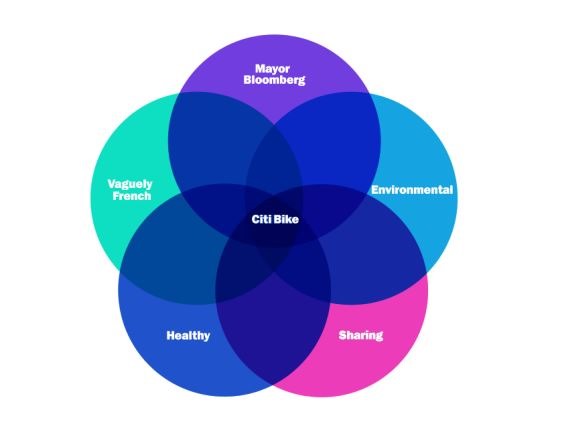
What is it about bicycles that makes conservatives lose their shit? I think New York Magazine has the answer, in a helpful Venn diagram:
**********
*What’s the proper term here? I said “biker” once and was informed that that term is limited to big hairy guys on motorcycles. “Bicyclist” seems sort of formal. “Cyclist”? “Badass mofos on two wheels?”
** In bad weather, I somehow always find a good excuse to drive, which is especially embarrassing because large numbers of students drive from somewhere else in the Denver metro area, park at the end of our street, and walk to the school.
*** OK, maybe not as irrational as killing abortion doctors in the name of defending life, or preventing loving couples from getting married in the name of defending marriage. But pretty damn irrational.
**** I love guest posts! Wanna be a guest blogger? Just ask!
A bakery near Denver is refusing to make a cake for a same-sex couple. While this is covered by the state’s anti-discrimination laws, it would also be an excellent case for my proposed Anti-Butthead Act. According to the Denver Post,
The shop’s owner, . . . [stated] that he has a strong stance toward the biblical view of marriage between one man and one woman.
I’m wondering if Mr. Phillips checks the Biblical-compliance status of his other customers. Does he ask his one-man/one-woman couples if they’ve had sex before the marriage. Awkward! Adultery and coveting of neighborhood wives? Also awkward! Theft? Does he do a criminal background check? How about honoring mom and dad? He needs to check on that, too, right?
This falls solidly within the black letter of the Anti-Butthead Act’s mandate: “Don’t be a Butthead.” Or, in the words of the colleague from whose Facebook post I blatantly stole this idea, “Just make the fucking cake, you dope!”
by Sproule Love (in response to my last post about this WSJ video editorial).
I don’t know what’s worse – the giggling sycophantic interviewer opening with a gleeful update about a citibike user getting hit by an SUV, or how out of touch Rabinowitz is with New York. How is this woman in a position of power at a major news outlet, even the Journal? These gems from the video are at the top of my list:
Is that why the current golden era of cycling infrastructure in NYC took 30+ years of tireless advocacy and has resulted in a 20% decrease in traffic fatalities over the last 10 years? Is that why of the 136 pedestrians killed in NYC in 2012, NONE were reportedly killed by cyclists, but all of the 155 pedestrians and cyclists killed in NYC traffic in the same year (15,465 were injured) were killed by motorists, half of whom got no citation whatsoever, and only one of whom was charged with a serious crime?
To the citibike naysayers, I say don’t knock it ’till you try it, and I much prefer looking at the citiBike rack in my neighborhood over a line of parked cars. NYC is slowly restoring the balance of street use away from just cars, and the change is dramatic. I hope our next mayor doesn’t drop the ball.
New York City recently started a bike-share program. It’s my understanding that the program is sponsored by Citibank — a capitalist institution last time I checked — and that participation is voluntary, that is, no one is being forced by brownshirts to ride borrowed bicycles.
According to Wall Street Journal editorial board member Dorothy Rabinowitz, I may have this all wrong.*
As helpfully transcribed by Talking Points Memo:
“Do not ask me to enter the mind of the totalitarians running this government of the city,” Rabinowitz said when asked what she thought was the motivation behind the program.
“Look, I represent the majority of citizens. . . .The majority of citizens of this city are appalled by what has happened and I would like to say to people who don’t live in New York that this means something much more than the specifics of this dreadful program. It means: envision what happens when you get a government that is run by an autocratic mayor or other leader and a government before which you are helpless. We now look at a city whose best neighborhoods are absolutely begrimed, is the word, by these blazing blue Citi Bank bikes — all of the finest, most picturesque parts of the city. It is shocking to walk around the city to see how much of this they have sneaked under the radar in the interest of the environment.”
“Begrimed”? Is that even a word? And here is the scene that Ms. Rabinowitz finds begrimy:
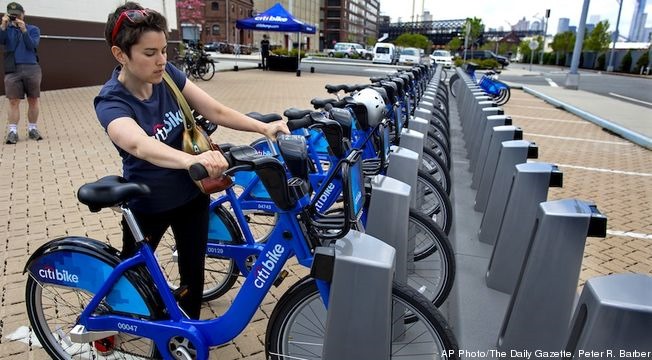
There are plenty of things in NYC that might properly be called grimy — though it’s possible that Ms. Rabinowitz does not encounter any of them between the limo and the doorman — but this does not seem to satisfy any common language definition of the term.
What this is, of course, is another example of Conservative Linguistic Debasement: “totalitarian” simply means “something a conservative does not like.” It doesn’t have to relate to “a political regime based on subordination of the individual to the state and strict control of all aspects of the life and productive capacity of the nation especially by coercive measures.” It just has to piss off a conservative.
*************
* Having sat through most of the video editorial, I agree with James Fallows: “Henceforth when you read the Journal‘s editorials, I invite you to hear this voice, expression, and tone. . . . Onion writers, watch and weep.”

