Author Archives: Amy Farr Robertson

Unknown's avatar

About Amy Farr Robertson

Civil Rights Lawyer. Dog Lover. Smartass.

Modesty glasses: finally, recognition that it’s their problem, not ours.

In Israel, new modesty glasses for Orthodox Jewish men blur women out of their line of sight – NY Daily News.

It’s the latest prescription for extreme ultra-Orthodox Jewish men who shun contact with the opposite sex: Glasses that blur their vision, so they don’t have to see women they consider to be immodestly dressed.

This is sheer genius!  With modern technology, if we can’t convince bigots to bring their thinking into the modern world, at least we don’t have to change our behavior to cater to their stone age views.  Bigot Glasses:  think of the uses!

  • Racist?  Here are glasses that make everyone’s skin tone look white.
  • Homophobic?  These glasses will portray, to the wearer, that any couple observed through the lenses consists of one man and one woman.
  • Islamophobic?  The glasses can be programmed to photographically superimpose members of the 4H Club overtop of any images of men with dark skin, beards, or turbans or women in headscarves.
  • Disabiliphobic?  There will be glasses to blur out wheelchairs, white canes, and sign language, showing instead those same people walking, seeing, hearing, and flipping you off.  (Still a few bugs in that technology.)

The ultimate genius, of course, is that Bigot Glasses only affect the bigot, so the rest of us can go about living our black, female, Islamic, gay, and/or disabled lives in peace.

There is, of course, one set of these glasses I’d invest in:  grumpy old lady glasses.   Technology that erases tattoos, pulls up pants, covers up exposed underwear, brushes hair, feigns respect, and edits out the word “like.”

Random s**t photography

When I started my first photography class, the instructor asked us to state what style of photography we were interested in.  What was stunning to me is that the rest of the class (“Digital 101″) had answers.  That is, they each knew the name for the styles they were interested in and rattled it off for the class.  I thought to myself, “random shit and southwestern colors,” but those didn’t appear to be standard categories.  I listened to my classmates, chose two that sounded close, and replied, “landscape and architecture.”  Everyone nodded knowingly, that is, knowing more than I did about the styles of photography to which I had just randomly pledged my interest.  Well, not totally randomly because — as I think I’ve mentioned — I determined quickly that my photographic interests do not include “portrait.”

One of the other things I’ve found interesting and sort of unexpected is the question of when and how much to stage a photo.

Now obviously, Saguaro doesn’t wear glasses or read a Kindle,* so I do a bit of staging when I’m goofing around.

But I was a bit taken aback at how much the instructor seemed to assume that we would be rearranging the scene before us, and not just by asking the owner of the naked behind we** were photographing to clench.  When your preferred photographic genre is random shit, however, you can’t stage.  It’s right there in the rulebook.  It has to be random.

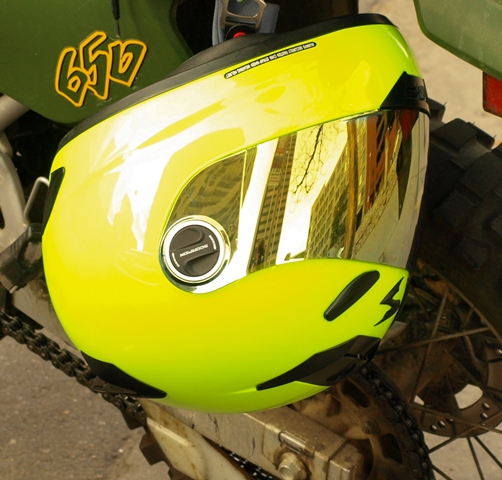
So when I found this excellent collection of randomness and color on Santa Fe Drive,

I knew it was a perfect shot for me.  And you have to trust me, that’s just how I found it.  Possibly TMI, but I don’t even own a bra in that color.   Nor does Tim.  Nor either of the dogs.  Herewith a couple of other random photos, with many more to follow, I’m sure.

*********
* He reads e-books on his laptop.

** The editorial we.  I’ve never actually photographed a naked behind.***

*** Well, not a naked human behind.

OMG OMG I can make panoramic photos!

I know, I know:  2009 called … to congratulate me on discovering its Photoshop technology.  I just learned that Photoshop Elements will take a series of photos and create a panorama.  I started with . . . ok ok I have to fess up to something first.  We are supposed to prepare a photo essay for the class I’m taking and because I have no imagination, my essay is on . . . ramps.  I know, right?   Get over it.

My original concept was to photograph small, out of the way, unlikely ramps, like these two in rural Maine somewhere north of Portland.

I was clearly in need of some coaching in the technical and compositional departments, but you get the idea.  My concept was on some level to be able to say to large international chains that remain out of compliance in 2012, “you see!  Ralph’s Home Sales of Somewhere Off Rte 1 in Maine, managed to install a ramp; so can you!”

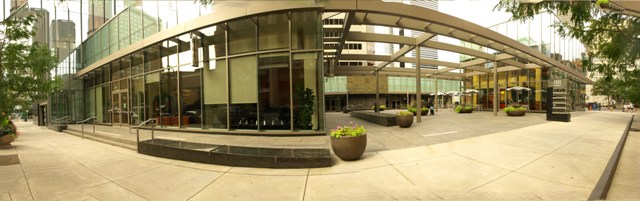
Since I don’t have the time to go anywhere out of the way, I’m left trying to tell a story through photographs of various ramps around Denver.  During the class session in which we critiqued one another’s first few essay photos, my classmates had lots of helpful advice like, “your theme could be dogs!” and “you could sit at a coffee shop for a day and photograph the people who patronize it.”  But I’m stubborn and don’t have time to sit at a coffee shop all day, so ramps it is.  And dammit, I think it’s kind of cool.  And!  It turns out that panoramic photography is sort of an interesting way to show how a ramp relates to the accessibility of the building it serves:

This was my first attempt at panoramic stitching.  (That term gives me the mild creeps, with a sort of Frankenstein vibe.)  It was so much fun, I spent today trying to dream up fun ways to use the technology.  Turns out graffiti walls make cool panoramic shots.

So does the dragon on Su Teatro’s building.  I was too close and trying to do too much, but it’s sort of cool.  I think I need to go back in the morning when there are no cars and photograph it from the middle of the street.

Here are three more ramp panos.  The first — on 17th at Curtis — is more an illustration of how several levels can come together in an almost imperceptible way.

The ramp below is on University Blvd just north of Asbury, and what I liked the most isn’t really visible from the pano:  The fact that the ramp starts low on the right, rises to the entrance and then the red wall keeps rising at the same angle — decoratively only, I believe — continuing the slash of red color from one side of the building to the other.

Finally, this is the west entrance to the DU aw school which is not visually very compelling, but lends itself nicely to panoramic treatment.

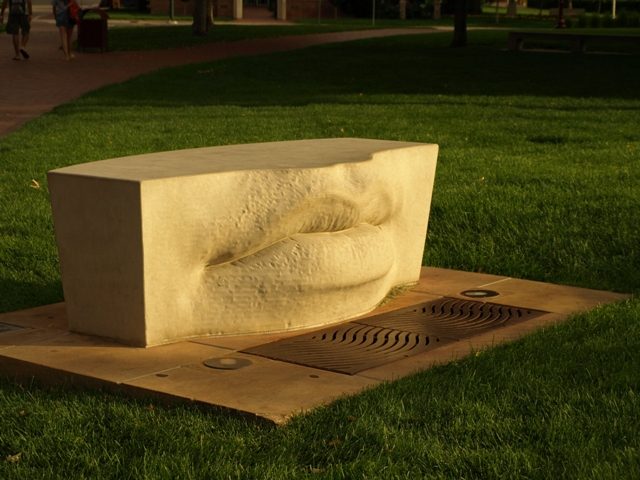
Since I was already wandering around the DU campus with a camera, I had to take the following photograph that to me poses a deep and unfathomable question: did anyone anywhere on the design team have an 8th Grader?  Access to an 8th Grader?  A friend’s 8th Grader to whom he or she could have shown this design?  Does anyone even think like an 8th Grader?  In other words, DOES ANYONE ELSE SNICKER WHEN THEY SEE BENCHES MADE OF LIPS?

Or is it just me?

Constitutional originalism for the unbuff

Scalia Suggests ‘Hand-Held Rocket Launchers’ Are Protected Under Second Amendment | ThinkProgress.

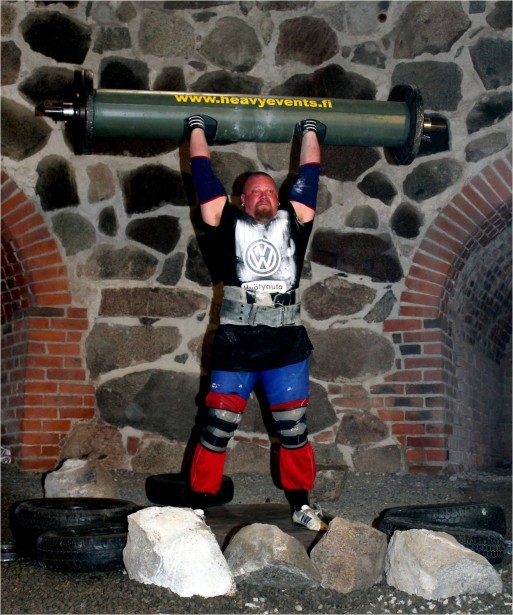
Can you guess why Scalia suggests hand-held rocket launchers are protected under the Second Amendment?  Because you can “bear” them.  That is, you can, theoretically, lift them onto your shoulder.  So for this reason, “it does not apply to cannons.”  I swear this is not The Onion.  Seriously, folks, if we’re going for originalism, we can’t stop with the bright line between hand-held rocket launchers and cannons.  Clearly your Second Amendment rights, per Scalia, are calibrated to the amount of weight you can bench press.  Clearly this guy’s

http://www.theworldsstrongestman.com/uncategorized/wsm-experience-finland-results/

constitutional rights are greater than mine, given that I’m not sure I could heft a Saturday Night Special.  But this, too, is flawed as originalism goes because at the time the Second Amendment was drafted, wasn’t the average body size smaller?  Shouldn’t we all be limited to the weapons that the average late 18th Century constitution-drafter could heft?  And if “bear” means only what it meant in 1781, how can freedom of the “press” apply to the internet?

Chicken and hate

I am not, repeat not, a biblical scholar.  In fact, my sum total of Bible-reading consists of (1) Christmas with the in-laws,* and (2) being stuck in a hotel room without a novel to read myself to sleep.  I do feel qualified to opine on fast food chicken, though, because I love junk food.  The best fast-food chicken is — objectively and indisputably — Popeye’s.  Why?  Grease and flavor.  Sure the Colonel’s chicken is good because it is thoroughly battered and bathed in grease.  But Popeye’s has that plus a tasty, spicy flavor that puts it over the top.  All this is to say that my total boycott of Chick-Fil-A** for their hate-based policies will  have precisely zero effect on their bottom line.

This woman, however, sounds like she could require an extra line on their next annual report.  Plus she knows her Bible.

The long and short of it– on 8/1 (the day Mike Huckabee wants Chick-Fil-A supporters to patronize the restaurant) go to Chick-Fil-A. Ask for a large water and nothing else. See if they adhere to Proverbs 25:21[***] and give it to you. If they do, yay! You took a few cents from their hate fund! If they don’t, well…I guess they’re proving their principals aren’t so “biblical.”

My favorite comment was:

The point is CHRISTIANS are ONLY under the NT not the OT! So her point was invalid on bringing up the OT when that law was abolished 2,000+ years ago.

So, I’m confused:  the Ten Commandments don’t apply to Christians?  That actually explains a lot, for example, the fact that the murder rate and the rate of both divorce and teen (presumably out-of-wedlock) birth is higher in more conservative states.  Scholars have attributed the latter to economic, historical, and other scholarly factors, but perhaps it’s simply that God repealed the Ten Commandments and the Blue States didn’t get the memo.

Balloon Juice also had this excellent photo:

Though again, for the record, KFC is only the second-best batter-dipped, grease-soaked chicken.  Popeye’s is the way to go.

*****************
* Sorry, guys, but you knew I was a heathen**** when I started dating Tim.

** When I first saw a Chick-Fil-A sign sometime in the 80s or 90s, I seriously thought it was pronounced “chick filla” — rhymes with Godzilla — because I could not believe anyone would be so backward as to be unable to say or spell “filet.”

*** “If thine enemy be hungry, give him bread to eat; and if he be thirsty, give him water to drink”

**** OK, not total heathen.  I’ve summarized/made light of my own religious views elsewhere on the blog.

Detritus on the mean streets of southeast Denver

A broken jar of pickled carrots on the sidewalk of S. Pearl Street.

My first attempt to blog from Flickr.  I’m working on my photo essay for the class I’m taking but as always discover that I’d much rather shoot photos of random shit than meaningful shit.  This amused me because where else but South Pearl Street would the litter consist of a broken jar of pickled carrots.  If I’d had the patience of a real photographer, I suspect in a half hour or so after this photo, the sun would have caught the orange in just the right way.

More randomness from Pearl Street:

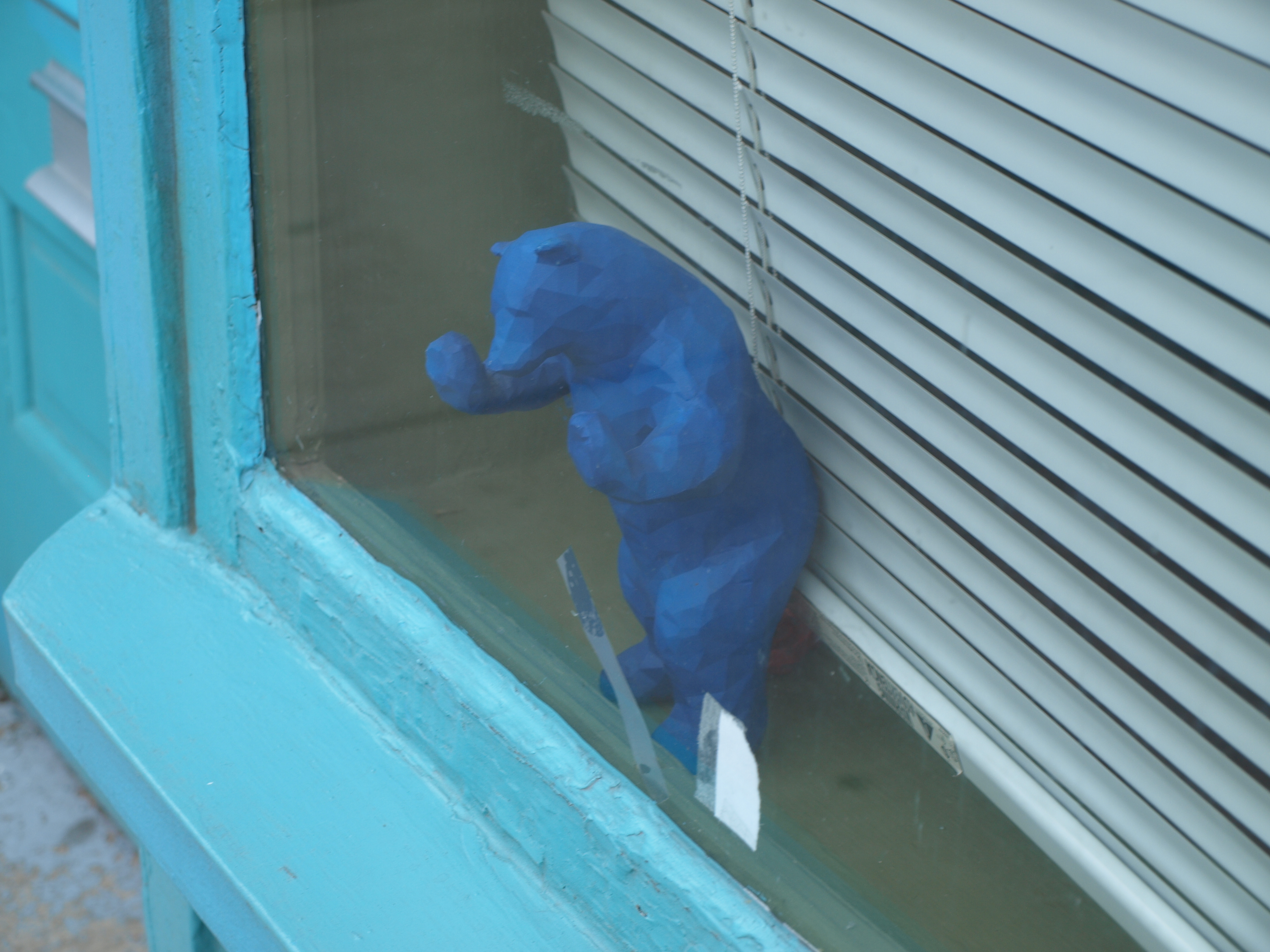
Da Bear

Anyone know why I can’t insert a second photo from Flickr?  Guess you can only blog one photo at a time!  Too bad for you, readers!

Absurdity Slider

No, it’s not a small, tasty, metaphysical snack.  It’s a review of a review — big time-saver! — and a digression into the meaning of life.  The slider is explained below.  (Look!  A teaser!)

I minored in philosophy.  At Swarthmore.  You’d think this would have trained me to overthink almost anything.  And honestly, I can overthink important things like the font in my email or whether to get the 90 Shilling or the 1554.  But I recently* read a review in the New Yorker of a book that I think may represent the gold standard in overthinking: David Benatar’s “Better Never to Have Been: The Harm of Coming Into Existence.”  The thesis: since it’s worse to suffer pain than to forego pleasure and since — in the words of the reviewer, “[e]ven the best of all possible lives consists of a mixture of pleasure and pain” — it is better never to have been born.

Yes, you read that correctly.  As the review notes:

The volume is dedicated to his parents, “even though they brought me into existence,” and to his brothers, “each of whose existence, although a harm to him, is a great benefit to the rest of us.”  (It’s fun to imagine what family reunions with the Benatars are like.)

But I think I’ve found the Rosetta Stone of disability discrimination.  As the reviewer explains it:

Benatar’s case rests on a critical but, in his view, unappreciated asymmetry. Consider two couples, the A’s and the B’s .  The A’s are young, healthy, and rich. If they had children, they could give them the best of everything — schools, clothes, electronic gaming devices. Even so, we would not say that the A’s have a moral obligation to reproduce.

The B’s are just as young and rich. But both have a genetic disease, and, were they to have a child together, that child would suffer terribly. We would say, using Benatar’s logic, that the B ‘s have an ethical obligation not to procreate.

They have a WHAT?

The case of the A’s and the B’s shows that we regard pleasure and pain differently. Pleasure missed out on by the nonexistent doesn’t count as a harm. Yet suffering avoided counts as a good, even when the recipient is a nonexistent one.

And what holds for the A’s and the B’s is basically true for everyone. Even the best of all possible lives consists of a mixture of pleasure and pain. Had the pleasure been forgone — that is, had the life never been created — no one would have been the worse for it. But the world is worse off because of the suffering brought needlessly into it.

Is this guy an android?  Everyone suffers at some point.  In fact, how does life have any meaning without suffering?  Hell, without pain, how do you learn basic things like not to touch a hot stove and not to listen to the Beach Boys?  I suppose if you never existed, you wouldn’t have to go through any bothersome learning processes.  But then, what’s the point?  I guess that is his point.

“One of the implications of my argument is that a life filled with good and containing only the most minute quantity of bad — a life of utter bliss adulterated only by the pain of a single pin-prick — is worse than no life at all,” Benatar writes.

He acknowledges that many readers will have difficulty accepting such a “deeply unsettling claim.” They will say that they consider their own existence to be a blessing, and that the same goes for their children’s. But they’re only kidding themselves.

Ladies and gentlemen, this is not The Onion and as near as I can tell, this dude expects his theory to be taken seriously.  On one level, it merits only derision.  Or this year’s Hitchhiker’s Guide Philosophy Award, an award I just started for philosophical arguments that measure up to my favorite ever, from the Hitchhiker’s Guide to the Galaxy, explaining the existence of the Babel Fish:

Now it is such a bizarrely improbable coincidence that anything so mindboggingly useful could have evolved purely by chance that some thinkers have chosen to see it as the final and clinching proof of the non-existence of God.

The argument goes something like this:

`I refuse to prove that I exist,’ says God, `for proof denies faith, and without faith I am nothing.’

`But,’ says Man, `The Babel fish is a dead giveaway, isn’t it? It could not have evolved by chance. It proves you exist, and so therefore, by your own arguments, you don’t. QED.’

`Oh dear,’ says God, `I hadn’t thought of that,’ and promptly vanished in a puff of logic.

`Oh, that was easy,’ says Man, and for an encore goes on to prove that black is white and gets himself killed on the next zebra crossing.

But on another level, the concept that it is better to avoid all pain than to experience any pleasure explains disabiliphobia.  It explains why the non-disabled world regularly projects on to people with disabilities a far lower quality of life than the latter actually experience.  This, in turn, leads non-disabled windbags like Peter Singer to opine that it is better for infants with disabilities not to be born or to be killed in infancy.  Benatar’s theory is simply the apotheosis of Singer’s: If it’s better not to be born than to be born with quadriplegia, where do we draw the line?  Better not to be born than to be born and later in life get the sniffles.  Perhaps it’s helpful to imagine this scale as a slider of the type I’m just now learning to use in Lightroom.  We’ll call it the Absurdity Slider:

The Absurdity Slider


Benatar took the Absurdity Slider and dragged it all the way to the right — up to 11 — where not only is it best to euthanize disabled infants, but it’s best that none of us ever have been born.

Given the highly accurate “that’s bullshit!” response most people will have to Benatar’s theory, I think he’s done us a service in placing Singer’s arguments along this all-important scale.  If only I had control of the actual slider.  Any coders out there want to help me develop a working Absurdity Slider, one that could tone down the absurdity in an argument the way you adjust the contrast in a digital photo?

*************

* Yes it was in the April 9 New Yorker, but it is true that I only recently read it, as I have just now reached that archeological layer in the New Yorker pile next to my comfy chair.

Introducing The Cute Puppies’ Guide to Title III of the ADA

There have been two types of post that have driven most of the traffic on this blog:  photos of my dogs; and my attempt to start an internet meme with the photo of Gus Fring being blown up by the mobster who used a wheelchair (MWD?).   So I try to publish my deep thoughts about disability rights, the practice of law, and adventures in trial technology, and what my immense readership really wants to see is photos of cute dogs and guys with their heads blown off.

This reminded me of one of my favorite Saturday Night Live sketches:  Kevin Nealon with No Attention Span News.  Not the funniest perhaps, but one that was excruciatingly accurate in portraying what it feels like to try to talk about something important but boring.  (Sorry for the ad.  It’s worth it.  Keep watching.)

With these thoughts in mind, I decided that we needed a more attention-grabbing way of presenting the ADA.  Lacking the copyright to the image of Gus Fring, but blessed with two very cute dogs, I decided to inaugurate The Cute Puppies’ Guide to Title III of the ADA:

There now!  Don’t you feel inspired to learn more?  You can check in from time to time on the FoxRobBlog, which will also have scintillating news of our latest case adventures and legal developments.  And puppies!

“Cooking” with Amy

I’m a recovering picky eater.  From the time I started eating solid food until I was 16, I rarely strayed from the following list of foods:

Pop-Tarts (brown sugar cinnamon)
Orange juice
Peanut butter and apple butter sandwiches (white bread; crusts cut off)
Hard boiled eggs
White rice
Chicken
Flank steak
Junk food

Note that this list does not contain any vegetables or fruits beyond orange juice.  This is not a typo.

During the summer after my junior year in high school, I was lucky enough to spend a couple of weeks in France, first living with a French family
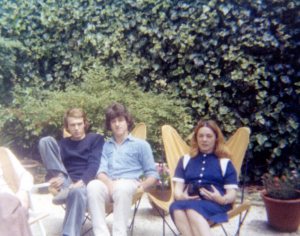
La Famille Gardey: brother; fellow visiting American dweeb; mother.

and then biking around with a group of American students.

It’s possible that I don’t like camping because this early camping experience involved cows.

I went from picky eater to omnivore in the nanosecond after the mother in the French family put the first dinner in front of me and it became clear that not eating was not an option.  She also tried to convert me to Catholicism and to convince me that I showered too often.  I won the former; the latter was a draw — I was permitted approximately three hard-fought-for showers per week.

Still, I loved being an omnivore, and spent the rest of the trip enjoying my newly-expanded food vocabulary — especially in the bread, cheese, and pastry categories — which was causally connected to my newly-expanded waistline.  If memory serves, my mother had to meet me at the airport in New York with a larger pair of pants.

I was even more of an omnivore during my travel in Asia.  The food in Taiwan is spectacular — from banquets to road-side stands — and saying no to a dish is a major insult to the host[ess], so I ate almost anything.  Highlights:  turtle; sea slug; thousand-year-old egg.

I still eat almost everything — with the startling exception of fruit — but given that I never learned to cook, my day-to-day diet is just the grown-up version of my childhood menu. In other words, I don’t cook; I permutate.

The list:

Buitoni cheese tortelinni
Butter lettuce
Black olives
Grilled red peppers
Near East curry couscous
Steak
Chicken
Annie’s Shiitake Sesame Salad Dressing
Fresh basil
Olive oil
Pesto

These ingredients yield a number of permutations which constitute dinner most nights of the week. For example:

Pasta:  tortellini, olive oil or pesto

Pasta couscous:*  tortellini, coucous, olive oil.

Pasta salad:  lettuce, tortelinni, olives, peppers, coucous, dressing.

Steak salad:   lettuce, steak, olives, peppers, coucous, dressing.

Steak fajitas:  tortilla, steak, lettuce, olives, peppers, basil, dressing.

Steak sandwich:  bread, steak, lettuce, peppers, basil, mustard.

Chicken curry stir-fry:  chicken, curry sauce, peppers.

Chicken salad, fajitas, or sandwich:  you get the picture.

My mother is prone to quote her favorite cookbook that it’s easier to get new friends than to learn new dishes.  I’m at least blessed with friends who are comfortable with predictability  . . . and carry-out!

**********

* Yes, I know couscous is technically a pasta.  I’m a big fan of carb combos like this.  For example, one of my favorite foods in the world is shao-biing you-tyau, a/k/a shao-bing yu-tiao** a Chinese breakfast that consists of a strip of deep-fried dough inside a baked sesame roll.

** I first learned Chinese at the Middlebury language school in the summer of 1979, when for whatever reason they used a romanization system called Gwoyeu Romatzyh.  GR has two notable features:  it makes more sense than any other romanization system; and it doesn’t appear to have been taught anywhere else in the US besides Middlebury in the late 70s.  I have tried to learn Pinyin, the system that both Chinese school children and American students of Chinese have been using since about 1979, but it just blends with GR in my head into an idiosyncratic romanization that makes sense to absolutely no one but me.

It’s good to be the czar

Had a nice chat session with Dell technical support.  Little did I know I was talking to the Czar!

Unfortunately, the Czar’s powers did not extend to figuring out why my battery won’t charge, so I have to send my laptop back to Dell.  So I’ll have to spend a couple of days writing with a chisel and a rock, that is, my ca. 2005 IBM ThinkPad.  Sigh.