Category Archives: Civil Rights

Litigation triumph (with photographic incompetence).

As we announced earlier on CREEC’s website, we finally settled the almost 12-year-old Taco Bell case.  Although the settlement requires notice and court approval, we decided to indulge in a bit of BBQ-based celebration on Thursday evening at T-Rex in Berkeley with most but not all of our wonderful team.   Unfortunately, my stubborn insistence on never using the pop-up flash on my camera resulted in some pretty blurry and/or grainy photos.  Blerg.  I’m now looking for an external flash for an Olympus XZ-2 that can tilt but that does not turn the whole thing into a giant, lumbering, unwieldy piece of photographic equipment.

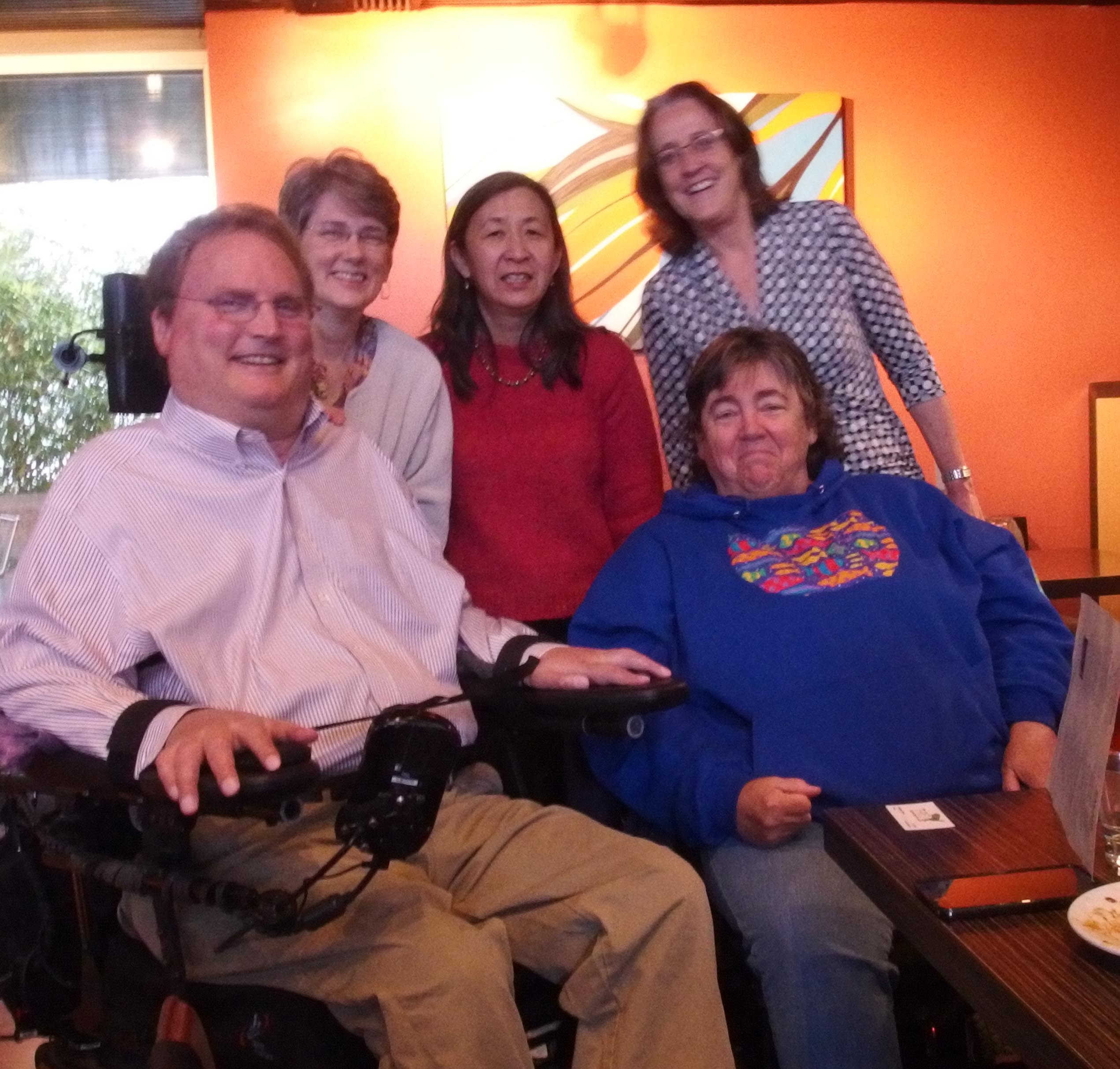
On to our team!  Here is the core litigation team — sans Tony Lawson, who was in LA, and Brad Seligman, who is now The Hon. and had pre-existing obligations relating to his talented musical daughters. It also doesn’t include the wonderful Dan Goldstein, who joined the team last fall to assist with settlement and who deserves huge heaping helpings of praise (and, later, scotch) for his successful efforts.

Below:  lawyers Tim Fox, me, Mari Mayeda, and Jocelyn Larkin and Named Plaintiff (and disability rights goddess) Corbett.

OLYMPUS DIGITAL CAMERA

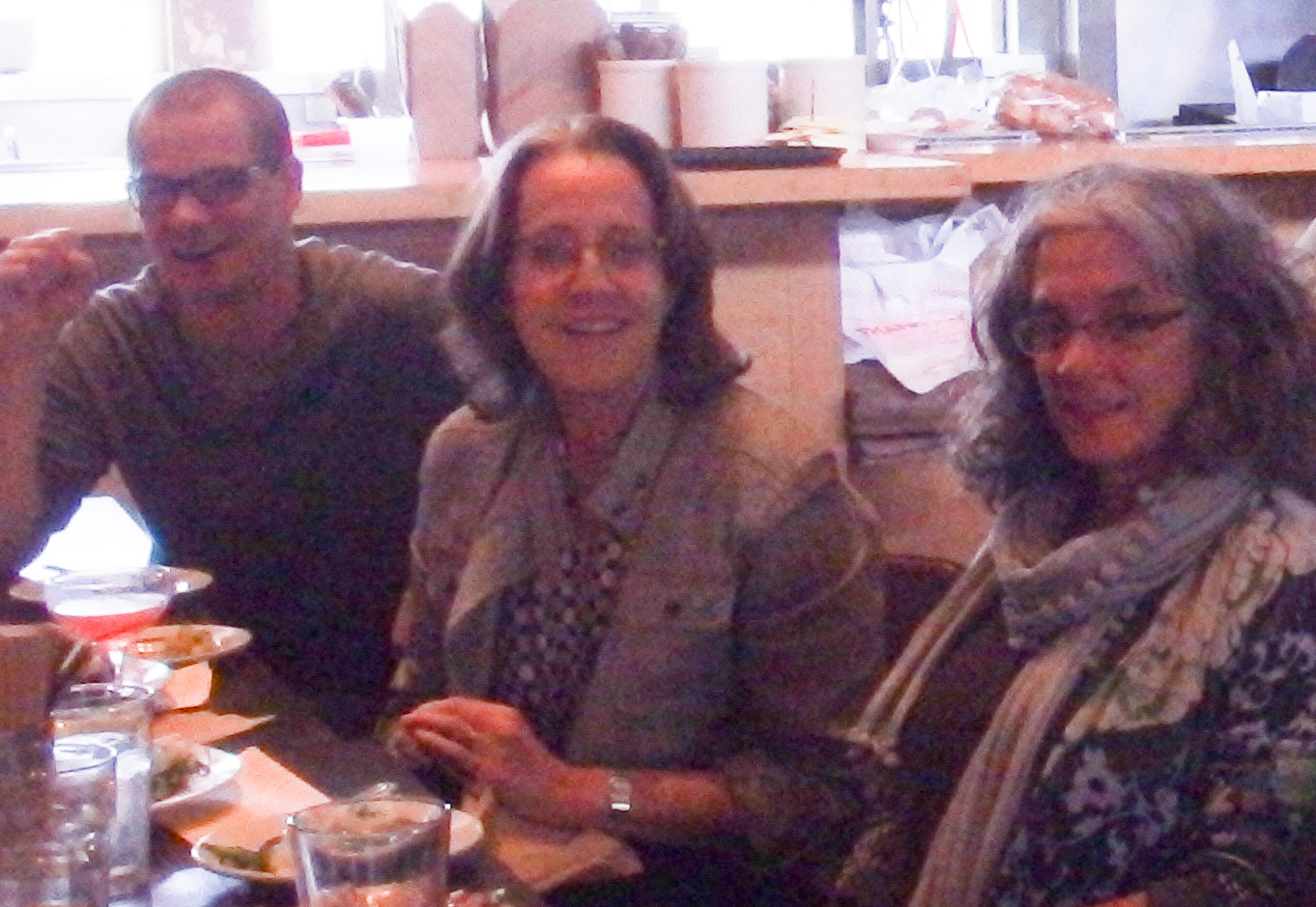
Bill Lee, who through his own work and that of his firm, was incredibly helpful to and supportive of our case.

OLYMPUS DIGITAL CAMERA

Co-counsel Robert Schug and Jocelyn Larkin of the Impact Fund and mentor Lainey Feingold.  (I really do need to investigate the flash situation….)

OLYMPUS DIGITAL CAMERA

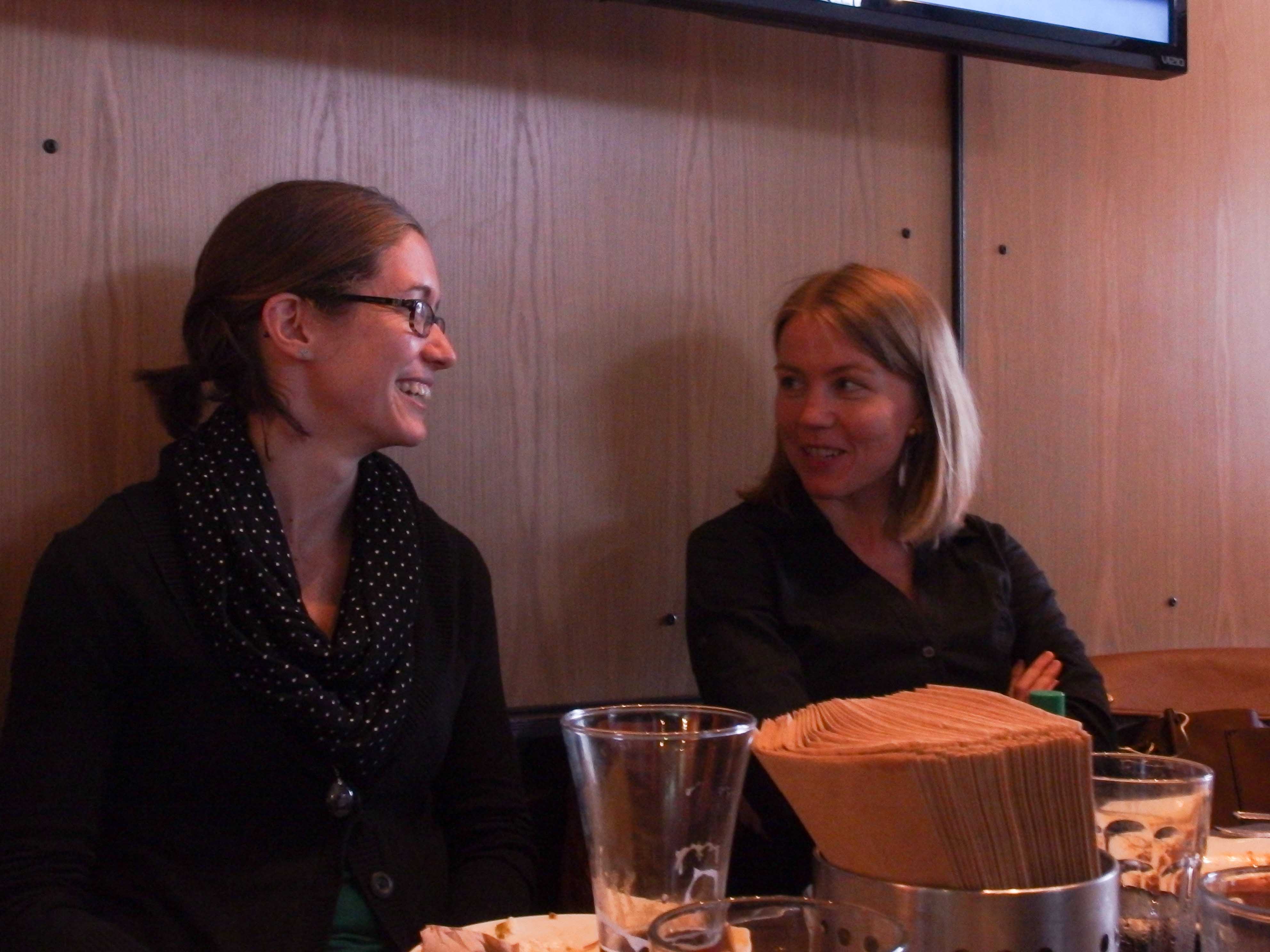
Future civil rights rock stars Sarah Morris (CREEC) and Meredith Johnson* (Impact Fund) plotting world domination.

OLYMPUS DIGITAL CAMERA

Tim’s assistant Dustin McNa enjoys some of T-Rex’s famed health food.

OLYMPUS DIGITAL CAMERA

And finally, the highlight of the evening:  obscure whiskey tasting!  The bartender told us this was a bottle from the latch batch ever of this whiskey.  “Like drinking a dodo bird,” explained Dustin.

OLYMPUS DIGITAL CAMERA

This post doesn’t even begin to recognize all of the people who helped us out over the past 12 years.  We’ll have a more complete, better-photographed version after (God willing) final approval.

**********

* It turns out Meredith and Tim both went to St. Olaf College in The Middle of Somewhere Very Cold, Minnesota.  We were treated to a brief but inspiring rendition of their college fight song, “Um Yah Yah” (which I think translates as “What Were We Thinking???”).   If you think I’m making that up — at least the song title part — check the school’s website!

America the Beautiful

I don’t usually get choked up over TV ads. (OK, yeah, I do. All it takes is folk music and/or puppies and I’m reaching for the kleenex.) But Coke’s America Is Beautiful Super Bowl ad was just beyond amazing.

It managed to portray – through images of our country, our American brothers and sisters, and the gorgeous voices of nine young girls singing “America the Beautiful” in nine different languages* — what is most beautiful, amazing, and exceptional about America.  I’m not sure my desire to drink a Coke is any greater after seeing the ad, but I’m really glad they made it.

Remember this?

Mother of Exiles. From her beacon-hand
Glows world-wide welcome; her mild eyes command
The air-bridged harbor that twin cities frame.
“Keep, ancient lands, your storied pomp!” cries she
With silent lips. “Give me your tired, your poor,
Your huddled masses yearning to breathe free,
The wretched refuse of your teeming shore.
Send these, the homeless, tempest-tost to me,
I lift my lamp beside the golden door!”

Send them, she said.  And they sent them.  Us.**  Which was highlighted eloquently by this excellent rebuttal to what turned out to be a conservative backlash against the ad.  That’s right, the part of the political spectrum that spends a lot of energy on American Exceptionalism — a/k/a why America is the Best.Country.Evah!!!1!!! — is angry about an ad that shows how truly exceptional we really are. We’re not exceptional because we have guns – the Somali pirates have guns. We’re not exceptional because we speak English – the Brits have been spreading English with colonialism for centuries, and it’s taught in high schools from Beijing to Kinshasa. We’re not exceptional because we’re white – most of us aren’t, and lots of liberal socialists with universal healthcare in Canada and Scandinavia are white.  We’re exceptional because we are one country formed by people from everywhere else.***

The prize for “I don’t think that word means what you think it means” goes to Glenn Beck who declared that the purpose of the ad was “to divide people.”  Yes, precisely, if by “divide” you mean “unify.”  Seriously,  you have to be addicted to anger to dislike this ad.  Do you think conservatives know that you can, in fact, be a Republican and still like this ad?  It’s OK.  They won’t take away your GOP membership card or your gun or your “Don’t Tread on Me” bumper sticker.  Go ahead — smile.  It’s a beautiful country full of beautiful people being sung about in beautiful voices.  Enjoy it for just a sec, then go back to being angry at  . . . whatever it is you’re always angry at, people getting healthcare or married or whatever.

As always, Jon Stewart has the best response.  I tried to embed the entire clip but failed.  But trust me, you’ll love it, especially — starting around the 4:30 mark — the long lost clip from a 1928 Super Bowl ad,  in which similarly marginalized and excluded Americans sing “America the Beautiful”:

{Image: White man standing on a street in front of the "Little Italy" sign, arms and hands splayed in front as he sings; image of the Italian flag (three horizontal green, white and red stripes) and the word "Italy" in the lower lefthand corner.}

{Image: an older white man sits at a bar with a full glass of dark beer in a Guinness glass; image of the Italian flag (three horizontal green, white and orange stripes) and the word "Ireland" in the lower lefthand corner.}

Gotta watch all the way to the end  — I love this lady!  Belt it out, sister!

{Image: White woman with dark hair and flowered dress with a necklace bearing the Hebrew letter "chai". Her arms are outstretched to the side and her mouth open in song. image of the soviet flag (yellow hammer & sickle against a red background) and the words "Soviet Union" in the lower lefthand corner.}

***********

* You can see each version individually on YouTube along with the girls’ narration:  English; Tagalog; Mandarin; Arabic; Hindi; Hebrew; Spanish; Keres; and Senegalese French.

** Well, most of us.

*** Again, ahem, most of us.

There Never Was a Golden Age

I keep meaning to write a long, interconnected, analytical post about how annoyed I get with the concept that Times Are Bad Now, Not Like the Olden Days.  My theory is that the Olden Days were good and bad in many and varying ways, just as our present times are good and bad in many and varying ways, and all of this for the simple reason that we’re talking about the history of human beings, a notoriously brilliant, stupid, open-minded, prejudiced, generous, stubborn, violent, peaceful, and above all self-centered species.

But another signal trait of our species is procrastination — think any other species would have survived, evolutionarily speaking, if they procrastinated like we do?  “I’ll worry about gathering acorns later.”  etc. — so of course I have never gotten around to writing that definitive, all-encompassing psycho-history-of-the-human-race post.  So I thought I’d start a new category — #thereneverwasagoldenage — and just add examples as I find them.

Today’s example:  there never was a golden age of lawyerly civility.  Every time some lawyer does something buttheaded these days, you hear the unison tsking of mainstream tongues about how it didn’t used to be like that, when we could settle a case over a G&T at the club instead of having to fight about depositions and interrogatories and (big, privileged, sigh) metadata.  Herewith, an example of legal argumentation in the good ol’ days of mid-1960s Mississippi.  First, the background of the case:

[P]etitioners and other Negro and white Episcopal clergymen undertook a ‘prayer pilgrimage’ in 1961 from New Orleans to Detroit. The purpose of the pilgrimage was to visit church institutions and other places in the North and South to promote racial equality and integration, and, finally, to report to a church convention in Detroit. Letters from the leader of the group to its members indicate that the clergymen intended from the beginning to go to Jackson and attempt to use segregated facilities at the bus terminal there, and that they fully expected to be arrested for doing so. The group made plans based on the assumption that they would be arrested if they attempted peacefully to exercise their right as interstate travelers to use the waiting rooms and other facilities at the bus terminal, and the letters discussed arrangements for bail and other matters relevant to arrests.

Pierson v. Ray, 386 U.S. 547, 552 (1967).  The point of the case is that the clergymen had standing to challenge segregation despite the fact that they did so knowing they were going to be arrested.  But here is an example of just how civil it was in court in the olden days:

the Court of Appeals reversed and remanded for a new trial on the . . . claim against the police officers because defense counsel had been allowed to cross-examine the ministers on various irrelevant and prejudicial matters, particularly including an alleged convergence of their views on racial justice with those of the Communist Party.

Id. at 551.  Something (one small example among many) to think about next time some old fart lawyer (in whose ranks I now count myself) tries to explain how much better it used to be.

Because the biggest f*****g problem with the ADA is too many f*****g drive-by plaintiffs

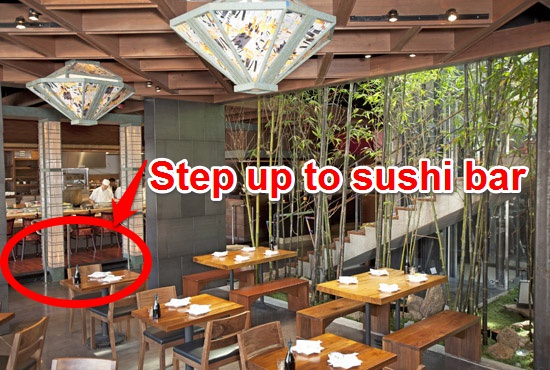
This evening we went back to the completely gutted and remodeled Izakaya Den restaurant and found that they installed a raised sushi bar with no ramp.  Here’s a photo from Westword with my added mark-up.

Photo of the inside of a restauarant.  To the lower left of the photo, a raised area is visible with seats at a lowered sushi bar.  The raised area is circled in red, with an arrow pointing to it from text that reads "Step up to sushi bar."

Sigh.

Just that, by itself, is deeply frustrating.  As we’ve discussed in connection with our lawsuit against the El Diablo restaurant, you can’t take an empty space and make part of it inaccessible.  While this should be obvious, it’s also illegal.

But what made this depressing, frustrating, infuriating and really sad was that we have been patronizing Izakaya Den and its sister restaurant, Sushi Den, for years.  They know us in both restaurants, well enough at Sushi Den that we had a table where we always sat, and most of the waitstaff had served us so often they automatically brought me a phone book to sit on.*  We had participated in a private sushi tasting with a chef visiting from Japan, and at that point (and others) met the owners.

It’s bad enough that Izakaya Den got seriously bad architectural advice.  It’s really depressing that no one ever stopped to think, this isn’t just a theoretical legal question; we have a regular customer who will want access to the sushi bar.   And what’s funny:  they have an elevator.  They added a second floor and an elevator.  Very fucking cool.  But damn!  Why on earth add an unnecessary, new, inaccessible raised area?

We proceeded from Izakaya Den to Kaos** pizza, which was also inaccessible,  then*** on to the Black Pearl which had this gorgeous ramp

Photo showing front of restaurant with a ramp to the front entrance adjacent to a patio area with tables and seats.

as well as truffle fries, an excellent cheese plate, and a nice refreshing bottle of 90 Shilling.

************

*  Yes, I’m that short and have that little pride.  But it’s nice to be able to look my fellow diners in the eye.

** Sounds like Maxwell Smart should be nearby, talking on his shoe phone.

*** I’m leaving out the part where I crossed the street from Kaos to where Tim was waiting, swearing my ass off, while he made “maybe you don’t want to use those words just now” eyebrow motions.  Turns out he was chatting with a nice woman — hidden to me by a parked car — and her cute Lab puppy.   I was embarrassed, she was understanding (“that’s OK; let it all hang out!”), and the puppy was really really cute.

Your accessible garage is “not in the best interest of the neighborhood.”

[This is cross-posted from CREECblog, though I would like to revise and extend by noting that the HOA in the post below was in violation of not only the Fair Housing Act, but of course the Anti-Butthead Act as well.]

My theory is that homeowners associations (HOAs) are run by the same people who bullied their fellow students in high school for not wearing the right brand of jeans.  Only now they have power over the house you bought and live in.

This post is about the Fair Housing Act and the fact that it requires landlords and HOAs to make reasonable accommodations in their policies and to permit residents to make reasonable (physical) modifications to property at their own expense where necessary because of the resident’s disability.* HUD and the DOJ have collaborated on excellent explanatory memos on both reasonable accommodations and reasonable modifications.  [Both pdf.]

Seth and Lisa Moates lived in a development called Plantation Oaks** outside of Montgomery, Alabama.  Mr. Moates uses a manual wheelchair, but was moving toward having to use a power chair which, in turn, would require a lift-equipped van.  The Moateses wanted to build a garage to fit their new van as well as Mr. Moates’s therapy equipment.  Of course, they couldn’t just build the structure they needed for Mr. Moates’s disability.  They lived in an HOA community, in which an “Architectural Review Committee” asserted power over decisions like this.  And of course

[t]he ARC denied the Moateses’ initial request on April 8, 2013 for the stated reason that alternate garages and structures were inconsistent with the other Plantation Oaks homes and not in the best interest of the neighborhood.***

That’s right, Mr. Moates, you can’t park your new van in a garage or store your therapy equipment because that would not be “in the best interest of the neighborhood.”  And just to be sure nothing as tacky as a van-accessible garage ever besmirched their plantation, “[t]he Covenants were changed to make the building requested by the Moateses prohibited.”****  You see, originally you just needed special permission for your van accessible garage, but now, in response to the request, that garage and others like it are simply prohibited.

The HOA finally relented after the Moateses reduced the size of the planned garage, BUT only on the condition that, when they sold the house, they demolished the garage and returned the property to its original, pristine, plantation-like***** condition.

The ensuing lawsuit is only at the motion to dismiss stage, but generated a well-reasoned decision denying the motion.  The judge noted that “equal opportunity to use and enjoy [a] dwelling” means

that handicapped[******] people must be afforded the same (or ‘equal’) opportunity to use and enjoy a dwelling as non-handicapped people.  . . . [O]thers in the neighborhood are allowed to park their vehicles in garages, thus affording protection.  Affording Mr. Moates a similar opportunity by allowing a larger garage wherein he can park his car, in the same way as his neighbors, plausibly will grant Mr. Moates the same peace of mind and security as everyone else in Plantation Oaks.

Luckily the Moateses have connected with a good attorney and the Central Alabama Fair Housing Center and filed suit.  The HOA — rather than coming to its senses, doing the right thing, and avoiding imposing attorneys’ fees for its stupidity on everyone else in the plantation, er, development — is fighting the suit, arguing not only that it did not violate the Fair Housing Act, but that the Moatses were not injured (did not have standing) and that the suit isn’t ripe for review because the new power wheelchair hasn’t arrived yet.

The judge properly denied those arguments in his well-reasoned decision; I would have been tempted to deny them on the grounds of “gimme a break!”

In this case and so many others, you really shouldn’t need a federal law to make the HOA do the right thing.  All it should require is a bit of common sense  . . . and the realization that we don’t all have to wear the same brand of jeans.

**********************

42 U.S.C. § 3604(f)(3)(A) & (B).

** I swear I did not make up the name.

*** Moates v. Plantation Oaks Homeowners’ Ass’n, 2013 WL 5532626, at *2  (M.D. Ala. Oct. 7, 2013).

**** Id.

***** Slight editorial license.

****** Unfortunately, the Fair Housing Act still uses this terminology, so lawyers and judges have to follow suit.

Why I love Autistic* women (and you should too). (Guest post!)

[I have been blessed with a guest post by Corbett O’Toole, longtime activist and kickass good writer. ]

My life and disability activism entwined since my early childhood with polio.  I got the good, bad and ugly of the 1950s Poster Child years.**  I got to be the “problem” at my public school (they threw me out after kindergarten because they said my climbing the school stairs would be a ‘liability’), and then an “inspiration” at my Catholic school as the only person with a visible disability (where I climbed 2 flights of stairs everyday).

After I graduated from college, I moved to Berkeley, California with a friend and fell into the Disability Rights Movement.***  We made history (well I just followed along and did what I was told (mostly)).  We got curb cuts on city sidewalks, stopped inaccessible public buses with ADAPT, even shut down HEW director offices in the 1977 Section 504 sit-in.  I saw lots of folks come to Berkeley and then start their own dreams.  It was a time of action (and a whole lot of sex, drugs and rock and roll but that’s another blog).

But by the mid-1980s a lot of disability activism disappeared.  We went mainstream and many folks saw our organizations as service providers not activist centers.  And we started to narrow who was included in “disabled”.  When the first generation of AIDS folks came to our centers, we gave them minimum services (and some places just turned them away).  When the hemophiliac folks started dying from tainted blood, we acted like they were not us and turned away.  Little by little our public face became more about getting public acceptance for specific groups of disabled people (i.e. “us”) and less about disability justice.****

I continued to participate in disability rights work but increasingly I was on the margins – working on queer disabled issues, building bridges with other marginalized crip folks like disabled people of color.  We were not being invited to the official disability tables (not even as token speakers).  Often it felt like the days of serious activism – in your face, on the streets – had passed.

Then I met the Autistic women.  They blew my mind with their honesty, compassion and stunning intellect.  Have you read some of their blogs? I did.  They name injustice.  They call for action.  They help each other out.  They prize kindness. And they are over-the-top smart.

And for their efforts, they are routinely derided, receive hate mail, and are largely ignored (and often shunned) by people in other disability communities.

Here are some of the things I learned from Autistic women (and a few men).  Remember these are folks who are usually excluded from disabled and nondisabled communities; their disability-related needs are ignored; they have no money (or jobs) – yet – they, in my opinion, are leading the way towards disability justice.

SPEAK OUT

Every week there is a news report of an autistic child or adult who was murdered (or nearly murdered) by someone close to them.  In response to the latest one, Alyssa called for a new blog to respond.  Within an hour, a group of Autistics created “Voices for Justice” – a place to fight the public complacency about these murders.

Nearly all the press coverage is ‘explaining’ why the murderer ‘needed’ to kill the disabled person who was a ‘burden’.  There’s been hardly a ripple from the other disability communities – except for the National Council on Disability  – even though this happens with lots of non-autistic disabled folks too.  Here is a great response from Beth Ryan, a parent of an autistic kid.

TAKE CARE OF EACH OTHER

The Autistics I know and follow online acknowledge that there is a lot of diversity among folks so they encourage people to ask for help as they need. They support each other and teach each other successful life survival skills. They also reach out to parents of autistic children.  Elizabeth (Ibby) Grace has a blog just to answer questions from parents.

They created systems to communicate nonverbally.  My favorite is for public spaces like conferences where people use “Interaction badges.” Kassianne explains it best.  Using red, yellow, and green pieces of colored paper we indicate our social availability.  When I am open to social interaction I display my green paper.  If I am feeling less social then I show yellow.  If I am out of juice and need to recharge, I show red.

TELL THE TRUTH

Most of the non-Autistic disabled folks that I know pretend that their disability doesn’t really impact them all that much.  Oh yeah, we complain about our stuff when it’s breaks our patterns – like when a wheelchair breaks – but we rarely talk about what works and doesn’t work everyday for our bodies/minds.

But the Autistic women do talk about this in a much more public way.  Someone might blog about how they can either get work done or clean because they don’t have enough energy for both (I can totally relate to this).  They even created a blog for all the stuff even they don’t like to discuss publicly to help parents of autistic children get some insight, support and strategies.

FIGHTING BACK

They are fighting back against ignorance (“autism = inability to feel empathy”), abuse (electroshocking of young children for “education”) and active annihilation (the murders mentioned above and public “education” campaigns that urge people to “prevent autism before it steals another child”). They challenge the methods and messages of organizations that want to “eliminate autism” (as if it was an scratchy coat) and spread misinformation.

WHY YOU SHOULD TOO

It took me a while to find a bridge into the Autistic world.  Autistic lawyer Shain Neumeier got me started and university professor and Autistic Elizabeth (Ibby) Grace brought me in.  I’m writing this post (THANK YOU AMY) because the kick-ass, fight-back, David-and-Goliath-work these Autistic folks are doing is amazing and needs your support.  They are an incredibly literate bunch and an easy way to find them is through their writings.  It will be well worth your time.  Here’s a taste:

Alyssa Z is a triple major college student (math, engineering and Chinese) who writes Yes, That Too.

Elizabeth (Ibby) Grace is a queer Autistic married mother of two who writes two blogs: Tiny Grace Notes AKA Ask an Autistic and NeuroQueer.

Autism Women’s Network has lots of fabulous writers.

And some great parent blogs:

Brenda Rothman writes Mama Be Good.

Ariane Zurcher writes Emma’s Hope Book.

****************

* I figure that since this is Amy’s blog, I need to follow her protocol and put in as many *footnotes as possible.   I think her record is 5 – I’m hoping to break it.  Back on topic: “Autistic” is the preferred term by many autistic activists.

**  In the 1950s, and for a long time after, children with disabilities were traipsed out like dogs at a Kennel Club show to raise money for organizations run by (and often for) nondisabled people who said they were “helping the handicapped”.  Neither we, nor our families, received any compensation for our ‘performance’.

*** You can read about this history at the Disability Rights and Independent Living Movement Oral Histories.

**** Before you start yelling at me (well, really at Amy since this is her space), I acknowledge that lots of good legislative changes happened because of our ability to be more effective and mainstream.  Lots of college kids got support.  But this blog is about activism and not mainstream stuff.

You look great! …

… I recently told a friend who had lost weight.

“Not to be sizist about it, but you do, you look terrific.” She thanked me and talked about the time she had put in at the gym. And she did look great. But then, she looked great before she lost weight, too. And as you can tell from my smartass qualification, the exchange had me thinking — mid-exchange — about fat shaming and how to respect one person’s goal for her body while equally respecting other bodies of different shapes.  I’ve been thinking a lot about it since I stumbled on the a blog called Dances with Fat.  (Motto:  “Life, liberty, and the pursuit of happiness are not size dependent.”)

It’s easy: just respect every body.  Everybody and every BODY.

This concept is at the core of the disability rights movement. That bodies of all shapes and functionalities — and the people inside them* — are equally deserving of respect. Hell, it’s at the core of the civil rights movement: that people, regardless of the color of their skin or shape of their privates, are equally deserving of respect.

But it seems like the last group of people it is respectable to out and out ridicule — besides lawyers — are fat people.  From Conan’s mocking of Kirstie Alley and a female Olympic weightlifter (who pwnd his sorry behind), to Jiminy Glick a/k/a Martin Short in a fat suit, we hear and apparently tolerate jokes about weight that we would never, in a million years, tolerate about, say, race or religion.**

And we’re supposed to “fight obesity.”  In one of many examples, the Denver Post reported in July

A 2011 state law requiring 30 minutes of physical activity a day for elementary students was supposed to mark a new tool in the fight against childhood obesity . . .

OK, that’s not a report, it’s a sentence fragment, but in that one fragment, you see the problem:  can we encourage physical exercise without “fighting obesity” — which is really asking us to fight against someone else’s body?  Why on earth is the shape of your body any of my business much less something I should fight against?

Health risks?  Everyone gets to take their own risks.  Health care costs?  If that’s the real worry — and not our judgmentalism —  then encourage healthy eating, not fat shaming.

Here I have to take issue with the First Lady — on whom I otherwise have a totally embarrassing girlcrush.  I’m very sorry she decided to label her cause “the epidemic of childhood obesity” rather than keeping the focus on kids eating a lot of stuff that’s really bad for them. You can be a healthy fat kid and you can also be a scrawny kid who eats only poptarts, peanut butter, and microwave pizzas. Though I doubt that either Lady Bird Johnson or Pat Nixon could have gotten me to eat more fruits and vegetables.

Moral:  Be happy with your body; don’t judge other people’s bodies; eat more fruits and vegetables!

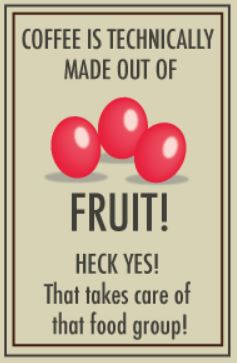
For example, from a website about my favorite fruit, I <Heart> Coffee

Graphic featuring 3 red coffee beans that reads:  "Coffee is technically made out of FRUIT!  HECK YES!  That takes care of that food group."


******

*Assumes a duality that we could argue over — from a philosophical, religious, and/or identity perspective — for days, possibly millennia.

** Outside the fringes of the Republican party.


This is why I never read comments on news stories

On Friday, the judge in our case against Hollister stores and their inaccessible front entrances ordered that the violations be remedied within three years.

Red Alert Politics — “an online publication written by and for young conservatives” — gave the case a straightforward, factual write-up.  There are two comments.  The first is I guess a typical conservative response:  it’s their store; they can do what they want.  Not respectful; not even legal; but plain vanilla conservative.

The second comment was this, by someone designated with a little star as a “Top Commenter”:

yeah well obama is all about controlling and lying…he’ll cost anyone money he can, direct the DOJ to infringe on multiple constitutional rights and keep doing it…

think about this, any speech charge, using what you say in court against you – is against the first amendment, that is saying that you’re freedom is speech can be used against you – that’s a law to the contrary, or the second ammendment – you have the right to keep and bear arms….

article 6 is the supremacy clause and the oath that judicial branches, judges, senators, congressmen, even the president takes….

any charge for a speech or a gun is unconstitutional — ever wonder why when they charge people with murder charges, the gun NEVER EVER comes up? lawyers of that caliber would shit on it….just like america needs to shit on obama, and carry guns, and exercise their god given rights, that their ancestors fought to ensure were protected.

So in response to the fact that Hollister stores will be required to fix their raised front entrances to make them accessible to customers in wheelchairs, we are supposed to “shit on obama and carry guns.”  Ladies and Gentlemen, I present:  Conservative Logic and Spelling 101.


Go Bureaucrats!

As I’ve previously blogged, I’m not a big fan of the racist name of Washington’s football team.  I’m pleased to report that more and more publications are taking this stand and not using the name, including SlateThe New Republic, The Washington City Paper, and Mother Jones.  I’ve also enjoyed some of the suggestions for new names, including Pigskins, Griffins,

Washington’s pro football team” or, if we get sassy, “the Washington [Redacted].”

My favorite, apparently from Huffington Post reporter Arthur Delaney:

This team should be called the Washington Department of Football.  . . . At least two former Skins players were known as secretaries of defense, including Dexter Manley and David Deacon Jones. So clearly, this is a name that would honor local tradition much better than ‘Redskins’ does.

Go Bureaucrats!*

*****************

* Defined, my Dad always said, as a Democrat who has a job a Republican wants.

The ramps of Route 1

[Cross-posted at CREECblog.]

Every summer or so, we visit my brother and his family at their place in Maine.  To do this, we generally fly into Boston and then drive the four hours from Logan to mid-coast Maine.  The first three hours are on I-95; the last hour or so on Route 1 from Brunswick to Thomaston.  It has long struck me, as we meander up the barely two-lane road — often at 30 mph behind a giant RV or tractor — the amazing number of very small businesses that have ramps.

This past weekend I made the trip with no deadline and no one else in the car, so I had the time* to take some photos of these examples of readily-achievableness. (Ready achievability?)**

Disclaimer, because every now and again some defense-side attorney (hi, guys!) may read this:  I did not evaluate these ramps for compliance with the Standards.  I don’t know their dimensions or slope.  If you try to introduce this as evidence in one of my cases, I will file a Motion for Judicial Notice of Completely Missing the Point.

The first couple were actually near Manchester, NH, where I had taken a detour to visit a college classmate.

Small free-standing store with parking lot.  Store has steps in front and a ramp up the side starting from the back of the store and rising to the middle of the right hand side.
These next two are churches, which aren’t even covered by the ADA (unless they have some sort of commercial business on the side):

Front view of white building with three steps at the front entrance (in the middle of the front of the building) and a ramp extending from the entrance along the front to the left side of the building.  Ramp has a sign that reads, "Christ Died for Our Sins."


Photo of beige church building with the words "Saint Peter" on the front and a ramp curving around to the right side of the building.


Onward to Rte 1:

One story building with front porch accessible by a short ramp in front of the building.

This actually might have been someone’s house.  Along Route 1, the distinction between house and business is often sort of vague.

Gabled grey house with wooden ramp extending from the front door and curling around to the right in the front yard.  The base of the ramp is white lattice work and flowers grow along the front of the base.

Just north of Wiscasset.

Small free-standing red building with a ramp extending from the middle of the front off to the right.

Jean Kigel Studio, Damariscotta.

One-story building viewed from the side where a ramp provides access up onto the porch.

Cheap cigarettes in Waldoboro.

One-store store with a sign in the front reading "Cheap Cigarettes."  The front door is served by a short apparently level ramp with a slighly sloped portion at the end.

Somewhere south of Thomaston.

House or business with approximately five steps to the front door and a ramp to a side door on the left.

The Hair Loft, Warren, Maine.

One-story building with a sign reading "Hair Loft."  The front entrance is on the left side of the photo, served by approximately six steps.  The door is also served by a ramp from the door leading to the right of the photo.

Unidentified business, Warren:

Front of a two-story house or business with a wide metal ramp leading to the front entrance.

The famous Moody’s Diner, Waldoboro:

White building with neon sign reading "Moody's Diner" on the roof.  A ramp is positioned along the left side of the building leading up to the entrance in the middle.

Ralph’s Homes, Waldoboro:

Freestanding white building with a long switch-back ramp serving the front entrance, which is up approximately six steps.

Random business south of Waldoboro:

Red building with approximately 3 steps to a porch serving the front entrance.  A ramp serves the porch as well.

The Nobleboro Antique Exchange:

Blue two-story building with a switch back ramp serving the porch and front entrance.  Sign in front of the building reads "Nobleboro Antique Exchange."

So next time you hear some fancy store or chain claim that it’s not readily achievable to ramp their business, here are some examples to, in legal terminology, call baloney.***

*****************

* My leisurely pace turned out to have been a good plan for another reason:  when I got to my brother’s house, he and his family were out and their house was guarded by their snarling goldendoodle.  Seriously.  This dog

Benign-looking light brown dog, sized somewhere between a poodle and a golden retriever, with a multicolored color, sitting on a lawn looking to the right of the photo.

exiled me to the hammock until my hosts returned to chaperone my canine interaction.

I was not suffering:

Legs and feet of photographer on hammock, sunny Maine seascape in the background.


** Under the ADA, buildings built after January 26, 1993 were required to be accessible.  42 U.S.C. § 12183(a).  Those built before that date and not altered since must remove barriers — by, for example, ramping entrances that are only accessible by steps — where it is “readily achievable” to do so.  42 U.S.C. § 12182(b)(2)(A)(iv).

*** I might have used a different word if not for the cross-posting, but I’m trying to keep it clean on CREECblog.