More from the photo archive

This time, from my Dad’s experiences at the Sebago School and Camp Ironwood, run by Matt and Margaret Werner in St. Louis (school) and Harrison, ME (Ironwood).

From the camp — I just loved these first two:

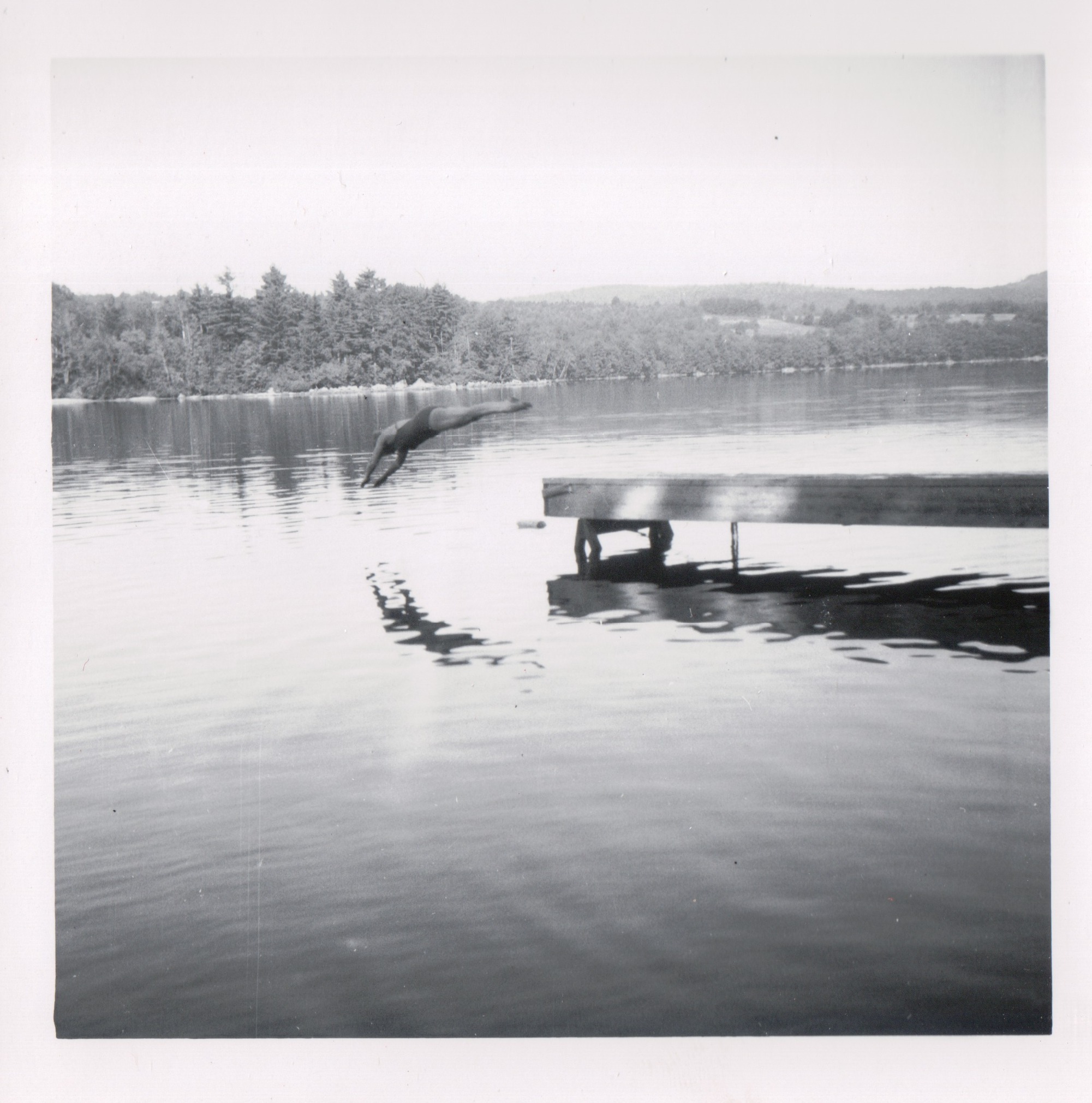
{Image: black and white photo of a person diving off of a dock into a lake.  The diver's image is reflected in the lake.}

{Image: black and white photo of a person diving into the water, but all we see is the person's legs, perfectly straight, angled from their toes at the center of the photo to the bottom right where their torso disappears off the edge of the photo. To the left are several canoes, and in the background, a boat.}

{Image:  black and white photo, taken from above looking straight down on two people sitting by the side of a stone building.  The person on the right is wearing saddle shoes and has their feet extended in front of them, with a plate of food on their lap.  The person on the left is wearing a sleeveless undershirt and holding a drink  (coffee?) in his left hand.  The photographer's feet on the edge of the building above are visible in the foreground.}

The next few are from a driving trip the school/camp took through the western United States:

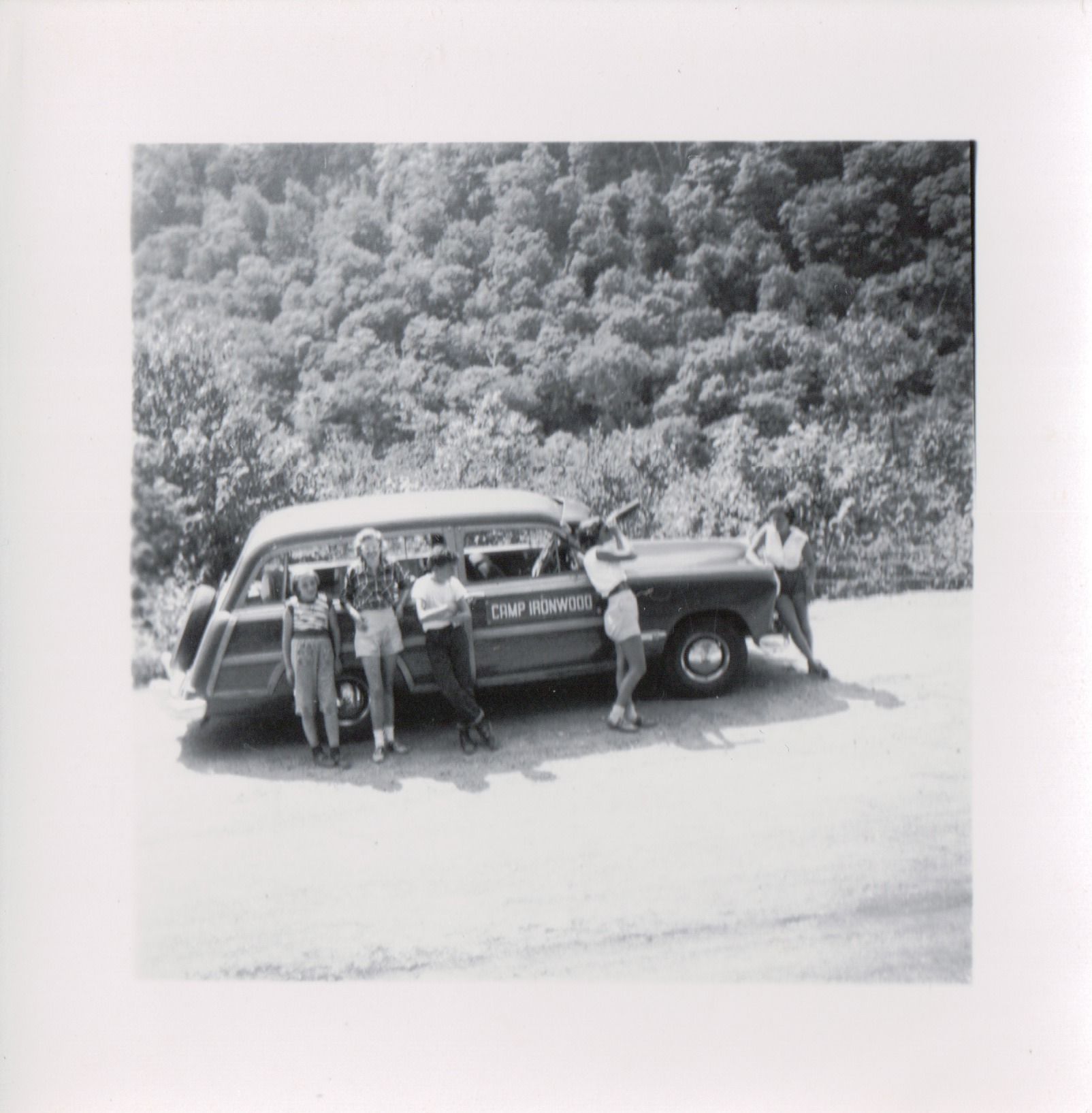
{Image:  1940s wood-paneled station wagon parked at the side of the road.  Five teen agers lean against it, one of whom is looking through a lens of some sort; the others facing the camera.}

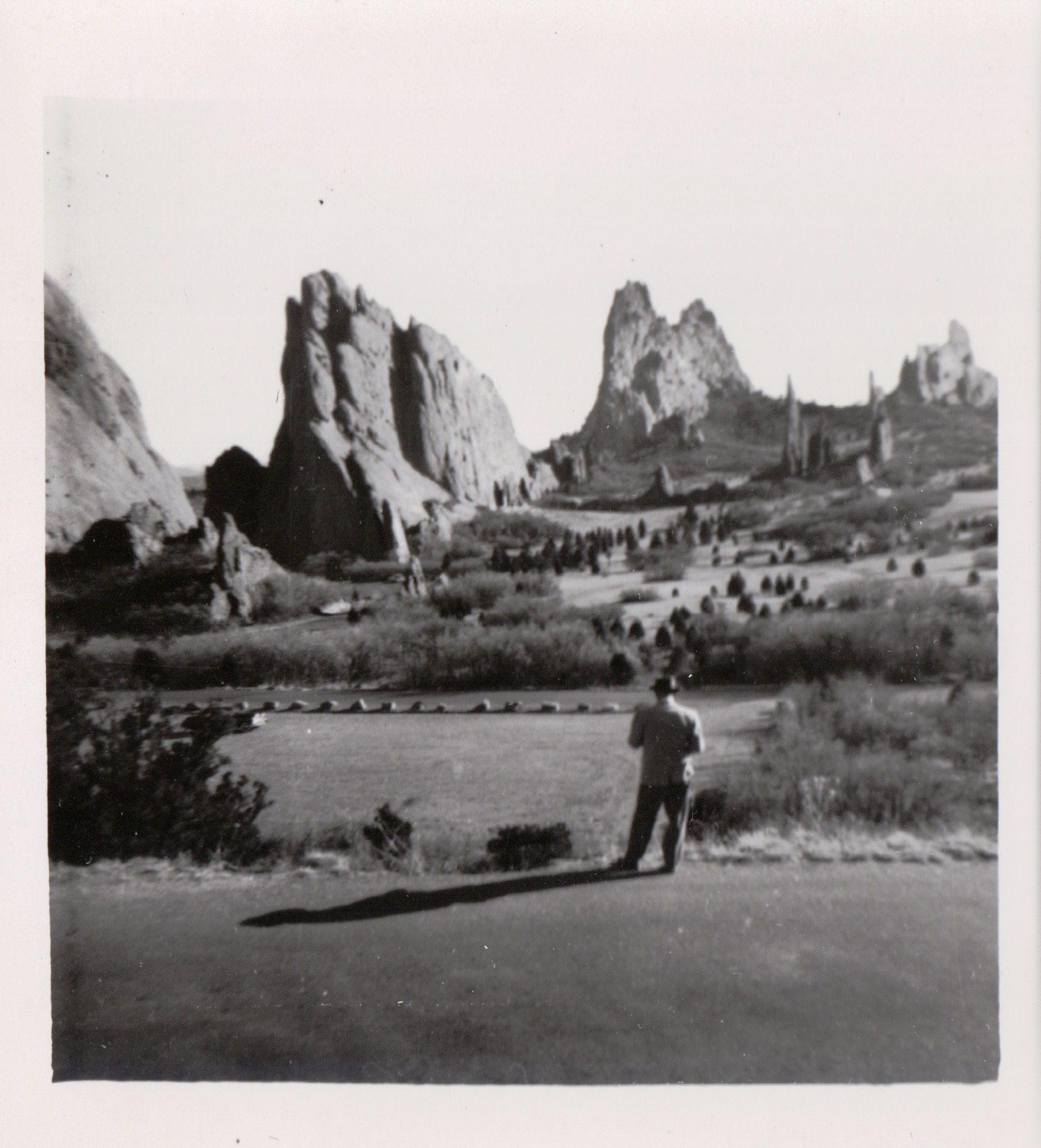
{Image:  black & white photo of Garden of the Gods, which is a series of rock formations in a high-desert landscape.  A man is in the foreground looking at the scenery.}

{Image: black & white photo of a narrow alley with brick buildings on either side and passageways overhead.}

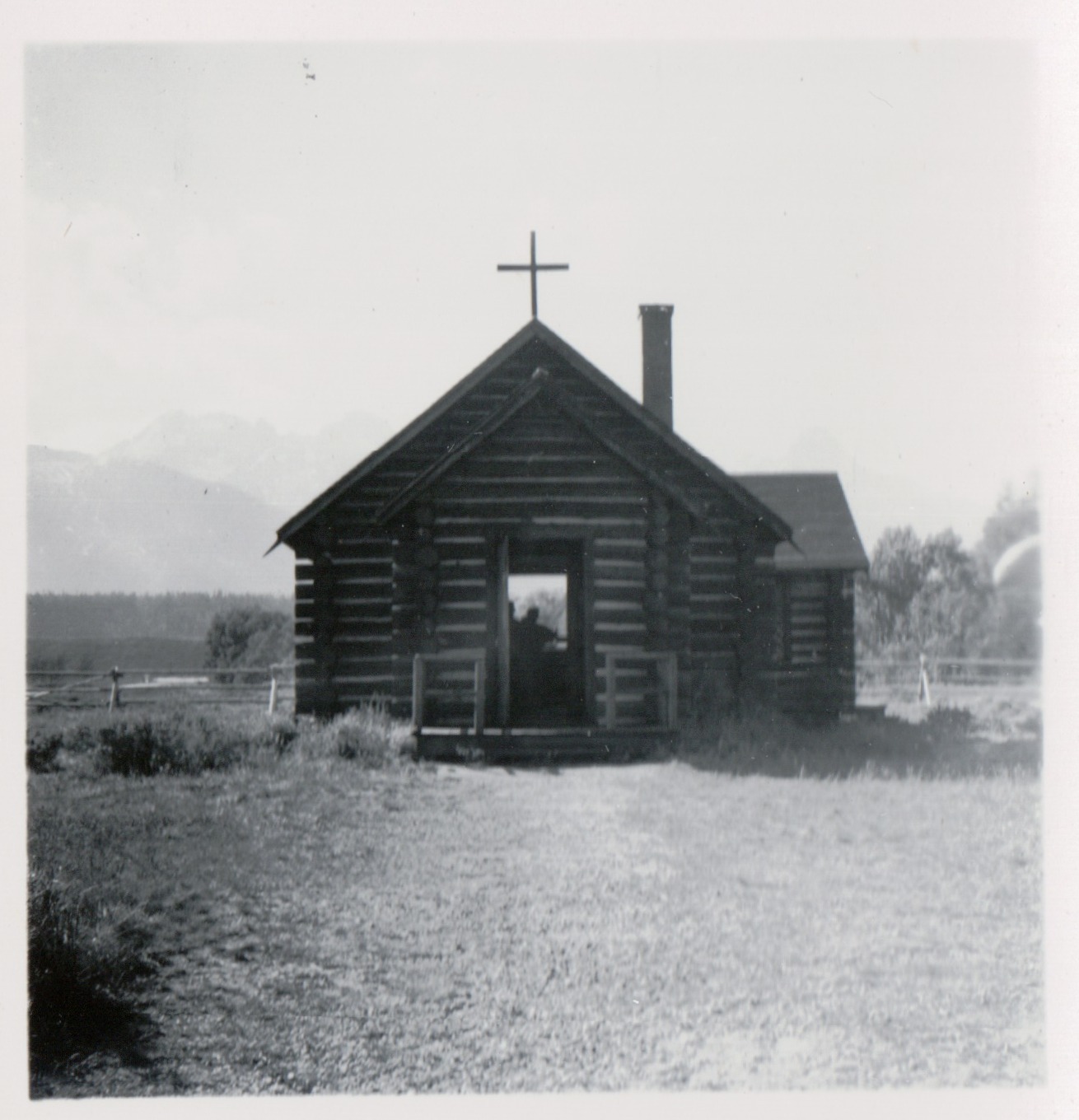
{Image:  Black & white photo of a small log church with a cross on top.}

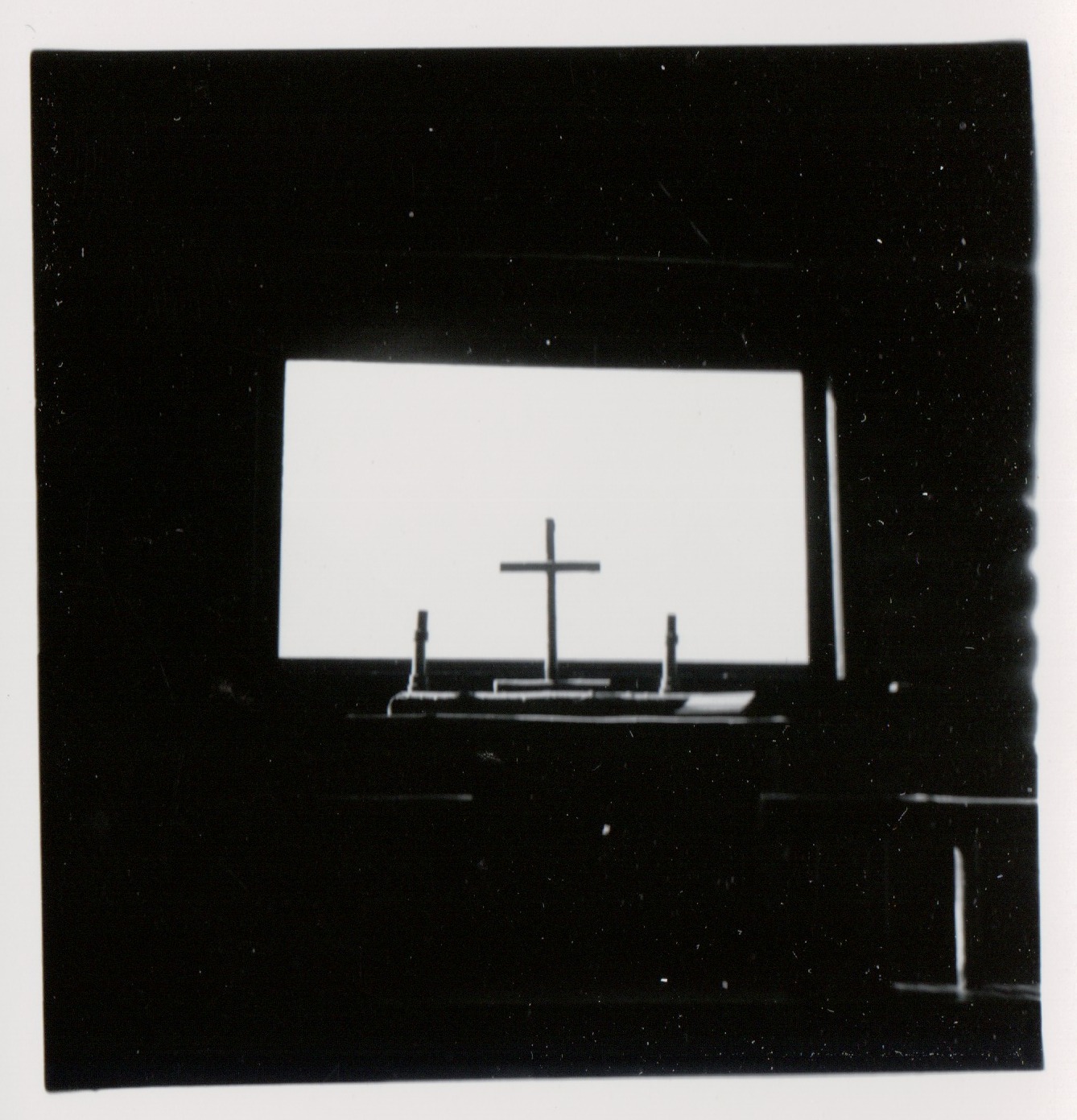
{Image:  black and white photo of a rectangular window with a cross silhouetted against the middle.}

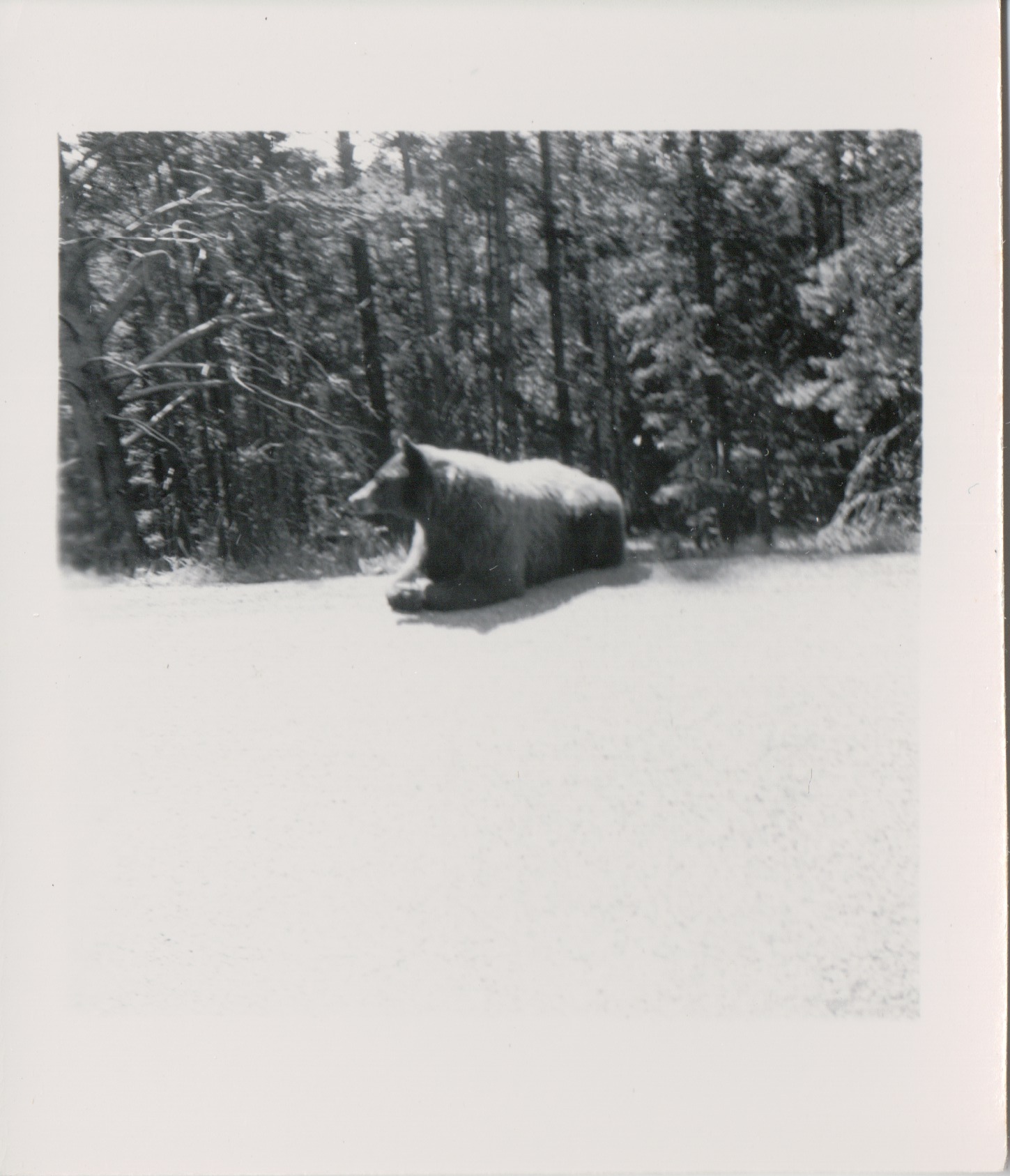
{Image: black & white photo of a large bear crossing a road.}

{Image: black & white photo of a large bear resting by the side of a wooded road.}

Hey, Lego, where’s *my* family?

I thought this sounded like a cool idea:

{Lego ad showing sample family of four people standing on two feet, plus a baby carriage.  Text reads "Minifigure Family.  Sending holiday cards was never this much fun!  Minifigure Family lets you create a customized holiday card featuring Minifigure representations of your own family. It's easy!"

Then I got started creating a holiday card with Minifigure representations of my own family, and found that it was not only not easy, but downright impossible.  Even though Lego appears to sell a variety of Minifigures With Disabilities (“MWD”), including Determined Wheelchair Tennis Player,

{Image of lego minifigure woman in a wheelchair holding a tennis racquet.  On her face is a very determined look, with eyes wide and yebrows constricted.}

Pissed Off Wheelchair Soccer Player,

{Image of lego minifigure man in a wheelchair kicking a soccer ball.  On his face is a pissed off look, with his mouth ticked off to the side and his eyebrows constricted.}

Really Pissed Off Wheelchair Basketball Player,

{Image of lego minifigure man in a wheelchair holding a a basketball.  On his face is a very angry look, with his teeth gritted and his eyebrows constricted.}

and Reasonably Emotionally Well-Adjusted Khaki Shirt Guy,

{Image of lego minifigure man in a wheelchair wearing a khaki shirt with a benevolent expression on his face.}

their Minifigure Holiday Card Generator does not have any wheelchair-using options.

Hey, Lego, what’s up with that?

Of course, that didn’t stop me from trying my best within Lego’s narrow-minded constraints:

{Image of two people and a dog on the surface of a distant planet, surrounded by flying asteroids, with a volcano and meteorite in the background.  The first Lego Minifigure on the left is labeled "Amy."  She has a helmet with antennae, a green shirt hanging with knives and other implements, and -- hanging from her belt -- a skull, a tooth and a test tube containing a spider.  The middle figure, labeled "Tim" is a man with blond hair, glasses and a wooden leg.  His shirt contains dials and meters.  The third figure is a yellow dog.}

Yes, Tim’s entire disability experience is represented by… a wooden leg.

To Russia With Love

I’ve been gradually scanning my father’s photos, posting them to Flickr, and encouraging my family — especially my mother — to comment so as to identify names and places that are unfamiliar to me.  I recently scanned the photos from my parents’ travels during the summer of 1959, including a trip to the Soviet Union.

I posted the photos and invited my mother to tag and comment . . . and ended up with mentions on a number of Russian websites, a couple of Russian commenters on Flickr offering their thoughts on the photos, and over 50,000 views since the photos went up a week ago.

With the help of Google Translate and my mother, who speaks Russian, I’ve been learning more about the photos and commenters.

For example, here is a Live Journal page by “Finnish Passenger

{Snip from LiveJournal page in Russian. Translated below.}

Google translates this as:

In 1959, the American Peter Robertson on a tourist visa to visit the Soviet Union. Under the cut I have selected 48 photographs from his archive. Photos from the trip are interesting in that a Soviet citizen would not do at all these pictures, because ordinary is happening, and in ofitsilnyh magazines and newspapers printed entirely different subjects.

Yeah, the translation is a bit rough.

Another Russian blogger turned the photos into a guessing game and then provided answers (in addition to the answers in the comments).

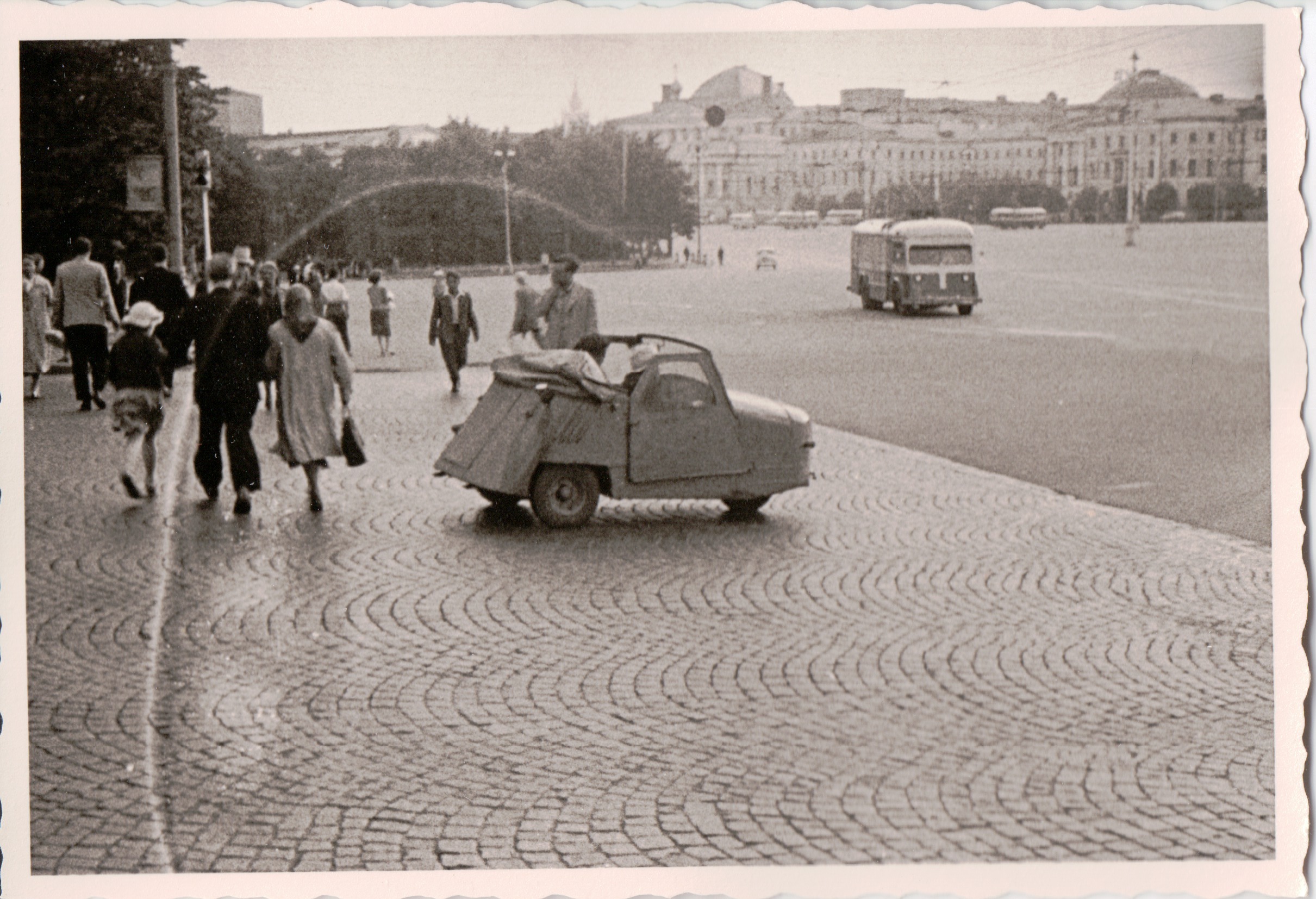
My favorite of the bunch is this photo and some of the commentary around it:

{Black and white photo of a cobblestone street and sidewalk.  In the foreground is a very small three-wheeled vehicle, suitable for at most one person, open on top and looking almost home-made out of pieces of welded steel.  In the background are pedestrians and in the far background, indistinct buildings.}

I had no idea what this was.  A Flickr commenter, Leonid Paulov, explained,

Machine for the disabled. When I was 8 years old living in Kazakhstan. Roads there was not. After the rain this car off the road. The driver of a war veteran with Germany very loudly berated those who made this car

Remember, this is Google Translate talking, so it’s not that everyone in Russia actually sounds like Boris and Natasha.  Mom did a better job with the translation:

It’s a machine for disabled people. When I was 8 years old, I lived in Kazakstan. There were no roads for automobiles. After it rained, this machine could go out on the shoulder. A bus driver who participated in the war with Germany loudly berated those who made this automobile.

I asked:

So this is car that would be used by a disabled person? Like a wheelchair with an engine?

Mr. Paulov responded,

Yes, this is the first vehicle for persons with disabilities in the Soviet Union manufactured 60 years ago.

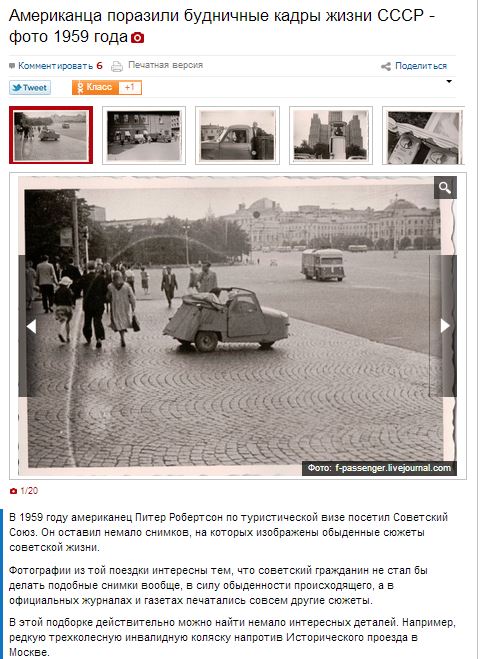
Still not clear on the role of the veteran/bus driver.  Here’s another Russian site commenting on the same photo.

Gazeta in Russian

The last paragraph reads,

In this collection you will actually find a lot of interesting details. For example, a rare three-wheeled wheelchair in front of the historic journey to Moscow.

There were a number of photos of women working on roads or in the fields.  One commenter noted  —  tersely but (to me) poignantly — that, because of the war, there was a dearth of men:

{Image snipped from a blog showing a black and white photograph of women working on a road and Cyrillic (Russian) letters in a caption above the photo.  The image also includes an icon representing the commenter, who looks like a buff comic book hero.}

(Pretty buff commenter, though, eh?)

A theater showing “War and Peace.”

{Black and white photograph of people walking in front of a building with a large banner in Russian.}

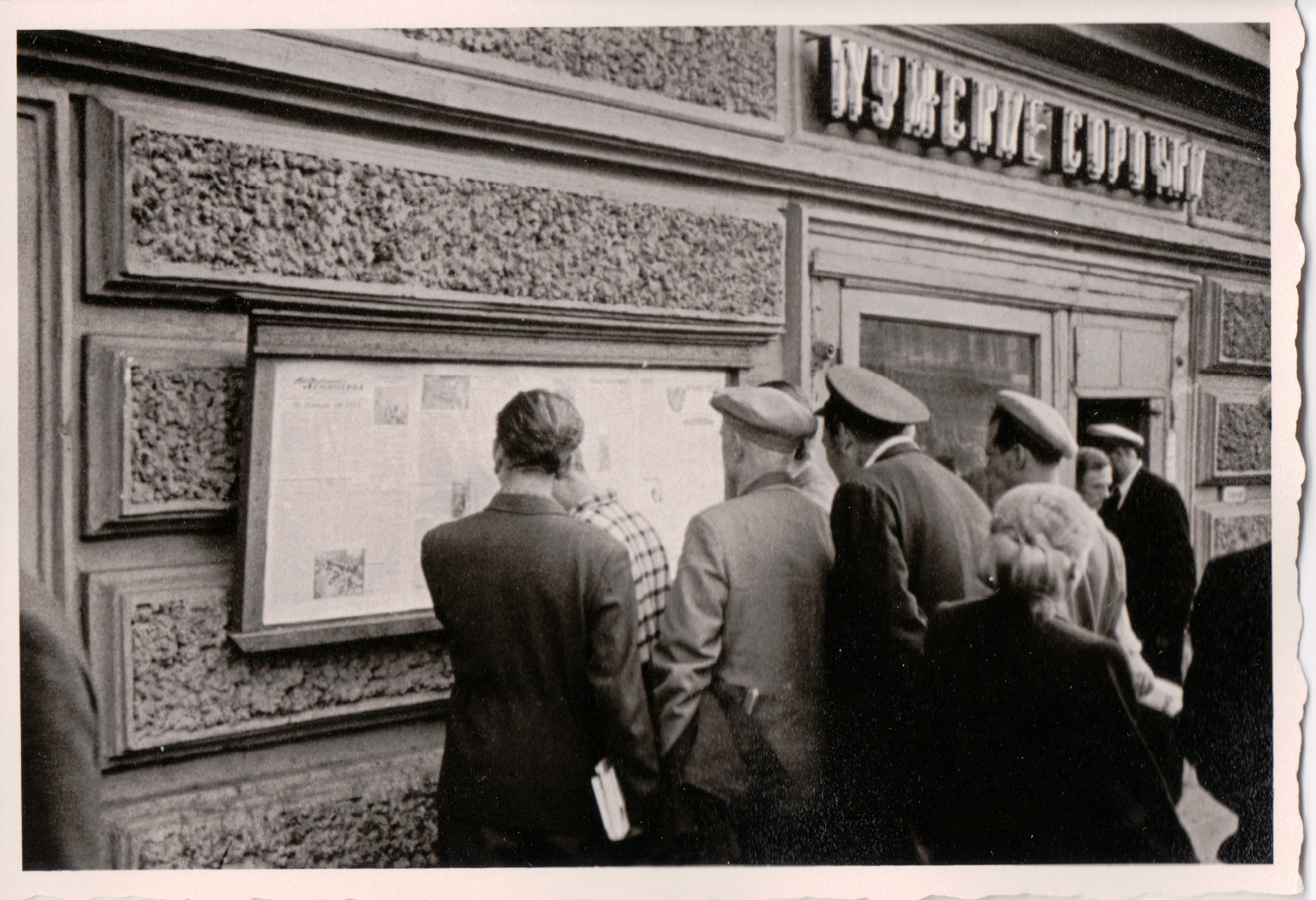
Reading the newspaper:

{Black and white photo of men gathered in front of a newspaper that is posted on the exterior wall of a building.}

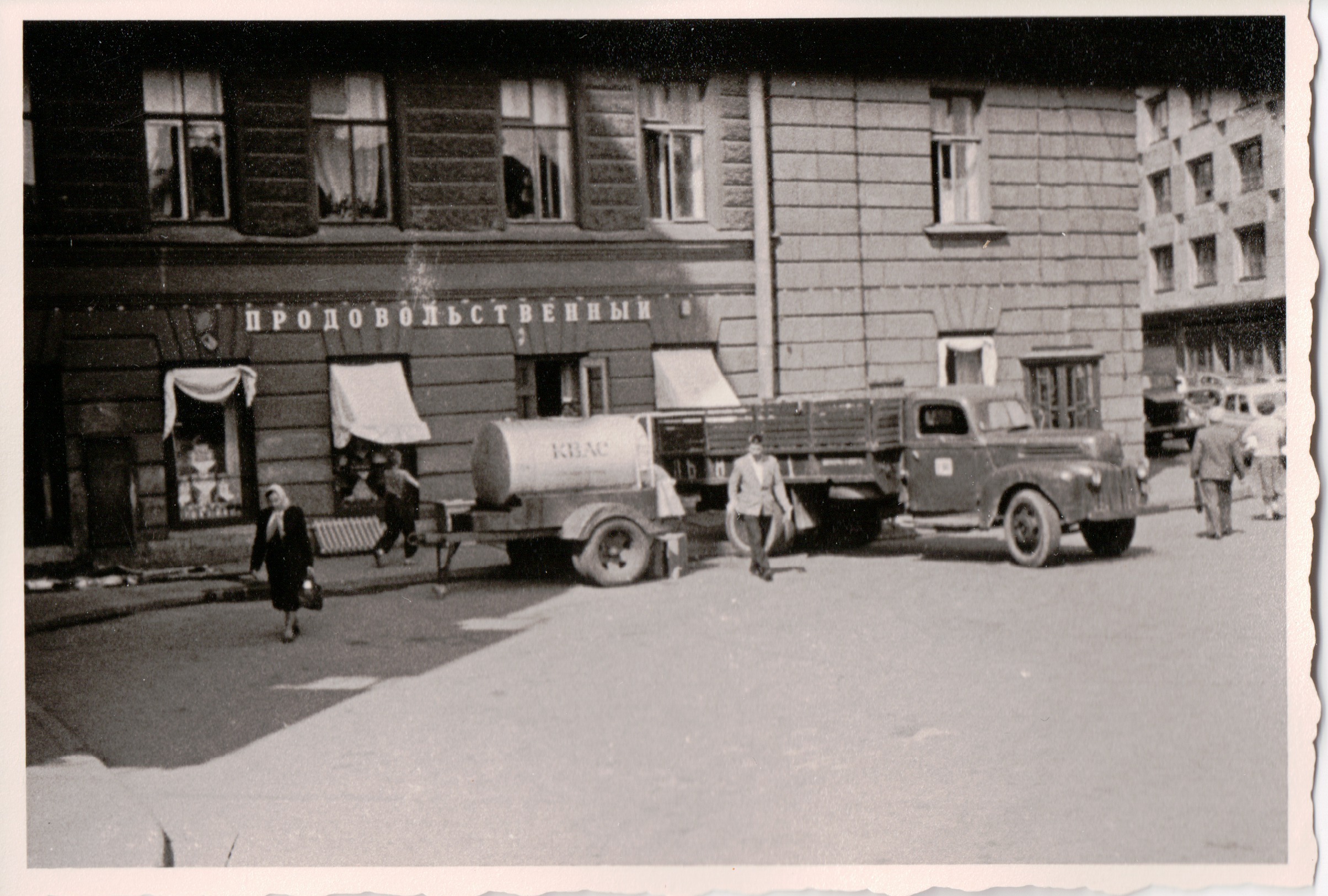
The photo below is apparently a tank of something called kvass, which my mother described as a drink made from fermented rye bread.  Truly a testament to the ingenuity that can arise from the combination of great deprivation and great thirst.

{Black and white photo of an old time pick up truck towing a small tank of liquid, parked in front of a building.}

The sign says “place for feeding pigeons.”  And that’s Mom — in her travel gear — a far cry from the jeans and hiking shoes I wore for my post-college travels.

PCR-1444

The requisite giant portrait of Khruschev.

{Black and white photo of a building with a giant portrait of Nikita Khruschev leaning against the columns in the front of the building.  The portrait is over twice the height of a man standing near it.}

and the people tasked with schlepping the giant portrait:

{Black and white photo of a giant portrait being carried horizontally by five women in scarves.}

More to come in a future post — by me or perhaps a guest post by Mom!

Dad’s Birthday

Thinking of my Dad on what would have been his 78th birthday.  Image:  Black and white photo from about 1962 of man in his 20s  in a white shirt and dark pants who has tossed a toddler into the air about two feet over his head.  His hands reach up to her, while her hands are at her mouth giggling.

You always lifted me up!  Miss you every day.

Sexy math?

I love it when the algorithms that seem to drive most of the internet get things weirdly wrong.  For example, when Facebook thought I wanted to hear about how Colorado’s governor was wimping out of an execution or when my Google search for a Moroccan restaurant returned California Pizza Kitchen and another California Pizza Kitchen.

Today I was searching on advice in formatting an Excel spreadsheet and found this helpful answer on about.com  . . . along with a sort of unlikely ad:

Clip from webpage showing advice on how to format in Excel along with an ad for "World's Sexiest Lingerie."


New Rule: You get 8 lines for your signature block, no mas!

Here are things that are reasonable to include in an email signature block:

  • Your name.
  • Your title (1 line max; more than that and you have a megalomania problem).
  • Your company name and possibly a *small* logo.
  • Your address (3 lines max; I don’t need to know the name of your building).
  • Your phone number (1 line; no one uses a fax machine; join the 21st century!  And no one uses TTY – learn to send/receive video relay).
  • Your company’s website and possibly one or two other social media sites (e.g. Twitter).

Things that are not OK and just end up making any email chain a total pain in the ass to scroll through:

  • Your email address.  You’re emailing me, you dork!  I have your email address.
  • Giant, complex, byte-hungry logos.
  • Assertions that the content is privileged, confidential, top secret, need-to-know basis only, destroy after reading.  The circumstances and participants will determine this; not magic words.
  • Long-winded ass-covering language that the email does not contain legal advice unless it does and it really doesn’t contain tax advice unless it does.
  • Delusional requests to delete the email if you are not the intended recipient.
  • Lectures on thinking about the environment before printing the email.  These always make me want to print 100 copies of it and then burn them to generate additional greenhouse gases.
  • Anything that moves.

The grumpy old woman email goddess has spoken.  Any questions?

Photos from LA

I’m in LA for the Disability Rights Legal Center’s Disability Rights Summit.  Great event. Saw lots of old friends and put lots of faces to internet names.  Presented on fair housing with Fernando Gaytan, a wonderful attorney from the Legal Aid Foundation of Los Angeles.

Couple of photos:

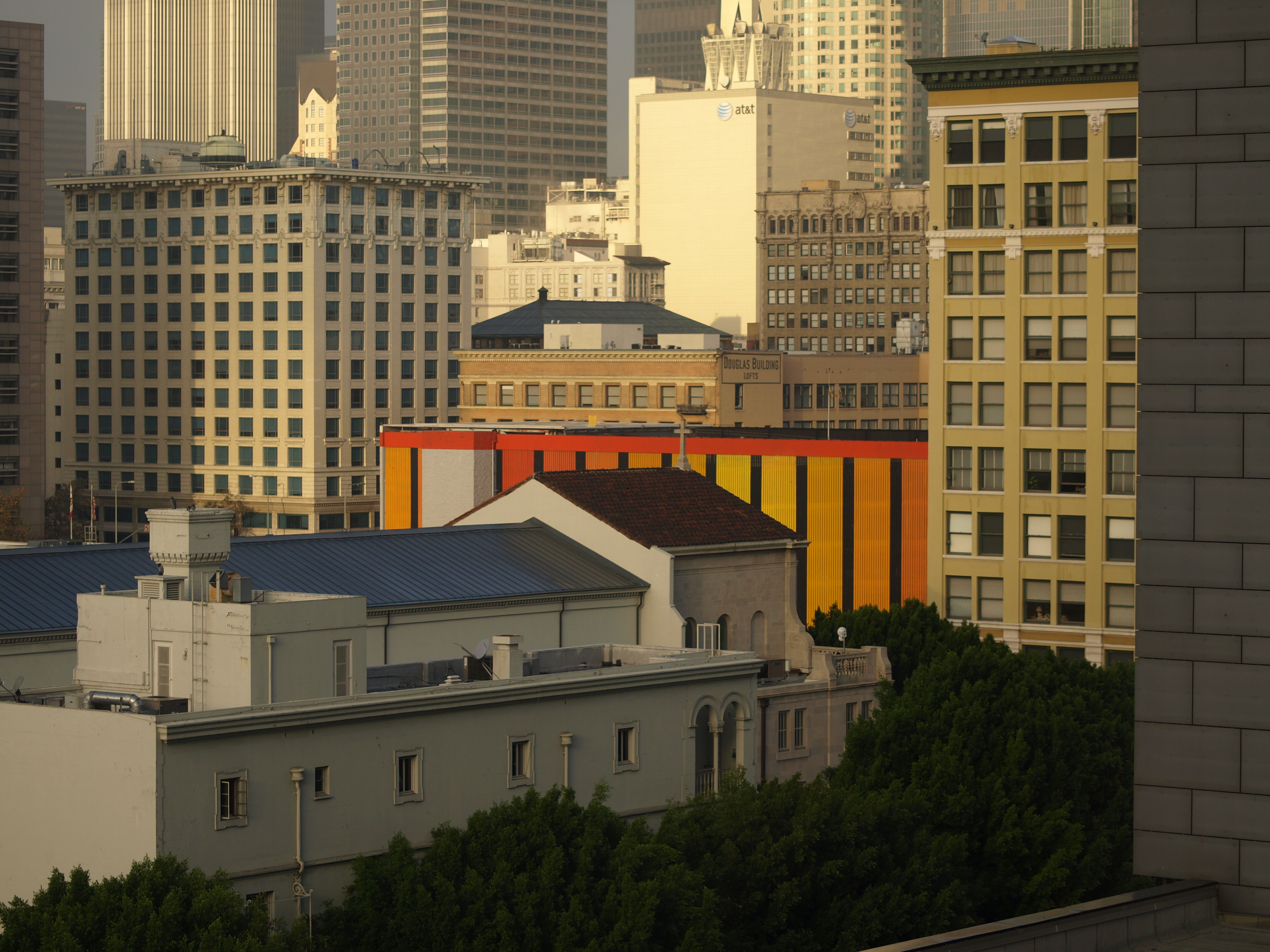
Photo of buildings. Most are beige. One low building in the center is bright red and yellow.


Photo of the side of a building with brick shaped windows, some of which are open and jutting out.


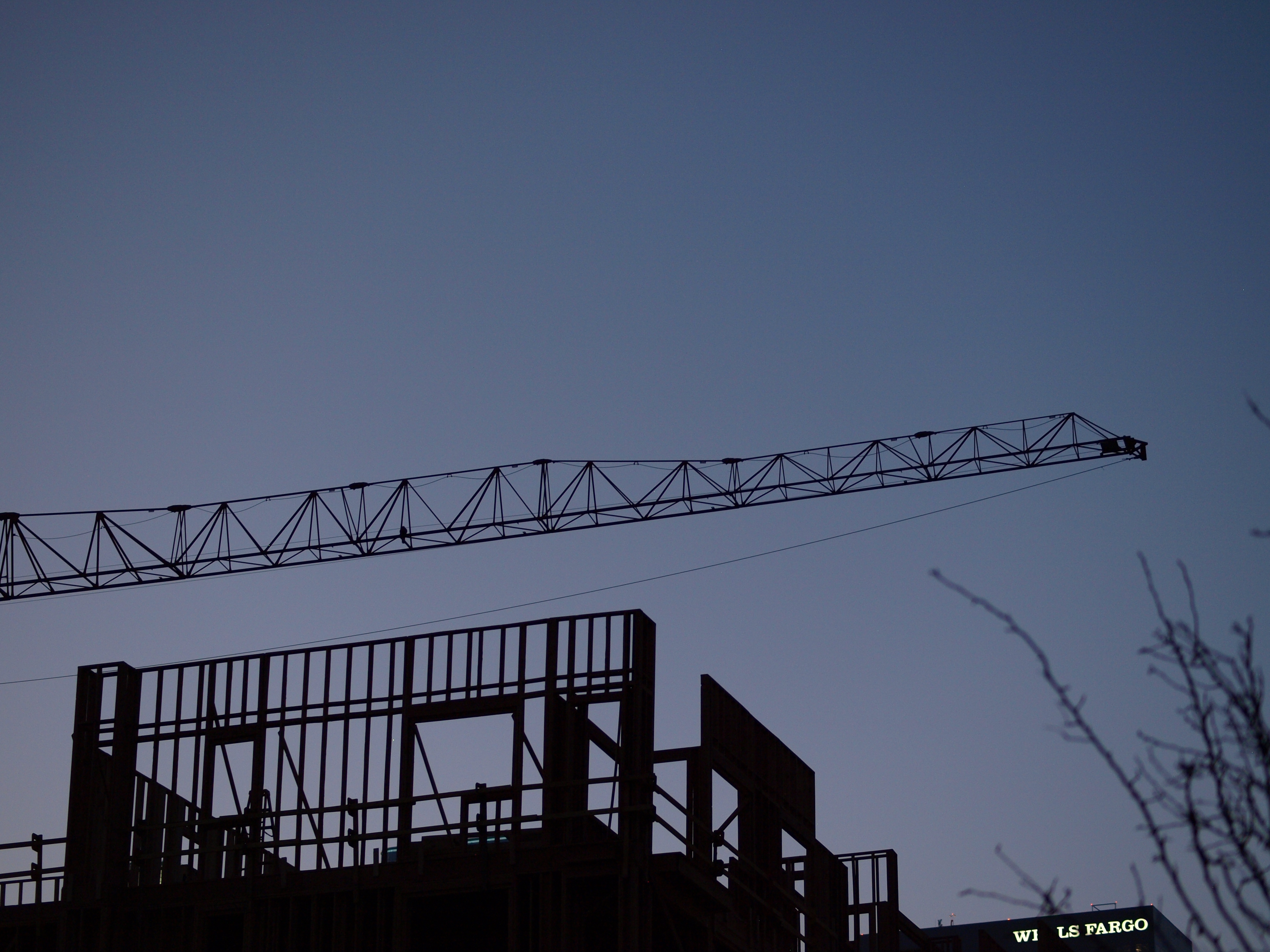
Photo of construction crane and building framework at dusk.


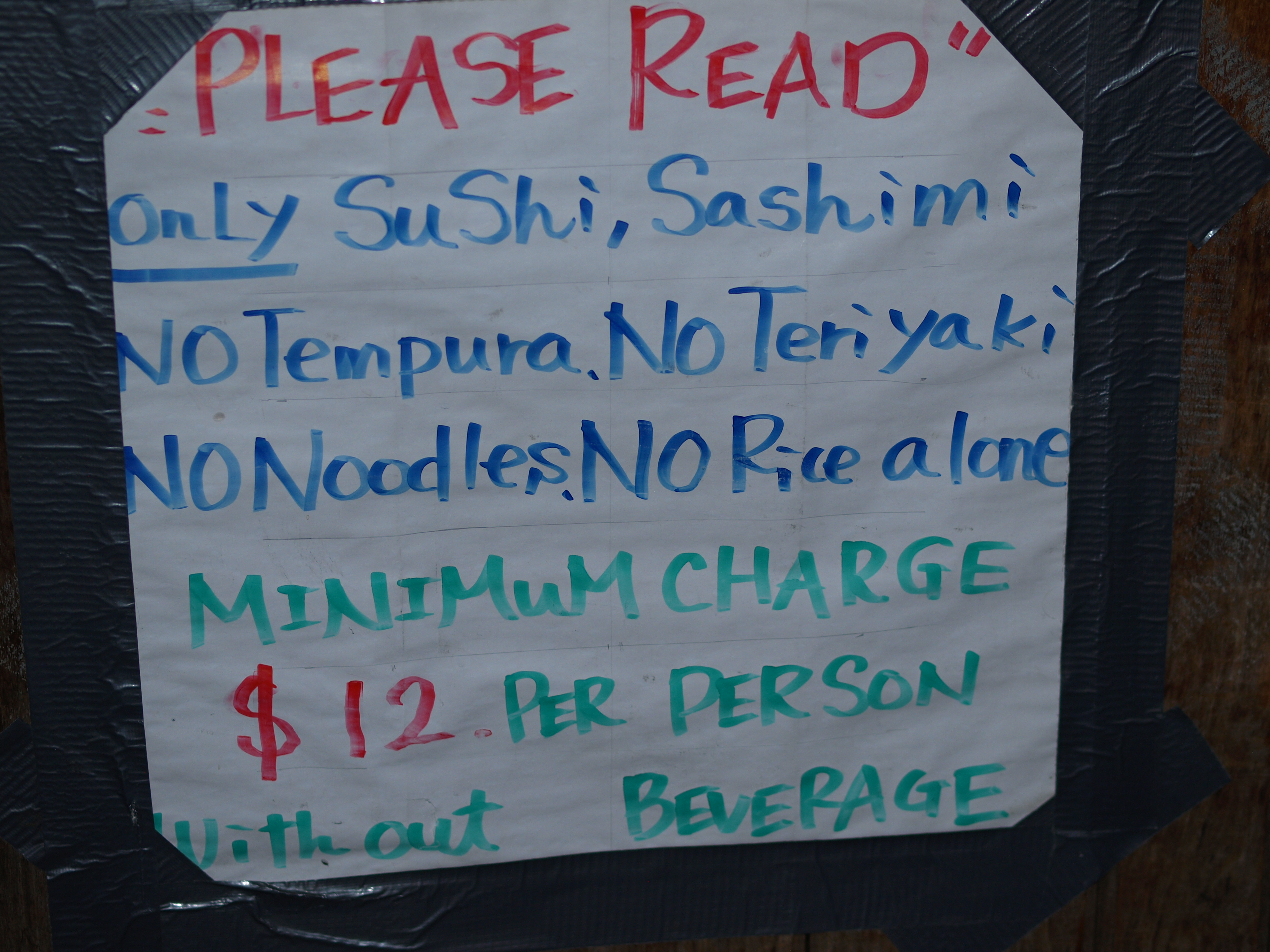
Had dinner at Hama Sushi, where they really really really only serve sushi.

Photo of hand-lettered sign that reads "please read. only sushi, sashimi. no tempura. no teriyaki. no noodles. no rice alone. minimum charge $12 per sperson without beverage."

And it was magnificent!!!

What is it about Mountain Time that confuses coastal peeps?

There are 4 time zones.  If you’re from the East Coast, they go -1, -2, and -3.  If you’re from the West Coast, they go +1, +2, and +3.  It’s as if east coasters say, “I can subtract 1 and I can subtract 3, but subtracting 2 just baffles me!”  And the equivalent for west coasters.

A woman stopped me in the Denver airport yesterday and asked the time.  I told her.  She reacted with great skepticism and confusion because the answer I gave (“4:15,” for the record) did not fall into one of the time zones of which she was aware.  So she demanded an explanation of how this bizarre Land of the Mountains related to other, better known, time zones.  Seriously, we had to have that discussion, while I justified the existence of our little chronological slice of the country.

And don’t get me started on the networks that tell you the show is at 9:00, 8:00 Central, and 6:00 Pacific.  Um, guys? Hellooooo?

If you can successfully count to 4 without missing any numbers, you can figure out Mountain Time.

Beautiful as our mountains are, I think we need a better name.  No one, but no one, will ever loose track of Craft Beer Time.

Because the biggest f*****g problem with the ADA is too many f*****g drive-by plaintiffs

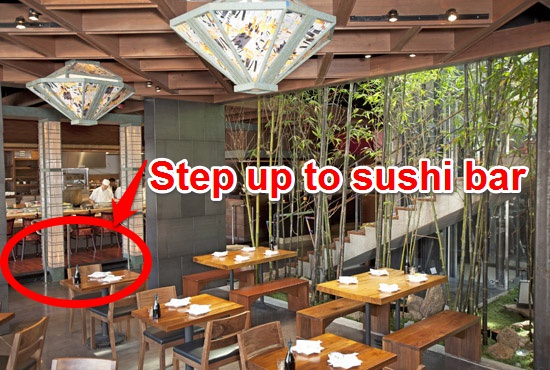
This evening we went back to the completely gutted and remodeled Izakaya Den restaurant and found that they installed a raised sushi bar with no ramp.  Here’s a photo from Westword with my added mark-up.

Photo of the inside of a restauarant.  To the lower left of the photo, a raised area is visible with seats at a lowered sushi bar.  The raised area is circled in red, with an arrow pointing to it from text that reads "Step up to sushi bar."

Sigh.

Just that, by itself, is deeply frustrating.  As we’ve discussed in connection with our lawsuit against the El Diablo restaurant, you can’t take an empty space and make part of it inaccessible.  While this should be obvious, it’s also illegal.

But what made this depressing, frustrating, infuriating and really sad was that we have been patronizing Izakaya Den and its sister restaurant, Sushi Den, for years.  They know us in both restaurants, well enough at Sushi Den that we had a table where we always sat, and most of the waitstaff had served us so often they automatically brought me a phone book to sit on.*  We had participated in a private sushi tasting with a chef visiting from Japan, and at that point (and others) met the owners.

It’s bad enough that Izakaya Den got seriously bad architectural advice.  It’s really depressing that no one ever stopped to think, this isn’t just a theoretical legal question; we have a regular customer who will want access to the sushi bar.   And what’s funny:  they have an elevator.  They added a second floor and an elevator.  Very fucking cool.  But damn!  Why on earth add an unnecessary, new, inaccessible raised area?

We proceeded from Izakaya Den to Kaos** pizza, which was also inaccessible,  then*** on to the Black Pearl which had this gorgeous ramp

Photo showing front of restaurant with a ramp to the front entrance adjacent to a patio area with tables and seats.

as well as truffle fries, an excellent cheese plate, and a nice refreshing bottle of 90 Shilling.

************

*  Yes, I’m that short and have that little pride.  But it’s nice to be able to look my fellow diners in the eye.

** Sounds like Maxwell Smart should be nearby, talking on his shoe phone.

*** I’m leaving out the part where I crossed the street from Kaos to where Tim was waiting, swearing my ass off, while he made “maybe you don’t want to use those words just now” eyebrow motions.  Turns out he was chatting with a nice woman — hidden to me by a parked car — and her cute Lab puppy.   I was embarrassed, she was understanding (“that’s OK; let it all hang out!”), and the puppy was really really cute.

Your accessible garage is “not in the best interest of the neighborhood.”

[This is cross-posted from CREECblog, though I would like to revise and extend by noting that the HOA in the post below was in violation of not only the Fair Housing Act, but of course the Anti-Butthead Act as well.]

My theory is that homeowners associations (HOAs) are run by the same people who bullied their fellow students in high school for not wearing the right brand of jeans.  Only now they have power over the house you bought and live in.

This post is about the Fair Housing Act and the fact that it requires landlords and HOAs to make reasonable accommodations in their policies and to permit residents to make reasonable (physical) modifications to property at their own expense where necessary because of the resident’s disability.* HUD and the DOJ have collaborated on excellent explanatory memos on both reasonable accommodations and reasonable modifications.  [Both pdf.]

Seth and Lisa Moates lived in a development called Plantation Oaks** outside of Montgomery, Alabama.  Mr. Moates uses a manual wheelchair, but was moving toward having to use a power chair which, in turn, would require a lift-equipped van.  The Moateses wanted to build a garage to fit their new van as well as Mr. Moates’s therapy equipment.  Of course, they couldn’t just build the structure they needed for Mr. Moates’s disability.  They lived in an HOA community, in which an “Architectural Review Committee” asserted power over decisions like this.  And of course

[t]he ARC denied the Moateses’ initial request on April 8, 2013 for the stated reason that alternate garages and structures were inconsistent with the other Plantation Oaks homes and not in the best interest of the neighborhood.***

That’s right, Mr. Moates, you can’t park your new van in a garage or store your therapy equipment because that would not be “in the best interest of the neighborhood.”  And just to be sure nothing as tacky as a van-accessible garage ever besmirched their plantation, “[t]he Covenants were changed to make the building requested by the Moateses prohibited.”****  You see, originally you just needed special permission for your van accessible garage, but now, in response to the request, that garage and others like it are simply prohibited.

The HOA finally relented after the Moateses reduced the size of the planned garage, BUT only on the condition that, when they sold the house, they demolished the garage and returned the property to its original, pristine, plantation-like***** condition.

The ensuing lawsuit is only at the motion to dismiss stage, but generated a well-reasoned decision denying the motion.  The judge noted that “equal opportunity to use and enjoy [a] dwelling” means

that handicapped[******] people must be afforded the same (or ‘equal’) opportunity to use and enjoy a dwelling as non-handicapped people.  . . . [O]thers in the neighborhood are allowed to park their vehicles in garages, thus affording protection.  Affording Mr. Moates a similar opportunity by allowing a larger garage wherein he can park his car, in the same way as his neighbors, plausibly will grant Mr. Moates the same peace of mind and security as everyone else in Plantation Oaks.

Luckily the Moateses have connected with a good attorney and the Central Alabama Fair Housing Center and filed suit.  The HOA — rather than coming to its senses, doing the right thing, and avoiding imposing attorneys’ fees for its stupidity on everyone else in the plantation, er, development — is fighting the suit, arguing not only that it did not violate the Fair Housing Act, but that the Moatses were not injured (did not have standing) and that the suit isn’t ripe for review because the new power wheelchair hasn’t arrived yet.

The judge properly denied those arguments in his well-reasoned decision; I would have been tempted to deny them on the grounds of “gimme a break!”

In this case and so many others, you really shouldn’t need a federal law to make the HOA do the right thing.  All it should require is a bit of common sense  . . . and the realization that we don’t all have to wear the same brand of jeans.

**********************

42 U.S.C. § 3604(f)(3)(A) & (B).

** I swear I did not make up the name.

*** Moates v. Plantation Oaks Homeowners’ Ass’n, 2013 WL 5532626, at *2  (M.D. Ala. Oct. 7, 2013).

**** Id.

***** Slight editorial license.

****** Unfortunately, the Fair Housing Act still uses this terminology, so lawyers and judges have to follow suit.